Have you ever paused before writing “relevant to” or “relevant for” and wondered which one sounds more natural? If so, you’re not alone. Relevant To vs. Relevant For: Which Is Correct?is a common grammar question because both expressions appear in everyday conversations, business communication, formal writing, emails, and professional documents.
Understanding the correct choice improves English usage, strengthens your writing, and helps you communicate with greater consistency.
Although these two phrases look similar, they serve different purposes depending on the context. This guide explains the grammatical distinction, practical usage rules, and real-world examples that make each expression easier to remember.
Whether you’re discussing project management, meetings, calendar updates, scheduling, time management, online booking, or broadcasting, choosing the right preposition makes your message clearer and more precise. You’ll also discover common mistakes, expert tips, and simple memory tricks to use both phrases confidently.
By the end of this article, you’ll know exactly when to use “relevant to” and when “relevant for” is the better choice. Along with clear explanations, comparison tables, and natural example sentences, you’ll gain practical insights that improve grammar, professional writing, and everyday communication.
Whether you’re a student, content writer, or business professional, this guide will help you write with confidence, accuracy, and clarity.
Quick Answer:
The short answer is:
- Relevant to = connected or related to something.
- Relevant for = useful, suitable, or important for a specific purpose.
Here is a quick comparison:
| Phrase | Meaning | Common Usage | Example |
| Relevant to | Something directly relates to a topic, subject, or matter | Discussions, research, facts, information | This evidence is relevant to the case. |
| Relevant for | Something is useful or suitable for a purpose, person, or situation | Jobs, skills, training, goals | This experience is relevant for the position. |
A simple way to remember the difference:
Relevant to answers: “What does this connect with?”
Relevant for answers: “Who or what can use this?”
For example:
- “This information is relevant to climate change.”
- The information connects with the topic of climate change.
- “This information is relevant for policymakers.”
- The information is useful for a specific group of people.
Both phrases can be correct. The meaning changes depending on the context.
What Does “Relevant” Mean?
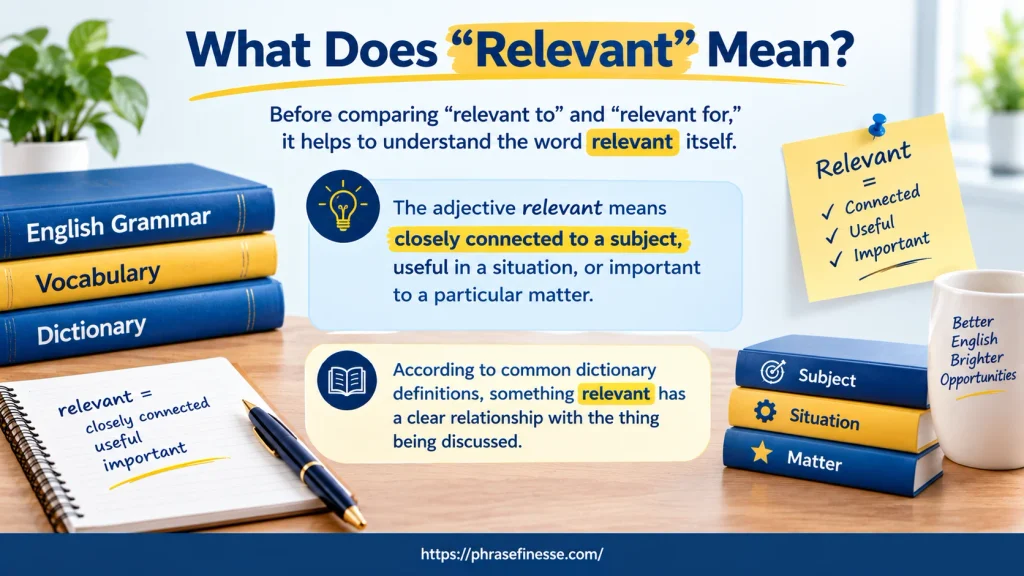
Before comparing “relevant to” and “relevant for,” it helps to understand the word relevant itself.
The adjective relevant means closely connected to a subject, useful in a situation, or important to a particular matter.
According to common dictionary definitions, something relevant has a clear relationship with the thing being discussed.
For example:
- A student studying for an exam needs relevant information.
- A lawyer presents relevant evidence in court.
- A company looks for relevant experience when hiring.
The word does not simply mean “important.” Something can be important but not relevant.
Consider this example:
A company hiring a software engineer may value cooking skills, but cooking skills are not necessarily relevant to the job.
The skill may be impressive. However, it does not directly connect with the role.
The Difference Between “Relevant To” and “Relevant For”
Although these phrases look almost identical, they emphasize different ideas.
Relevant To Focuses on Connection
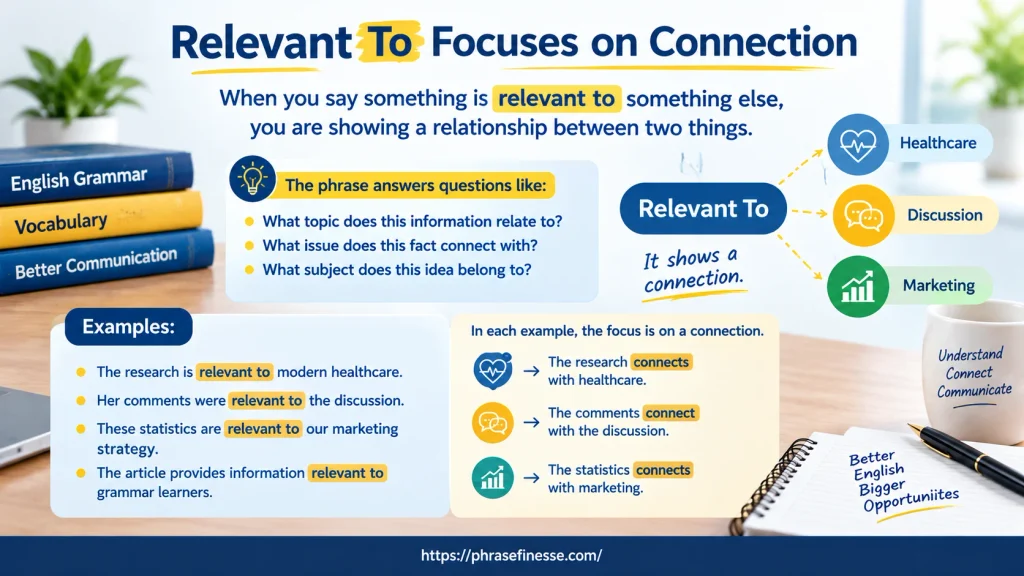
When you say something is relevant to something else, you are showing a relationship between two things.
The phrase answers questions like:
- What topic does this information relate to?
- What issue does this fact connect with?
- What subject does this idea belong to?
Examples:
- The research is relevant to modern healthcare.
- Her comments were relevant to the discussion.
- These statistics are relevant to our marketing strategy.
- The article provides information relevant to grammar learners.
In each example, the focus is on a connection.
The research connects with healthcare.
The comments connect with the discussion.
The statistics connect with marketing.
Relevant For Focuses on Purpose or Usefulness
The phrase relevant for highlights how something can help, apply, or benefit someone or something.
It often appears when discussing:
- Jobs
- Skills
- Training
- Requirements
- Decisions
- Future plans
Examples:
- Communication skills are relevant for leadership positions.
- This training is relevant for new employees.
- The information is relevant for people starting a business.
- These qualifications are relevant for the role.
Here, the question is not “What does this connect with?”
Instead, the question becomes:
“Who needs this information?” or “What purpose does this serve?”
Use “Relevant To” When Talking About Topics, Ideas, or Information
The phrase relevant to appears frequently in formal writing because it clearly shows a relationship between ideas.
You will often see it in:
- Academic writing
- Research papers
- Reports
- Articles
- News writing
- Legal documents
Example: Academic Writing
The study examines factors relevant to student performance.
The factors connect directly with student performance.
Example: Business Communication
Please provide information relevant to the upcoming meeting.
The information should relate directly to the meeting topic.
Example: Everyday Conversation
That story isn’t relevant to our conversation.
The story does not connect with what people are discussing.
Common Situations Where “Relevant To” Works Best
| Situation | Example |
| Research | The findings are relevant to public health. |
| Discussion | Your point is relevant to this topic. |
| Evidence | The document is relevant to the investigation. |
| Education | This lesson is relevant to the exam. |
| News | The report contains relevant information. |
Use “Relevant For” When Something Has Practical Value
While relevant to is more common, relevant for has an important role.
It emphasizes usefulness.
Think about situations where someone asks:
- “Will this help me?”
- “Does this apply to my situation?”
- “Is this suitable for this purpose?”
That is where relevant for often works.
Examples:
- Your previous experience is relevant for this position.
- These exercises are relevant for beginners.
- The course content is relevant for marketing professionals.
- This advice is relevant for anyone learning English.
The focus is on application.
Relevant To vs. Relevant For in Job and Career Writing
One of the most common places where people debate these phrases is professional writing.
A resume, cover letter, or job description often talks about experience, skills, and qualifications.
Both phrases can appear, but they create slightly different meanings.
Example One: Resume Experience
I have five years of experience relevant to digital marketing.
Meaning:
Your experience connects directly with digital marketing.
I have five years of experience relevant for this position.
Meaning:
Your experience is useful or suitable for this particular job.
Career Writing Comparison
| Sentence | Main Focus |
| My skills are relevant to marketing. | The skills connect with marketing. |
| My skills are relevant for this role. | The skills fit this specific job. |
A recruiter may use relevant for when discussing suitability.
A researcher may prefer relevant to when discussing connections.
See More :Published In vs. Published On: Which Is Correct?
Why “Relevant To” Is More Common
The phrase “relevant to” appears much more frequently in everyday and formal English.
There are a few reasons:
It Shows a Clear Relationship
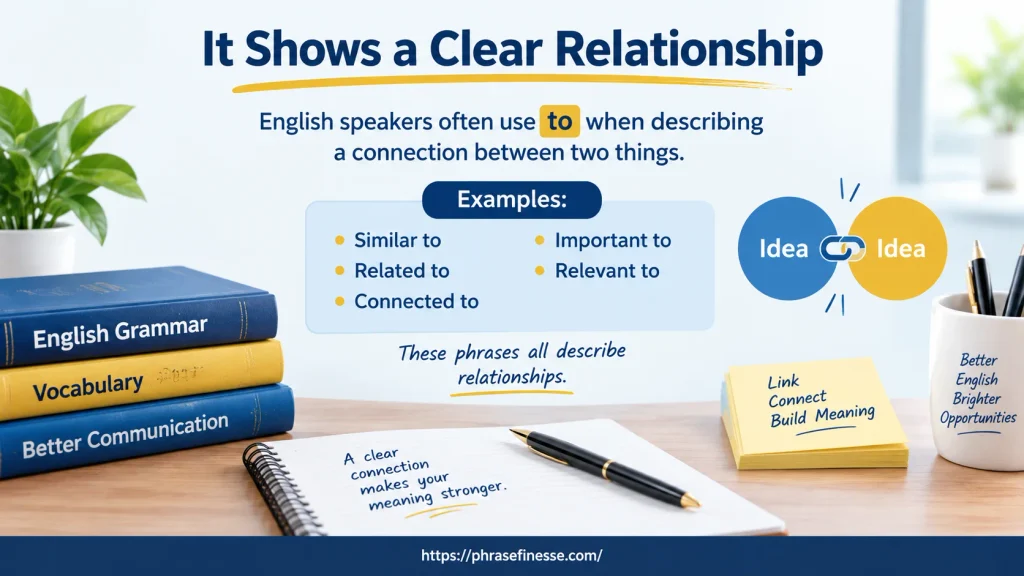
English speakers often use to when describing a connection between two things.
Examples:
- Similar to
- Related to
- Connected to
- Important to
- Relevant to
These phrases all describe relationships.
It Works in More Situations
You can use relevant to in almost every context:
- Relevant to science
- Relevant to history
- Relevant to the problem
- Relevant to the audience
- Relevant to the conversation
It has broad usage.
It Sounds More Natural in Formal Writing
Professional writers often choose relevant to because it directly connects information with a subject.
For example:
The researcher analyzed data relevant to environmental changes.
This sounds natural because the data relates directly to the topic.
Relevant To vs. Relevant For: Side-by-Side Examples
The easiest way to understand the difference is to compare similar sentences.
| Sentence | Meaning |
| This information is relevant to the discussion. | The information connects with the discussion. |
| This information is relevant for managers. | Managers can use this information. |
| Her experience is relevant to healthcare. | Her experience relates to healthcare. |
| Her experience is relevant for this position. | Her experience makes her suitable for this position. |
| The article is relevant to grammar studies. | The article connects with grammar studies. |
| The article is relevant for students. | Students can benefit from the article. |
Notice how the subject changes the emphasis.
Can You Use “Relevant To” and “Relevant For” Together?
Yes, you can use both in the same context when they describe different relationships.
For example:
This research is relevant to climate science and relevant for policymakers.
The first phrase explains the connection:
- The research relates to climate science.
The second phrase explains the usefulness:
- Policymakers can use the research.
Another example:
These communication strategies are relevant to business studies and relevant for managers.
Meaning:
- They belong to the field of business studies.
- Managers can apply them.
Common Mistakes With “Relevant To” and “Relevant For”
Many mistakes happen because writers choose the preposition based only on what sounds familiar.
Here are common errors.
Mistake: Using “Relevant For” When Talking About a Topic
Incorrect:
This information is relevant for the discussion.
Better:
This information is relevant to the discussion.
Why?
The information connects with the discussion topic.
Mistake: Using “Relevant To” When Emphasizing Usefulness
Possible:
This training is relevant to new employees.
Correct, but:
This training is relevant for new employees.
may sound more natural because it focuses on who benefits from the training.
A Simple Memory Trick for Relevant To vs. Relevant For
Remember this formula:
Topic + Subject + Issue = Relevant To
Purpose + Person + Goal = Relevant For
Examples:
Topic:
- Relevant to science
- Relevant to history
- Relevant to the conversation
Purpose:
- Relevant for students
- Relevant for employees
- Relevant for the position
When in doubt, ask:
“Am I talking about a connection or a practical use?”
Connection = relevant to
Usefulness = relevant for
A quick reminder:
- Relevant to = connected with something
- Relevant for = useful for something
Once you understand this small difference, choosing the right phrase becomes much easier. Instead of guessing, you can select the expression that matches your exact meaning.
FAQs
1. Is “relevant to” or “relevant for” more common?
“Relevant to” is far more common in standard English. It is the preferred choice when referring to something that is connected or related to a topic, person, or situation.
Example:
- This information is relevant to your research.
- The new policy is relevant to all employees.
2. When should I use “relevant for”?
Use “relevant for” when referring to the purpose, benefit, or suitability of something. It emphasizes what something is useful or appropriate for.
Example:
- These training materials are relevant for new employees.
- The software is relevant for small businesses.
3. Can I use “relevant to” and “relevant for” interchangeably?
Not always. Although both phrases may sound natural in some contexts, they often express slightly different meanings. “Relevant to” focuses on relation, while “relevant for” highlights purpose or suitability. Choosing the correct one makes your writing more accurate and natural.
4. Which expression is preferred in formal writing?
In most cases, “relevant to” is the preferred expression in formal writing, academic papers, legal documents, and business communication. It is widely accepted as the standard grammatical construction.
5. Is “relevant for” grammatically correct?
Yes. “Relevant for” is grammatically correct when it describes something that is appropriate, useful, or applicable for a particular audience, activity, or objective.
Example:
- This guide is relevant for beginners learning English.
6. How can I remember the difference between “relevant to” and “relevant for”?
A simple memory trick is:
- Relevant to = connected to a topic or subject.
- Relevant for = useful or suitable for a purpose or person.
If you’re talking about a relationship or connection, choose “relevant to.” If you’re emphasizing usefulness or intended use, “relevant for” is often the better option.
Conclusion
Understanding the difference between “relevant to” and “relevant for” can significantly improve your English usage, grammar, and formal writing. While “relevant to” is the standard expression for showing a connection between ideas, topics, or situations, “relevant for” is best used when emphasizing suitability or usefulness for a particular purpose.
Although both phrases are correct, selecting the right one creates clearer, more professional communication.
Whenever you’re unsure, think about the meaning you want to express. If you’re describing a relationship, choose “relevant to.” If you’re focusing on purpose or benefit, “relevant for” may be the better fit.
With regular practice and attention to context, you’ll use both expressions naturally and confidently in everyday conversations, academic writing, and professional communication.


[…] See More : Relevant To vs. Relevant For: Which Is Correct? […]