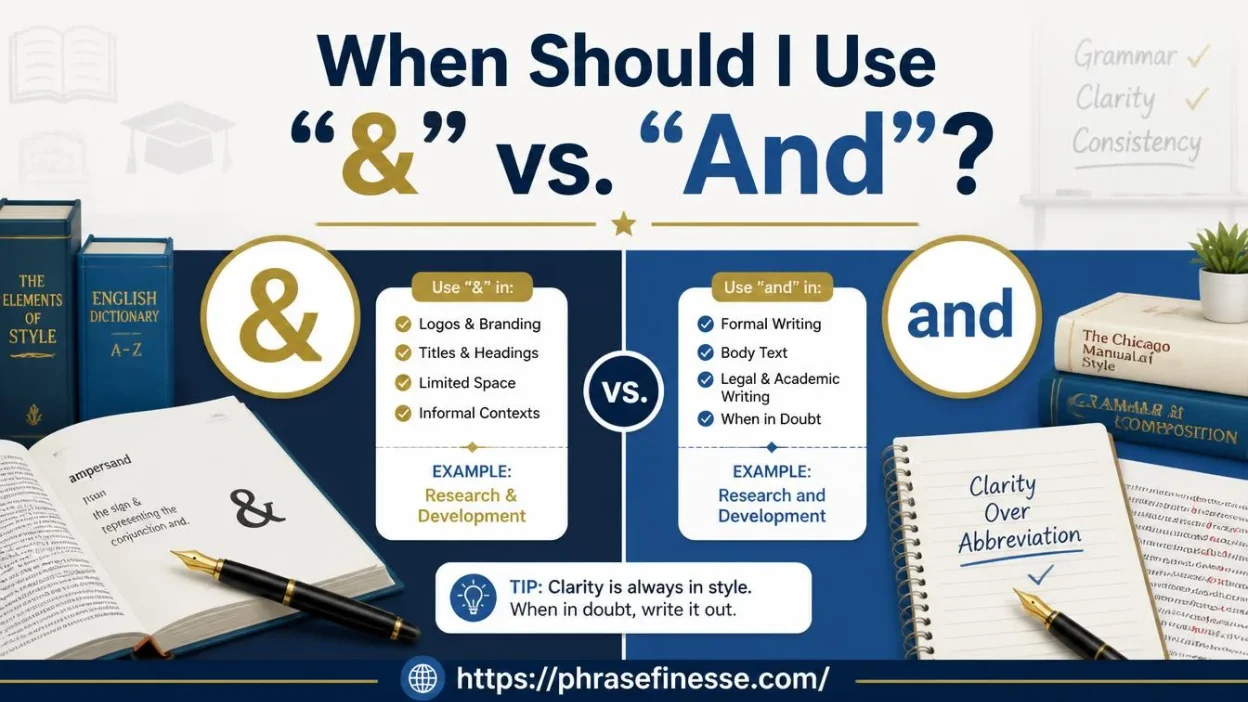
Have you ever paused while writing an email or report and wondered, “When Should I Use “&” vs. “And”? Although these two forms often seem interchangeable, choosing the right one can improve grammar, English usage, formal writing, and overall consistency.
Whether you’re drafting business communication, preparing documents, or creating professional content, understanding the difference helps your writing appear more polished and intentional.
The ampersand (&) has specific uses, while the word and remains the preferred choice in most everyday and professional writing. Knowing when each is appropriate is especially valuable in project management, meetings, calendar entries, scheduling, time management, online booking systems, and broadcasting, where space, style, and readability often influence writing decisions.
Using the correct form also strengthens clarity and helps readers process information more naturally.
In this guide, you’ll learn the practical differences between & and and, discover the grammar rules behind each choice, and explore real-world examples across formal and informal contexts.
We’ll also cover common mistakes, style recommendations, and expert tips to help you write with greater confidence, accuracy, and consistency in every situation.
Quick Answer:
If you’re unsure, use “and.”
That simple rule will keep your writing correct in most situations.
Professional editors generally prefer the written word because it improves readability and maintains consistency.
The Difference Between “&” and “And”
Before exploring specific rules, it’s important to understand what these two forms actually are.
What Does “And” Mean?
The word “and” is a coordinating conjunction. Its primary job is to connect words, phrases, clauses, and ideas.
For example:
- Sarah and Michael attended the meeting.
- We bought coffee and pastries.
- The proposal was approved and implemented.
In English grammar, “and” remains the standard form used in nearly all types of writing.
Because readers encounter it constantly, it feels natural and requires no interpretation.
What Does “&” Mean?
The symbol “&”, known as the ampersand, represents the word “and.”
Although many people think it’s a modern shorthand symbol, the ampersand actually has ancient origins. It developed from a stylized combination of the letters E and T, which form the Latin word et, meaning “and.”
Over centuries, scribes gradually merged those letters into the symbol we recognize today.
Despite sharing the same meaning as “and,” the ampersand functions more as a stylistic, branding, or formatting tool than a standard grammatical replacement.
Are “&” and “And” Grammatically Identical?
From a meaning perspective, yes.
Both communicate addition, connection, or combination.
For example:
- Research and Development
- Research & Development
The meaning remains unchanged.
However, grammar and style are not always the same thing. While both forms mean the same thing, professional writing standards often treat them differently.
That’s where most confusion begins.
Use “And” in Formal Writing
Formal writing almost always favors “and.”
Examples include:
- Academic essays
- Research papers
- Business reports
- Professional proposals
- Government documents
- Legal contracts
- Books
- Articles
- Press releases
Consider these examples:
✅ The sales and marketing teams collaborated successfully.
✅ The study examined education and income levels.
❌ The sales & marketing teams collaborated successfully.
❌ The study examined education & income levels.
While the ampersand isn’t necessarily wrong, most style guides would recommend spelling out “and.”
Use “And” in Complete Sentences
Whenever you’re writing standard prose, “and” typically looks better.
Examples:
- The conference included speakers and workshops.
- She purchased notebooks and pens.
- The company expanded operations and hired new staff.
Notice how the sentences flow naturally.
Using an ampersand in these examples would create unnecessary visual interruption.
Why Most Editors Prefer “And”
Editors value clarity.
The written word:
- Improves readability
- Appears more professional
- Creates consistency
- Matches style guide requirements
- Enhances formal communication
Think of “and” as the default setting.
Only switch to “&” when a specific reason exists.
When Is It Correct to Use an Ampersand (&)?
Although “and” dominates formal writing, the ampersand remains useful in many situations.
Official Business Names
One of the most important rules involves official company names.
If a business uses an ampersand in its legal or public branding, keep it exactly as written.
Examples include:
- Johnson & Johnson
- Procter & Gamble
- Barnes & Noble
- Dolce & Gabbana
- Marks & Spencer
Changing those names can create branding inconsistencies.
For example:
✅ Johnson & Johnson announced new initiatives.
❌ Johnson and Johnson announced new initiatives.
The second version technically communicates the same meaning. However, it doesn’t reflect the company’s official branding.
Brand Names and Logos
Brand identity often depends on consistency.
Many organizations intentionally choose the ampersand because it:
- Saves space
- Improves visual balance
- Creates memorable branding
- Looks cleaner in logos
As a result, always respect official brand styling.
Tables, Charts, and Graphs
Space matters in data presentation.
Consider this table:
| Department | Budget |
| Sales & Marketing | $500,000 |
| Research & Development | $800,000 |
The ampersand keeps labels concise.
That’s why you’ll often see it in:
- Charts
- Dashboards
- Infographics
- Financial reports
- Presentations
Headlines and Titles
Writers frequently use ampersands in titles.
Examples:
- Tips & Tricks for Better Writing
- Health & Wellness Guide
- Food & Travel Adventures
Shorter titles often look cleaner and fit design constraints more effectively.
Website Navigation Menus
Website designers frequently prefer ampersands because menu space is limited.
Common examples include:
- Terms & Conditions
- Research & Development
- Home & Garden
- Health & Wellness
The shorter form improves navigation clarity.
Social Media and Marketing Content
Digital communication rewards brevity.
Character limits and visual design often make the ampersand attractive.
Examples:
- Sales & discounts this weekend.
- Tips & strategies for entrepreneurs.
- News & updates from our team.
In these situations, the symbol often improves readability rather than hurting it.
Situations Where You Should Avoid Using “&”
Certain contexts strongly favor the word “and.”
Academic Writing
Universities and academic journals generally expect formal language.
Use:
- Literature and history
- Science and technology
Avoid:
- Literature & history
- Science & technology
Unless an official title includes an ampersand, stick with “and.”
School Assignments
Teachers typically expect standard grammar conventions.
Students should spell out conjunctions rather than relying on symbols.
Professional Reports
Corporate reports often follow style guides that prioritize consistency.
Use “and” throughout narrative sections.
Reserve ampersands for charts, tables, and official names.
Formal Emails
Professional emails should prioritize clarity.
Example:
✅ The finance and operations teams reviewed the proposal.
Not:
❌ The finance & operations teams reviewed the proposal.
Legal and Government Documents
Precision matters.
Most legal professionals avoid ampersands in standard text.
Resumes and Cover Letters
Recruiters generally prefer traditional writing conventions.
However, keep official company names unchanged.
Example:
✅ Worked at Procter & Gamble.
“&” vs. “And” in Different Types of Writing
The following table provides a quick reference guide.
| Writing Type | Use “And” | Use “&” |
| Academic Papers | ✓ | Rarely |
| Business Reports | ✓ | Sometimes |
| Formal Emails | ✓ | Rarely |
| Books | ✓ | Rarely |
| Social Media | Sometimes | ✓ |
| Advertising | Sometimes | ✓ |
| Website Menus | Sometimes | ✓ |
| Company Names | Rarely | ✓ |
| Charts & Tables | Sometimes | ✓ |
| Legal Documents | ✓ | Rarely |
Common Examples of Correct Usage
Examples often clarify rules better than explanations.
Examples Using “And”
- Bread and butter.
- Salt and pepper.
- Parents and teachers.
- Education and training.
- Leadership and management.
These combinations appear naturally in everyday writing.
Examples Using “&”
- Food & Beverage Department
- Research & Development
- Terms & Conditions
- Finance & Accounting
- Sales & Marketing
These phrases frequently appear in headings, navigation menus, and business materials.
Company Name Examples
Some famous organizations use ampersands as part of their identity.
| Company | Official Style |
| Johnson & Johnson | Ampersand |
| Procter & Gamble | Ampersand |
| Barnes & Noble | Ampersand |
| Marks & Spencer | Ampersand |
| Dolce & Gabbana | Ampersand |
Always preserve the official version.
Ampersand in Business Names and Trademarks
Branding introduces another layer to the discussion.
Why Official Naming Matters
Trademarks protect brand identity.
A company’s official spelling contributes to:
- Brand recognition
- Legal consistency
- Marketing effectiveness
- Consumer trust
Changing the presentation may create confusion.
Should You Replace “&” With “And” in Company Names?
Generally, no.
If the official name contains an ampersand, keep it.
Examples:
1.✅ Barnes & Noble
2.✅ Procter & Gamble
3.✅ Johnson & Johnson
Maintaining consistency demonstrates professionalism and attention to detail.
Well-Known Brands Using Ampersands
Many globally recognized brands rely on ampersands.
Examples include:
- AT&T
- Dolce & Gabbana
- Tiffany & Co.
- Marks & Spencer
- Johnson & Johnson
- Barnes & Noble
Notice how the symbol contributes to visual identity.
See More :Thereby vs. Therefore: Meaning and Usage
Ampersand in Digital Communication
Modern communication often prioritizes speed and visual efficiency.
That’s where the ampersand shines.
Social Media Posts
Short content benefits from concise wording.
For example:
- Travel & adventure tips.
- Marketing & branding insights.
- Health & fitness strategies.
The symbol helps save characters without losing meaning.
Text Messages
Informal communication frequently uses ampersands.
Examples:
- Coffee & lunch tomorrow?
- Work & family have kept me busy.
In casual settings, this feels completely natural.
Online Advertising
Advertising often relies on quick scanning.
Examples:
- Save time & money.
- Comfort & performance.
- Quality & value.
The shorter format improves visual impact.
Email Subject Lines
Subject lines benefit from brevity.
Examples:
- Updates & Announcements
- Pricing & Features
- Sales & Marketing Review
The ampersand can improve readability when space is limited.
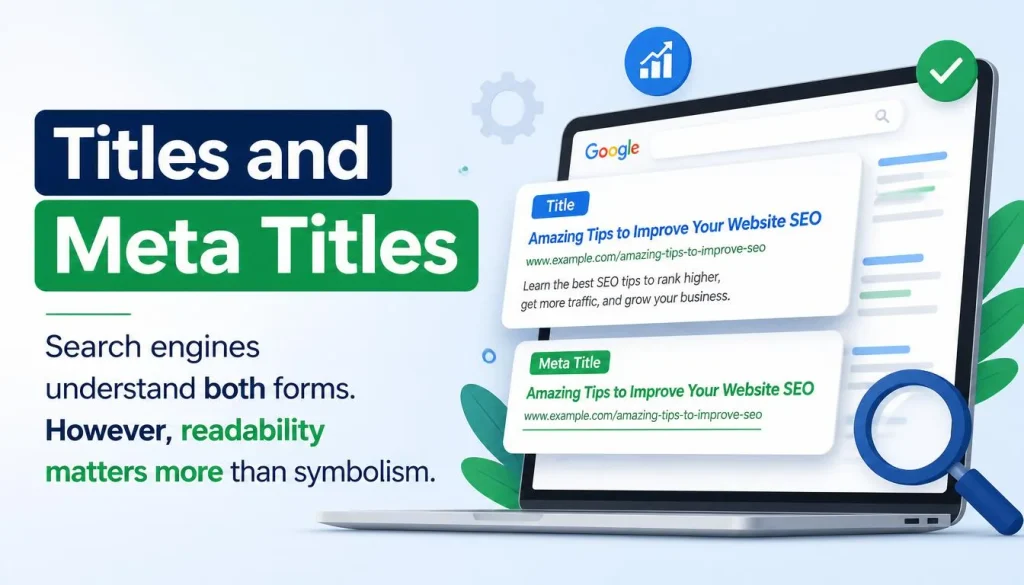
Titles and Meta Titles
Search engines understand both forms.
However, readability matters more than symbolism.
Examples:
- Travel and Tourism Guide
- Travel & Tourism Guide
Either can work.
What Major Style Guides Say About “&” vs. “And”
Professional writers often rely on established style guides.
AP Style
Associated Press style generally prefers “and.”
Ampersands appear primarily in:
- Official company names
- Recognized abbreviations
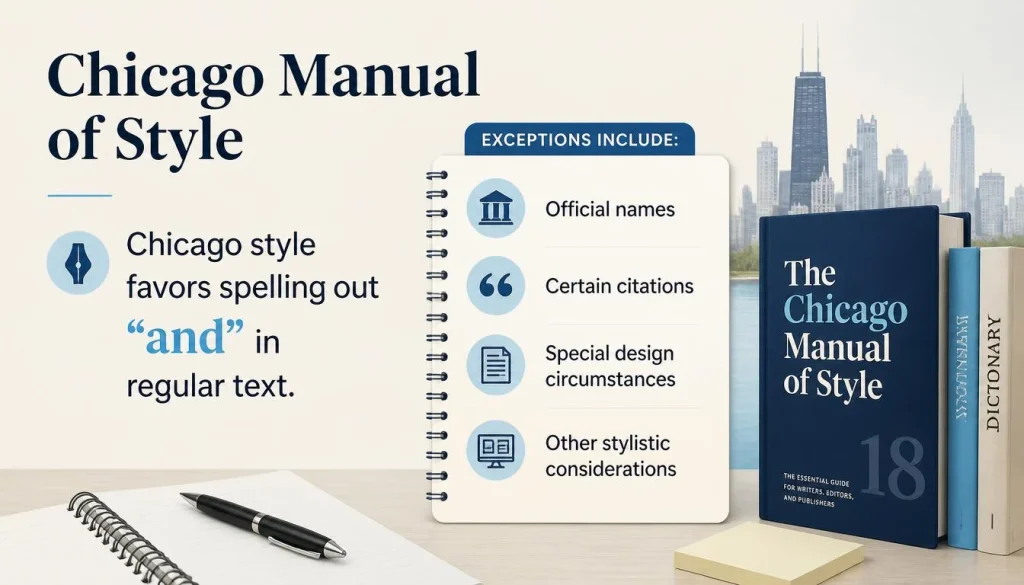
Chicago Manual of Style
Chicago style favors spelling out “and” in regular text.
Exceptions include:
- Official names
- Certain citations
- Special design circumstances
MLA Style
MLA typically uses “and” throughout academic writing.
APA Style
APA follows a similar approach.
Researchers should spell out “and” in prose.
What Most Editors Recommend
A simple principle guides most editors:
Use “and” by default. Use “&” only when a clear reason exists.
That advice works in almost every writing situation.
Common Mistakes People Make
Even experienced writers sometimes misuse ampersands.
Using “&” Throughout Formal Writing
This remains the most common error.
Example:
❌ The research & development team collaborated with finance & operations.
Better:
✅ The research and development team collaborated with finance and operations.
Mixing “And” and “&” Inconsistently
Consistency matters.
Avoid switching back and forth without purpose.
Altering Official Brand Names
Never rewrite official names for convenience.
Keep the company’s chosen styling intact.
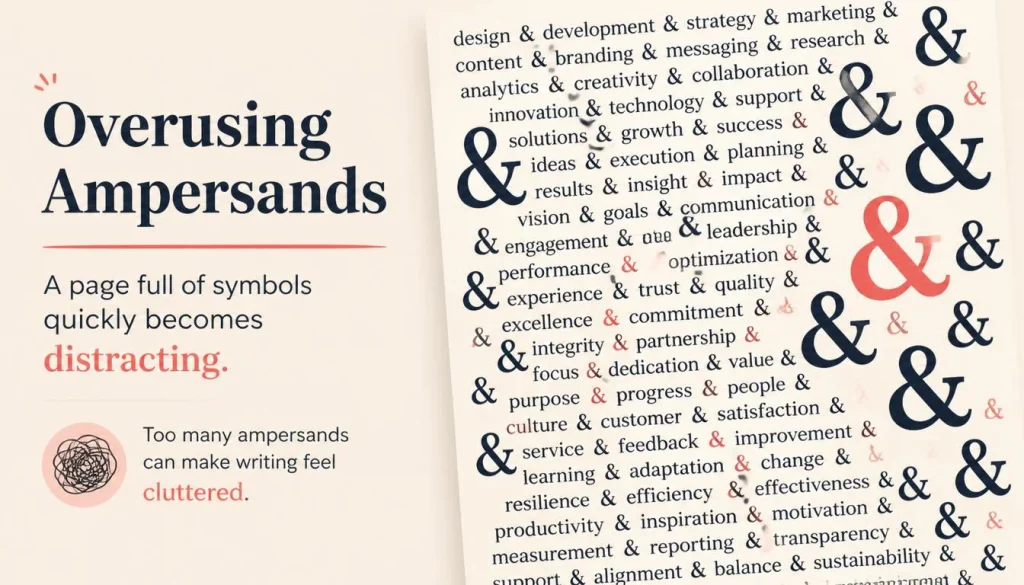
Overusing Ampersands
A page full of symbols quickly becomes distracting.
Too many ampersands can make writing feel cluttered.
Choosing Brevity Over Readability
Saving one or two characters rarely justifies reduced readability.
Always prioritize the reader.
How to Decide Between “&” and “And”
A simple framework can eliminate uncertainty.
Ask These Four Questions
Is This Formal Writing?
If yes, use “and.”
Is It Part of an Official Name?
If yes, preserve the ampersand if the organization uses one.
Am I Trying to Save Space?
If yes, the ampersand may help.
Does It Improve Readability?
If yes, consider using it.
If not, spell out “and.”
Case Study: How Professional Editors Handle Ampersands
Imagine a company preparing three pieces of content:
Annual Report
The editor writes:
- Finance and operations
- Sales and marketing
- Research and development
Reason: Formal narrative content.
Website Navigation
The designer uses:
- Terms & Conditions
- Research & Development
- Health & Wellness
Reason: Space efficiency.
Press Release Mentioning a Company
The writer uses:
- Johnson & Johnson
Reason: Official brand name.
Notice that all three decisions follow the same principle: context determines the correct choice.
“&” vs. “And” at a Glance
| Situation | Best Choice |
| Essay | And |
| Academic Paper | And |
| Research Study | And |
| Formal Email | And |
| Business Proposal | And |
| Company Name | Official Style |
| Website Menu | Often & |
| Advertisement | Often & |
| Social Media Post | Either |
| Chart or Table | Often & |
| Legal Document | And |
| Book Manuscript | And |
FAQs
1. Is it grammatically correct to use & instead of and?
Yes, & is grammatically correct in certain situations. It is commonly used in company names, headings, tables, logos, and when space is limited. However, in most formal writing, the word and is the preferred choice.
2. Should I use & in academic or professional writing?
In most academic papers, business reports, and professional documents, you should use and unless a specific style guide or an official name requires the ampersand. This keeps your writing clear, formal, and consistent.
3. Can I use & in emails and business communication?
Yes, you can use & in informal emails, subject lines, headings, or official business names. However, for complete sentences and formal business communication, writing and is generally the better option.
4. Why do some company names use & instead of and?
Many businesses use & as part of their official branding because it is shorter, visually appealing, and easy to recognize. If & appears in a company’s legal or official name, you should reproduce it exactly as written.
5. Does using & improve readability?
It depends on the context. The ampersand can improve readability in lists, charts, labels, and headings where space is limited. In paragraphs, however, and usually creates a smoother reading experience and looks more natural.
6. What is the easiest rule to remember when choosing between & and and?
A simple rule is this: Use and in complete sentences and formal writing. Use & only when it is part of an official name, follows a style convention, or helps save space without reducing clarity.
Conclusion
Knowing when should I use “&” vs. “and” is more than a punctuation question—it’s an important part of writing with clarity, professionalism, and consistency. While and remains the standard choice for most sentences, the ampersand (&) has a clear purpose in branding, headings, abbreviations, and space-conscious formats. Understanding these differences helps you communicate more effectively in academic, professional, and everyday writing.
Whenever you’re unsure, choose and unless there’s a specific reason to use &. Following this simple principle will make your writing easier to read, align with common style guides, and leave a stronger impression on your audience. By applying the examples and rules covered in this guide, you’ll be able to use both forms confidently and correctly in any writing situation.

Emma Brooke is an English language specialist, editor, and content writer at Phrase Finesse, where she helps readers develop stronger writing and communication skills through clear, practical, and engaging content. With a passion for the English language, she specializes in simplifying grammar rules, vocabulary, spelling, punctuation, and word usage for learners at every level.
Emma has extensive experience creating educational content that is accurate, well-researched, and easy to understand. She is particularly skilled at explaining confusing word pairs, grammar concepts, idioms, sentence structure, and effective writing techniques, making complex topics approachable for students, professionals, educators, and English learners worldwide.
[…] See More : When Should I Use “&” vs. “And”? […]