Have you ever paused before sending a message because the wording sounded slightly unusual? If you’ve wondered Is “May You Please Explain This” Correct? you’re asking a question that many English learners, professionals, and native speakers share.
While the phrase is understandable, it raises important points about English usage, grammar, formal writing, politeness, and consistency. Choosing the right expression can make your communication sound more natural and professional in both everyday conversations and workplace settings.
In this guide, you’ll discover whether the phrase is grammatically correct, when it sounds appropriate, and which alternatives native speakers prefer. We’ll explore the subtle differences between similar expressions, explain the underlying grammar rules, and provide practical examples for emails, business communication, presentations, and academic writing.
You’ll also learn how word choice influences clarity, tone, and professionalism in real-world situations.
Because clear language supports effective collaboration, this article also connects proper phrasing with modern communication contexts, including meetings, project management, scheduling, time management, calendar invitations, online booking confirmations, and even broadcasting announcements.
By the end, you’ll know exactly when to use this expression, when to replace it with a more natural alternative, and how to communicate with greater confidence, accuracy, and fluency in every professional or personal setting.
Is “May You Please Explain This” Grammatically Correct?
The short answer is:
Yes, “May you please explain this?” is grammatically possible, but it is not the most natural way to ask someone for an explanation.
The sentence follows a correct grammatical pattern:
May + subject + base verb + object
Examples:
- May you explain this?
- May you help me?
- May you provide additional information?
From a strict grammar perspective, nothing is wrong with the structure.
However, English speakers usually do not use “may” this way. In most situations, may asks for permission or expresses possibility.
For example:
- May I leave early today?
- May I ask a question?
- It may rain tomorrow.
In these examples, may has a clear purpose. It either requests permission or shows uncertainty.
When you say:
May you please explain this?
the listener may understand your meaning, but the sentence can sound unusual because you are using may to request someone else’s action.
Most native speakers would naturally say:
- Could you please explain this?
- Can you please explain this?
- Would you please explain this?
These options match normal English request patterns.
Why Does “May You Please Explain This” Sound Unnatural?
The main reason is the difference between permission and request.
English speakers generally use may when the speaker wants permission to do something.
Look at these examples:
Asking permission:
May I open the window?
Meaning:
“Do I have permission to open the window?”
The person asking is requesting approval for their own action.
Now compare:
May you open the window?
This sounds strange because it suggests:
“Are you allowed to open the window?”
It does not naturally mean:
“Please open the window.”
The same problem appears with:
May you please explain this?
The sentence sounds like you are asking whether the person has permission or ability to explain something rather than politely requesting an explanation.
Understanding the Meaning and Use of “May”
To understand why this phrase feels unusual, you need to understand what may actually does in English.
The word may is a modal verb. Modal verbs modify the meaning of another verb by showing things like:
- Permission
- Possibility
- Formal requests
- Uncertainty
Here are the main uses of may.
“May” for Asking Permission
The most common use of may involves permission.
Examples:
- May I borrow your pen?
- May I speak with the manager?
- May we start the meeting now?
These sentences ask whether an action is allowed.
The structure usually looks like this:
May + I/we + base verb
Examples:
| Sentence | Meaning |
| May I enter the room? | Do I have permission to enter? |
| May I ask something? | Do I have permission to ask? |
| May we begin? | Are we allowed to start? |
This is why “May I explain this?” sounds natural.
It means:
“Do I have permission to explain this?”
“May” for Possibility
Another common use of may is showing that something could happen.
Examples:
- The meeting may start late.
- She may arrive tomorrow.
- The company may change its policy.
Here, may does not ask anything. It simply shows possibility.
A quick comparison:
| Sentence | Meaning |
| She may join us. | There is a possibility she will join. |
| May she join us? | Asking permission for her to join. |
The meaning changes depending on the sentence structure.
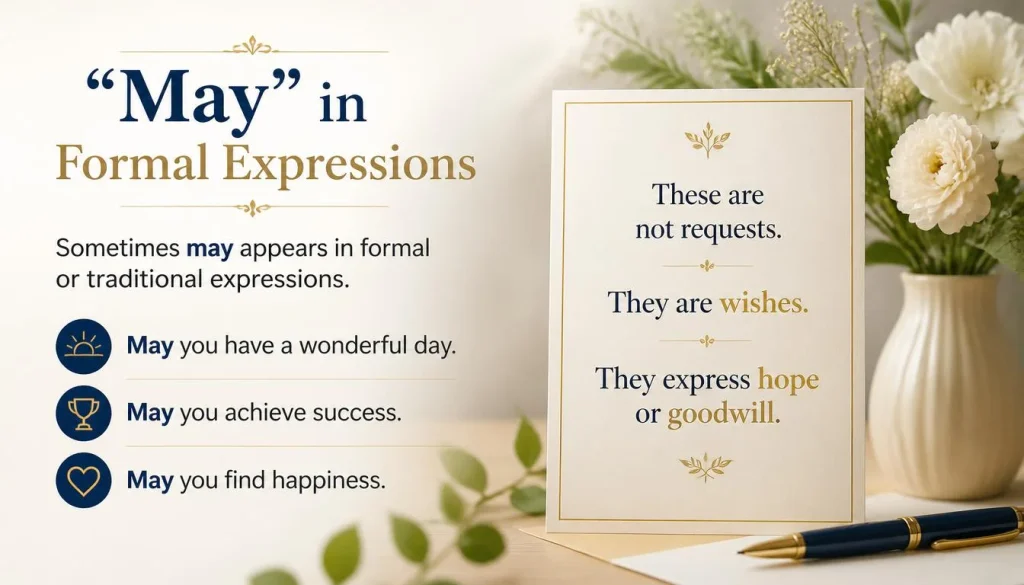
“May” in Formal Expressions
Sometimes may appears in formal or traditional expressions.
Examples:
- May you have a wonderful day.
- May you achieve success.
- May you find happiness.
These are not requests. They are wishes.
They express hope or goodwill.
For example:
May you enjoy your new home.
This means:
“I hope you enjoy your new home.”
It does not mean:
“Please enjoy your new home.”
This distinction explains why “May you please explain this?” feels different from typical polite requests.
“May I Explain This?” vs. “May You Explain This?”
The difference between I and you completely changes the meaning.
| Phrase | Meaning | Natural? |
| May I explain this? | Am I allowed to explain this? | Yes |
| May you explain this? | Are you permitted to explain this? | Uncommon |
| Could you explain this? | Please explain this | Yes |
Consider a workplace example.
Situation:
A colleague misunderstands a report.
Natural response:
May I explain this section?
You are asking permission to provide an explanation.
Less natural:
May you explain this section?
You are asking another person to explain it, but the wording does not match normal English patterns.
Better:
Could you explain this section?
Better Alternatives to “May You Please Explain This”
If you want to politely ask someone for clarification, several alternatives work better.
“Could You Please Explain This?” — The Best General Option
For most situations, “Could you please explain this?” is the safest and most natural choice.
It sounds:
- Polite
- Professional
- Friendly
- Respectful
Examples:
- Could you please explain this concept?
- Could you please explain this part of the report?
- Could you please explain how this process works?
You can use this phrase in:
- Emails
- Workplace conversations
- Customer service situations
- Academic discussions
Example:
Could you please explain this section of the contract? I want to make sure I understand the requirements correctly.
This sounds professional without feeling overly formal.
“Can You Please Explain This?” — A Common Everyday Choice
Many people believe “can” is incorrect for requests because it originally relates to ability.
However, modern English widely accepts can for polite requests.
Examples:
- Can you please explain this problem?
- Can you help me understand this rule?
- Can you explain what happened?
The difference between can and could is mostly about tone.
| Phrase | Tone |
| Can you explain this? | Direct and conversational |
| Could you explain this? | More polite and softer |
For casual conversations, can works perfectly.
Example:
Friend:
“I don’t understand this game.”
You:
“Can you explain what part is confusing?”
This sounds natural.
See More : Half an Hour vs. Half Hour: Which Is Correct?
“Would You Please Explain This?” — A More Formal Option
Would you please explain this? sounds more formal and sometimes more serious.
Examples:
- Would you please explain this decision?
- Would you please explain the next steps?
- Would you please explain this issue further?
This phrase works well in:
- Formal emails
- Business communication
- Official requests
However, depending on the situation, it can sound slightly firm.
Compare:
Could you please explain this?
vs.
Would you please explain this?
The first feels more collaborative.
The second feels more like a formal request.
“Could You Help Me Understand This?” — A Friendly Alternative
Sometimes, the best request does not directly ask someone to explain.
Instead, it invites cooperation.
Examples:
- Could you help me understand this?
- Could you help me understand how this works?
- Could you help me understand this decision?
This phrase works well because it creates a team-oriented feeling.
Instead of saying:
“You need to explain this.”
you are saying:
“Help me understand this better.”
That small change can make conversations feel warmer.
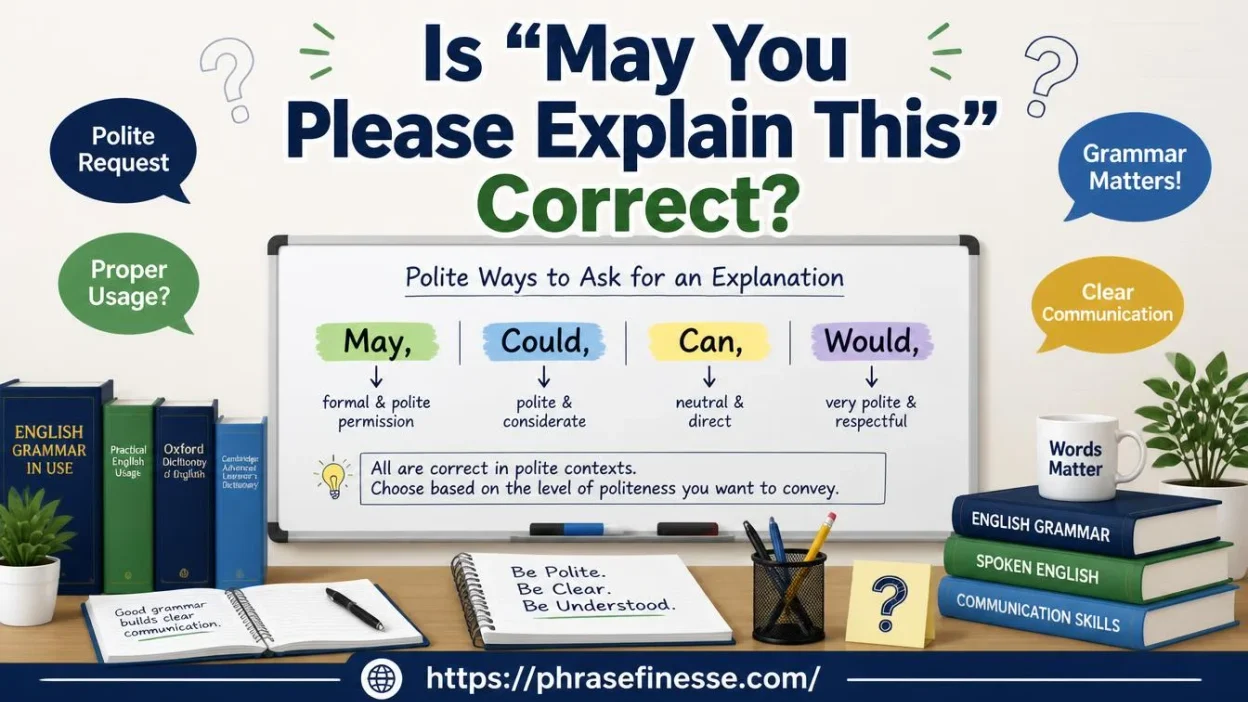
Quick Comparison: May vs. Can vs. Could vs. Would
| Word | Main Use | Example | Tone |
| May | Permission or possibility | May I ask a question? | Formal |
| Can | Ability or casual request | Can you explain this? | Neutral |
| Could | Polite request | Could you explain this? | Polite |
| Would | Formal request | Would you explain this? | Formal |
Understanding these differences helps you choose the right expression for every situation.
Using “May” When You Mean “Could”
A common mistake happens when writers use may because they think it always sounds more polite.
However, politeness depends on using the correct structure.
Less natural:
May you please send the document?
Better:
Could you please send the document?
The second sentence sounds smoother because it matches normal request patterns.
Using Overly Formal Language in Casual Situations
Some phrases are grammatically acceptable but feel unnatural because they sound too formal.
Example:
May you please pass the salt?
Most people would simply say:
Could you pass the salt?
or:
Can you pass the salt?
Natural communication is not only about correctness. It is also about matching the situation.
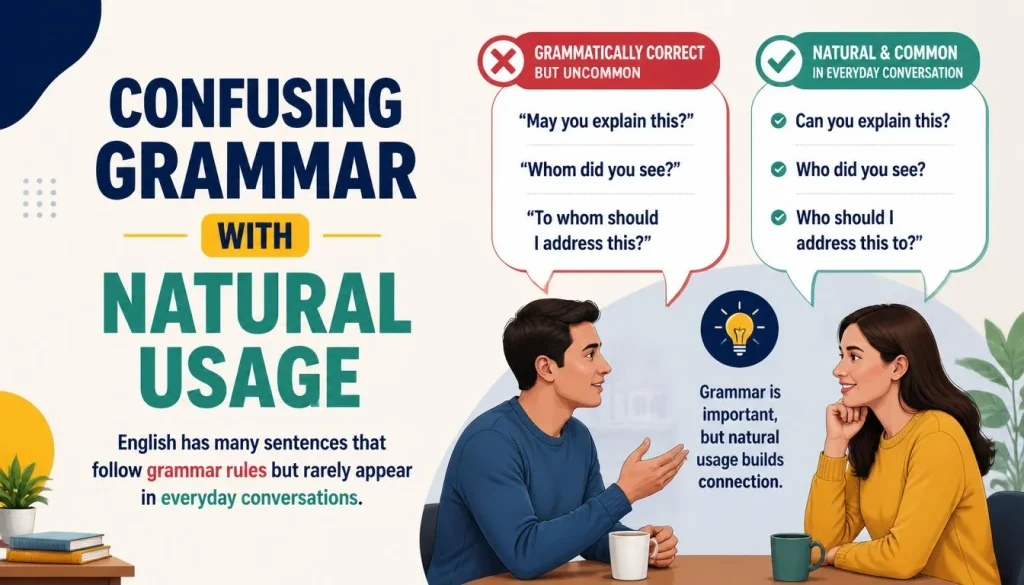
Confusing Grammar With Natural Usage
English has many sentences that follow grammar rules but rarely appear in everyday conversations.
For example:
- “May you explain this?”
- “Whom did you see?”
- “To whom should I address this?”
These sentences are not necessarily wrong. They simply belong to specific contexts.
Good communication requires understanding both:
- What is grammatically possible
- What native speakers actually use
Using “May You Please Explain This” in Professional Writing
In professional communication, word choice matters.
A small difference can affect how your message sounds.
Compare:
Less natural:
May you please explain the changes made to this document?
Better:
Could you please explain the changes made to this document?
The second option sounds more natural while maintaining professionalism.
Email Examples
Requesting clarification from a coworker
Could you please explain the updated process? I want to make sure I follow the correct steps.
Asking a client for details
Would you please provide more information about this request?
Asking a teacher or instructor
Could you please explain this concept in more detail? I would like to understand it better.
These examples sound respectful without appearing stiff.
Real-Life Case Study: Choosing the Right Phrase
Situation: Workplace Meeting
A manager presents a new reporting system.
An employee does not understand one part.
Option 1:
May you please explain this?
The sentence is understandable but sounds unusual.
Option 2:
Could you please explain this?
This sounds professional and natural.
Option 3:
Can you explain this?
This works in a more casual workplace.
Best choice:
Could you please explain this section of the reporting system?
It is polite, clear, and appropriate.
FAQs
1. Is “May You Please Explain This” grammatically correct?
The phrase is generally understandable, but it is not considered natural English. Native speakers rarely use “may” in this way. Instead, expressions such as “Could you please explain this?” or “Can you please explain this?” sound much more natural.
2. Why does “May You Please Explain This” sound awkward?
The verb “may” is traditionally used to ask for or give permission, not to request another person’s action directly. Because of this, the sentence feels unnatural even though most people understand its meaning.
3. What is the most polite alternative?
One of the best alternatives is “Could you please explain this?” It is polite, professional, and appropriate for emails, workplaces, classrooms, and everyday conversations. “Would you mind explaining this?” is another excellent formal option.
4. Can I use this phrase in professional emails?
It’s better to avoid “May You Please Explain This” in professional writing. Choosing more natural expressions helps improve business communication, creates a professional tone, and makes your request easier to understand.
5. Is “Can you please explain this?” less polite than “Could you please explain this?”
Both are polite, but “Could you please explain this?” sounds slightly more formal and courteous. “Can you please explain this?” is common in everyday conversations and is perfectly acceptable in many workplace situations.
6. How can I improve my grammar when making polite requests?
Read authentic English materials, observe how native speakers phrase requests, and practice using common expressions in context. Focusing on grammar, English usage, and formal writing patterns will help you make polite, natural requests with confidence.
Conclusion
Although “May You Please Explain This” is understandable, it is not the most natural or grammatically preferred way to ask someone for clarification in modern English. Native speakers typically choose expressions like “Could you please explain this?”, “Can you please explain this?”, or “Would you mind explaining this?” because they sound smoother, more polite, and more idiomatic.
Understanding these subtle differences improves your English usage, grammar, and formal writing skills while helping you communicate more confidently in academic, professional, and everyday situations. Whether you’re writing emails, participating in business communication, attending meetings, managing project management tasks, or requesting clarification during online booking or broadcasting discussions, selecting the right wording creates a stronger impression.
The best approach is to focus on clarity, politeness, and consistency rather than translating phrases directly from another language. Once you become familiar with these common patterns, asking someone to explain something will feel natural, professional, and effortless.

Mia Rose is an English language specialist and editorial writer at Phrase Finesse, where she helps readers master grammar, vocabulary, spelling, and effective communication. Passionate about making English simple and practical, she creates well-researched, reader-friendly content that explains complex language concepts in a clear and engaging way.
With extensive experience in English language education, content writing, and editorial review, Mia specializes in grammar, punctuation, word choice, idioms, confusing word pairs, and writing style. Her articles are carefully researched, fact-checked, and designed to help students, professionals, writers, and English learners build confidence in both written and spoken English.