Have you ever wondered whether Half an Hour vs. Half Hour: Which Is Correct?Is this conversation helpful so far?Both expressions appear in everyday conversations, emails, and professional documents, yet they don’t always serve the same purpose.
Understanding the difference can improve your English usage, strengthen your grammar, and help you communicate with greater consistency in both casual and formal situations.
Whether you’re discussing scheduling, planning meetings, updating a calendar, handling project management tasks, or confirming an online booking, choosing the right expression makes your writing more precise.
The distinction also matters in business communication, formal writing, and even broadcasting, where clear and natural language leaves a stronger impression. Small wording choices often have a significant impact on clarity and professionalism.
In this guide, you’ll learn when “half an hour” is the grammatically correct standalone time expression, when “half-hour” functions as a compound modifier, and why context determines the best choice.
You’ll also find easy-to-follow grammar rules, practical examples, common mistakes to avoid, and expert usage tips that will help you write and speak with confidence in every situation.
Quick Answer:
If you’re looking for the short answer, here it is:
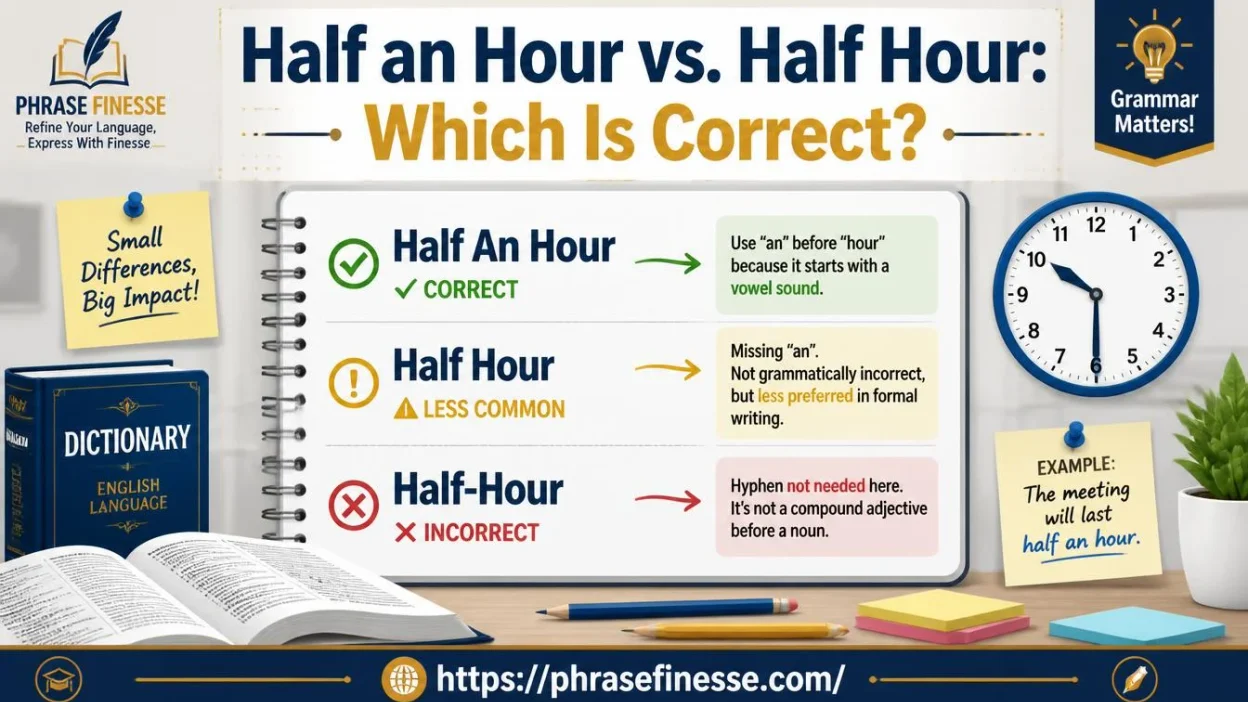
- Half an hour is the most common and standard expression.
- Half hour is correct in certain contexts.
- Half-hour is used as a compound adjective before a noun.
Consider these examples:
1.✅ I waited for half an hour.
2.✅ The meeting lasted half an hour.
3.✅ We had a half-hour meeting.
4.✅ The first half hour of the movie was exciting.
Although all of these examples are correct, each phrase functions differently within the sentence.
Quick Comparison Table
| Expression | Function | Example |
| Half an hour | Noun phrase | I waited for half an hour. |
| Half hour | Noun phrase in specific contexts | The first half hour was difficult. |
| Half-hour | Compound adjective | We attended a half-hour seminar. |
Understanding these distinctions will immediately improve your grammar accuracy.
What Does “Half An Hour” Mean?
The expression half an hour simply means 30 minutes.
It refers to a duration of time and is the form most native speakers use in everyday conversation.
Definition of Half An Hour
A period equal to one-half of an hour.
Since an hour contains 60 minutes, half an hour equals:
| Time Measurement | Equivalent |
| Half an hour | 30 minutes |
| 0.5 hour | 30 minutes |
| 1,800 seconds | 30 minutes |
When to Use Half An Hour
You should use half an hour when discussing how long something lasts.
Examples:
- I exercised for half an hour.
- She studied for half an hour before dinner.
- The presentation continued for half an hour.
- We waited half an hour for the train.
Notice that these examples focus on duration.
The phrase often follows prepositions such as:
- For
- In
- Within
- After
- During
Examples:
- I’ll arrive in half an hour.
- The package arrived after half an hour.
- They completed the task within half an hour.
This structure sounds natural and is widely accepted in both American and British English.
Why Is It “An Hour” Instead of “A Hour”?
Many learners ask this question.
The answer comes from pronunciation rather than spelling.
Although the word hour begins with the letter H, the H is silent.
You pronounce it as:
our
Since the word begins with a vowel sound, English grammar requires an instead of a.
Similar Examples
| Correct Form | Incorrect Form |
| an hour | an hour |
| an honest person | a honest person |
| an honor | a honor |
| an heir | a heir |
A useful rule to remember:
Use an before vowel sounds, not necessarily vowel letters.
That’s why half an hour is correct.
What Does “Half Hour” Mean?
The phrase half hour also refers to a 30-minute period.
However, it functions somewhat differently from half an hour.
Rather than emphasizing duration, it often identifies a specific segment or portion of time.
Examples:
- The first half hour was boring.
- The final half hour changed everything.
- During the next half hour, several issues emerged.
In these examples, the phrase identifies a particular block of time rather than describing how long something lasted.
Is Half Hour Grammatically Correct?
Yes.
Contrary to popular belief, half hour is not grammatically wrong.
However, it appears in more limited situations.
Common Contexts
- Specific time segments
- Sports commentary
- Broadcast schedules
- Academic discussions
- Historical narratives
Examples:
- The second half hour of the program attracted more viewers.
- The opening half hour of the game was intense.
- Attendance increased during the final half hour.
In these situations, removing an sounds perfectly natural.
The Key Difference Between Half An Hour and Half Hour
This distinction becomes clearer when you compare their primary functions.
| Feature | Half An Hour | Half Hour |
| Refers to 30 minutes | Yes | Yes |
| Describes duration | Yes | Sometimes |
| Identifies a time segment | Rarely | Frequently |
| Common in everyday speech | Very common | Less common |
| Used after “for” | Usually | Rarely |
Example Comparison
Duration
- I waited for half an hour.
Specific Time Segment
- The first half hour of the meeting was productive.
The first sentence tells you how long the waiting lasted.
The second identifies a particular section of the meeting.
That subtle distinction explains why both forms exist.
Understanding the Hyphenated Form: Half-Hour
The hyphenated version causes even more confusion.
Many writers mistakenly omit the hyphen when they shouldn’t.
What Is a Half-Hour?
A half-hour becomes a compound adjective when it describes a noun.
Examples:
- a half-hour presentation
- a half-hour drive
- a half-hour workout
- a half-hour interview
The phrase now functions as a single descriptive unit.
Why the Hyphen Matters
The hyphen improves clarity.
Without it, readers may need an extra moment to understand the sentence.
Compare:
❌ a half hour meeting
✅ a half-hour meeting
The second version follows standard English grammar rules for compound modifiers.
The Easy Rule
Remember this simple guideline:
| Structure | Correct Form |
| Before a noun | half-hour |
| After a verb | half an hour |
Examples:
✅ We attended a half-hour lecture.
✅ The lecture lasted half an hour.
This rule works almost every time.
Common Grammar Mistakes With Half An Hour and Half Hour
Even experienced writers occasionally make errors.
Here are the most frequent mistakes.
Omitting the Article
Incorrect:
❌ I waited for half hour.
Correct:
✅ I waited for half an hour.
Since you’re describing duration, the article is necessary.
Forgetting the Hyphen
Incorrect:
❌ We had a half hour meeting.
Correct:
✅ We had a half-hour meeting.
Compound adjectives require hyphenation before nouns.
Mixing Different Structures
Incorrect:
❌ The seminar lasted a half-hour.
Correct:
✅ The seminar lasted half an hour.
The hyphenated form works only as an adjective.
See More :More Than Happy To Help: Meaning, Usage, and Alternatives
Using Half Hour Where Half An Hour Sounds Better
While technically possible in some contexts, many learners overuse half hour.
Natural English often prefers:
✅ Wait half an hour.
instead of
⚠️ Wait half hour.
Real-Life Examples in Everyday English
Grammar becomes easier when you see how people actually use these expressions.
Workplace Examples
Modern offices frequently discuss time blocks and durations.
Examples:
- The briefing lasted half an hour.
- We scheduled a half-hour conference call.
- The final half hour focused on questions.
Each sentence uses a different form correctly.
Travel Examples
Travel situations provide excellent examples.
- The train was delayed by half an hour.
- We stopped for a half-hour break.
- The final half hour of the journey felt endless.
Academic Examples
Schools and universities often divide schedules into thirty-minute blocks.
Examples:
- Students received a half-hour recess.
- The lecture lasted half an hour.
- The first half hour covered theory.
Sports Examples
Sports commentators frequently use half hour.
Examples:
- The opening half hour belonged to the home team.
- Players trained for half an hour.
- The coach delivered a half-hour tactical session.
British English vs. American English Usage
One question often appears in grammar discussions:
Does British English use different rules?
The answer is largely no.
Both American and British English follow the same principles.
Shared Usage
Both varieties commonly use:
- half an hour
- half-hour meeting
- first half hour
Examples from newspapers, academic writing, and professional communication show remarkable consistency.
Minor Differences
The differences tend to involve style rather than grammar.
British publications may occasionally use certain time expressions more frequently, while American publications often favor concise constructions.
However, the core rules remain identical.
Half An Hour in Formal Writing
Formal writing values precision.
For that reason, half an hour is generally preferred when describing duration.
Examples:
- The experiment lasted half an hour.
- Participants completed the survey within half an hour.
- Emergency response teams arrived in half an hour.
These constructions sound polished and professional.
Half-Hour in Formal Writing
The hyphenated form frequently appears in:
- Business reports
- Academic papers
- Government documents
- Legal writing
Examples:
- A half-hour consultation was provided.
- The training session included a half-hour assessment.
Writers prefer it because it clearly modifies the noun.
How Native Speakers Actually Use These Expressions
Language textbooks often simplify grammar.
Real-world usage reveals more nuance.
Native speakers overwhelmingly favor half an hour when discussing duration.
Common examples include:
- Give me half an hour.
- I’ll be there in half an hour.
- We waited half an hour.
- The movie starts in half an hour.
These phrases appear millions of times in books, websites, television scripts, and everyday conversations.
When Native Speakers Use Half Hour
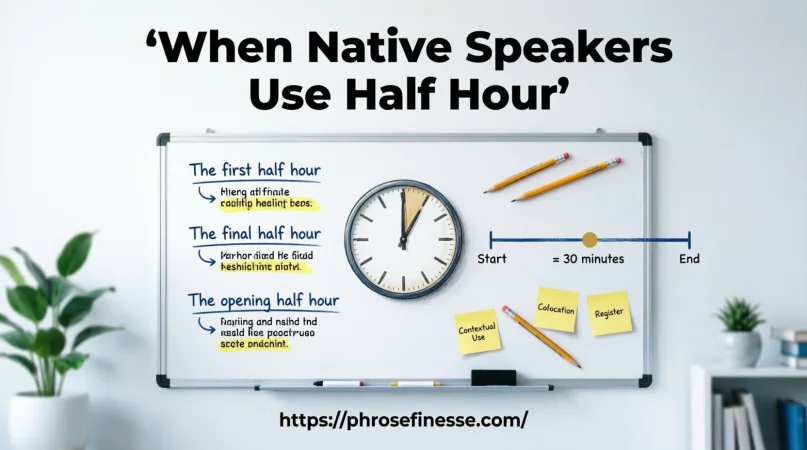
You’ll frequently hear half hour when referring to a segment of time.
Examples:
- The first half hour was chaotic.
- The final half hour felt longer than expected.
- The opening half hour generated excitement.
Notice the pattern.
The phrase points to a particular section rather than a duration.
Similar Time Expressions That Follow the Same Pattern
English contains several related expressions.
Learning them helps reinforce the rule.
Quarter of an Hour
Meaning:
15 minutes
Example:
- We waited for a quarter of an hour.
An Hour and a Half
Meaning:
90 minutes
Example:
- The trip took an hour and a half.
Half a Day
Meaning:
Approximately 12 hours.
Example:
- The project required half a day.
Half a Minute
Meaning:
30 seconds.
Example:
- Give me half a minute.
Half a Second
Meaning:
A very short period.
Example:
- She hesitated for half a second.
Pattern Table
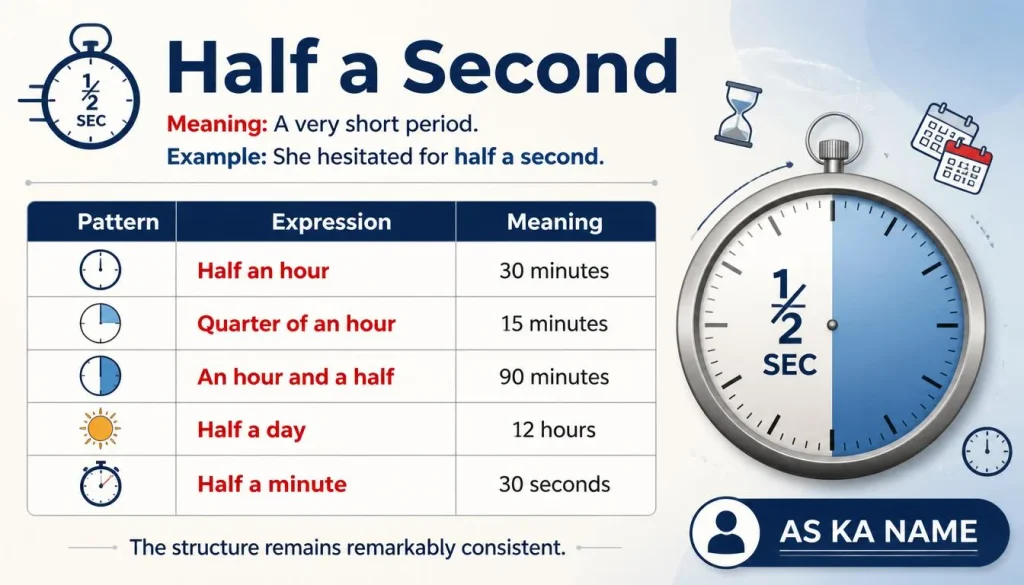
| Expression | Meaning |
| Half an hour | 30 minutes |
| Quarter of an hour | 15 minutes |
| An hour and a half | 90 minutes |
| Half a day | 12 hours |
| Half a minute | 30 seconds |
The structure remains remarkably consistent.
Why This Grammar Rule Exists
The history behind the expression is surprisingly logical.
English inherited many time-related structures from older forms of the language.
Over centuries, speakers naturally developed phrases such as:
- half a day
- half a year
- half an hour
The article remained because the phrase refers to a fractional portion of a larger unit.
Think of it this way:
Half an hour literally means half of an hour.
That underlying structure explains why the article survives today.
Quick Reference Chart
If you’re still unsure which version to choose, use this chart.
| Situation | Correct Choice |
| Describing duration | Half an hour |
| After “for” | Half an hour |
| After “in” | Half an hour |
| Before a noun | Half-hour |
| Referring to a specific time segment | Half hour |
| Formal business writing | Half an hour / Half-hour |
| Casual conversation | Half an hour |
Case Study: How One Small Hyphen Changes Meaning
Consider these sentences:
Sentence A
We had a half-hour meeting.
Sentence B
We had a meeting for half an hour.
The meaning is nearly identical.
However, the grammar differs.
In Sentence A, half-hour modifies meeting.
In Sentence B, half an hour describes duration.
Understanding this distinction helps writers create cleaner, more professional sentences.
Expert Grammar Insight
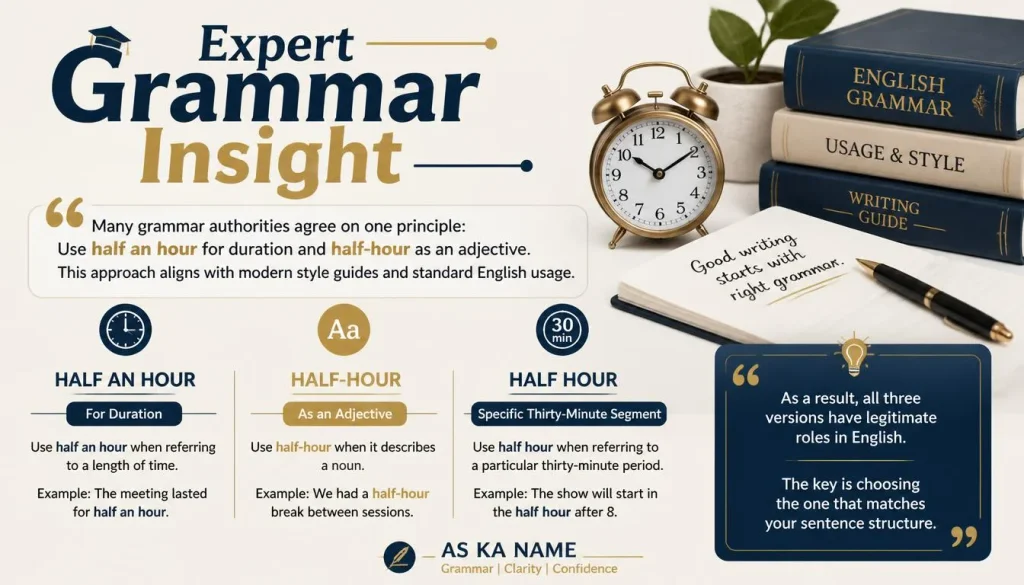
Many grammar authorities agree on one principle:
Use half an hour for duration and half-hour as an adjective.
This approach aligns with modern style guides and standard English usage.
The form half hour remains acceptable when referring to a particular thirty-minute segment.
As a result, all three versions have legitimate roles in English.
The key is choosing the one that matches your sentence structure.
FAQs
1. Is “half an hour” grammatically correct?
Yes. Half an hour is the standard and grammatically correct expression when referring to a duration of 30 minutes. For example, The meeting lasted half an hour.
2. When should I use “half-hour” instead of “half an hour”?
Use half-hour (with a hyphen) when it acts as a compound adjective before a noun. For example, we had a half-hour presentation. The hyphen shows that the words work together to describe the noun.
3. Is “half hour” without a hyphen correct?
Yes, but only in certain contexts. Half hour can be used as a noun phrase in some informal or fixed expressions, such as the half hour before lunch. However, when it modifies a noun directly, half-hour with a hyphen is the preferred form.
4. Which is better for formal writing: “half an hour” or “half-hour”?
Both are correct in formal writing, but they serve different purposes. Use half an hour for a time duration and half-hour as an adjective before a noun. Choosing the correct form improves grammar, clarity, and consistency.
5. Do native English speakers use both expressions?
Yes. Native speakers frequently use both. Half an hour is far more common when talking about time, while half-hour is regularly used in phrases like a half-hour meeting, a half-hour break, or a half-hour commute.
6. How can I remember the difference easily?
A simple rule is:
- Use half an hour when it stands alone as the amount of time.
- Use half-hour when it comes before a noun to describe it.
- Avoid using half hour as an adjective without the hyphen.
Conclusion
The difference between “half an hour” and “half-hour” is straightforward once you understand their roles in a sentence. Half an hour refers to a duration of 30 minutes, while half-hour functions as a compound adjective describing a noun.
Using the correct form makes your English usage more accurate and your business communication, formal writing, and everyday conversations clearer. By following these simple grammar rules and reviewing the examples in this guide, you can confidently choose the right expression every time

Mia Rose is an English language specialist and editorial writer at Phrase Finesse, where she helps readers master grammar, vocabulary, spelling, and effective communication. Passionate about making English simple and practical, she creates well-researched, reader-friendly content that explains complex language concepts in a clear and engaging way.
With extensive experience in English language education, content writing, and editorial review, Mia specializes in grammar, punctuation, word choice, idioms, confusing word pairs, and writing style. Her articles are carefully researched, fact-checked, and designed to help students, professionals, writers, and English learners build confidence in both written and spoken English.



[…] See More : Half an Hour vs. Half Hour: Which Is Correct? […]