Have you ever paused during a family introduction and wondered what to call your wife’s sister’s husband without sounding unsure? Finding the right family relationship term can be confusing, especially when English doesn’t always provide a commonly used everyday word for every connection.
This guide on What to Call Your Wife’s Sister’s Husband? explains the correct kinship term, its meaning, and how to use it naturally in conversations.
Understanding family titles and relationship vocabulary improves your English usage, grammar, and confidence in both casual and formal writing. While some relationships have simple names like brother-in-law or sister-in-law, others require more explanation.
This article explores the proper terminology, common expressions, and real-life examples to help you communicate with greater clarity, consistency, and accuracy.
Whether you are writing a message, preparing for business communication, organizing meetings, managing a calendar, or simply improving your everyday language skills, choosing the right words matters.
Just like scheduling, online booking, broadcasting, and project management require precise communication, family relationships also depend on clear terms. By the end of this article, you’ll understand the correct way to refer to your wife’s sister’s husband and avoid common mistakes in English grammar and formal communication.
What To Call Your Wife’s Sister’s Husband?
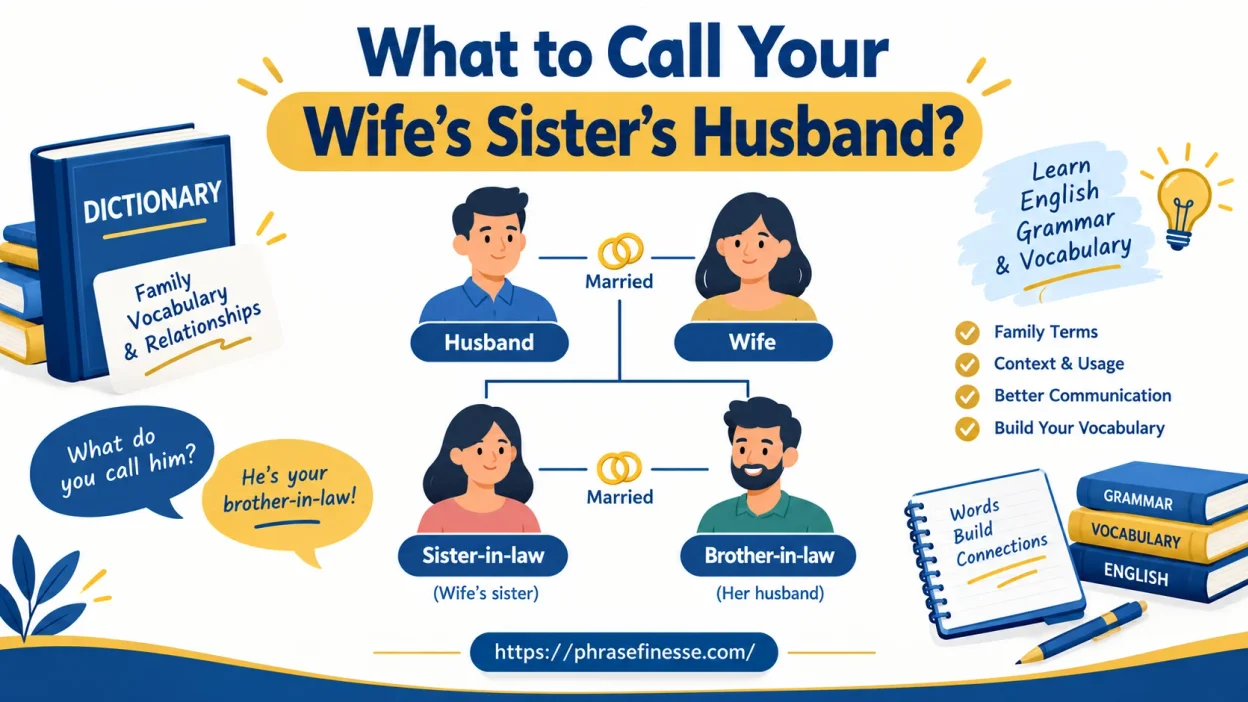
The correct term for your wife’s sister’s husband is brother-in-law.
A brother-in-law is someone connected to you through marriage rather than through blood. Since your wife’s sister becomes your sister-in-law after your marriage, her husband becomes your brother-in-law.
Here’s a simple breakdown:
| Person | Relationship to You | Correct Term |
| Your wife’s sister | Your sister-in-law | Sister-in-law |
| Your wife’s sister’s husband | Your brother-in-law | Brother-in-law |
| Your wife’s brother | Your brother-in-law | Brother-in-law |
| Your sibling’s husband | Your brother-in-law | Brother-in-law |
| Your sibling’s wife | Your sister-in-law | Sister-in-law |
So, if someone asks:
“Who is your wife’s sister’s husband?”
You can simply say:
“He’s my brother-in-law.”
That answer is accurate, natural, and widely understood.
Why Is Your Wife’s Sister’s Husband Called a Brother-in-Law?
The phrase brother-in-law combines two ideas:
- Brother — a male family connection
- In-law — a relationship created through marriage
The phrase does not mean the person is your biological brother. Instead, it shows that marriage created the family connection.
For example:
- Your wife’s brother shares a family connection with your wife.
- Your wife’s sister’s husband joins the family through marriage.
- Both relationships become “brother-in-law” relationships.
English uses broad family labels because it does not create separate words for every marriage connection.
Imagine a family tree like a web. Marriage adds new branches, but English often gives those branches the same names instead of creating hundreds of different terms.
Example Family Connection
Your Wife
|
—————-
| |
Her Sister Her Brother
| |
Her Husband |
| |
Your Brother-in-Law |
Both her brother and her sister’s husband have the same English label, even though the connection forms differently.
What Does Brother-in-Law Actually Mean?
The term brother-in-law has several accepted meanings in English.
According to standard English usage, it can refer to:
- Your spouse’s brother
- Your sibling’s husband
- Your spouse’s sister’s husband
This flexibility sometimes causes confusion.
For example:
“My brother-in-law is visiting this weekend.”
A listener might wonder:
- Is he your wife’s brother?
- Is he your sister’s husband?
- Is he your wife’s sister’s husband?
The sentence is correct, but it does not explain the exact relationship.
When the specific connection matters, add more details:
“My wife’s sister’s husband is visiting this weekend.”
or:
“My brother-in-law, who is married to my wife’s sister, is visiting.”
Common Alternatives to Brother-in-Law
Although brother-in-law is the official term, people use several alternatives depending on the situation.
Some options sound more natural in everyday conversations because family relationships are often personal rather than formal.
My Wife’s Sister’s Husband
The phrase “my wife’s sister’s husband” is the clearest descriptive alternative.
It removes all confusion because it explains exactly how the person is connected to you.
Example:
“My wife’s sister’s husband owns a restaurant downtown.”
Someone hearing this immediately understands the relationship.
This phrase works best when:
- You are explaining the relationship to someone unfamiliar with your family.
- You need complete clarity.
- You are writing something formal.
However, it feels longer than saying “brother-in-law.”
In everyday speech, most people would shorten it.
Instead of:
“I’m going to my wife’s sister’s husband’s house.”
Most people would say:
“I’m going to my brother-in-law’s house.”
My Sister-in-Law’s Husband
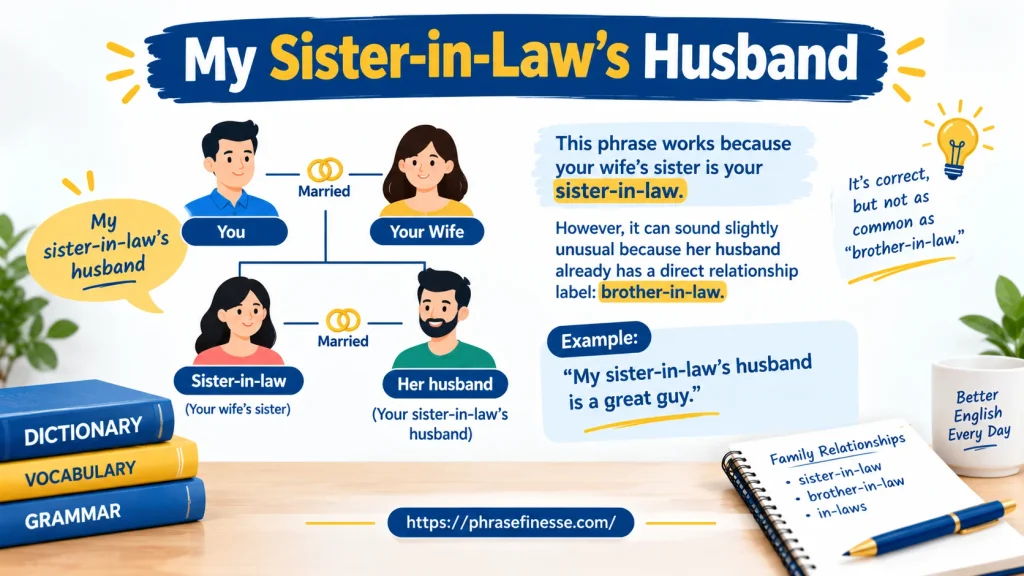
Another possible description is “my sister-in-law’s husband.”
This phrase works because your wife’s sister is your sister-in-law.
However, it can sound slightly unusual because her husband already has a direct relationship label: brother-in-law.
Compare:
Natural:
“My brother-in-law is coming over.”
Less common:
“My sister-in-law’s husband is coming over.”
Both are understandable, but the first option sounds smoother.
My In-Law
Some people use the shorter phrase “my in-law” when the exact relationship is not important.
For example:
“One of my in-laws invited us for dinner.”
This works in general conversations.
However, in-law is a broad term. It could mean:
- Mother-in-law
- Father-in-law
- Sister-in-law
- Brother-in-law
- Other relatives connected through marriage
Because of that, avoid using it when someone needs specific information.
Example:
❌ “My in-law is visiting.”
The listener may ask:
“Which in-law?”
Better:
✅ “My brother-in-law is visiting.”
See More : Joiners vs. Joiners: Which Is Correct?
Family Member
Sometimes the simplest option is the best.
If the exact relationship does not matter, you can say:
- “He’s part of my family.”
- “He’s an extended family member.”
- “He’s a relative by marriage.”
These phrases focus on the relationship rather than the technical title.
For example:
“John is part of our extended family.”
This sounds warm and natural, especially when speaking with people who already know him.
Using His First Name
In real-life conversations, many people simply use the person’s name.
Families often stop focusing on formal titles after they become close.
For example:
Instead of:
“I’m meeting my wife’s sister’s husband.”
You might simply say:
“I’m meeting David for dinner.”
This happens because relationships become personal over time. A title explains the connection, but a name reflects the actual relationship.
Can You Call Your Wife’s Sister’s Husband Your Brother?
Yes, but only in an informal sense.
Some people call close relatives by marriage “brother” to show affection and trust.
For example:
“He’s like a brother to me.”
This does not mean he is your biological brother. It shows emotional closeness.
Many cultures use family terms this way. A person may call a close friend “brother” or “sister” even without a legal or biological connection.
However, if you are describing the relationship accurately, brother-in-law remains the correct term.
Casual Ways To Refer To Your Wife’s Sister’s Husband
Family relationships often develop beyond official labels. Your brother-in-law may also become your:
- Friend
- Travel partner
- Business partner
- Sports buddy
- Trusted family member
The best word depends on your relationship.
Friend
If you have a close friendship, you might say:
“My brother-in-law is one of my closest friends.”
This describes both the family connection and the personal bond.
Buddy
In casual American English, “buddy” works well.
Example:
“I’m going fishing with my brother-in-law this weekend.”
or:
“My brother-in-law is my golf buddy.”
Like a Brother
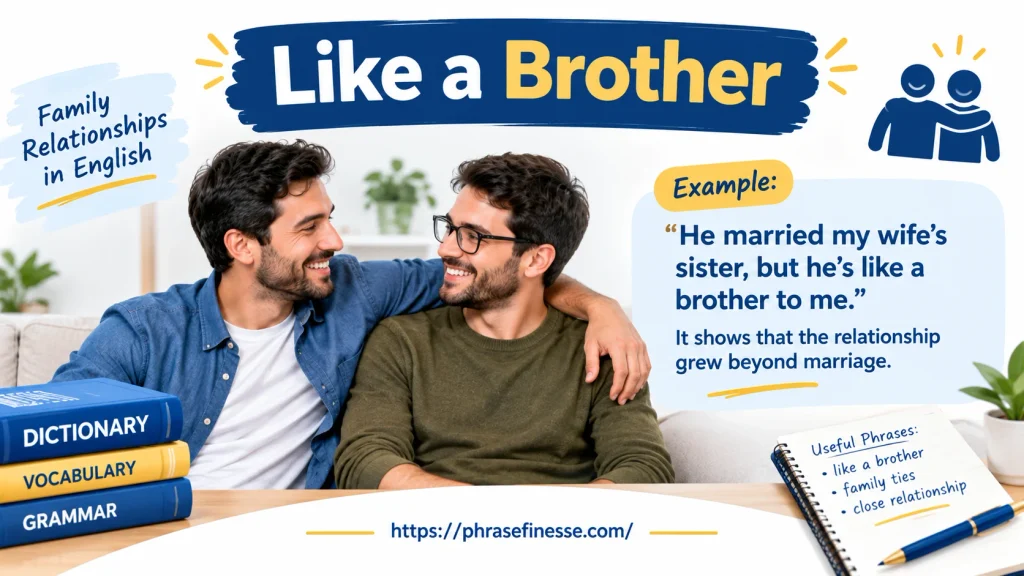
This phrase highlights emotional closeness.
Example:
“He married my wife’s sister, but he’s like a brother to me.”
It shows that the relationship grew beyond marriage.
Brother-in-Law vs. Wife’s Sister’s Husband: Understanding the Difference
Many people confuse the relationship because “brother-in-law” covers multiple family connections.
Here is the difference:
| Description | Relationship |
| Wife’s sister | Sister-in-law |
| Wife’s sister’s husband | Brother-in-law |
| Wife’s brother | Brother-in-law |
| Husband’s sister | Sister-in-law |
| Sister’s husband | Brother-in-law |
The word does not change based on whether the connection comes from your spouse’s sibling or your sibling’s spouse.
Is Your Wife’s Sister’s Husband a Blood Relative?
No. Your wife’s sister’s husband is not your blood relative.
He becomes your family member through marriage.
There are two major types of family relationships:
| Type | Example |
| Blood relationship | Parent, sibling, child |
| Marriage relationship | Brother-in-law, mother-in-law, sister-in-law |
A brother-in-law is a legal and social family connection, not a biological one.
How Different Cultures Name In-Law Relationships
English is relatively simple when compared with many other languages.
Some cultures have specific words for different in-law relationships. They may distinguish between:
- Wife’s sister’s husband
- Husband’s brother’s wife
- Older or younger relatives
- Family position and age
For example, some Asian and South Asian languages use separate terms based on:
- Gender
- Age
- Side of the family
- Marriage connection
English usually simplifies these relationships.
Instead of creating separate words, English speakers rely on explanations:
“My wife’s sister’s husband.”
or:
“My brother-in-law.”
When Should You Use Brother-in-Law Instead of a Longer Description?
In most situations, brother-in-law is the best choice.
Use it when:
- Introducing someone casually
- Talking about family events
- Writing everyday messages
- Speaking with friends
Examples:
“My brother-in-law is coming to Thanksgiving.”
“I visited my brother-in-law last weekend.”
Use a longer description when:
- Someone does not know your family structure.
- You need to explain exactly who you mean.
- You are writing a detailed family history.
Real-Life Example: Choosing the Right Term
Imagine you are telling a coworker about your weekend.
Situation 1: Casual Conversation
“My brother-in-law came over for dinner.”
Perfect. The relationship does not need more explanation.
Situation 2: Introducing Him at an Event
“This is my brother-in-law, Alex. He’s married to my wife’s sister.”
Clear and friendly.
Situation 3: Writing a Family Document
“Alex is the husband of my wife’s sister.”
A more detailed description works better.
The best term depends on your audience.
FAQs
1. What do you call your wife’s sister’s husband?
Your wife’s sister’s husband is usually called your brother-in-law. The term brother-in-law commonly refers to several family relationships, including your spouse’s sibling and your sibling’s spouse. In everyday English, you can also simply refer to him as your wife’s sister’s husband if more clarity is needed.
2. Is my wife’s sister’s husband my brother-in-law?
Yes, your wife’s sister’s husband can be considered your brother-in-law. However, this relationship is created through marriage rather than a direct sibling connection. English often uses the same family relationship term for multiple in-law relationships.
3. Does English have a specific word for my wife’s sister’s husband?
No, English does not have a separate word specifically for your wife’s sister’s husband. Unlike some languages that have unique terms for every family connection, English uses broader terms like brother-in-law to describe this relationship.
4. Can I call my wife’s sister’s husband my brother?
You can casually call him your brother, especially if you have a close relationship, but the more accurate term is brother-in-law. Using the correct kinship term helps maintain clarity in both personal conversations and formal writing.
5. What is the difference between a brother-in-law and a brother?
A brother is a male sibling connected by birth or adoption, while a brother-in-law is connected through marriage. Your wife’s sister’s husband falls into the second category because your relationship exists through family ties created by marriage.
6. How should I mention my wife’s sister’s husband in formal situations?
In formal communication, it is best to use his name or clearly describe the relationship if needed. For example, you can say, “My brother-in-law attended the meeting,” or “My wife’s sister’s husband joined us.” Choosing precise language improves English usage, clarity, and consistency.
Conclusion
Knowing what to call your wife’s sister’s husband helps you communicate family relationships more clearly and confidently. In most situations, the correct term is brother-in-law, although the exact meaning can depend on the context. Since English does not have a unique word for every family connection, understanding how kinship terms work makes everyday conversations easier.
Whether you are improving your grammar, writing a message, or practicing better English usage, using accurate relationship words creates stronger communication. Just as clear language matters in business communication, formal writing, and professional settings, it also matters when describing personal connections.
Now that you understand this family relationship term, you can confidently explain the connection without confusion. The next time someone asks about your wife’s sister’s husband, you’ll know the correct and natural way to describe him.

Emma Brooke is an English language specialist, editor, and content writer at Phrase Finesse, where she helps readers develop stronger writing and communication skills through clear, practical, and engaging content. With a passion for the English language, she specializes in simplifying grammar rules, vocabulary, spelling, punctuation, and word usage for learners at every level.
Emma has extensive experience creating educational content that is accurate, well-researched, and easy to understand. She is particularly skilled at explaining confusing word pairs, grammar concepts, idioms, sentence structure, and effective writing techniques, making complex topics approachable for students, professionals, educators, and English learners worldwide.