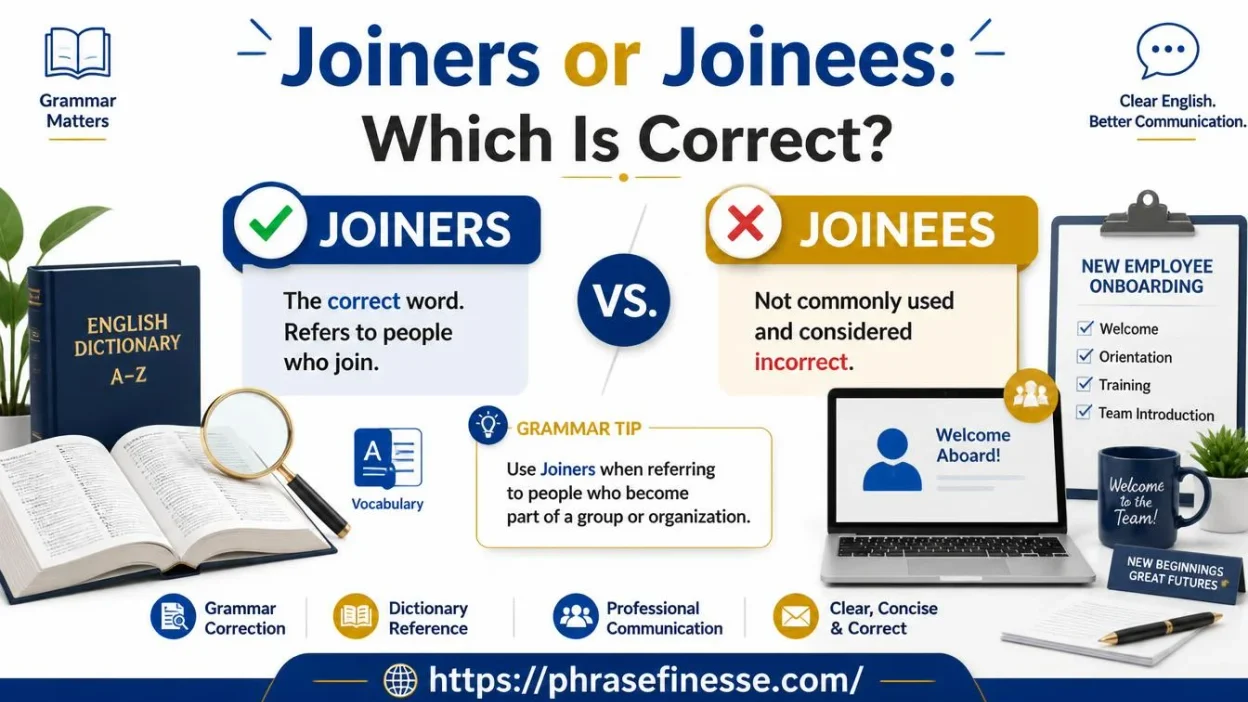
Have you ever wondered whether “Joiners” or “Joinees” is the right word to use in professional conversations? Many people encounter this confusion while writing business communication, preparing formal writing, or discussing new employees joining an organization.
The question “Joiners vs.Joinees: Which Is Correct?” often appears in workplace contexts, especially when creating reports, emails, meetings notes, or project management documents where accurate English usage and grammar matter.
Understanding the difference between joiners and joinees helps you choose the right term for different situations. While one word may sound common in certain regions or industries, the other may follow more standard English grammar patterns.
This article will explain the meaning, usage, and practical differences between these workplace terms with clear examples. You’ll also learn how these words fit into professional communication, scheduling, time management, recruitment processes, and everyday office language.
Whether you are writing a company announcement, updating a calendar, managing online booking details, or preparing internal broadcasting messages, using the correct terminology improves clarity and consistency. In this guide, we’ll explore the correct usage of joiners and joinees, common mistakes, and expert tips to make your writing more precise, natural, and effective in modern professional settings.
Joiner in American English
American English speakers usually understand the word joiner, but they don’t commonly use it for employees.
Instead, they prefer:
- New hire
- New employee
- Recently hired employee
- New team member
For example:
American workplace style:
We hired five new employees this month.
British workplace style:
We welcomed five new joiners this month.
Both sentences communicate the same idea.
The difference is mainly about regional preference.
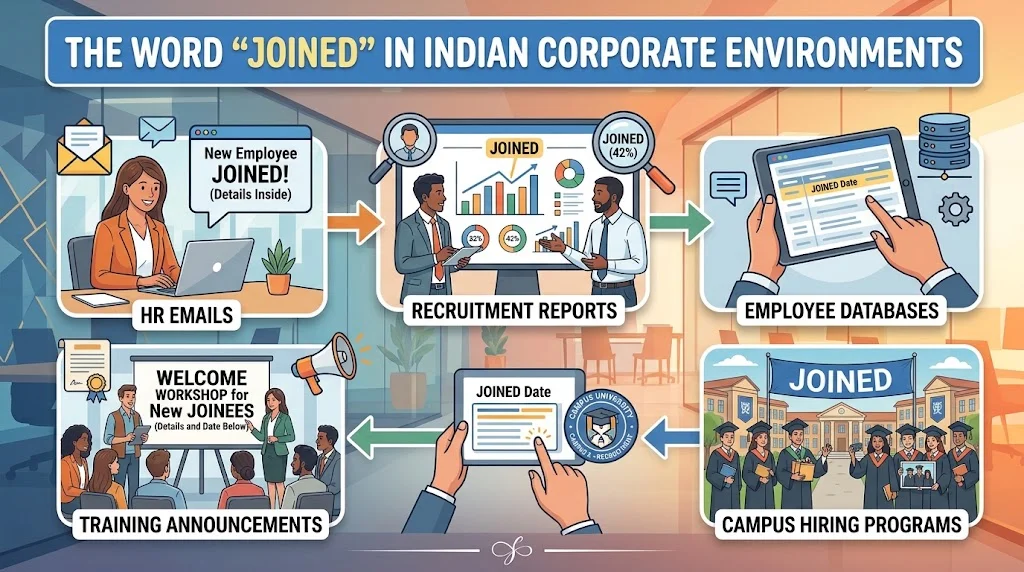
Joinee in Indian English
The word joinee is especially common in Indian corporate environments.
Many companies use it in:
- HR emails
- Recruitment reports
- Employee databases
- Training announcements
- Campus hiring programs
Examples:
All new joinees must complete the compliance training.
The HR department prepared onboarding schedules for fresh joinees.
In these contexts, most employees understand the meaning immediately.
However, outside Indian English, the word may sound unusual.
Why Did “Joinee” Become Popular in Corporate Language?
The rise of joinee is closely connected with modern workplace communication.
Large companies often need simple labels for different employee groups.
For example, HR teams may categorize employees as:
- New joinees
- Existing employees
- Former employees
- Internal transfers
The term provides a quick way to identify recently added members of a company.
Imagine an HR spreadsheet with thousands of employees. A short label like “joinee” feels convenient.
Instead of:
Employees who joined the company during the first quarter
A company may write:
Q1 joinees
This saves space and creates an easy internal category.
Joiner vs Joinee: Examples in Real Sentences
Understanding words becomes easier when you see them in context.
Examples Using Joiner
Example One:
The company organized a training program for new joiners.
Meaning:
Employees who recently joined the company need training.
Example Two:
Every joiner receives an employee handbook during onboarding.
Meaning:
Every new employee gets important workplace information.
Example Three:
New joiners should meet their managers before starting their projects.
Meaning:
Recently hired employees should connect with their supervisors.
Examples Using Joinee
Example One:
The HR team welcomed 50 new joinees this month.
Meaning:
The HR team welcomed 50 newly hired employees.
Example Two:
All joinees must submit their documents before joining day.
Meaning:
All newly selected employees must provide required paperwork.
Example Three:
The company arranged a special orientation session for fresh joinees.
Meaning:
The company created an introduction program for recently hired employees.
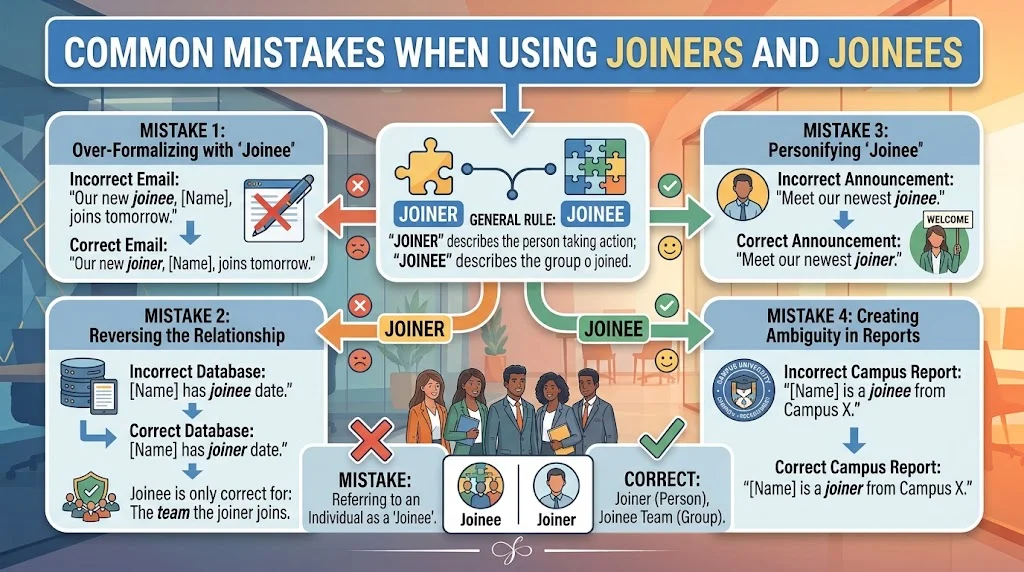
Common Mistakes When Using Joiners and Joinees
Choosing the wrong term usually doesn’t create a serious misunderstanding. However, it can make your writing sound less natural.
Here are common mistakes to avoid.
Mistake: Using Joinee in Global Professional Writing
A common mistake is assuming joinee works everywhere because it is common in one region.
For example:
Dear joinees, please complete your onboarding forms.
This may be understood in India.
However, for an international audience, a better option would be:
Dear new employees, please complete your onboarding forms.
or:
Dear new team members, please complete your onboarding forms.
The second version sounds more natural globally.
Mistake: Thinking Joiner Only Means Employee
Although companies often use joiner for new employees, the word has broader meanings.
For example:
She is a joiner who participates in many community activities.
Here, joiner means someone who enjoys becoming part of groups.
Another example:
The club gained 200 new joiners this year.
Here, it refers to new members.
The meaning depends on the situation.
Mistake: Using Informal Terms in Formal Documents
Corporate communication requires careful word choice.
An internal chat message can use casual language.
A legal document, company policy, or official report should use clearer terms.
Compare:
Informal Internal Message:
Welcome our new joinees!
Formal Announcement:
We welcome our newly hired employees.
The second option works better in professional documents.
Better Alternatives to Joinee in Professional Writing
If your audience includes international readers, replacing joinee with a clearer term is usually better.
Here are some alternatives:
| Instead of “Joinee” | Use This |
| New joinee | New employee |
| Fresh joinee | Recent hire |
| New joinees list | New employee list |
| Joinee information | Employee information |
| Joinee orientation | New employee orientation |
These alternatives sound natural in most English-speaking workplaces.
See More : Do You Work “In” Or “At” A Company? The Grammar Guide
When Should You Use Joiner?
Use joiner when:
- Writing for a British audience
- Communicating with international teams
- Referring to someone who recently became part of a group
- Using workplace English where the term is accepted
Examples:
✅ Good:
The new joiners will attend a company introduction session.
✅ Good:
We created a guide to help new joiners understand company policies.
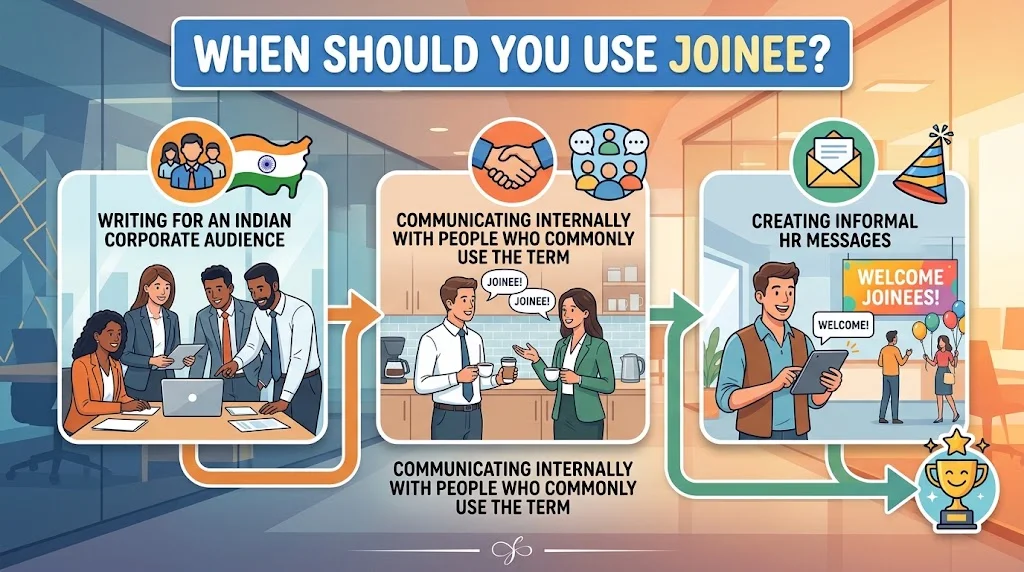
When Should You Use Joinee?
Use joinee when:
- Writing for an Indian corporate audience
- Communicating internally with people who commonly use the term
- Creating informal HR messages
Examples:
✅ Common in Indian workplaces:
New joinees will receive their ID cards tomorrow.
However, for global communication, consider replacing it.
Case Study: Choosing the Right Word in a Global Company
Imagine a technology company with offices in India, the United States, and the United Kingdom.
The HR team wants to announce new employees.
The Indian office writes:
Welcome our new joinees joining the engineering team.
Employees understand the message.
The UK office writes:
Welcome our new joiners joining the engineering team.
This also sounds natural.
The US office writes:
Welcome our new hires joining the engineering team.
This matches American workplace style.
All three versions communicate the same idea.
The difference is not meaning. It is audience and language preference.
For websites, blogs, and professional resources, choosing widely understood language matters.
Search engines consider user experience. Content should match how people naturally search and understand information.
For a global audience, these terms usually perform better:
- New employee
- New hire
- New team member
- Recently hired employee
However, if your audience searches specifically for:
- “new joinee meaning”
- “joinee vs joiner”
- “joiners or joinees”
then explaining both terms helps readers find the answer.
A strong article should include both words naturally.
FAQs
1. Which is correct: joiners or joinees?
Both joiners and joinees are used in workplace contexts, but joiner is the more widely accepted and standard English term. It refers to a person who joins an organization, group, or activity. Joinee is commonly used in Indian English, especially in recruitment and corporate communication, but it is less common in standard international English usage.
2. What does the word joiner mean?
A joiner is someone who becomes part of a group, organization, company, or event. In professional settings, it usually refers to a new employee who has recently joined a company. For example: “The new joiners will attend the orientation session on Monday.”
3. Is joinee a grammatically correct word?
Joinee is understandable and frequently used in some business environments, especially in South Asian workplaces. However, many native English speakers consider it a less natural formation. Standard English usually prefers alternatives like new employee, new hire, or person who joined.
4. Can I use joiners in formal writing?
Yes, you can use joiners in many professional situations. However, the best choice depends on your audience and industry. For international formal writing, terms like new hires, new employees, or recent recruits may sound more natural and widely accepted.
5. What is the difference between a joiner and a joinee?
The main difference is usage and acceptance. A joiner follows common English word formation rules and describes someone who joins something. A joinee is a newer workplace term that describes someone who has joined an organization but is mainly used in specific regional business environments.
| Term | Meaning | Common Usage |
| Joiner | A person who joins a group, company, or activity | Global English usage |
| Joinee | A person who has recently joined an organization | Mainly corporate Indian English |
6. Should companies use joiners or joinees in HR documents?
For HR documents, recruitment emails, and official announcements, companies should usually prefer new hires, new employees, or joiners. These terms are clearer for international audiences and improve professional business communication.
7. Why do people use the word joinee?
People often use joinee because it follows a pattern similar to words like employee or trainee. In some workplaces, especially recruitment departments, it has become a common term for tracking newly hired employees during onboarding processes.
8. What are better alternatives to joinee?
Depending on the context, you can replace joinee with:
- New employee
- New hire
- Recent recruit
- Incoming employee
- New team member
- New staff member
These alternatives are often more natural in professional English usage.
9. Are joiners and joinees used in recruitment processes?
Yes, both terms may appear in recruitment and onboarding workflows. Companies often use these words when discussing scheduling, joining dates, training sessions, and employee orientation. However, global organizations usually prefer clearer terms such as new hires or incoming employees.
10. Which word should I use in professional emails: joiner or joinee?
For professional emails, joiner is generally a safer choice than joinee. If you want your message to sound natural for a worldwide audience, phrases like new employee or new team member are even better.
Conclusion
Choosing between joiners and joinees depends on your audience, industry, and communication style. While joiners follows standard English grammar and is widely understood, joinee is mainly used in certain workplace environments and regional business settings. Understanding this difference helps you communicate more effectively in professional situations.
In modern workplaces, accurate word choice matters across emails, formal writing, meetings, recruitment updates, and project management communication. Using clear terms such as new hire, new employee, or joiner can improve professionalism and maintain consistency in your workplace language.
So, when you ask “Joiners Or Joinees: Which Is Correct?”, the answer is simple: joiner is the more universally accepted term, while joinee is a regional workplace expression. Choose the word that best fits your audience, and your communication will remain clear, professional, and grammatically effective.



[…] See More : Joiners vs. Joiners: Which Is Correct? […]
[…] See More : Joiners vs. Joiners: Which Is Correct? […]
[…] Read More : Joiners vs. Joiners: Which Is Correct? […]