Here’s a polished three-paragraph introduction designed to satisfy search intent, establish topical relevance, and keep the keyword usage natural.Have you ever wondered what you should call someone who is staying at a hotel? The answer isn’t always as simple as hotel guest. Depending on the situation, you may encounter terms such as lodger, resident, occupant, or guest. In this guide to Five Correct Names for People Staying at a Hotel, you’ll learn what each term means and when it fits naturally. Understanding these distinctions can make your English usage, grammar, and formal writing much more precise.
The right word can also depend on the context. Hotel staff may use different terminology for guests, occupants, or residents when handling online booking, scheduling, check-in records, or customer requests. Similarly, clear wording matters in business communication, meetings, calendar planning, and travel-related documents. Choosing the most accurate term helps you communicate your meaning without creating unnecessary confusion.
Throughout this article, we’ll explore five accurate names for people staying at a hotel. You’ll see clear definitions, practical examples, and context-based explanations for each term. We’ll also clarify which words sound natural in everyday conversation and which suit more formal writing. Whether you’re working in hospitality, managing time management tasks, handling project management, or simply improving your vocabulary, this guide will help you use these terms with confidence and consistency.
Quick Answer
The most correct and natural name for someone staying at a hotel is “guest.” Depending on the context, you can also use hotel guest, lodger, patron, or resident.
| Term | Best Use | How Natural Is It? |
| Guest | Someone staying at a hotel | ⭐⭐⭐⭐⭐ |
| Hotel guest | A specific hotel occupant | ⭐⭐⭐⭐⭐ |
| Lodger | Someone receiving temporary accommodation | ⭐⭐⭐ |
| Patron | A customer using a business or service | ⭐⭐ |
| Resident | Someone staying or living somewhere long-term | ⭐⭐ |
For everyday English, use “guest.” If you need to make the hotel context explicit, use “hotel guest.”
What Do You Call Someone Staying at a Hotel?
The standard word for a person staying at a hotel is guest.
For example:
“The guest asked the front desk for an extra towel.”
This sentence sounds completely natural in American English. You don’t need to say hotel resident or hotel occupant unless a specific context requires it.
The word guest has a broader meaning in English. It can describe someone invited into your home, someone attending an event, or someone staying at a commercial accommodation business.
Hotels traditionally use guest because the word emphasizes the person’s relationship with the establishment. The person isn’t merely occupying a room. They’re receiving accommodation and hospitality.
Is “Hotel Guest” the Correct Term?
Yes. Hotel guest is a clear and standard expression.
The phrase simply combines hotel with guest to remove any possible ambiguity.
Compare these examples:
- “The guest checked in at 3 p.m.”
- “The hotel guest checked in at 3 p.m.”
- “All guests must present identification.”
- “All hotel guests must present identification.”
All four can work. The shorter version usually sounds more natural when everyone already knows you’re discussing a hotel.
5 Correct Names for People Staying at a Hotel
Several English words can describe someone associated with hotel accommodation. However, their meanings aren’t identical.
The key is understanding what each word emphasizes.
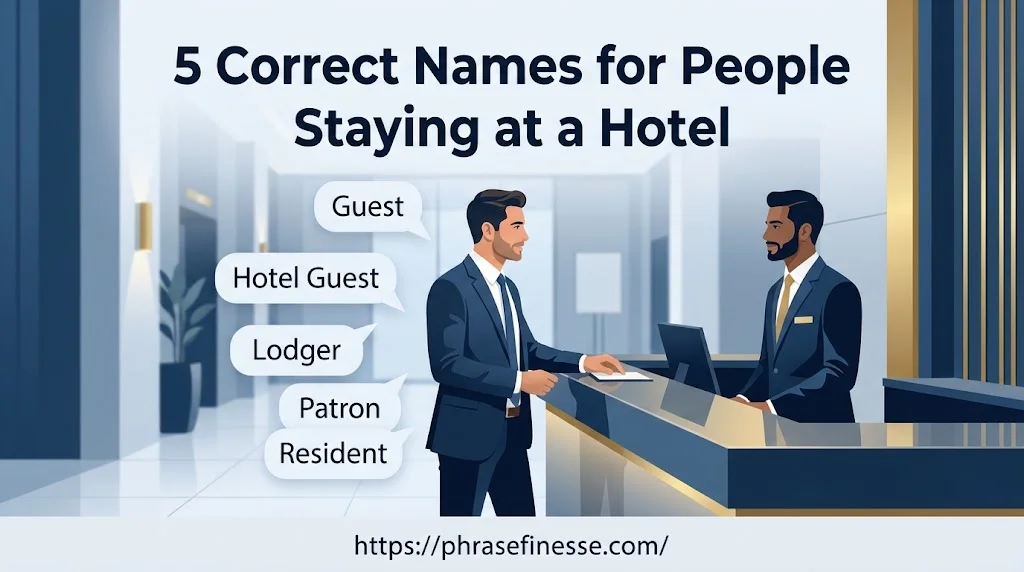
The five useful terms are:
- Guest
- Hotel guest
- Lodger
- Patron
- Resident
Let’s examine each one closely.
Guest
Guest is by far the best general term for someone staying at a hotel.
If you walk into a hotel and tell the receptionist, “I’m a guest here,” the meaning is immediately clear. There’s no need for a more elaborate expression.
Hotels also use guest throughout their everyday operations. You’ll see phrases such as:
- guest room
- guest services
- guest relations
- guest check-in
- guest checkout
- guest amenities
- guest information
- guest services desk
- registered guest
The word has become deeply embedded in hospitality vocabulary.
What Does “Guest” Mean at a Hotel?
In this context, a guest is a person who has accommodation at a hotel or is otherwise receiving hotel services.
The person may have booked the room personally. A company may have booked it for them. Someone else may even have paid for the reservation.
That distinction is important.
The guest is the person staying in the room. The customer can refer to the person who purchased the service.
For example:
“Sarah booked a room for James.”
Sarah may be the customer who made or paid for the reservation. James is the guest staying at the hotel.
Depending on the hotel’s booking system, Sarah could also be listed as the booking guest. Context matters.
Examples of “Guest”
Here are natural examples:
- “The guest requested a late checkout.”
- “Every guest receives a room key.”
- “The guest reported a problem with the air conditioning.”
- “Hotel staff helped the guest with her luggage.”
- “The guest left his passport at the front desk.”
- “Only registered guests can access this floor.”
Why “Guest” Is Usually the Best Choice
The word guest wins in most everyday situations because it’s:
- Natural
- Clear
- Widely understood
- Common in hospitality
- Suitable for formal and informal communication
- Specific enough for ordinary hotel conversations
If you’re unsure which word to choose, guest is the safest option.
Hotel Guest
Hotel guest is the more specific version of guest.
It means a person staying at or receiving accommodation from a hotel.
The added word hotel gives the phrase extra precision. That’s particularly useful when you’re discussing several types of guests or customers.
For example:
“The restaurant welcomes both hotel guests and outside customers.”
Here, hotel guests clearly identifies people staying at the property. Outside customers refers to people who aren’t necessarily staying there.
When Should You Use “Hotel Guest”?
Use hotel guest when the setting isn’t already obvious.
It’s especially useful in:
- Hospitality articles
- Hotel policies
- Business communication
- Customer service documentation
- Hotel management discussions
- Travel writing
- Academic writing about tourism
For example:
“Hotel guests must show their room key when requesting access to the private lounge.”
The phrase works because it identifies exactly who the policy concerns.
Examples of “Hotel Guest”
- “Every hotel guest receives complimentary Wi-Fi.”
- “The shuttle is available to registered hotel guests.”
- “Hotel guests can request additional toiletries.”
- “The restaurant offers special rates to hotel guests.”
- “Only hotel guests may enter the restricted pool area.”
Guest vs. Hotel Guest
There’s no major difference in meaning.
| Phrase | Meaning | Example |
| Guest | Someone staying at a hotel | “The guest called reception.” |
| Hotel guest | Someone specifically staying at a hotel | “The hotel guest called reception.” |
The main difference is specificity.
When the context already makes the hotel obvious, guest usually sounds smoother. When you need precision, hotel guest works better.
Lodger
Lodger is another word connected with temporary accommodation. However, it’s much less common than guest in ordinary hotel conversations.
A lodger is generally someone who pays for and occupies accommodation in another person’s property or establishment.
The word focuses more strongly on the lodging arrangement than the hospitality relationship.
That’s why you’ll encounter lodger in certain accommodation, legal, or property-related contexts.
Is a Hotel Guest a Lodger?
Sometimes the concepts overlap, but they’re not perfect synonyms.
A hotel guest certainly receives lodging. Yet calling that person a lodger may sound unusual in normal hotel conversation.
Consider these two sentences:
“The guest asked for breakfast.”
“The lodger asked for breakfast.”
The first sounds completely ordinary in a hotel setting. The second sounds more formal and may make you picture a person renting a room in someone’s house.
When Can You Use “Lodger”?
Lodger makes more sense when the accommodation arrangement itself matters.
For example:
- A person renting a room in a private home
- Someone receiving temporary accommodation
- A property agreement involving a room
- Formal discussions about lodging arrangements
Example:
“The property owner provides a furnished room for a weekly lodger.”
That sentence naturally focuses on the accommodation relationship.
Lodger vs. Guest
| Guest | Lodger |
| Common in hotels | Less common in hotels |
| Emphasizes hospitality | Emphasizes accommodation |
| Natural in conversation | More formal or specific |
| Common hotel vocabulary | More common in lodging/property contexts |
Bottom line: lodger is a legitimate word, but guest is usually the better choice for hotels.
Patron
Patron can describe someone who uses a business or service. That means a hotel customer can technically be called a patron.
However, this word doesn’t specifically mean someone staying overnight.
That’s an important distinction.
A person could visit a hotel restaurant, attend a conference, use the spa, or purchase another service without booking a room. That person could be a patron.
What Does “Patron” Mean in a Hotel?
In hospitality or business language, patron can refer to someone who uses or supports a business.
For example:
“The hotel provides several amenities for its patrons.”
The sentence is grammatically fine. Yet it doesn’t necessarily tell you that those people are staying overnight.
Compare:
“The hotel provides several amenities for its guests.”
This sentence strongly suggests people staying at the hotel.
When Is “Patron” Appropriate?
Patron works best when you’re discussing:
- Business relationships
- Customers
- Hospitality services
- Hotel restaurants
- Events
- Formal writing
- Commercial activity
For example:
“The restaurant serves both hotel guests and outside patrons.”
That distinction is useful because the restaurant can serve people who aren’t staying at the hotel.
Why “Patron” Isn’t the Best Everyday Choice
The main problem is specificity.
If you say:
“A patron is staying in Room 412.”
The sentence sounds awkward because patron doesn’t naturally identify an overnight hotel occupant.
Instead, say:
“A guest is staying in Room 412.”
That’s much more idiomatic.
Resident
Resident can describe someone who lives or stays in a particular place. However, you shouldn’t automatically use it for every hotel guest.
Why?
Because resident usually carries a stronger sense of ongoing residence.
Someone spending two nights at a hotel is normally a guest, not a resident.
Someone living in a hotel for several months may reasonably be described as a resident, depending on the circumstances.
When Can a Hotel Guest Be Called a Resident?
The word may fit when someone has a longer-term connection with the property.
For example:
- Extended hotel stays
- Long-term accommodation
- Hotel-style residential properties
- Serviced apartments
- Residence hotels
- Situations involving tenancy or residency
Consider this example:
“The hotel accommodates several long-term residents.”
That sentence suggests something different from:
“The hotel has several guests tonight.”
The first emphasizes duration and residence. The second emphasizes temporary hospitality.
Guest vs. Resident
| Guest | Resident |
| Usually temporary | Often suggests longer-term occupancy |
| Standard hotel term | Context-dependent |
| Common for travelers | Common for people who live somewhere |
| Focuses on hospitality | Focuses on residence |
Legal definitions can also vary by jurisdiction. In some situations, a long-term hotel occupant may acquire rights or status that differ from those of an ordinary short-term guest.
Therefore, resident isn’t a universal replacement for guest.
Guest vs. Customer vs. Visitor
One of the easiest ways to understand hotel vocabulary is to compare guest, customer, and visitor.
These words overlap, but each highlights something different.
Guest
A guest is generally the person receiving hospitality or staying at the hotel.
“The guest checked into Room 305.”
Customer
A customer is someone who purchases goods or services.
A hotel’s customer could book:
- A room
- Restaurant service
- A spa treatment
- A conference package
- An event
- Transportation
- Other hotel services
Therefore, not every hotel customer is necessarily a hotel guest.
Visitor
A visitor is someone who comes to a place without necessarily staying there.
For example:
“The guest’s visitor must register at reception.”
Here, the distinction is obvious. The guest stays at the hotel. The visitor comes to see the guest.
Quick Comparison
| Term | Staying Overnight? | Main Focus |
| Guest | Usually | Staying at the hotel |
| Hotel guest | Yes | Hotel accommodation |
| Customer | Not necessarily | Purchasing services |
| Visitor | Usually not | Coming to the property |
| Patron | Not necessarily | Using or supporting the business |
| Resident | Sometimes | Living or staying long-term |
| Lodger | Often | Receiving accommodation |
This distinction prevents a surprisingly common mistake: assuming every person connected to a hotel is a guest.
What Do You Call Someone Staying in a Hotel Room?
The clearest term is hotel guest.
You could also simply say guest if the context is obvious.
For example:
“The guest in Room 214 requested housekeeping.”
That’s natural hotel English.
You could technically say:
“The occupant of Room 214 requested housekeeping.”
However, occupant sounds more administrative. It focuses on who occupies the room rather than who receives hotel hospitality.
That distinction becomes useful in certain contexts.
Guest vs. Occupant
Guest is better for:
- Customer service
- Hotel conversations
- Travel writing
- General English
Occupant can work better for:
- Security reports
- Emergency procedures
- Administrative documents
- Technical descriptions
For example:
“Emergency personnel should verify whether any occupants remain inside.”
In an emergency procedure, occupants makes sense because the document focuses on physical presence rather than hospitality status.
What Is the Plural of “Hotel Guest”?
The plural of hotel guest is hotel guests.
Simply add -s to guest.
Examples
- “The hotel has 250 guests.”
- “All hotel guests must follow the fire-safety instructions.”
- “The restaurant offers breakfast to hotel guests.”
- “Guests can request additional blankets.”
- “Several guests complained about the noise.”
Don’t write guest’s when you mean more than one guest.
Guest vs. Guests vs. Guest’s
| Form | Meaning | Example |
| Guest | One person | “The guest arrived.” |
| Guests | More than one person | “The guests arrived.” |
| Guest’s | Possessive singular | “The guest’s room is ready.” |
| Guests’ | Possessive plural | “The guests’ rooms are ready.” |
This small distinction matters in hotel policies and professional writing.
Common Mistakes When Referring to Hotel Guests
Although guest seems straightforward, several related words can cause confusion.
Calling Every Guest a “Resident”
A short-term hotel visitor isn’t normally called a resident.
Someone staying for two nights is a guest. Someone living in a hotel for an extended period may be considered a resident depending on the context.
Better: “Hotel guests must check out by noon.”
Less natural: “Hotel residents must check out by noon.”
The second sentence creates a contradiction because resident suggests a continuing stay.
Using “Visitor” for Someone Staying Overnight
A visitor typically comes to see someone or visit a place.
A person who has booked and occupies a hotel room is generally a guest.
For example:
“The guest’s visitor must leave by 10 p.m.”
Here, guest and visitor have distinct roles.
The guest stays there. The visitor doesn’t necessarily stay overnight.
Using “Patron” as a Direct Replacement for “Guest”
A patron is a customer or user of a business. The word doesn’t specifically identify an overnight hotel occupant.
For instance, someone eating dinner at a hotel’s restaurant could be a patron without being a hotel guest.
Therefore, use guest when accommodation is the central idea.
Assuming “Customer” Always Means “Guest”
A customer pays for or purchases a service. A guest receives hospitality or accommodation.
Those roles often overlap, but they aren’t identical.
Example
Imagine Maria books a hotel room for her colleague David.
- Maria may be the customer.
- David is the guest.
- If David stays for three months, he may also be described as a resident, depending on the circumstances.
One situation can involve several valid labels.
Using “Lodger” in Casual Hotel Conversations
There’s nothing inherently wrong with lodger. It simply isn’t the usual hotel term.
If you tell a hotel receptionist:
“I’m a lodger.”
They’ll probably understand you. Yet “I’m a guest” sounds much more natural.
Language isn’t only about grammatical correctness. Natural usage matters too.
See More : What Does “Table Something” Mean? US vs. UK Usage
Real-World Examples of the Correct Terms
A useful way to choose the right word is to imagine actual situations.
Scenario: A Traveler Checks In
John arrives at the hotel and receives his room key.
Best term: Guest
“The guest checked in at 4 p.m.”
There’s no reason to use a more complicated word.
Scenario: A Hotel Policy
The hotel wants to identify people staying at the property.
Best term: Hotel guests
“Hotel guests must present identification during check-in.”
The phrase provides clear, professional wording.
Scenario: Someone Renting a Room
A person rents a room in a private property for several weeks.
Possible term: Lodger
“The homeowner provides the lodger with a furnished bedroom.”
Here, the accommodation arrangement matters more than hotel hospitality.
Scenario: A Hotel Restaurant
Someone visits the hotel restaurant but doesn’t have a room.
Possible term: Patron or customer
“Restaurant patrons may dine without staying at the hotel.”
The person uses a hotel service without being a hotel guest.
Scenario: Long-Term Accommodation
Someone lives in a hotel-style property for an extended period.
Possible term: Resident
“Long-term residents receive access to additional services.”
The longer-term arrangement makes resident more appropriate.
Which Term Is Most Correct for Someone Staying at a Hotel?
If the question is simply “What do you call someone staying at a hotel?”, the answer is straightforward:
You call them a guest.
That’s the term to choose in ordinary conversation.
If you want to specify the setting, use:
Hotel guest
The other terms require more context.
A Practical Ranking
| Rank | Term | When to Use It |
| 1 | Guest | Almost any ordinary hotel context |
| 2 | Hotel guest | When you need extra specificity |
| 3 | Lodger | When emphasizing temporary lodging |
| 4 | Patron | When emphasizing business or service use |
| 5 | Resident | For certain extended-stay situations |
The ranking isn’t about whether a word is grammatically “correct.” It’s about naturalness and precision.
What Is the Best Word for Formal Hotel Writing?
For formal writing, hotel guest often provides the clearest wording.
For example:
“Hotel guests must comply with all property safety regulations.”
That’s precise and professional.
However, don’t assume formal writing requires longer words.
Sometimes the shorter version is better:
“Guests must comply with all property safety regulations.”
If the document already concerns hotel guests, adding hotel doesn’t improve the sentence.
Good formal writing isn’t about sounding complicated. It’s about being precise.
What Should You Call Someone Staying at a Hotel for One Night?
Call them a guest.
The duration doesn’t change the basic term.
Whether someone stays:
- One night
- Three nights
- One week
- Two weeks
they can generally be called a hotel guest.
Duration becomes important when considering terms such as resident, which may suggest a longer-term arrangement.
Can You Call Someone Staying at a Hotel a Customer?
Yes, but customer and guest emphasize different things.
A customer purchases something from the hotel. A guest stays there or receives hospitality.
For example:
“The customer booked a room online.”
This emphasizes the transaction.
“The guest requested another room.”
This emphasizes the person’s hotel stay.
Both sentences can describe the same individual. They simply spotlight different aspects of the relationship.
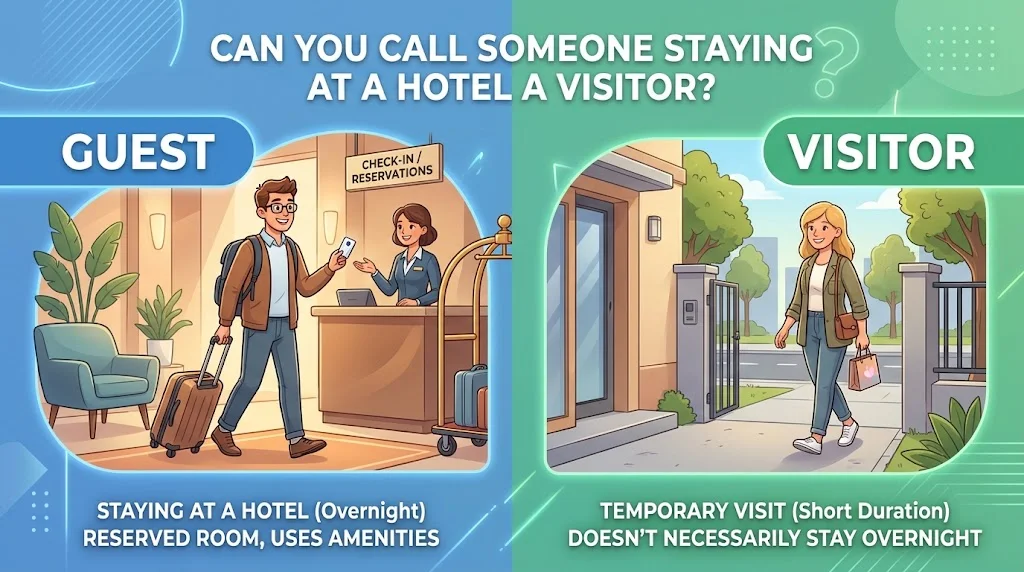
Can You Call Someone Staying at a Hotel a Visitor?
Usually, guest is better.
The word visitor generally suggests someone who comes to a location temporarily without necessarily staying there.
For example:
“Visitors must sign in at the front desk.”
That could describe someone meeting a hotel guest.
Meanwhile:
“Guests must sign in at the front desk.”
suggests people who are actually staying at the hotel.
This distinction becomes especially important in hotel security policies, where guests and visitors may have different access privileges.
Case Study: Choosing the Right Hotel Term
Consider a fictional hotel called Riverside Hotel.
Three people arrive during the same evening:
- Emma checks into Room 201 for two nights.
- Daniel visits Emma but has no room reservation.
- Sophia has lived in the hotel’s extended-stay section for four months.
How should the hotel describe them?
| Person | Best Term | Why |
| Emma | Guest | She’s staying at the hotel temporarily |
| Daniel | Visitor | He’s visiting someone without staying there |
| Sophia | Resident | Her extended stay gives “resident” more contextual relevance |
Now imagine the hotel restaurant serves all three.
The restaurant could describe them collectively as customers or patrons because they’re using its services.
This example shows why context matters. The same person can have different labels depending on what you’re describing.
Hotel Vocabulary: Related Terms You Should Know
Understanding the surrounding vocabulary makes the main distinction even clearer.
Registered Guest
A registered guest is someone officially recorded as staying at the hotel.
Example:
“Only registered guests may access the private lounge.”
Walk-In Guest
A walk-in guest arrives without making a reservation in advance.
Example:
“The hotel accepted several walk-in guests during the afternoon.”
Long-Term Guest
A long-term guest stays considerably longer than a typical traveler.
Example:
“The property offers discounted rates for long-term guests.”
Overnight Guest
An overnight guest specifically stays through the night.
Example:
“Breakfast is available to all overnight guests.”
House Guest
In some contexts, house guest can refer to someone staying in a private home. Hotels generally prefer guest or hotel guest.
A Simple Rule for Choosing the Right Word
When you’re unsure, ask yourself one question:
What aspect of the person’s relationship with the hotel am I describing?
If the answer is “They are staying here,” use guest.
If the answer is “They are specifically staying at this hotel,” use hotel guest.
If the answer is “They are receiving accommodation,” lodger may fit in certain contexts.
If the answer is “They are using or paying for a business service,” customer or patron may work.
If the answer is “They live here or stay for an extended period,” resident may be appropriate.
That simple distinction prevents most vocabulary errors.
FAQs
1. What do you call a person staying at a hotel?
The most common term is hotel guest or simply guest. A guest is someone who has booked or is temporarily staying in a hotel room. In specific contexts, terms such as lodger, occupant, or resident may also apply.
2. Is “hotel guest” the correct term?
Yes, hotel guest is the most natural and widely understood term. Hotels commonly use “guest” when referring to people who have checked in, made reservations, or are receiving hotel services. It works well in both everyday and professional communication.
3. What is another word for someone staying at a hotel?
Depending on the context, you can use lodger, occupant, resident, or guest. However, these words don’t always have identical meanings. Guest is usually the best choice for someone staying temporarily at a hotel.
4. Can you call a hotel guest a resident?
You can use resident in certain contexts, especially when someone stays at a hotel for an extended period. However, it may sound less natural for a typical short hotel stay. Guest remains the standard term for most situations.
5. What is the difference between a guest and an occupant?
A guest is generally a person receiving hospitality or staying at a hotel. An occupant simply refers to someone who occupies a room or space. Therefore, “occupant” is more neutral and administrative, while “guest” sounds more natural in hospitality and everyday English.
6. What is the best formal term for someone staying in a hotel?
Hotel guest is usually the clearest formal and professional term. In administrative documents, occupant may also be appropriate when the focus is on room occupancy rather than hospitality. The best choice ultimately depends on the specific context.
Conclusion
Knowing the right term for someone staying at a hotel can make your communication clearer and more professional. While hotel guest is the most common choice, words such as lodger, resident, and occupant can work in specific situations.
The key is to consider the context before choosing a word. For everyday conversations and most hospitality settings, guest is usually the safest and most natural option. By understanding these five terms, you can improve your English vocabulary, grammar, and confidence in both.