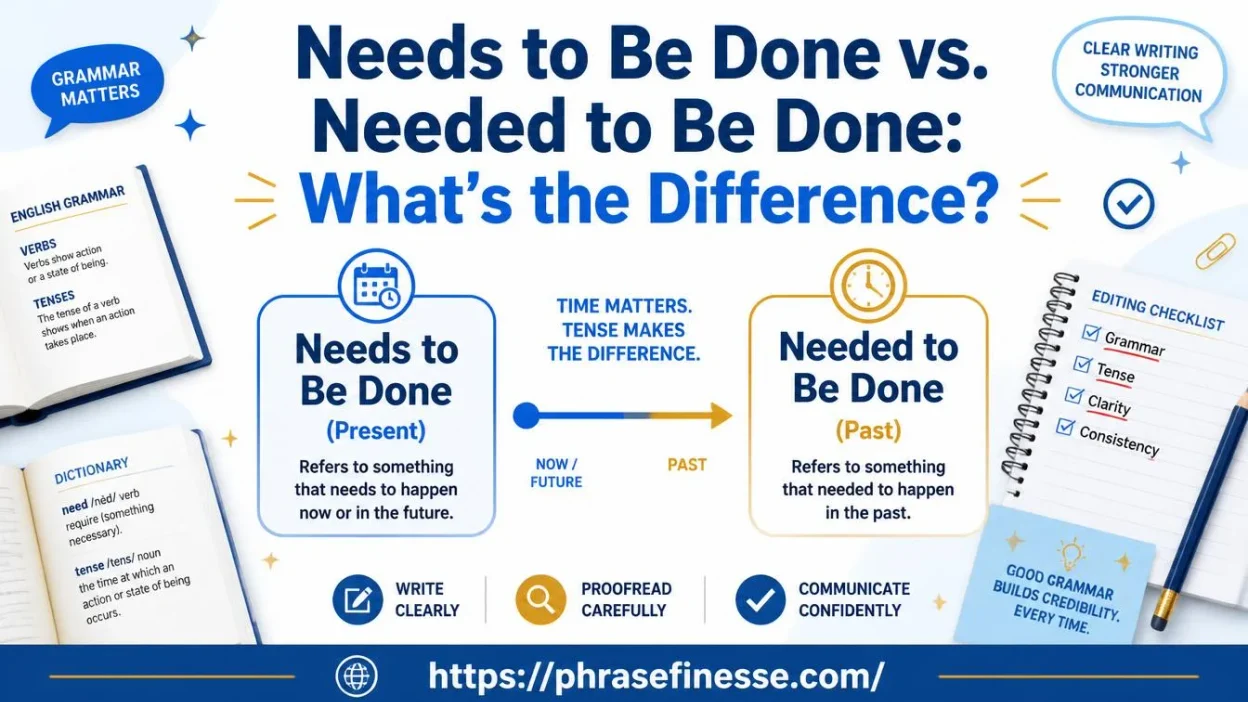
When I explain this slight difference in English usage, I usually begin with Needs to Be Done vs. Needed to Be Done: What’s the Difference?because it describes things that must be completed now or as part of an ongoing project. The verb phrase uses the auxiliary verb “needs” in the present tense, so it points to a current necessity, requirement, or obligation.
For example, if you have a list of tasks, you can say that these required tasks need to be done before completion. However, “what is needed to be done” is less natural in standard grammar and can create an ambiguous sentence. In most cases, the better phrasing and wording is “what needs to be done.” This sentence structure clearly shows the intent and context, without changing the basic meaning or interpretation.
In the first case, you simply must do these things, while the second case can imply that when the list is complete, the project will be done. That does not necessarily indicate that every task will complete the bigger project, though, because a list, its items, and the actual project scope can differ.
For the past tense, use “needed to be done” when the actions were necessary at an earlier time. This is the main distinction in correct usage and grammatical usage. The word “needed” signals a past necessity, while “needs” signals a present one.
The second sentence can therefore describe outstanding tasks that must be completed or needed to be done at that earlier point.
If your intent is to describe all outstanding tasks for a given project, you can make the sentence more explicit by saying “everything that needs to be done” or “things that must be done in order to finish this project.”
In the first sentence, the first case focuses on what remains necessary; in the second sentence, the second case focuses on what was necessary before. When using these forms, remember that “needs” and “needed” change the tense, while “done” stays the same. That simple rule makes the usage differences easier to explore, understand, and apply correctly when you use the expressions and learn how to use it in an article or everyday writing.
What Does “Needs to Be Done” Mean?
The phrase “needs to be done” describes something that is necessary now or will become necessary in the immediate future. In other words, the action hasn’t happened yet, but someone considers it required.
You will often hear this phrase in workplaces, classrooms, project meetings, emails, and daily conversations whenever someone discusses unfinished tasks.
Consider these examples:
- The report needs to be done before Friday.
- Your application needs to be done today.
- The kitchen needs to be cleaned.
- This problem needs to be solved immediately.
Each sentence refers to a task that still requires attention.
Unlike commands, “needs to be done” sounds polite and objective. Instead of telling someone what to do directly, it focuses on the task itself.
Compare the following:
| Direct Command | More Neutral Expression |
| Finish the report today. | The report needs to be done today. |
| Clean the office. | The office needs to be cleaned. |
| Fix the software. | The software needs to be fixed. |
Because of this softer tone, the phrase appears frequently in professional communication.
The Grammar Behind “Needs to Be Done”
Although the phrase looks long, its structure follows a straightforward pattern.
Formula:
Subject + needs + to be + past participle
Let’s examine each part.
| Part | Function | Example |
| Subject | The person or thing being discussed | The report |
| needs | Present tense of need | needs |
| to be | Passive infinitive | to be |
| done | Past participle | done |
Putting these elements together creates:
The report needs to be done.
Notice that done never changes because it is the past participle of do.
Only the verb need changes according to tense.
Why Is “Done” Always the Same?
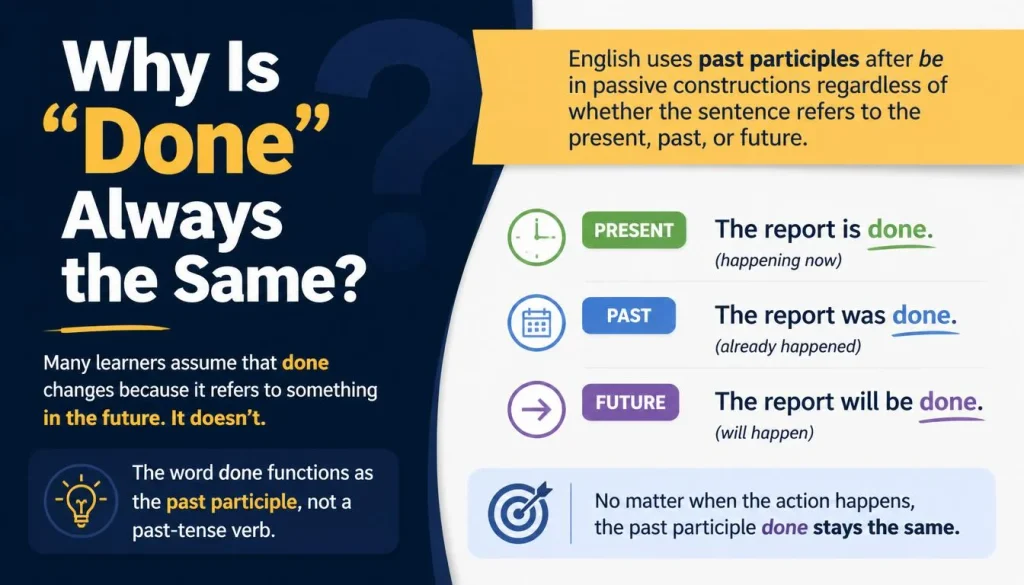
Many learners assume that done changes because it refers to something happening in the future.
It doesn’t.
The word done functions as the past participle, not a past-tense verb.
English uses past participles after be in passive constructions regardless of whether the sentence refers to the present, past, or future.
Consider these examples:
- The work needs to be done today.
- The work needed to be done yesterday.
- The work will need to be done tomorrow.
Notice how only the helping verb changes.
The word done remains exactly the same every time.
This pattern applies to many English verbs.
| Base Verb | Past Participle |
| do | done |
| write | written |
| complete | completed |
| finish | finished |
| repair | repaired |
| clean | cleaned |
| solve | solved |
Understanding this pattern makes many passive constructions easier to recognize.
When Should You Use “Needs to Be Done”?
The phrase fits situations where an action remains incomplete and someone expects it to happen.
Here are the most common situations.
Current Responsibilities
Perhaps the most common use involves work that still needs attention.
Examples:
- The invoices need to be processed today.
- Your passport application needs to be submitted this week.
- The presentation needs to be updated before tomorrow’s meeting.
In every example, the task remains unfinished.
Ongoing Projects
Businesses frequently use this expression while discussing project progress.
For example:
- Several improvements need to be made before launch.
- The final design needs to be approved.
- Additional testing needs to be completed.
The emphasis stays on unfinished work rather than the person responsible.
Maintenance and Repairs
You’ll also hear the phrase whenever something requires fixing or maintenance.
Examples include:
- The roof needs to be repaired.
- The air conditioner needs to be serviced.
- These documents need to be organized.
Again, the work hasn’t happened yet.
Daily Conversations
Outside formal settings, native speakers use this construction naturally.
Examples:
- Dinner needs to be cooked soon.
- The laundry needs to be washed.
- My phone needs to be charged.
These expressions sound far more natural than repeatedly saying someone must perform each action.
Examples of “Needs to Be Done” in Different Contexts
The phrase appears across nearly every type of English writing.
Business
- The quarterly budget needs to be reviewed before approval.
- Every invoice needs to be verified.
Education
- Your assignment needs to be submitted online.
- The essay needs to be revised before grading.
Healthcare
- The patient needs to be examined immediately.
- Additional tests need to be conducted.
Construction
- The foundation needs to be strengthened.
- The inspection needs to be completed before work continues.
Home
- The garage needs to be cleaned.
- The windows need to be replaced.
Although these examples come from different fields, the underlying grammar never changes.
Common Verbs That Follow “Needs to Be”
Many verbs naturally appear after needs to be.
Some of the most common include:
| Phrase | Example |
| needs to be completed | The project needs to be completed. |
| needs to be fixed | The leak needs to be fixed. |
| needs to be repaired | The fence needs to be repaired. |
| needs to be reviewed | Your application needs to be reviewed. |
| needs to be approved | The proposal needs to be approved. |
| needs to be updated | The website needs to be updated. |
| needs to be replaced | The battery needs to be replaced. |
| needs to be cleaned | The room needs to be cleaned. |
| needs to be organized | The files need to be organized. |
| needs to be signed | The contract needs to be signed. |
Learning these common collocations helps your English sound more natural.
What Does “Needed to Be Done” Mean?
While “needs to be done” points to the present or near future, “needed to be done” shifts the action into the past.
It describes something that was necessary at an earlier time.
The action may already have happened, or the speaker may simply be explaining what was required during a previous situation.
For example:
- The repairs needed to be done before winter arrived.
- The paperwork needed to be completed last month.
- Everything needed to be organized before the guests arrived.
- The software update needed to be installed immediately.
Each sentence refers to a past necessity rather than a current one.
Grammar Structure of “Needed to Be Done”
The sentence pattern changes only slightly.
Formula:
Subject + needed + to be + past participle
For example:
The report needed to be done before Monday.
Breaking it down:
| Part | Function | Example |
| Subject | The topic | The report |
| needed | Past tense of need | needed |
| to be | Passive infinitive | to be |
| done | Past participle | done |
Only one word changes from the present-tense version.
That single change moves the sentence into the past.
When Should You Use “Needed to Be Done”?
This phrase works whenever you’re discussing something that was necessary during an earlier period.
Historical Events
Examples:
- The bridge needed to be rebuilt after the flood.
- Several roads needed to be repaired following the storm.
Stories and Narratives
Writers often use the phrase while describing past events.
For example:
Before opening the restaurant, every inspection needed to be completed. The kitchen needed to be cleaned, the equipment needed to be tested, and the permits needed to be approved.
Everything refers to requirements that existed before opening day.
Past Workplace Situations
Managers frequently explain previous projects using this construction.
Examples:
- The database needed to be migrated before the update.
- Every employee needed to be trained.
Academic Writing
Researchers commonly describe past procedures this way.
Examples:
- The samples needed to be stored below freezing.
- Each participant needed to be interviewed individually.
The phrase helps explain requirements that existed during an earlier process.
Examples of “Needed to Be Done” Across Different Contexts
Here are more examples that demonstrate how naturally the expression fits into everyday English.
Business
- The audit needed to be completed before the merger.
- Several contracts needed to be signed first.
Education
- The assignment needed to be submitted before midnight.
- The experiment needed to be repeated.
Healthcare
- The surgery needed to be performed immediately.
- Additional scans needed to be reviewed before treatment.
Home
- The roof needed to be repaired after the storm.
- The walls needed to be painted before moving in.
Across all these examples, the requirement existed in the past, even if the results still matter today.
Present Necessity vs. Past Necessity at a Glance
The easiest way to choose between these two expressions is to ask one simple question:
Is the task still required, or was it only required in the past?
- If the task still needs attention, use “needs to be done.”
- If the task was required at an earlier time, use “needed to be done.”
That distinction forms the foundation for using both phrases correctly in everyday English.
The Main Difference Between “Needs to Be Done” and “Needed to Be Done”
At first glance, “needs to be done” and “needed to be done” look almost identical. However, the difference lies in when the necessity exists.
- Needs to be done refers to a current or future requirement.
- Needed to be done refers to a requirement that existed in the past.
Think of it this way:
- If the task is still waiting to happen, use needs.
- If you’re looking back at something that was necessary, use needed.
Quick Comparison Table
| Feature | Needs to Be Done | Needed to Be Done |
| Verb Tense | Present | Past |
| Time Reference | Present or future | Past |
| Action Required | Yes, still required | Was required |
| Common Context | Instructions, reminders, planning | Reports, storytelling, history |
| Example | The report needs to be done today. | The report needed to be done yesterday. |
Although the grammar changes by only one word, choosing the wrong tense can confuse readers about when the action is supposed to happen.
Side-by-Side Sentence Comparisons
Looking at similar sentences makes the difference much easier to understand.
| Present Situation | Past Situation |
| The documents need to be signed today. | The documents needed to be signed yesterday. |
| The website needs to be updated. | The website needed to be updated before launch. |
| Your homework needs to be finished tonight. | Your homework needed to be finished last night. |
| The equipment needs to be tested. | The equipment needed to be tested before shipment. |
| This issue needs to be resolved immediately. | This issue needed to be resolved before the meeting. |
| The software needs to be installed. | The software needed to be installed last week. |
Notice that only the verb need changes tense. Everything else stays exactly the same.
Timeline: When Should You Use Each Phrase?
A simple timeline can help you visualize the difference.
PAST —————— NOW —————— FUTURE
Needed to be done Needs to be done
↑ ↑
Past necessity Current or upcoming necessity
If the requirement belongs on the left side of the timeline, use needed.
If it belongs at the present moment or in the near future, use needs.
Understanding the Grammar Rule
The grammar behind these expressions is straightforward once you understand the sentence pattern.
Present Tense Pattern
Formula
Subject + needs + to be + past participle
Examples:
- The proposal needs to be approved.
- Your account needs to be verified.
- The application needs to be reviewed.
The verb needs tells readers that the requirement exists right now.
Past Tense Pattern
Formula
Subject + needed + to be + past participle
Examples:
- The proposal needed to be approved before funding.
- Your account needed to be verified yesterday.
- The application needed to be reviewed first.
Here, needed signals that the necessity belonged to the past.
Why Only One Word Changes
Many English learners wonder why only need changes while done stays the same.
That’s because:
- Need is the main verb, so it changes tense.
- Done is a past participle, which doesn’t change in passive constructions.
Compare these examples:
| Present | Past |
| needs to be written | needed to be written |
| needs to be fixed | needed to be fixed |
| needs to be completed | needed to be completed |
| needs to be repaired | needed to be repaired |
| needs to be submitted | needed to be submitted |
The past participle remains unchanged every time.
See More : “As Part Of” vs. “As A Part Of”: Meaning and Usage Explained
Common Mistakes and How to Avoid Them
Even advanced English speakers occasionally confuse these phrases because the sentences look so similar.
Fortunately, the mistakes usually fall into a few predictable patterns.
Mistake: Using “Needed” for a Current Situation
❌ Incorrect
The report needed to be done today.
Unless you’re speaking after today has already passed, this sentence sounds incorrect.
✅ Correct
The report needs to be done today.
Whenever the deadline is still active, use the present tense.
Mistake: Using “Needs” for a Finished Event
❌ Incorrect
The repairs need to be done before last winter.
This sentence mixes present tense with a completed past event.
✅ Correct
The repairs needed to be done before last winter.
Mistake: Ignoring Time Expressions
Time words often reveal the correct tense immediately.
Present Time Expressions
These usually require needs.
- today
- now
- currently
- this week
- tonight
- tomorrow
- soon
- immediately
Examples:
- This paperwork needs to be completed today.
- The issue needs to be addressed immediately.
Past Time Expressions
These usually require needed.
- yesterday
- last week
- last month
- before
- previously
- earlier
- at that time
- in 2024
Examples:
- The paperwork needed to be completed yesterday.
- The issue needed to be addressed earlier.
Mistake: Focusing on the Action Instead of the Time
Many learners think about whether the action happened.
Native speakers usually think about when the requirement existed.
For example:
The presentation needed to be finished before the conference.
The sentence doesn’t necessarily tell us whether it was actually finished.
It simply explains that finishing it was required.
Mistake: Forgetting Subject-Verb Agreement
Remember that need changes depending on the subject.
| Singular Subject | Plural Subject |
| The report needs to be reviewed. | The reports need to be reviewed. |
| The machine needs to be repaired. | The machines need to be repaired. |
| This form needs to be signed. | These forms need to be signed. |
The same rule applies in the past.
- The report needed to be reviewed.
- The reports needed to be reviewed.
Notice that needed does not change between singular and plural subjects.
Is “Needs to Be Done” Passive Voice?
One question appears frequently in grammar discussions:
Is “needs to be done” passive voice?
The answer is yes—but with an important detail.
The phrase contains a passive infinitive, which forms part of a passive construction.
Compare these two sentences.
Active Voice
The team needs to finish the report.
The subject (the team) performs the action.
Passive Construction
The report needs to be finished.
Now the report receives the action.
The sentence emphasizes the task rather than the people completing it.
Why Do Writers Use Passive Constructions Here?
Passive constructions aren’t always bad.
In fact, they’re often the best choice when:
- the person performing the action is unknown
- the performer isn’t important
- the task itself deserves emphasis
- you’re writing formally
Examples:
- The application needs to be approved.
- The road needs to be repaired.
- The equipment needs to be replaced.
In each example, readers care more about what must happen than who will do it.
When Active Voice Works Better
Sometimes active voice creates clearer, stronger writing.
Compare these examples.
| Passive | Active |
| The report needs to be completed. | The finance team needs to complete the report. |
| The files need to be organized. | You need to organize the files. |
| The machine needs to be repaired. | A technician needs to repair the machine. |
If the person responsible matters, active voice usually communicates more clearly.
Similar Expressions You Can Use Instead
English offers several alternatives depending on the level of formality you want.
Alternatives for “Needs to Be Done”
| Expression | Tone |
| must be completed | Strong |
| has to be finished | Neutral |
| should be completed | Suggestive |
| requires attention | Formal |
| requires completion | Formal |
| is due | Professional |
| remains unfinished | Descriptive |
| calls for action | Formal |
Examples:
- The project must be completed today.
- Your application requires attention.
- The contract has to be signed.
Alternatives for “Needed to Be Done”
| Expression | Meaning |
| had to be completed | Strong necessity |
| was required | Formal |
| required completion | Business writing |
| was necessary | Neutral |
| ought to have been completed | Indicates expectation |
| should have been completed | Suggests it may not have happened |
Examples:
- The inspection had to be completed before construction.
- Additional research was required.
- The repairs were necessary after the storm.
Each alternative carries a slightly different tone, so choose the one that best fits your context.
Which Phrase Sounds More Natural?
Native English speakers don’t choose between these phrases based on style. They choose based on time.
That’s why both expressions sound perfectly natural when used correctly.
Consider these situations.
Workplace
✔ The report needs to be finished today.
✔ The report needed to be finished before the board meeting.
✔ Your documents need to be submitted by Friday.
✔ Your documents needed to be submitted before the deadline.
Academic Writing
✔ Additional data needs to be collected.
✔ Additional data needed to be collected during the study.
Everyday Conversation
✔ The kitchen needs to be cleaned.
✔ The kitchen needed to be cleaned after the party.
As you can see, neither expression is more natural than the other. The surrounding context determines which one fits.
Quick Decision Guide
When you’re unsure which phrase to choose, ask yourself one simple question:
Am I talking about a current requirement or a past requirement?
Use “Needs to Be Done” When:
- The task is still unfinished.
- You’re discussing current responsibilities.
- The deadline hasn’t passed.
- You’re giving instructions.
- The work is planned for the near future.
Examples
- The contract needs to be signed.
- This issue needs to be investigated.
- The report needs to be updated.
Use “Needed to Be Done” When:
- You’re discussing past events.
- The requirement existed earlier.
- The deadline has already passed.
- You’re explaining historical events.
- You’re writing about completed projects.
Examples
- The contract needed to be signed before Friday.
- The issue needed to be investigated immediately.
- The report needed to be updated before publication.
A Simple Memory Trick
If you’re still unsure, remember this rule:
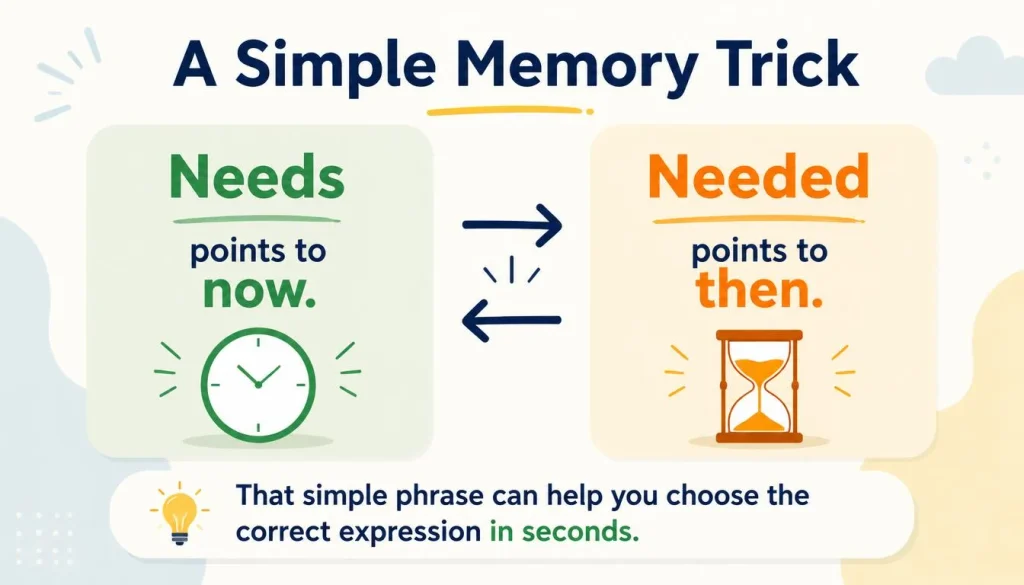
“Needs” points to now. “Needed” points to then.
That simple phrase can help you choose the correct expression in seconds.
Practice Quiz: Can You Choose the Correct Phrase?
Test your understanding by selecting either “needs to be done” or “needed to be done” for each sentence.
Questions
- The proposal __________ before tomorrow’s meeting.
- The repairs __________ before winter arrived.
- Your passport application __________ this week.
- The software update __________ before the system went live.
- The kitchen __________ before the guests arrive.
- The final inspection __________ before construction could continue.
- The presentation __________ by the end of today.
- Several documents __________ before the merger was approved.
- This issue __________ immediately.
- The experiment __________ again because the first results were inconsistent.
Answers
| Question | Correct Answer | Explanation |
| 1 | needs to be done | The deadline is still in the future. |
| 2 | needed to be done | The requirement existed before winter. |
| 3 | needs to be done | The application is still due this week. |
| 4 | needed to be done | The update was required before launch. |
| 5 | needs to be done | The guests haven’t arrived yet. |
| 6 | needed to be done | Construction refers to a past sequence of events. |
| 7 | needs to be done | The deadline hasn’t passed. |
| 8 | needed to be done | The merger occurred in the past. |
| 9 | needs to be done | The issue still requires action. |
| 10 | needed to be done | The experiment refers to a completed situation. |
If you answered most of these correctly, you’ve already mastered the key difference between the two expressions.
Quick Summary Table
When you’re writing or speaking, use this table as a quick reference.
| If You’re Talking About… | Use This Phrase | Example |
| A task that still requires action | Needs to be done | The report needs to be done today. |
| A task that was required earlier | Needed to be done | The report needed to be done yesterday. |
| Current instructions | Needs to be done | The form needs to be signed. |
| Past requirements | Needed to be done | The form needed to be signed before approval. |
| Ongoing projects | Needs to be done | More testing needs to be done. |
| Historical events | Needed to be done | Extensive repairs needed to be done after the flood. |
Common Contexts Where These Phrases Appear
Understanding where native speakers commonly use these expressions can help you recognize them more easily.
| Context | Common Expression | Example |
| Business emails | Needs to be done | The budget needs to be finalized by Friday. |
| Project management | Needs to be done | Several tasks need to be completed before launch. |
| Construction reports | Needed to be done | Structural repairs needed to be completed first. |
| Academic writing | Needed to be done | Additional research needed to be conducted. |
| Healthcare | Needs to be done | Further testing needs to be performed. |
| Everyday conversation | Needs to be done | The laundry needs to be done today. |
Real-World Case Studies
Seeing these expressions in realistic situations makes the grammar easier to remember.
Case Study: Office Project
A marketing team is preparing for a product launch.
Monday Morning
The project manager says:
“The website needs to be updated, the landing page needs to be tested, and the promotional emails need to be scheduled before Friday.”
At this point, every task is still pending, so needs to be done is the correct choice.
Two Weeks Later
After the launch, the manager reviews the project:
“The website needed to be updated before launch, and every campaign needed to be tested before we went live.”
Now the discussion looks back at past requirements, making needed to be done the correct option.
Case Study: Home Renovation
Imagine you’re renovating a house.
Before moving in, you might say:
- The walls need to be painted.
- The floors need to be polished.
- The plumbing needs to be inspected.
After you’ve settled into the house, you might describe the project like this:
- The walls needed to be painted before we moved in.
- The floors needed to be polished.
- The plumbing needed to be inspected before we received approval.
Again, the only difference is the time frame.
Expert Grammar Tip
“Choose the tense of need, not the tense of done. The past participle remains the same, while the main verb tells readers whether the requirement belongs to the present or the past.”
This simple principle explains nearly every correct use of these expressions.
FAQs
1. What does “needs to be done” mean?
“Needs to be done” refers to something that is necessary now or remains necessary. It commonly describes current tasks, actions, or requirements that you still need to complete.
2. What does “needed to be done” mean?
“Needed to be done” refers to something that was necessary in the past. It uses the past tense and describes a previous task, action, or requirement.
3. Is “what needs to be done” correct?
Yes. “What needs to be done” is natural and grammatically correct. You can use it when asking about tasks or actions that currently require attention.
4. Is “what is needed to be done” grammatically correct?
Although people may understand “what is needed to be done,” it often sounds awkward. “What needs to be done” is usually the clearer and more natural choice.
5. What is the main difference between “needs” and “needed”?
The main difference is tense. “Needs” refers to a present requirement, while “needed” refers to something that was required in the past.
6. Can I use “needs to be done” for a project?
Yes. You can use “needs to be done” when discussing tasks that remain necessary for a project. For example, “We need to review the final report before the project is complete.”
Conclusion
Understanding “needs to be done” and “needed to be done” becomes much easier when you focus on the tense and context. Use “needs to be done” when a task, action, or requirement is necessary now or remains necessary. Use “needed to be done” when you’re talking about something that was necessary in the past.
The main difference is simple: “needs” shows a present requirement, while “needed” shows a past requirement. For clear English usage, grammar, and sentence structure, choosing the correct form helps your writing sound natural and precise. In most situations, “what needs to be done” is also more natural than “what is needed to be done.”
When you’re unsure which expression to use, look at the timing of the task. If it still requires attention, “needs to be done” is usually the right choice. If the requirement belonged to an earlier time, “needed to be done” works better. This simple distinction can help you use both expressions correctly in everyday writing and professional communication.

Alyan Ashraf is an English language writer and editor at Phrase Finesse, where he specializes in grammar, vocabulary, spelling, word usage, and clear communication. Passionate about the English language, he creates practical, research-backed content that helps readers avoid common mistakes and write with greater accuracy and confidence.
Known for his clear writing style and attention to detail, Alyan simplifies complex language topics into easy-to-understand guides filled with real-world examples and actionable insights. His work covers confusing word pairs, grammar rules, idioms, punctuation, and everyday English usage, making learning both accessible and engaging for students, professionals, writers, and non-native English speakers.
Every article Alyan writes is carefully researched, fact-checked, and designed to meet high editorial standards. His goal is to help readers strengthen their English skills, expand their vocabulary, and communicate more effectively in academic, professional, and everyday settings.
Through Phrase Finesse, Alyan is committed to publishing trusted language resources that make mastering English simpler, clearer, and more enjoyable for learners around the world