In Efforts To vs. In An Effort To: Meaning and Usage helps clarify these phrases and their English usage. The phrases in an effort to, in effort to, and in efforts to can have slightly different contexts, even when they convey a similar meaning. In an effort to is the common, formal phrase for making an attempt or taking action to achieve a goal.
In standard English usage, it’s usually the best expression when you mean one effort or attempt. In effort to is less common and can sound awkward or informal, while in efforts to uses the plural form for several efforts or actions. The difference depends on the context, wording, and intended meaning, and good grammar can make your sentence construction clearer.
It’s important to know what the two phrases mean before you use them. This article will talk through their general ideas, usage, and distinction. The singular effort usually describes one focused action, attempt, or goal, while efforts can describe multiple actions or several efforts.
In an effort to is generally correct and formal, while in efforts to can also be correct when several actions are involved. Informally, speakers may use in effort to, but standard language usage generally favors in an effort to. This choice helps you convey your intended meaning clearly and use each phrase naturally.
Quick Answer
If you’re looking for the short answer, here it is:
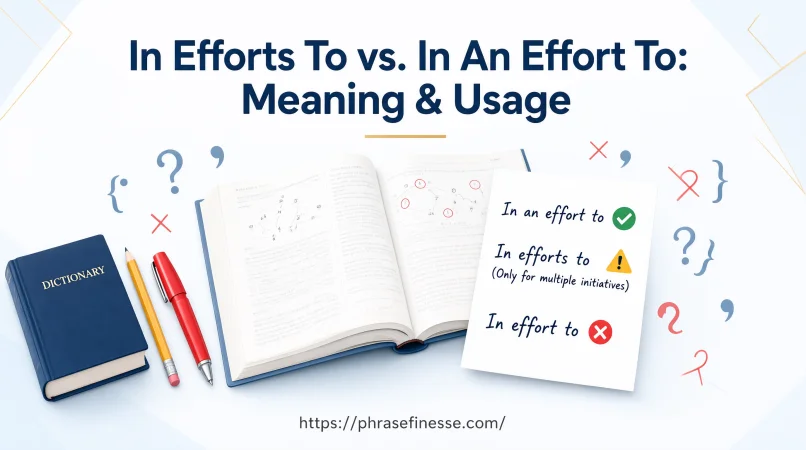
- ✅ In an effort to is the standard and most common expression.
- ⚠️ In efforts to is correct only when referring to multiple separate efforts, campaigns, or initiatives.
- ❌ In effort to is generally incorrect because the singular noun effort requires an article.
- ⚠️ In the effort to is grammatical but much less common because it refers to one specific, previously identified effort.
Quick Comparison
| Phrase | Correct? | When to Use |
| In an effort to | ✅ Yes | To express the purpose behind an action |
| In efforts to | ✅ Sometimes | When discussing multiple independent efforts |
| In effort to | ❌ No | Missing the required article |
| In the effort to | ⚠️ Rare | Refers to a particular effort already known to the reader |
Quick Tip: If you’re unsure which phrase to use, “in an effort to” is almost always the safest and most natural choice.
What Does “In An Effort To” Mean?
The phrase “in an effort to” means “in an attempt to”, “with the goal of”, or “to try to achieve something.”
Writers use it to explain why someone takes a particular action. Instead of focusing on the action itself, the phrase highlights the intention behind it.
For example:
- The company lowered its prices in an effort to attract more customers.
- She attended extra classes in an effort to improve her writing skills.
- The city planted thousands of trees in an effort to reduce air pollution.
In every example, the action comes first, while “in an effort to” introduces the desired outcome.
The Grammar Behind the Phrase
The expression follows a simple structure.
| Part | Function |
| In | Preposition |
| an | Indefinite article |
| effort | Singular countable noun |
| to | Infinitive marker |
| Base verb | Shows the intended action |
Formula
In an effort to + base verb
Examples:
- In an effort to improve customer service…
- In an effort to reduce costs…
- In an effort to increase productivity…
- In an effort to prevent accidents…
- In an effort to encourage participation…
Because effort is a singular countable noun, English requires an article before it. That’s why “in effort to” sounds incomplete.
Why Native Speakers Prefer This Expression
English contains many fixed expressions that speakers learn naturally rather than constructing from grammatical rules each time.
Examples include:
- In an attempt to
- In an effort to
- In a bid to
- In a move to
These expressions have become standard because they sound smooth and communicate purpose clearly.
Think of “in an effort to” as a ready-made phrase rather than five separate words.
Examples in Everyday English
You’ll hear or read this expression across many settings.
Business
- The retailer expanded online services in an effort to reach more customers.
- Management introduced flexible schedules in an effort to improve employee satisfaction.
Education
- Teachers redesigned the curriculum in an effort to boost student engagement.
- Schools added tutoring programs in an effort to improve graduation rates.
Healthcare
- Hospitals hired additional nurses in an effort to shorten waiting times.
- Doctors launched awareness campaigns in an effort to encourage early screenings.
Government
- Officials introduced stricter regulations in an effort to improve road safety.
- Lawmakers proposed new legislation in an effort to reduce fraud.
Environmental Protection
- Communities organized recycling drives in an effort to decrease landfill waste.
- Conservation groups restored wetlands in an effort to protect wildlife habitats.
Notice how the phrase works naturally in formal, professional, and everyday writing.

Why This Phrase Sounds Natural
Imagine someone asks:
Why did the company lower prices?
You could answer:
The company lowered prices to attract more customers.
Or you could say:
The company lowered prices in an effort to attract more customers.
Both are correct. However, the second version emphasizes that the company made a deliberate attempt rather than guaranteeing success.
That subtle difference explains why journalists, researchers, and business professionals often choose “in an effort to.”
A Helpful Analogy
Picture a basketball player taking a difficult shot.
The player shoots in an effort to score.
The phrase doesn’t promise the ball will go in. It simply tells you the player’s intention.
Likewise:
- A business launches a campaign in an effort to increase sales.
- A student studies harder in an effort to pass an exam.
- A city builds bike lanes in an effort to reduce traffic.
The outcome remains uncertain, but the purpose is clear.
What Does “In Efforts To” Mean?
Unlike its singular counterpart, “in efforts to” refers to multiple efforts rather than one general attempt.
Here, efforts is plural, meaning several organized actions, campaigns, or initiatives contribute toward the same goal.
Although the phrase is grammatically correct in the right context, it appears far less often because everyday situations usually describe one overall attempt rather than many distinct ones.
When Is “In Efforts To” Correct?
Use the plural when several separate efforts exist.
These may include:
- Multiple organizations working together
- Different projects pursuing the same objective
- Repeated attempts over time
- Independent initiatives with a shared goal
For example:
- Governments cooperated in efforts to combat climate change.
- Scientists shared research in efforts to develop better vaccines.
- International charities united in efforts to reduce global hunger.
- Local communities collaborated in efforts to restore damaged ecosystems.
Each sentence describes numerous coordinated efforts instead of one broad attempt.
Singular vs. Plural: A Key Difference
Many writers mistakenly assume that more people require the plural efforts.
That’s not how the grammar works.
The noun describes the attempt, not the number of participants.
Consider these examples.
One organization
- The company invested heavily in an effort to improve customer service.
One hundred employees
- The employees worked overtime in an effort to meet the deadline.
Although many people participated, everyone contributed to one shared effort.
Now compare this example.
- Universities launched separate research projects in efforts to develop renewable energy technologies.
Here, multiple independent projects exist. The plural noun accurately reflects that reality.
Real-World Comparison
| Situation | Best Choice | Why |
| A company lowers prices | In an effort to | One business strategy |
| A school updates its curriculum | In an effort to | One educational initiative |
| Several countries launch different climate programs | In efforts to | Multiple initiatives |
| International agencies coordinate separate relief operations | In efforts to | Many organized efforts |
Why the Plural Is Less Common
Most situations involve one overall purpose.
For example:
- A restaurant changes its menu.
- A teacher introduces a new lesson.
- A hospital buys new equipment.
- A city repairs roads.
Even if dozens of people participate, the action represents one coordinated effort.
That’s why professional editors usually prefer “in an effort to.”
Read More : “Independent From” Or “Independent Of”? Which Is Correct?
Why “In An Effort To” Is Far More Common
Search through newspapers, business reports, government announcements, or academic articles, and you’ll quickly notice a pattern. “In an effort to” appears far more often than “in efforts to.”
This isn’t just a matter of style. It’s rooted in how English expresses purpose.
It Functions as an Idiom
An idiom is a phrase whose meaning becomes familiar through repeated use.
Examples include:
- On the other hand
- By the way
- In fact
- At first glance
- In an effort to
Because native speakers encounter these expressions regularly, they recognize them instantly.
Replacing the singular noun with the plural disrupts that familiar rhythm unless the context genuinely involves multiple efforts.
It Fits Most Writing Situations
You’ll commonly find “in an effort to” in:
- News articles
- Academic journals
- Business reports
- Government announcements
- Scientific research
- Corporate press releases
- Professional emails
- Formal essays
For example:
The city expanded public transportation in an effort to reduce traffic congestion.
This sentence sounds polished because the phrase has become standard English.
It Highlights Purpose Rather Than Success
One subtle advantage of “in an effort to” is that it emphasizes intention instead of outcome.
Compare these sentences.
- The company invested heavily to increase sales.
- The company invested heavily in an effort to increase sales.
The second version acknowledges that success isn’t guaranteed. It simply explains why the company acted.
That nuance makes the phrase especially valuable in journalism and professional writing, where accuracy matters.
A Note on Style
Many professional style guides encourage writers to choose familiar idiomatic expressions because they improve clarity and readability.
“In an effort to” accomplishes exactly that. Readers understand it immediately without stopping to interpret the wording.
When your goal is clear communication, the singular form usually delivers the strongest result.
Grammar Breakdown: Understanding the Structure
Knowing why the phrase works makes it much easier to use correctly.
Consider this sentence:
The nonprofit launched a fundraising campaign in an effort to expand its community programs.
Let’s examine each part.
| Word | Role |
| In | Introduces the prepositional phrase |
| an | Identifies one effort |
| effort | Names the attempt |
| to | Begins the infinitive |
| expand | States the intended action |
Together, these elements create a phrase that answers one simple question:
Why did the nonprofit launch the campaign?
The answer:
In an effort to expand its community programs.
The grammar remains consistent regardless of the subject.
Examples:
- Researchers collected more data in an effort to improve accuracy.
- Parents established routines in an effort to help their children sleep better.
- Engineers redesigned the bridge in an effort to enhance safety.
Each sentence follows the same reliable pattern.
Effort vs. Efforts: Understanding the Difference
The distinction between effort and efforts extends beyond this single expression. Understanding the nouns themselves will help you make better grammatical choices in many situations.
| Singular | Plural |
| One attempt | Multiple attempts |
| One initiative | Several initiatives |
| One campaign | Several campaigns |
| One coordinated action | Many independent actions |
Consider these examples.
Singular
- Her effort impressed the judges.
- The rescue effort lasted three days.
- Their fundraising effort exceeded expectations.
Plural
- Rescue efforts continued throughout the week.
- International efforts reduced the spread of the disease.
- Community efforts transformed the neighborhood.
Side-by-Side Comparison
| Incorrect Context | Better Choice |
| The company advertised in efforts to increase sales. | The company advertised in an effort to increase sales. |
| Several organizations collaborated in an effort to coordinate separate campaigns. | Several organizations collaborated in efforts to coordinate separate campaigns. |
A useful rule of thumb is simple:
Use the singular when you describe one overall attempt. Use the plural only when the context genuinely involves multiple distinct efforts.
That small distinction makes your writing more precise and more natural.
“In An Effort To” vs. Similar Expressions
English offers several ways to express purpose. Although these phrases often overlap, each carries a slightly different tone or level of formality.
Choosing the right one can make your writing sound more natural and precise.
Comparison Table
| Expression | Meaning | Best Used In | Formality |
| In an effort to | To make an attempt to achieve something | General writing, journalism, business | High |
| To | Shows purpose directly | Everyday writing and speech | Neutral |
| In order to | Expresses purpose with extra emphasis | Academic and formal writing | High |
| So as to | Indicates purpose in a very formal way | Legal and technical writing | Very High |
| With the aim of | Focuses on a planned objective | Reports and research | High |
| With the goal of | Highlights a desired outcome | Business communication | High |
| To help | Indicates assistance or support | Informal and conversational writing | Neutral |
“In An Effort To” vs. “To”
Both phrases explain why someone does something.
Example:
- The company hired more staff to improve customer service.
- The company hired more staff in an effort to improve customer service.
The first sentence simply states the purpose.
The second emphasizes that hiring more staff was an intentional attempt, not necessarily a guaranteed solution.
“In An Effort To” vs. “In Order To”
Both are grammatically correct.
However, “in order to” focuses only on purpose, while “in an effort to” suggests a deliberate attempt.
Example
- She left early in order to catch the train.
- She left early in an effort to catch the train.
The second version subtly implies that she wasn’t sure she would actually catch it.
“In An Effort To” vs. “With the Goal of”
Both introduce an objective.
However, “with the goal of” sounds more strategic and long-term.
Example
- The charity expanded nationwide with the goal of helping more families.
- The charity expanded nationwide in an effort to help more families.
The first emphasizes planning.
The second highlights the attempt
Which Expression Should You Choose?
If you want one expression that works almost everywhere, choose:
✅ In an effort to
It sounds natural in:
- Business writing
- Academic papers
- News articles
- Government reports
- Professional emails
- Everyday formal English
Common Mistakes to Avoid
Even experienced writers occasionally misuse these expressions.
Fortunately, the errors are easy to fix once you know what to watch for.
Using the Plural Without a Reason
This is by far the most common mistake.
❌ Incorrect
The company invested more money in efforts to increase sales.
✅ Correct
The company invested more money in an effort to increase sales.
Although many employees participated, the company made one overall attempt.
Omitting the Article
Because effort is a singular countable noun, it needs an article.
❌ Incorrect
In effort to improve communication…
✅ Correct
In an effort to improve communication…
This mistake often appears among English learners because some languages don’t require articles.
Assuming More People Means “Efforts”
The number of people involved doesn’t determine whether effort should be singular or plural.
Consider this sentence:
Hundreds of volunteers worked together in an effort to clean the beach.
Even though many volunteers participated, they all contributed to one organized effort.
Using the Phrase Too Often
Although “in an effort to” is an excellent expression, repeating it several times in one article can make your writing sound repetitive.
Instead, vary your language.
For example:
- To
- In order to
- With the goal of
- To help
- To improve
- To reduce
- To encourage
Good writing balances consistency with variety.
Real-World Examples Across Different Contexts
Understanding grammar is easier when you see it in realistic situations.
Business
Companies frequently explain why they make strategic decisions.
Examples
- The retailer launched a loyalty program in an effort to retain customers.
- The manufacturer upgraded its equipment in an effort to improve efficiency.
- The startup expanded internationally in an effort to reach new markets.
Education
Schools often introduce changes with a specific goal.
Examples
- Teachers incorporated interactive lessons in an effort to increase classroom participation.
- Universities expanded scholarship programs in an effort to attract talented students.
- Schools introduced financial literacy courses in an effort to prepare students for adulthood.
Healthcare
Medical organizations often communicate intentions rather than guaranteed outcomes.
Examples
- Hospitals increased staffing in an effort to reduce waiting times.
- Health officials launched awareness campaigns in an effort to improve vaccination rates.
- Clinics extended weekend hours in an effort to make healthcare more accessible.
Government
Government announcements commonly use this expression because policies represent attempts rather than promises.
Examples
- Officials introduced stricter traffic laws in an effort to reduce accidents.
- The city expanded green spaces in an effort to improve air quality.
- Parliament approved new funding in an effort to strengthen public transportation.
Environmental Conservation
Environmental projects often involve long-term objectives.
Examples
- Volunteers planted native trees in an effort to restore wildlife habitats.
- Scientists monitored coral reefs in an effort to understand climate change.
- Communities organized cleanup events in an effort to reduce plastic pollution.
Technology
Technology companies regularly describe product improvements using this phrase.
Examples
- Developers redesigned the interface in an effort to improve user experience.
- Engineers strengthened cybersecurity systems in an effort to protect customer data.
- Software companies simplified onboarding in an effort to reduce customer frustration.
Can You Start a Sentence With “In An Effort To”?
Absolutely.
Starting a sentence with this expression is both grammatical and common.
In fact, journalists frequently use it to explain motivation before introducing the main action.
Examples
- In an effort to reduce waste, the restaurant eliminated single-use plastics.
- In an effort to improve accessibility, the museum added audio guides.
- In an effort to attract investors, the company announced an ambitious expansion plan.
When the phrase appears at the beginning of a sentence, place a comma after the introductory phrase.
Pattern
In an effort to + verb, main clause.
Example:
In an effort to improve efficiency, the company automated several routine tasks.

Is “In Efforts To” Ever Incorrect?
Not necessarily.
The phrase isn’t wrong. It’s simply much less common because most situations describe one overall effort.
Sounds Unnatural
❌ The teacher explained the lesson in efforts to help students.
✅ The teacher explained the lesson in an effort to help students.
Only one teaching strategy exists here.
Sounds Natural
✅ International organizations collaborated in efforts to eliminate malaria.
Each organization contributes separate initiatives toward the same goal.
Another Comparison
Singular
The city launched a recycling campaign in an effort to reduce landfill waste.
Plural
Cities across the country introduced different recycling programs in efforts to reduce landfill waste.
The second sentence clearly refers to numerous independent initiatives.
Quick Comparison Table
| Feature | In an effort to | In efforts to |
| Common in everyday English | ✅ Yes | ❌ Rare |
| Standard idiomatic expression | ✅ Yes | ❌ No |
| Used in journalism | ✅ Frequently | Occasionally |
| Suitable for academic writing | ✅ Yes | Yes, when appropriate |
| Refers to one overall attempt | ✅ Yes | ❌ No |
| Refers to multiple initiatives | ❌ No | ✅ Yes |
| Safe default choice | ✅ Yes | ❌ Only in specific contexts |
Memory Trick
Here’s an easy way to remember the difference.
Ask yourself this question:
Am I describing one attempt or several separate efforts?
If the answer is one attempt, choose:
✅ In an effort to
If the answer is several independent initiatives, choose:
✅ In efforts to
Another Helpful Test
Replace the phrase with “to try to.”
If the sentence still sounds natural, “in an effort to” is almost certainly correct.
Example
- The company hired more staff to try to improve service.
- The company hired more staff in an effort to improve service.
The meaning stays the same.
FAQs
1. Is “in an effort to” grammatically correct?
Yes. “In an effort to” is grammatically correct and widely used in formal and professional English.
2. Is “in efforts to” correct?
Yes. “In efforts to” can be correct when you’re referring to multiple efforts or several actions toward a goal.
3. Is “in effort to” correct?
“In effort to” is less common and can sound awkward. In most formal writing, “in an effort to” is the more natural choice.
4. What does “in an effort to” mean?
It means making an attempt or taking action to achieve a particular goal. For example, “She changed her schedule in an effort to save time.”
5. What is the difference between “effort” and “efforts”?
“Effort” usually refers to one focused attempt, while “efforts” refers to multiple attempts or actions. Your choice depends on the context.
6. Which phrase should I use in formal writing?
In most cases, “in an effort to” is the safest and most natural option for formal writing. Use “in efforts to” when you specifically mean multiple efforts.
Conclusion
“In an effort to” and “in efforts to” can both describe actions taken toward a goal, but their meanings differ slightly. The singular “effort” usually presents one focused attempt, while the plural “efforts” suggests multiple actions or attempts.
“In an effort to” is the more common and formal expression. It works naturally in business communication, academic writing, and everyday English. “In effort to” is less common and may sound awkward, so it’s usually better to avoid it in polished writing.
When choosing between these phrases, consider whether you mean one attempt or several. Understanding this small distinction can improve your grammar, wording, and overall English usage while helping you express your intended meaning more clearly.

Emma Brooke is an English language specialist, editor, and content writer at Phrase Finesse, where she helps readers develop stronger writing and communication skills through clear, practical, and engaging content. With a passion for the English language, she specializes in simplifying grammar rules, vocabulary, spelling, punctuation, and word usage for learners at every level.
Emma has extensive experience creating educational content that is accurate, well-researched, and easy to understand. She is particularly skilled at explaining confusing word pairs, grammar concepts, idioms, sentence structure, and effective writing techniques, making complex topics approachable for students, professionals, educators, and English learners worldwide.