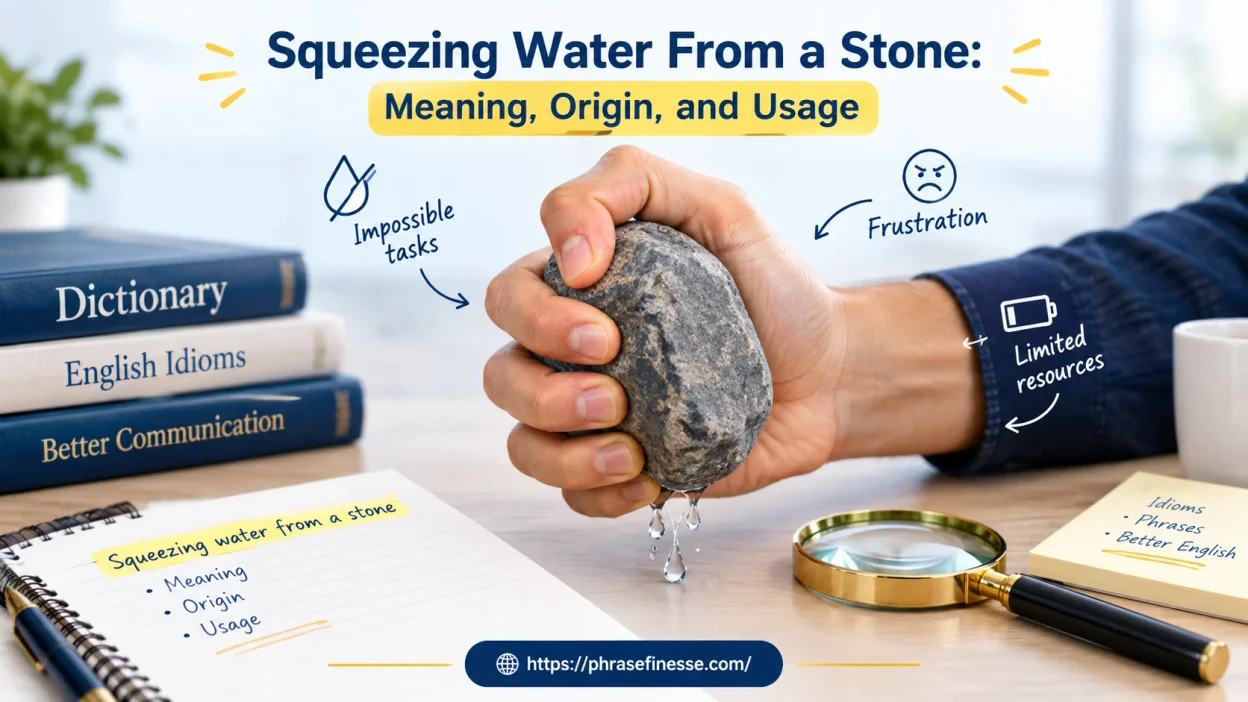
Have you ever faced a task that seemed completely impossible, no matter how much effort you invested? The idiom Squeezing Water From a Stone: Meaning, Origin, and Usageperfectly captures that frustrating experience.
Whether you’re improving your English usage, refining your grammar, or trying to understand common idiomatic expressions, learning the deeper meaning behind this phrase helps you communicate with greater confidence and accuracy.
In this guide, you’ll discover the meaning, origin, and real-world examples of “Squeezing Water From A Stone.” We’ll also explain when to use this expression in everyday conversations, business communication, formal writing, and professional discussions
. From project management challenges and meetings to time management, scheduling, calendar planning, online booking issues, and even broadcasting scenarios, this idiom often describes situations where success is highly unlikely despite repeated effort.
You’ll also learn the common mistakes to avoid and the subtle differences between similar expressions.
By the end of this article, you’ll know exactly how to use “Squeezing Water From A Stone” naturally in different contexts while maintaining consistency in your writing and speech. With practical examples, clear explanations, and modern usage tips, this guide will help you strengthen your vocabulary, improve your understanding of English idioms, and communicate more effectively in both personal and professional settings.
What Does “Squeezing Water From A Stone” Mean?
“Squeezing water from a stone” means trying to get something from a person, situation, or resource when there is nothing available to give.
It usually describes:
- An impossible task
- An unrealistic expectation
- A hopeless effort
- A situation with no available resources
In simple terms, you’re trying to obtain something that cannot realistically be obtained.
Example
Asking a bankrupt company for a large donation is like squeezing water from a stone.
The company doesn’t have the money, so the request is unlikely to succeed.
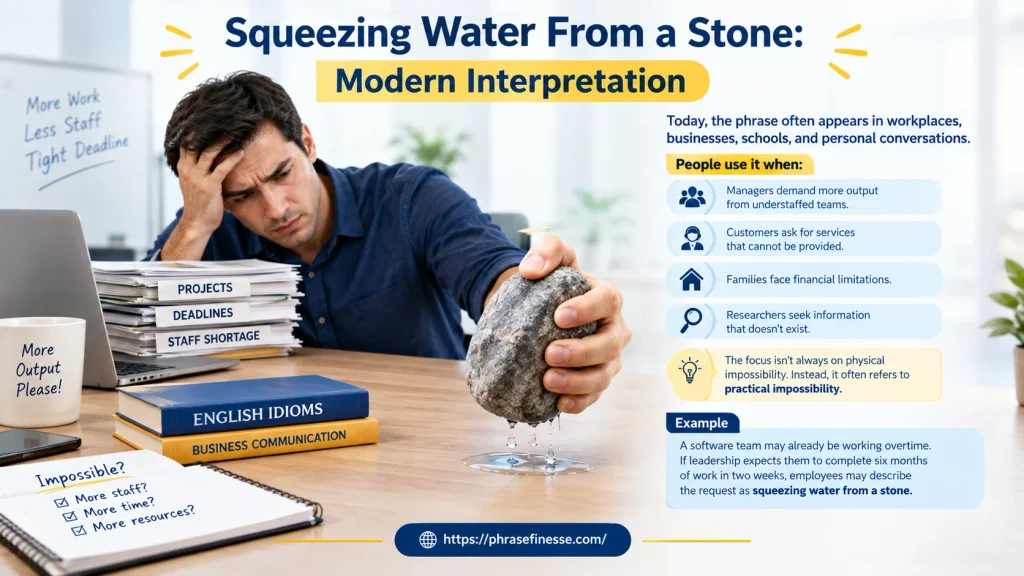
Modern Interpretation
Today, the phrase often appears in workplaces, businesses, schools, and personal conversations.
People use it when:
- Managers demand more output from understaffed teams.
- Customers ask for services that cannot be provided.
- Families face financial limitations.
- Researchers seek information that doesn’t exist.
The focus isn’t always on physical impossibility. Instead, it often refers to practical impossibility.
Example
A software team may already be working overtime. If leadership expects them to complete six months of work in two weeks, employees may describe the request as squeezing water from a stone.
Why the Phrase Is So Effective
Many idioms survive because they create powerful mental images.
Imagine holding a dry rock in your hand. You can squeeze it all day long. Nothing happens.
That’s why the expression instantly communicates:
- Frustration
- Futility
- Unrealistic expectations
- Resource shortages
The image is simple, memorable, and universally understood.
Is “Squeezing Water From A Stone” an Idiom or a Metaphor?
The phrase functions primarily as an idiom, though it also contains a metaphorical element.
Understanding the Figurative Meaning
The stone represents:
- A person with nothing left to give
- A resource that has been exhausted
- A situation lacking necessary support
The water represents:
- Money
- Information
- Productivity
- Assistance
- Results
Because the phrase doesn’t mean exactly what the words suggest, it qualifies as an idiom.
Literal vs. Figurative Meaning
| Literal Meaning | Figurative Meaning |
| Trying to extract water from a rock | Trying to obtain something unavailable |
| Physically impossible task | Practically impossible task |
| No water exists inside the stone | No resources exist in the situation |
| Effort produces nothing | Effort yields little or no result |
The Origin of “Squeezing Water From A Stone”
The exact origin of the phrase is difficult to pinpoint. However, the concept has existed for centuries.
Earliest Historical References
Throughout history, writers and speakers have used impossible natural actions to symbolize hopeless efforts.
Ancient proverbs frequently relied on imagery involving:
- Dry rocks
- Empty wells
- Barren land
- Dead trees
These symbols represented scarcity and impossibility.
The idea behind squeezing water from a stone likely developed from these older traditions.
The Connection to “Getting Blood From a Stone”
Many language historians believe the phrase evolved alongside another famous expression:
“Getting blood from a stone.”
This proverb dates back several centuries and appears in various forms across European languages.
Both expressions communicate nearly the same idea:
| Expression | Meaning |
| Getting blood from a stone | Trying to obtain something impossible |
| Squeezing water from a stone | Trying to obtain something unavailable |
The difference is subtle.
Blood from a stone often emphasizes extreme difficulty.
Water from a stone often highlights the complete absence of available resources.
Historical Development
As English evolved, speakers naturally adapted older sayings.
Business leaders, politicians, and journalists began using “squeezing water from a stone” to describe:
- Economic hardship
- Government budget cuts
- Resource shortages
- Workforce limitations
Today, the phrase remains common because modern life constantly produces situations where people are expected to do more with less.
When Should You Use “Squeezing Water From A Stone”?
Knowing when to use the expression is just as important as knowing its meaning.
Common Situations
The idiom fits situations where success is highly unlikely because necessary resources simply don’t exist.
Examples include:
- Asking broke friends for money
- Requesting unavailable information
- Expecting impossible deadlines
- Seeking cooperation from unwilling participants
Professional Settings
Businesses often use this expression.
Budget Constraints
Imagine a company reduces funding by 50%.
Management still expects the same output.
Employees may say:
“They’re asking us to squeeze water from a stone.”
Staffing Shortages
A department loses half its workforce.
Yet performance targets remain unchanged.
Workers often use this phrase to express frustration.
Educational Settings
Teachers encounter similar challenges.
For example:
- Limited classroom supplies
- Reduced funding
- Large class sizes
Many educators feel pressure to achieve exceptional results despite insufficient support.
Personal Relationships
The phrase also appears in everyday conversations.
Examples include:
- Asking emotional support from someone already overwhelmed
- Expecting generosity from someone struggling financially
- Seeking answers from a person who genuinely doesn’t know
Real-Life Examples of “Squeezing Water From A Stone”
Below are practical examples showing how native speakers use the idiom.
Workplace Budget Cuts
The marketing department lost half its budget, yet executives still expected record-breaking results. The team felt they were squeezing water from a stone.
Collecting Debt
The lender continued calling a borrower who had already declared bankruptcy. At that point, collecting money was like squeezing water from a stone.
Academic Research
Researchers searched for historical documents that had been destroyed decades earlier. The effort resembled squeezing water from a stone.
Sales Targets
Sales representatives faced unrealistic goals during an economic recession. Meeting those numbers felt like squeezing water from a stone.
Negotiations
The company tried convincing an unwilling supplier to lower prices further. Negotiators eventually realized they were squeezing water from a stone.
Customer Service
Support agents attempted to satisfy demands that company policies simply couldn’t accommodate. The situation felt impossible.
Small Business Challenges
A struggling local business couldn’t increase salaries despite employee requests. The owner genuinely lacked the resources.
Family Finances
Parents already managing tight budgets couldn’t afford additional expenses. Further requestsonly increased stress.
Job Searching
An applicant continued applying to positions requiring qualifications they didn’t possess. Progress remained difficult despite significant effort.
Dialogue Examples in Context
Understanding idioms becomes easier when you see them in natural conversations.
See More :5 Words For Answering A Question With A Question
Office Conversation
Manager: Can we launch the project next week?
Team Lead: Not realistically.
Manager: Why not?
Team Lead: We’ve lost two developers and our budget was reduced. At this point, we’re squeezing water from a stone.
Family Conversation
Son: Can we go on another vacation this month?
Mother: We already took one trip recently.
Son: But it would be fun.
Mother: It would. However, asking for another vacation right now is like squeezing water from a stone.
Business Meeting
Executive: Why aren’t profits growing?
Finance Director: Market demand has dropped significantly.
Executive: Can’t we increase sales?
Finance Director: We’ve already exhausted every available strategy. Further growth would be squeezing water from a stone.
Common Variations of the Expression
Language changes over time, which creates alternative versions of many idioms.
Getting Blood From a Stone
This variation is arguably more common.
Meaning
Trying to obtain something impossible from someone unwilling or unable to provide it.
Example
Collecting taxes from a bankrupt business is like getting blood from a stone.
Drawing Water From a Stone
This variation appears less frequently but carries essentially the same meaning.
Example
Convincing him to change his mind was like drawing water from a stone.
Extracting Water From a Stone
Writers occasionally use this version for stylistic purposes.
Although less common, readers generally understand it immediately.
Similar Idioms and Expressions
English contains many expressions that communicate comparable ideas.
| Idiom | Meaning |
| Getting blood from a stone | Obtaining the impossible |
| Beating a dead horse | Continuing a pointless effort |
| Chasing a lost cause | Pursuing something hopeless |
| Pushing a rope | Trying to force an impossible outcome |
| Fighting an uphill battle | Facing severe difficulties |
| Running into a brick wall | Meeting constant resistance |
| Going nowhere fast | Making little progress |
Opposite Expressions
Sometimes the easiest way to understand an idiom is by comparing it with its opposite.
| Expression | Meaning |
| Low-hanging fruit | Easily achievable task |
| Easy win | Quick success |
| Piece of cake | Very easy task |
| Within reach | Achievable objective |
| Sure thing | Highly likely success |
Common Mistakes People Make
Even advanced English learners occasionally misuse the phrase.
Using It for Difficult Tasks
The idiom doesn’t simply mean “hard.”
It means nearly impossible or completely unrealistic.
Incorrect
Learning Spanish is squeezing water from a stone.
Learning Spanish may be difficult, but it’s certainly possible.
Better
Learning Spanish in one weekend would be squeezing water from a stone.
Taking the Phrase Literally
Some learners mistakenly focus on actual stones and water.
The expression should almost always be interpreted figuratively.
Confusing It With “Getting Blood From a Stone”
Although closely related, they aren’t always identical.
Quick Comparison
| Phrase | Main Focus |
| Water from a stone | No available resources |
| Blood from a stone | Extreme difficulty or impossibility |
How Native English Speakers Use the Phrase Today
Despite its age, the expression remains surprisingly relevant.
Business and Management
Executives often use it when discussing:
- Staffing shortages
- Budget reductions
- Productivity concerns
- Resource allocation
Politics and Government
Politicians frequently reference the concept when discussing:
- Tax revenue
- Public spending
- Economic limitations
- Funding shortages
Sports Commentary
Sports analysts occasionally use the phrase when teams face overwhelming disadvantages.
Example
A coach attempting to win championships with an inexperienced roster might be described as squeezing water from a stone.
Everyday Speech
Most commonly, you’ll hear the idiom in casual conversation.
People use it to express:
- Frustration
- Realism
- Practical limitations
It helps speakers communicate a complex idea in just a few words.
Case Study: A Real Business Example
Consider a small manufacturing company facing rising costs.
The Situation
- Revenue declined by 20%
- Labor costs increased
- Supply prices surged
- Workforce shrank
Management’s Expectation
Leadership wanted:
- Higher output
- Faster delivery
- Better customer service
The Result
Employees repeatedly described the situation as squeezing water from a stone.
Why?
Because expectations continued increasing while resources continued shrinking.
This case perfectly demonstrates the modern meaning of the idiom.
Quick Usage Guide
| Situation | Appropriate? |
| Impossible request | ✓ Yes |
| Unrealistic expectation | ✓ Yes |
| Resource shortage | ✓ Yes |
| Severe limitation | ✓ Yes |
| Difficult task | Sometimes |
| Normal challenge | ✗ No |
| Achievable goal | ✗ No |
| Routine work | ✗ No |
Why This Idiom Has Survived for Centuries
Many expressions disappear over time.
This one remains popular because the underlying experience never changes.
People constantly encounter situations where:
- Expectations exceed reality
- Resources run out
- Demands become unreasonable
- Effort cannot produce results
The phrase captures that frustration perfectly.
As long as those situations exist, speakers will likely continue using the expression..
FAQs
1. What does “Squeezing Water From A Stone” mean?
“Squeezing Water From A Stone” is an idiom that describes trying to achieve something impossible or expecting results where none are realistically possible. It often refers to wasting effort on a hopeless task.
2. Where did the phrase “Squeezing Water From A Stone” originate?
The expression has ancient roots and has appeared in various forms throughout history. It comes from the idea that a stone contains no water, making the task naturally impossible. Over time, it became a popular metaphor in English for unrealistic expectations.
3. Is “Squeezing Water From A Stone” a positive or negative expression?
It is generally considered a negative expression because it highlights situations where success is highly unlikely or impossible despite significant effort. However, it can also emphasize persistence in a humorous or descriptive way.
4. Can I use “Squeezing Water From A Stone” in professional writing?
Yes. The idiom is appropriate in business communication, presentations, or informal workplace discussions when describing unrealistic goals or impossible requests. In highly formal documents, however, a more literal expression may be preferable.
5. What are some similar idioms to “Squeezing Water From A Stone”?
Common alternatives include “Beating a dead horse,” “Trying to get blood from a stone,” “An impossible task,” and “Barking up the wrong tree.” Each has a slightly different meaning, but they all describe difficult or unproductive efforts.
6. How can I use “Squeezing Water From A Stone” correctly in a sentence?
Use the idiom when describing a situation where someone’s efforts are unlikely to produce results.
Example: Convincing him to change his mind was like squeezing water from a stone.
Conclusion
The idiom “Squeezing Water From A Stone” is a powerful way to describe situations where success is virtually impossible despite repeated effort. Understanding its meaning, origin, and proper usage can improve your English vocabulary, strengthen your grammar, and make your conversations and writing more expressive.
By using this phrase in the right context and avoiding common mistakes, you’ll communicate more naturally and confidently in both everyday situations and professional communication. Whether you’re learning English or expanding your command of idiomatic expressions, this timeless phrase is a valuable addition to your vocabulary.