Have you ever stopped mid-sentence and wondered whether a comma belongs before or after the word “especially”? If so, you’re not alone. “Especially” and Comma Rules Explained (Helpful Examples) is a topic that often confuses writers because punctuation choices can affect clarity, sentence flow, and overall grammar.
Understanding the correct usage helps you write with greater confidence in both casual and professional contexts.
The word especially appears frequently in English usage, formal writing, emails, reports, and everyday communication. Whether you’re discussing business communication, planning meetings, managing a calendar, handling project management tasks, or writing about scheduling and time management, knowing when commas are required can improve readability and maintain consistency.
Small punctuation decisions often make a significant difference in how your message is understood.
In this guide, you’ll learn the essential comma rules for especially, discover when punctuation is necessary, and explore practical examples drawn from real-world situations.
We’ll also cover common mistakes, usage patterns in online booking, broadcasting, workplace correspondence, and other professional settings. By the end, you’ll have a clear understanding of how to use especially correctly and effectively in modern written English.
What Does “Especially” Mean?
Before discussing punctuation, it’s important to understand how especially works.
According to standard English grammar, especially is an adverb used to indicate:
- Particular importance
- Greater degree
- Special emphasis
- A notable example within a larger group
In simple terms, it means:
More than others or particularly.
Examples
- I enjoy all kinds of music, especially jazz.
- She was especially pleased with the results.
- The city is beautiful, especially at night.
Notice that especially doesn’t always perform the same job.
Sometimes it introduces an example.
Sometimes it modifies a verb.
Sometimes it modifies an adjective or an adverb.
That’s why comma usage changes.
Common Uses of “Especially”
Writers typically use especially in three major ways.
To Highlight a Specific Example
- I love fruit, especially strawberries.
- Many tourists visit Europe, especially France.
To Add Emphasis
- She especially enjoys historical fiction.
- We especially appreciate your support.
To Show Greater Degree
- The weather became especially cold overnight.
- This software is especially useful for beginners.
Understanding these uses is the key to mastering comma placement with especially.
The Basic Comma Rule With “Especially”
Here’s the simplest rule to remember:
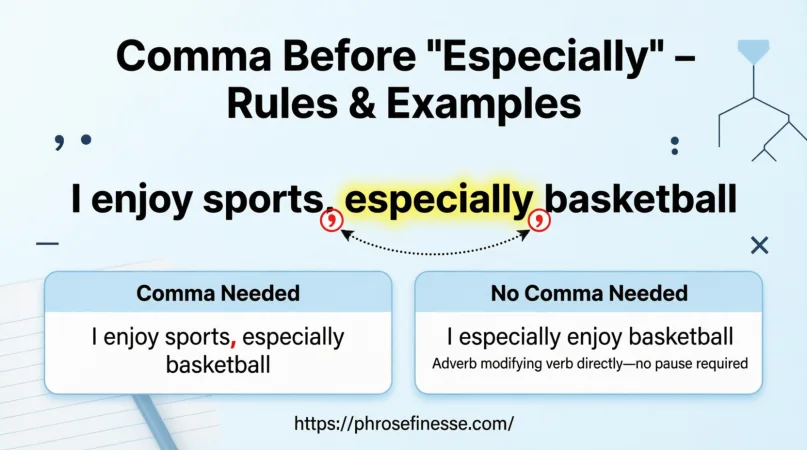
Use a comma before “especially” when it introduces additional information, clarification, or a specific example.
Do not use a comma when “especially” directly modifies a verb, adjective, or adverb.
Let’s compare.
| Sentence | Correct? | Explanation |
| I enjoy desserts, especially cheesecake. | ✅ | Introduces a specific example |
| I especially enjoy cheesecake. | ✅ | Directly modifies “enjoy” |
| The movie was especially entertaining. | ✅ | Modifies adjective |
| Many students, especially freshmen, attended. | ✅ | Adds extra information |
| I, especially enjoy cheesecake. | ❌ | Unnecessary comma |
The difference depends on the role especially plays in the sentence.
When to Use a Comma Before “Especially”
Most comma questions arise when especially introduces examples or supplementary information.
Let’s look at the situations where a comma is usually required.
Especially Introducing a Specific Example
This is the most common pattern.
Structure
General statement + comma + especially + specific example
Examples
- I enjoy outdoor activities, especially hiking.
- The company invests heavily in technology, especially artificial intelligence.
- Children love holidays, especially Christmas.
- Many animals hibernate, especially bears.
The phrase after especially narrows the focus.
The sentence remains complete even if you remove that phrase.
Example
Original:
I enjoy outdoor activities, especially hiking.
Without the phrase:
I enjoy outdoor activities.
The sentence still works.
That’s why the comma belongs there.
Especially Adding Nonessential Information
Sometimes especially introduces information that is helpful but not necessary.
Examples
- Most employees, especially managers, supported the proposal.
- Several cities, especially coastal areas, experienced flooding.
- Many students, especially freshmen, attended orientation.
The information after especially provides clarification.
However, removing it doesn’t destroy the sentence.
Example
With phrase:
Most employees, especially managers, supported the proposal.
Without phrase:
Most employees supported the proposal.
The sentence still makes complete sense.
Therefore, commas are appropriate.
Especially Following a Complete Idea
Many writers use especially after expressing a complete thought.
Examples
- Air travel can be stressful, especially during holidays.
- Exercise becomes important, especially as people age.
- Traffic gets worse, especially during rush hour.
- Hotels fill quickly, especially in peak tourist season.
Here, the comma acts like a bridge between the main statement and the added emphasis.
Especially With Time, Place, and Condition Phrases
Writers frequently use especially to highlight circumstances.
Examples
- Roads become dangerous, especially after heavy rain.
- Demand increases, especially during winter.
- The park looks beautiful, especially at sunset.
- Businesses thrive, especially in growing economies.
These examples typically require commas because the phrase after especially functions as supplemental information.
When Not to Use a Comma With “Especially”
Now let’s examine situations where adding a comma would be incorrect.
Especially Modifying a Verb
When especially directly modifies a verb, no comma is needed.
Examples
- I especially enjoy classical music.
- We especially appreciate your patience.
- She especially wanted to visit Italy.
- They especially admired the architecture.
Notice what happens here.
The word especially directly affects the action.
Removing it changes the meaning significantly.
Example
Original:
I especially enjoy jazz.
Without especially:
I enjoy jazz.
The sentence still works, but the emphasis disappears.
Since especially directly modifies the verb, no comma is used.
Especially Modifying an Adjective
No comma is needed when especially strengthens an adjective.
Examples
- The presentation was especially informative.
- The weather became especially cold.
- This guide is especially useful.
- Her explanation was especially clear.
In each sentence, especially intensifies the adjective.
See More :Thank You for Your Insight: Meaning and Usage
Especially Modifying an Adverb
The same rule applies to adverbs.
Examples
- He drove especially carefully.
- The athlete performed especially well.
- She responded especially quickly.
- The machine operates especially efficiently.
No comma is necessary.
Especially as an Essential Part of Meaning
Sometimes the sentence depends on especially.
Examples
- We are especially concerned about safety.
- She is especially talented in mathematics.
- The committee was especially interested in costs.
Because especially directly contributes to the core meaning, commas aren’t used.
Especially vs. Particularly: Do Comma Rules Change?
Many people wonder whether particularly follows different punctuation rules.
The answer is simple:
The comma rules are almost identical.
Both words function similarly.
Comparison Table
| With Especially | With Particularly |
| I enjoy sports, especially tennis. | I enjoy sports, particularly tennis. |
| She was especially excited. | She was particularly excited. |
| Traffic increases, especially on weekends. | Traffic increases, particularly on weekends. |
| I especially like jazz. | I particularly like jazz. |
Especially vs Particularly in Tone
While grammar remains similar, tone can differ.
| Word | Typical Tone |
| Especially | Conversational |
| Particularly | Slightly formal |
| Specifically | Precise |
| Notably | Academic or professional |
Example
Conversational:
I love desserts, especially brownies.
Formal:
The findings were particularly significant among younger participants.
Both are correct.
The choice depends on style.
Using “Especially” at the Beginning of a Sentence
Can especially begin a sentence?
Absolutely.
When it introduces an opening phrase, a comma often follows.
Introductory Especially Phrases
Examples
- Especially during winter, roads become hazardous.
- Especially for beginners, this guide provides valuable insight.
- Especially in large cities, housing costs continue to rise.
- Especially after sunset, temperatures drop quickly.
Here, the comma separates the introductory phrase from the main clause.
Why the Comma Matters
Without the comma, readability suffers.
Compare:
❌ Especially during winter roads become hazardous.
✅ Especially during winter, roads become hazardous.
The second version reads more naturally.
Using “Especially” in the Middle of a Sentence
This position creates the most confusion.
The key is determining whether especially introduces additional information or directly modifies another word.
Examples Requiring Commas
- The team, especially younger members, adapted quickly.
- The policy, especially its financial section, drew criticism.
- The city, especially downtown areas, saw rapid growth.
The inserted information is supplementary.
Commas are required.
Examples Not Requiring Commas
- The team especially appreciated extra support.
- The city especially benefits from tourism.
- We especially value customer feedback.
Here, especially modifies the verb.
No comma belongs.
Using “Especially” at the End of a Sentence
This is one of the most common writing patterns.
Comma Usually Required
Examples
- I enjoy classical music, especially Mozart.
- Tourism increases in summer, especially near the coast.
- Many people exercise regularly, especially runners.
- The park attracts visitors, especially families.
The phrase after especially adds emphasis or specificity.
Therefore, the comma is appropriate.
Why This Pattern Is So Common
Writers often begin broadly and end narrowly.
Example
Broad:
I enjoy desserts.
Narrow:
I enjoy desserts, especially cheesecake.
This structure feels natural because it moves from general information to a precise example.
Common Comma Mistakes With “Especially”
Let’s examine the errors that appear most frequently.
Mistake: Missing a Necessary Comma
Incorrect
- I enjoy sports especially basketball.
- She loves movies especially comedies.
Correct
- I enjoy sports, especially basketball.
- She loves movies, especially comedies.
Mistake: Adding an Unnecessary Comma
Incorrect
- I, especially enjoy reading.
- We, especially appreciate your help.
Correct
- I especially enjoy reading.
- We especially appreciate your help.
Mistake: Misidentifying Essential Information
Incorrect
- She is, especially talented in science.
Correct
- She is especially talented in science.
The phrase is essential to meaning.
No comma is needed.
Case Study: How Professional Writers Use “Especially”
Professional editors rely on sentence function rather than memorized rules.
Consider this news-style sentence:
Economic growth accelerated, especially in technology sectors.
The phrase identifies a specific area of growth.
The comma helps introduce that clarification.
Now compare:
Investors especially favored technology stocks.
Here, especially modifies favored.
No comma is required.
This distinction appears throughout journalism, business writing, and academic publications.
Especially in Academic Writing
Academic writers frequently use especially to narrow broad statements.
Examples
- Climate change affects vulnerable populations, especially coastal communities.
- The findings were especially significant among younger participants.
- Economic shifts affect small businesses, especially family-owned firms.
Because academic writing values precision, especially often introduces important examples.
Academic Writing Tips
When using especially:
- Verify whether you’re introducing an example.
- Check whether the phrase is removable.
- Avoid unnecessary punctuation.
- Prioritize clarity over stylistic complexity.
Especially in Everyday Writing
You probably use especially more often than you realize.
Email Example
Thank you for your assistance, especially during the final stages of the project.
Text Message Example
I especially liked the ending.
Social Media Example
Fall is my favorite season, especially October.
Blog Writing Example
SEO becomes increasingly competitive, especially in crowded industries.
The same grammar rules apply regardless of platform.
Quick Test: Should You Use a Comma Before “Especially”?
Ask yourself three questions.
Is “Especially” Introducing an Example?
Example
I enjoy sports, especially basketball.
If yes, use a comma.
Can the Phrase Be Removed?
Example
Most students, especially freshmen, attended orientation.
Remove phrase:
Most students attended orientation.
Still works.
Use commas.
Is “Especially” Directly Modifying a Word?
Example
I especially enjoy basketball.
Here, especially modifies enjoy.
No comma.
Especially Comma Rules Cheat Sheet
| Situation | Comma Needed? | Example |
| Introducing an example | Yes | I like desserts, especially cake. |
| Adding extra information | Yes | Many employees, especially managers, attended. |
| Modifying a verb | No | I especially like cake. |
| Modifying an adjective | No | The cake was especially delicious. |
| Modifying an adverb | No | She performed especially well. |
| Introductory phrase | Usually Yes | Especially during summer, sales rise. |
| End-of-sentence emphasis | Usually Yes | Tourism grows, especially in July. |
FAQs
1. Do you always need a comma before “especially”?
No. A comma before especially depends on how it functions in the sentence. In many cases, no comma is required, while introductory or parenthetical phrases may need punctuation for clarity.
2. Should there be a comma after “especially”?
Usually, no comma follows especially when it directly modifies a word or phrase. However, commas may be used when additional sentence structure or emphasis requires them.
3. Is “especially” different from “particularly” in punctuation?
Both words often follow similar punctuation patterns. The need for commas depends more on sentence structure than on the specific word used.
4. Can “especially” begin a sentence?
Yes. Especially can start a sentence, particularly in informal or stylistic writing. Writers should ensure the sentence remains complete and clear.
5. Is using commas with “especially” important in formal writing?
Yes. Correct punctuation improves formal writing, enhances readability, and helps maintain professional consistency in documents, reports, and correspondence.
6. What is the most common mistake with “especially”?
A common mistake is inserting unnecessary commas around especially when it functions as a normal modifier. Over-punctuation can make sentences feel awkward and disrupt flow.
Conclusion
Understanding the comma rules for especially is essential for clear and effective communication. While commas are sometimes necessary, they are not automatically required every time the word appears.
By recognizing how especially functions within a sentence, you can improve grammar, strengthen English usage, and create more polished writing. Whether you’re drafting professional emails, managing business communication, or writing everyday content, applying these rules correctly will help your sentences remain clear, natural, and easy to understand.

Alyan Ashraf is an English language writer and editor at Phrase Finesse, where he specializes in grammar, vocabulary, spelling, word usage, and clear communication. Passionate about the English language, he creates practical, research-backed content that helps readers avoid common mistakes and write with greater accuracy and confidence.
Known for his clear writing style and attention to detail, Alyan simplifies complex language topics into easy-to-understand guides filled with real-world examples and actionable insights. His work covers confusing word pairs, grammar rules, idioms, punctuation, and everyday English usage, making learning both accessible and engaging for students, professionals, writers, and non-native English speakers.
Every article Alyan writes is carefully researched, fact-checked, and designed to meet high editorial standards. His goal is to help readers strengthen their English skills, expand their vocabulary, and communicate more effectively in academic, professional, and everyday settings.
Through Phrase Finesse, Alyan is committed to publishing trusted language resources that make mastering English simpler, clearer, and more enjoyable for learners around the world