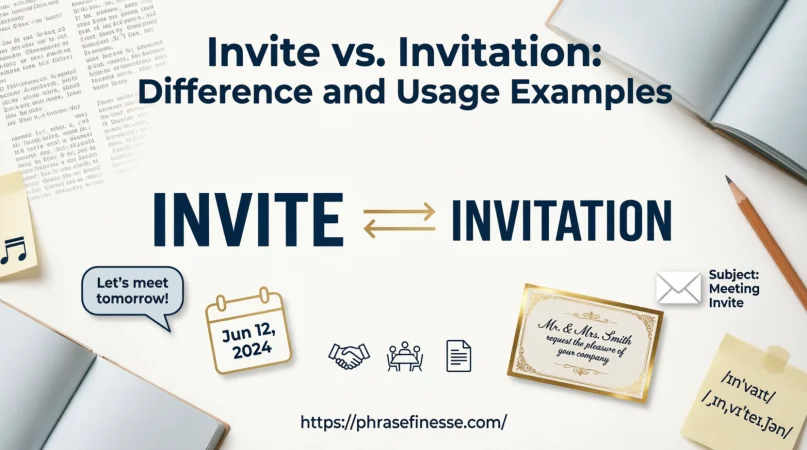
Have you ever wondered whether you should say invite or invitation in a message, email, or conversation? Many English learners and native speakers use these words interchangeably, even though they serve different grammatical purposes.
This Invite vs. Invitation: Difference and Usage Examples guide breaks down the distinction with simple explanations, practical examples, and visual comparisons to help you choose the right word with confidence.
Understanding the difference matters more than you might think. Whether you’re writing a professional email, organizing meetings, managing a calendar, improving business communication, handling online booking, planning events, or coordinating project management, using the correct term makes your writing clearer and more professional.
You’ll also strengthen your English usage, grammar, formal writing, consistency, scheduling, time management, and even communication related to broadcasting or public announcements.
In this article, you’ll learn when invite functions as a verb or noun, when invitation is the better choice, and which expression sounds most natural in different contexts. We’ll also include easy-to-read graphs, real-world examples, common mistakes to avoid, and practical tips that make the rules easier to remember.
By the end, you’ll know exactly which word fits every situation and communicate with greater accuracy and confidence.
Invite vs. Invitation: Quick Summary
Before diving deeper, here’s the short answer.
| Word | Part of Speech | Meaning | Example |
| Invite | Verb and informal noun | To ask someone to attend or participate | “I invited Emma to dinner.” |
| Invitation | Noun | A formal request to attend an event | “I received an invitation to the conference.” |
Quick Rule
- Use invite as a verb anytime.
- Use invitation as the safest noun choice.
- Use noun invite mainly in informal speech and modern digital communication.
What Does “Invite” Mean?
The word invite has existed in English for centuries. Most people recognize it primarily as a verb.
Invite as a Verb
When used as a verb, invite means to ask someone to attend, participate, join, or take part in something.
Examples:
- I invited my neighbors to the barbecue.
- The company invited industry experts to the event.
- She invited me to join the discussion.
- The teacher invited questions from students.
In each example, the action involves extending a request or welcome.
Common Structures with “Invite”
English speakers frequently use these patterns:
| Pattern | Example |
| Invite someone to something | They invited me to the wedding. |
| Invite someone over | We invited friends over for dinner. |
| Invite someone for something | She invited him for coffee. |
| Invite participation | The organization invited public comments. |
Because it functions as a verb, invite fits naturally into both formal and informal communication.
Invite Can Mean More Than Events
Interestingly, invite isn’t limited to parties or meetings.
For example:
- The advertisement invites attention.
- The design invites curiosity.
- His behavior invited criticism.
In these situations, the word suggests encouraging or prompting a response rather than requesting attendance.
Invite as a Noun: Is It Really Correct?
One of the biggest sources of confusion in the invite vs. invitation debate is whether invite can function as a noun.
The answer is yes.
Modern dictionaries recognize noun invite as standard English.
Examples include:
- Thanks for the invite.
- Did you get the invite?
- I never received the Zoom invite.
- The wedding invite arrived yesterday.
These examples sound perfectly natural to many native speakers, especially in North America.
Why Some People Still Object
Traditional language experts often preferred invitation because it sounded more formal and established.
As noun invite became increasingly popular during the twentieth century, some grammar enthusiasts considered it informal or unnecessary.
However, language evolves.
Today, noun invite appears frequently in:
- Email communication
- Workplace conversations
- Social media
- Event planning apps
- Calendar software
- Text messages
While some people still prefer invitation, noun invite is widely accepted.
What Does “Invitation” Mean?
Unlike invite, the word invitation functions only as a noun.
An invitation refers to:
- The request itself
- The document containing the request
- The act of inviting someone
Examples:
- I received an invitation to the ceremony.
- The wedding invitation arrived by mail.
- Thank you for your invitation.
- Invitations will be sent next week.
Why “Invitation” Sounds More Formal
The word has a longer, more traditional history in formal writing.
As a result, people often associate it with:
- Weddings
- Corporate functions
- Academic events
- Official ceremonies
- Government functions
- Charity galas
When professionalism matters, invitation usually sounds more polished.
Invite vs. Invitation: The Main Difference
The core difference comes down to function and formality.
Side-by-Side Comparison
| Feature | Invite | Invitation |
| Verb | Yes | No |
| Noun | Yes | Yes |
| Formality | Casual to neutral | Neutral to formal |
| Business Writing | Sometimes acceptable | Preferred |
| Wedding Usage | Less common | Preferred |
| Digital Communication | Extremely common | Common |
| Traditional Grammar Preference | Lower | Higher |
The Simplest Way to Remember
Think of it like this:
- Invite is shorter, quicker, and often more conversational.
- Invitation sounds more formal and traditional.
Both are correct. The choice depends on context.
How Native Speakers Actually Use These Words
Grammar books tell only part of the story.
Real-world English often follows usage patterns rather than strict rules.
In Casual Conversation
Most native speakers comfortably say:
- Thanks for the invite.
- I got your invite.
- Send me the invite.
- Did you receive the invite?
These phrases sound natural and friendly.
In Formal Situations
People usually switch to:
- Thank you for your invitation.
- We appreciate your invitation.
- An official invitation will be sent shortly.
These expressions carry a more professional tone.
Why the Shift Happens
Language tends to become shorter over time.
People naturally favor efficient communication.
That’s one reason noun invite became increasingly popular, especially as email and digital communication expanded.
Invite vs. Invitation in Professional Communication
Business writing often demands precision and professionalism.
Because of that, invitation usually remains the safer choice.
Preferred Professional Examples
1.✓ Thank you for your invitation.
2.✓ We appreciate the invitation to participate.
3. ✓ An invitation will be forwarded to attendees.
4. ✓ Please accept this invitation to join our conference.
Less Formal Alternatives
1. ✓ Thanks for the invite.
2. ✓ We received your event invite.
3. ✓ The meeting invite was sent earlier.
These alternatives aren’t necessarily wrong. They simply sound less formal.
Email Examples: Invite vs. Invitation
Let’s compare actual workplace scenarios.
Formal Email
Thank you for your invitation to attend the annual leadership summit. We look forward to participating in this important event.
Informal Email
Thanks for the invite. I’d be happy to join the meeting.
Both are correct.
The difference lies in tone rather than grammar.
Invite vs. Invitation in Digital Communication
Technology has dramatically influenced modern English.
Many software platforms now use invite as the default term.
Examples include:
- Calendar invite
- Zoom invite
- Teams invite
- Webinar invite
- Meeting invite
- Event invite
Millions of users encounter these phrases daily.
Why Technology Prefers “Invite”
Several reasons explain this trend:
- Shorter wording
- Easier interface design
- Faster reading
- Better mobile display
- Conversational tone
Software developers often favor concise labels, which helped popularize noun invite.
Real-World Examples
You may receive messages like:
- “Your meeting invite has been updated.”
- “Please accept the calendar invite.”
- “The invite contains the access link.”
These expressions are now standard in many workplaces.
See More :More Than Happy To Help: Meaning, Usage, and Alternatives
Is “Invite” Incorrect as a Noun?
Some people still ask this question.
The answer is simple.
No, invite is not incorrect as a noun.
Major dictionaries recognize noun invite as legitimate English.
What Modern Dictionaries Say
Leading dictionaries include noun definitions for invite and provide examples such as:
- Accepting an invite
- Sending an invite
- Receiving an invite
This widespread recognition reflects actual usage among native speakers.
Why the Debate Continues
Language traditions often change slowly.
Some teachers learned that only invitation was acceptable.
Consequently, they continue teaching that preference even though modern usage has evolved.
British English vs. American English
Regional preferences can influence word choice.
American English
American speakers frequently use noun invite.
Examples:
- Thanks for the invite.
- I got the invite yesterday.
- Send me the Zoom invite.
These phrases sound completely natural.
British English
British speakers often favor invitation, particularly in formal settings.
Examples:
- Thank you for the invitation.
- The invitation arrived this morning.
That said, noun invite also appears in modern British English.
Does It Matter?
Not significantly.
Most English speakers understand both forms instantly.
Context matters far more than regional preference.
Common Mistakes and How to Avoid Them
Even experienced writers occasionally misuse these words.
Using Invitation as a Verb
Incorrect:
❌ She invitationed me to dinner.
Correct:
✓ She invited me to dinner.
Remember:
Invitation is never a verb.
Using Invite in Highly Formal Documents
Less Professional:
❌ We appreciate your invite.
More Professional:
✓ We appreciate your invitation.
Formal communication generally benefits from the more traditional noun.
Assuming Invite Is Always Wrong
Incorrect assumption:
❌ Noun invite is bad grammar.
Reality:
✓ Noun invite is widely accepted modern English.
The issue involves style and formality rather than correctness.
Real-World Examples Across Different Situations
Examining actual scenarios helps clarify usage.
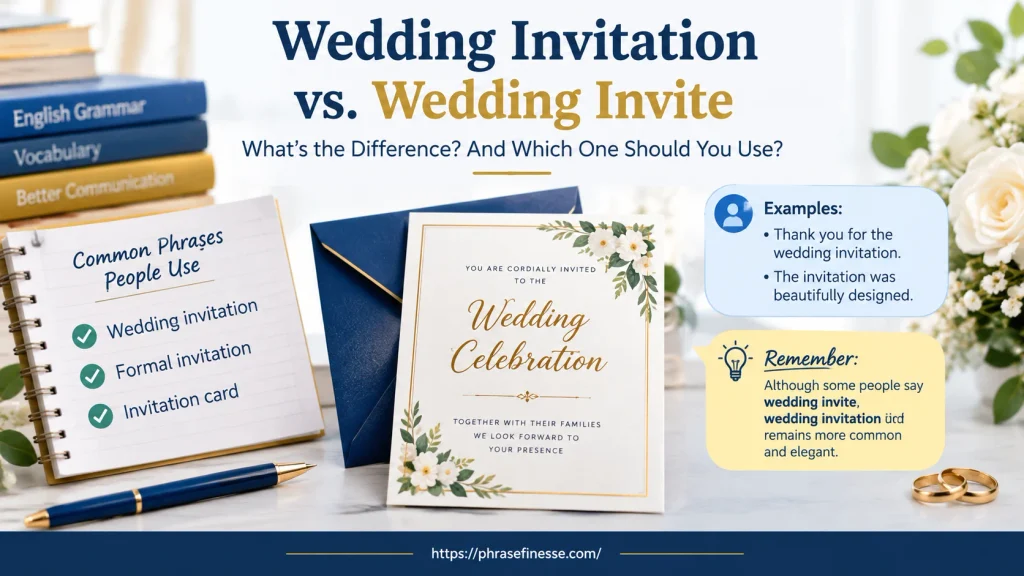
Wedding Context
Most people naturally say:
- Wedding invitation
- Formal invitation
- Invitation card
Examples:
- Thank you for the wedding invitation.
- The invitation was beautifully designed.
Although some people say wedding invite, wedding invitation remains more common and elegant.
Corporate Meeting Context
Modern workplaces often favor shorter language.
Examples:
- The meeting invite has been updated.
- I accepted the calendar invite.
- Check your invite for login details.
These expressions appear daily in business environments.
Birthday Party Context
Both options work.
Examples:
- Thanks for the invite.
- Thanks for the invitation.
The first sounds slightly more casual.
The second sounds slightly more formal.
Neither is incorrect.
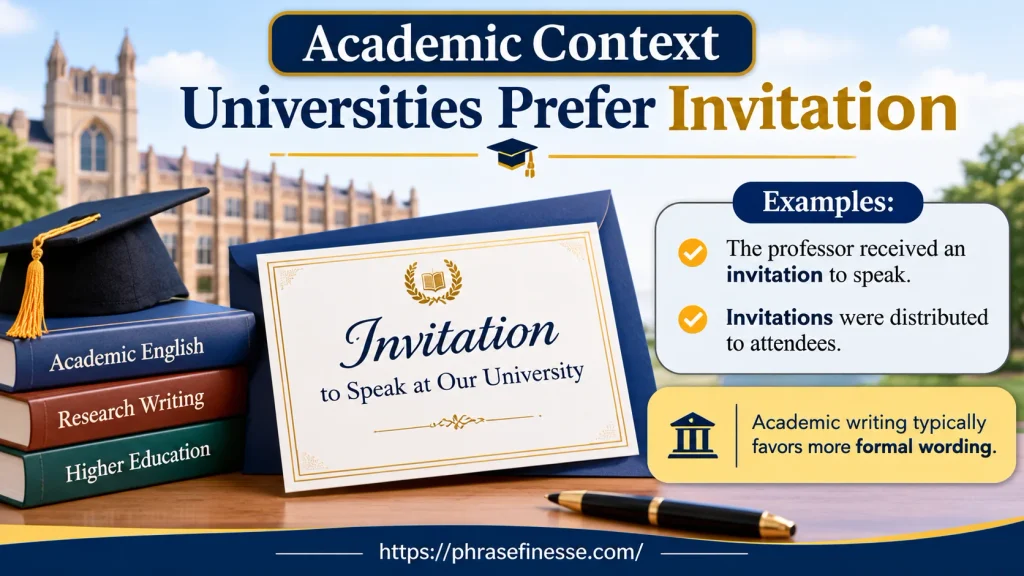
Academic Context
Universities often prefer invitation.
Examples:
- The professor received an invitation to speak.
- Invitations were distributed to attendees.
Academic writing typically favors more formal wording.
Why Invitation Remains Important
Despite the rise of noun invite, invitation continues to dominate certain situations.
Formal Documents
Examples include:
- Diplomatic invitations
- Government invitations
- Wedding invitations
- Scholarship invitations
Prestige and Tradition
Long-standing traditions often preserve formal vocabulary.
A luxury event planner might choose invitation because it conveys elegance and importance.
Reader Expectations
People expect certain wording in formal situations.
A wedding invitation feels traditional.
A wedding invite feels more casual.
Neither is wrong, yet the emotional impact differs.
Invite vs. Invitation Usage Trends
The rise of digital communication changed how people use these words.
Historically, invitation dominated nearly every context.
Over time, invite gained popularity because it offered a shorter alternative.
Estimated Modern Usage Pattern
What the Trend Reveals
Several interesting patterns emerge:
- Informal communication favors invite.
- Formal communication favors invitation.
- Business communication sits somewhere in the middle.
- Digital platforms helped normalize noun invite.
Easy Rule
If you’re writing:
- A wedding card → invitation
- A business proposal → invitation
- A text message → invite
- A calendar request → invite
You’ll almost always sound natural.
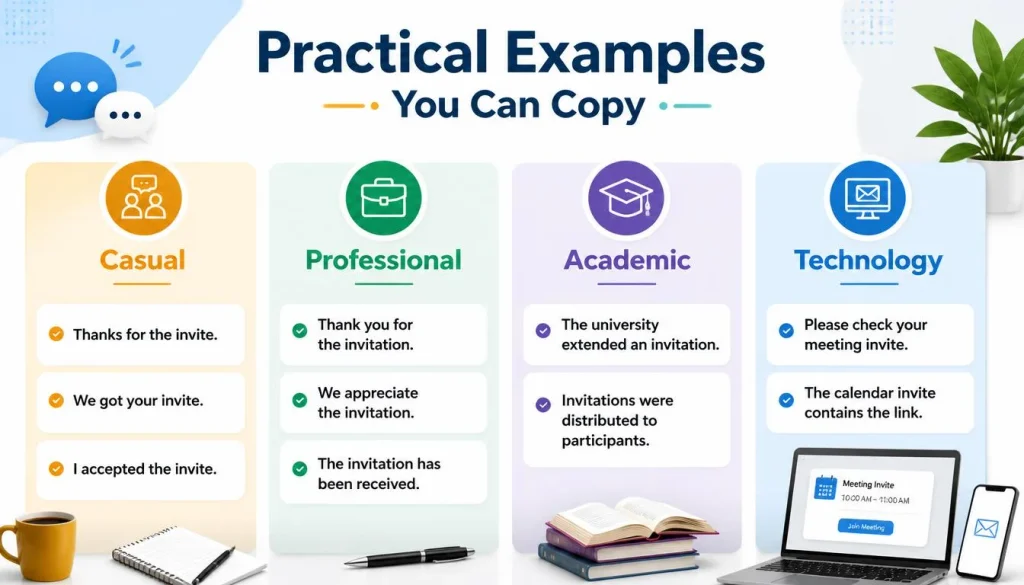
Practical Examples You Can Copy
Casual
- Thanks for the invite.
- We got your invite.
- I accepted the invite.
Professional
- Thank you for the invitation.
- We appreciate the invitation.
- The invitation has been received.
Academic
- The university extended an invitation.
- Invitations were distributed to participants.
Technology
- Please check your meeting invite.
- The calendar invite contains the link.
FAQs
1. What is the main difference between invite and invitation?
The main difference is that invite is primarily a verb meaning “to ask someone to attend,” while invitation is a noun referring to the actual request or document inviting someone.
2. Is it correct to use invite as a noun?
Yes, invite can be used as a noun, especially in informal English. However, invitation is generally preferred in formal writing, business emails, and professional communication.
3. Which is more appropriate for business emails: invite or invitation?
In most professional situations, invitation is the better choice. For example, “Thank you for the invitation.” Use invite as a verb, such as “I’d like to invite you to the meeting.”
4. Can I say “Thanks for the invite”?
Yes. “Thanks for the invite” is grammatically correct and common in casual conversation. In formal contexts, “Thank you for the invitation” sounds more polished.
5. Why do people confuse invite and invitation?
People often confuse them because both relate to asking someone to attend an event. The key difference is their grammatical function: invite usually describes the action, while invitation names the request itself.
6. How can I remember when to use invite or invitation?
A simple trick is to ask whether you’re describing an action or a thing. If it’s the action of asking someone, use invite. If it’s the request, card, email, or message itself, use invitation.
Conclusion
Choosing between invite and invitation is easier once you understand their grammatical roles. In most situations, invite functions as a verb, while invitation is the standard noun used in both everyday and formal writing.
Although invite can also appear as a noun in informal English, especially in casual conversation, invitation remains the preferred choice for professional and written communication.
By learning the difference and reviewing the examples and graphs, you can improve your English usage, strengthen your grammar, and write with greater consistency. Whether you’re sending event emails, arranging meetings, managing a calendar, or communicating in a business communication setting, selecting the correct word makes your message clearer, more natural, and more effective.

[…] See More :Invite vs. Invitation: Difference and Usage Examples […]
[…] Read More: Invite vs. Invitation: Difference and Usage Examples […]