Before sending an email, requesting documents, or asking for information in a professional setting, have you ever wondered if there’s a more polished way to phrase your request? Understanding “6 More Formal Ways To Say “Please Provide…”” can instantly improve your business communication, strengthen your professional image, and make your messages sound more respectful and effective. The right wording often creates a better response while maintaining a courteous tone.
In modern workplaces, clear language matters across meetings, project management, scheduling, and daily correspondence. Whether you’re requesting details for an online booking, coordinating a calendar update, managing time management tasks, or sharing information through internal broadcasting channels, choosing the appropriate expression can make your communication more precise.
Strong formal writing habits also help ensure clarity, professionalism, and consistency in every interaction.
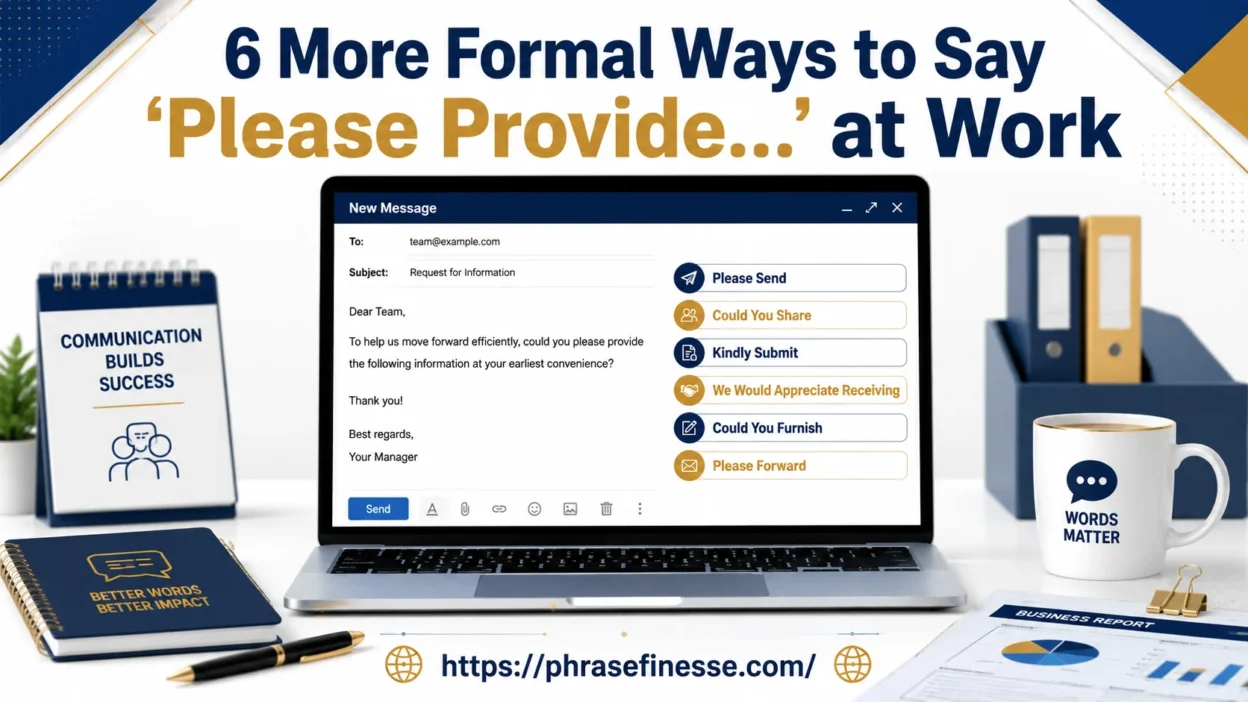
This guide explores six professional alternatives to “Please Provide,” explaining when and how to use each one correctly. Along the way, you’ll gain practical insights into English usage, grammar, workplace etiquette, and tone selection. By the end, you’ll know which phrase best fits different professional situations, helping you communicate with greater confidence and credibility.
Why You Should Avoid Repeating “Please Provide” in Professional Emails
Professional communication isn’t just about being polite. It’s also about being clear, efficient, and audience-focused.
When employees, managers, and clients repeatedly see the same phrase, it can lose impact.
Consider these examples:
- Please provide the updated report.
- Please provide your feedback.
- Please provide the signed agreement.
- Please provide clarification.
While all four sentences are acceptable, they create a repetitive rhythm that can make emails feel mechanical.
A more polished communicator adapts language based on the request.
For example:
- Could you share the updated report?
- We’d appreciate receiving your feedback.
- Kindly submit the signed agreement.
- Could you clarify this matter?
Each request feels more natural because the wording matches the context.
Read More: Froze or Frozen? How to Use Both Words Correctly
The Problem With Overused Business Phrases
Business communication often suffers from “corporate copy-and-paste syndrome.”
Common examples include:
- Please advise
- As per my previous email
- Kindly do the needful
- Please provide
Overusing these expressions can make messages feel impersonal.
Strong communicators focus on clarity rather than relying on stock phrases.
Choosing the Right Level of Formality
Different audiences require different tones.
| Audience | Recommended Formality |
| Coworkers | Moderate |
| Team members | Moderate |
| Managers | Moderate to High |
| Clients | High |
| Vendors | High |
| Legal departments | Very High |
| Government agencies | Very High |
A phrase suitable for a legal request might sound excessive in a quick message to a colleague.
What Makes a Request Sound Professional?
Professional requests generally include four elements:
- Clarity
- Respect
- Brevity
- Context
Instead of focusing solely on sounding formal, focus on making the request easy to understand and act upon.
“Professional communication is not about using bigger words. It’s about making action easier.”
Formal Alternatives to “Please Provide”
Please Send
Among all alternatives to “please provide,” please send is the most versatile.
It sounds direct without being rude.
Best Used For
- Documents
- Reports
- Contracts
- Attachments
- Images
- Presentations
Examples
- Please send the finalized presentation by Friday.
- Please send the signed agreement at your earliest convenience.
- Please send the latest sales report for review.
Why It Works
The phrase immediately tells the recipient what action is required.
There is no ambiguity.
Instead of asking someone to “provide” something, you’re clearly asking them to send it.
When to Avoid It
Avoid using it when requesting explanations, opinions, or complex information.
For example:
❌ Please send your thoughts on the proposal.
Better:
✅ Could you share your thoughts on the proposal?
Could You Share
This phrase creates a collaborative tone.
It feels less transactional and more conversational.
Best Used For
- Team collaboration
- Feedback requests
- Information gathering
- Project discussions
Examples
- Could you share your feedback on the draft?
- Could you share the latest project status?
- Could you share any concerns before the meeting?
Why It Works
The word share suggests collaboration rather than obligation.
As a result, it often feels warmer and more professional in team environments.
When to Avoid It
For legal, compliance, or contractual requests, stronger wording is usually preferable.
Kindly Submit
“Kindly submit” carries a higher level of formality.
It implies that a document or item must be officially delivered.
Best Used For
- HR requests
- Compliance requirements
- Applications
- Government documentation
- Regulatory submissions
Examples
- Kindly submit the required documentation before July 15.
- Kindly submit your expense reports by the deadline.
- Kindly submit all supporting materials for review.
Why It Works
It communicates that completion is expected rather than optional.
When to Avoid It
Using “kindly submit” for casual conversations can sound stiff.
Example:
❌ Kindly submit your lunch preferences.
A simple request would work better.
We Would Appreciate Receiving
This phrase is highly courteous and relationship-oriented.
It works particularly well when communicating with clients or partners.
Best Used For
- Client communications
- Vendor relationships
- Sensitive requests
- High-value stakeholders
Examples
- We would appreciate receiving the updated proposal by Thursday.
- We would appreciate receiving confirmation of your attendance.
- We would appreciate receiving the requested documentation.
Why It Works
It frames the request positively.
Rather than focusing on what you need, it emphasizes appreciation.
When to Avoid It
For urgent matters, this wording may feel too indirect.
Could You Furnish
The word furnish is common in legal, procurement, and contractual communication.
Although less common in everyday business writing, it remains valuable in formal settings.
Best Used For
- Legal requests
- Procurement processes
- Regulatory compliance
- Contract negotiations
Examples
- Could you furnish copies of the requested records?
- Could you furnish evidence supporting the claim?
- Could you furnish the required financial statements?
Why It Works
It conveys precision and professionalism.
When to Avoid It
Using “furnish” in everyday workplace emails can sound overly formal.
Many professionals rarely use it outside legal contexts.
Please Forward
When information already exists and simply needs to be passed along, “please forward” is often the most accurate choice.
Best Used For
- Email chains
- Existing documents
- Previous correspondence
- Approval records
Examples
- Please forward the approved version when available.
- Please forward the meeting minutes.
- Please forward any updates received from the vendor.
Why It Works
The action required is clear.
You’re not requesting new information. You’re requesting transmission of existing information.
When to Avoid It
Don’t use it when asking someone to create a new document.
Comparison Table: Formal Alternatives to “Please Provide”
| Phrase | Formality Level | Best For | Tone |
| Please Send | Moderate | Documents | Direct |
| Could You Share | Moderate | Information | Collaborative |
| Kindly Submit | High | Official Documents | Formal |
| We Would Appreciate Receiving | High | Clients | Courteous |
| Could You Furnish | Very High | Legal Matters | Precise |
| Please Forward | Moderate | Existing Records | Efficient |
How to Choose the Right Alternative to “Please Provide”
Selecting the right phrase depends on three factors:
- Audience
- Purpose
- Urgency
Think about who will read the request and what action you need.
Requesting Documents From Colleagues
Recommended choices:
- Please send
- Could you share
Example:
Could you share the latest version of the report before tomorrow’s meeting?
This sounds professional while maintaining a collaborative tone.
Communicating With Clients
Recommended choices:
- We would appreciate receiving
- Could you share
Example:
We would appreciate receiving the signed agreement by Friday.
The wording remains respectful and client-friendly.
Requesting Information From Vendors
Recommended choices:
- Please send
- Kindly submit
Example:
Kindly submit the requested pricing information by the stated deadline.
Following Up on Outstanding Requests
Follow-up messages require diplomacy.
Recommended choices:
- Could you share
- We would appreciate receiving
Example:
We would appreciate receiving the outstanding documents at your earliest convenience.
Making Urgent Requests Professionally
Urgency should be communicated clearly.
Example:
Please send the requested files by 3:00 PM today to avoid project delays.
Notice how direct wording becomes more appropriate when time matters.
Real-World Case Study: Improving Email Response Rates
A mid-sized consulting company analyzed over 10,000 internal emails.
They discovered that requests using clear action verbs such as:
- Send
- Share
- Submit
- Forward
received faster responses than messages containing vague language.
Employees reported that they immediately understood what action was required.
The result?
- Faster response times
- Fewer clarification emails
- Improved project efficiency
The lesson is simple:
Specific language drives action.
Common Mistakes When Replacing “Please Provide”
Even good alternatives can become ineffective if used incorrectly.
Sounding Overly Formal
Many professionals believe more formal language automatically sounds better.
That’s not always true.
Compare:
Could you furnish the requested information?
Versus:
Could you share the requested information?
For most workplace situations, the second option feels more natural.
Using Legalistic Language in Everyday Emails
Words such as:
- Furnish
- Herewith
- Pursuant
- Therein
may be appropriate in legal documents.
However, they often create unnecessary complexity in routine communication.
Being Too Indirect
Politeness matters.
Clarity matters more.
Instead of:
We would greatly appreciate if you could potentially provide the information when convenient.
Write:
We would appreciate receiving the information by Friday.
Shorter. Clearer. More actionable.
Ignoring Context
The same phrase won’t fit every audience.
A request sent to a government regulator should differ from one sent to a teammate.
Always consider context before choosing your wording.
Email Examples Using Formal Alternatives to “Please Provide”
Requesting Project Documents
Hello Sarah,
Could you share the latest project timeline and supporting documents before tomorrow’s meeting?
Thank you.
Best regards,
Michael
Asking a Client for Information
Dear Mr. Johnson,
We would appreciate receiving the updated project requirements by Thursday so we can proceed with the next phase.
Thank you for your assistance.
Kind regards,
Amanda
Requesting Compliance Records
Dear Compliance Team,
Kindly submit all required documentation related to the annual audit no later than July 15.
Thank you.
Best regards,
David
Following Up on a Previous Request
Hello Lisa,
This is a friendly follow-up regarding the requested materials.
We would appreciate receiving them at your earliest convenience.
Thank you.
Best,
James
Requesting Urgent Documentation
Hello Team,
Please send the finalized contract documents by 2:00 PM today so we can meet the submission deadline.
Thank you.
Regards,
Olivia
Quick Reference for “Please Provide” with Alternatives
| If You Need To… | Best Alternative |
| Request a file | Please Send |
| Ask for information | Could You Share |
| Request official paperwork | Kindly Submit |
| Make a client request | We Would Appreciate Receiving |
| Request legal documents | Could You Furnish |
| Obtain existing records | Please Forward |
FAQs
1. What is a formal alternative to “Please provide”?
Some common formal alternatives include “Could you please furnish,” “Kindly submit,” “Please supply,” and “Would you be able to share.” These phrases sound more professional and are often used in business and academic communication.
2. Is “Please provide” considered professional?
Yes, “Please provide” is generally professional and polite. However, in highly formal settings, alternative expressions may sound more refined and better suited to official correspondence.
3. Which alternative works best in business emails?
The best choice depends on the context. “Could you please provide,” “Kindly submit,” and “Please furnish” are widely accepted in professional emails because they maintain a respectful and courteous tone.
4. Are formal request phrases important in workplace communication?
Absolutely. Using formal request phrases improves business communication, promotes clarity, and helps maintain professionalism during meetings, project management, and client interactions.
5. Can I use these alternatives in academic writing?
Yes. Many formal alternatives to “Please provide” are suitable for academic and administrative communication, especially when requesting documents, references, research materials, or additional information.
6. How do I choose the right alternative to “Please provide”?
Consider your audience, purpose, and level of formality. For official requests, phrases like “Please furnish” or “Kindly submit” work well, while “Could you share” may be more appropriate for collaborative workplace communication.
Conclusion
Choosing the right wording can significantly improve the quality of your professional communication. While “Please provide” is already polite and effective, knowing these 6 More Formal Ways To Say “Please Provide…” allows you to adapt your language to different situations with greater precision.
Whether you’re handling business communication, coordinating meetings, managing projects, or writing formal correspondence, the right phrase helps convey professionalism and respect. By applying these alternatives thoughtfully, you can enhance clarity, maintain consistency, and create stronger professional relationships in every interaction.

Mia Rose is an English language specialist and editorial writer at Phrase Finesse, where she helps readers master grammar, vocabulary, spelling, and effective communication. Passionate about making English simple and practical, she creates well-researched, reader-friendly content that explains complex language concepts in a clear and engaging way.
With extensive experience in English language education, content writing, and editorial review, Mia specializes in grammar, punctuation, word choice, idioms, confusing word pairs, and writing style. Her articles are carefully researched, fact-checked, and designed to help students, professionals, writers, and English learners build confidence in both written and spoken English.