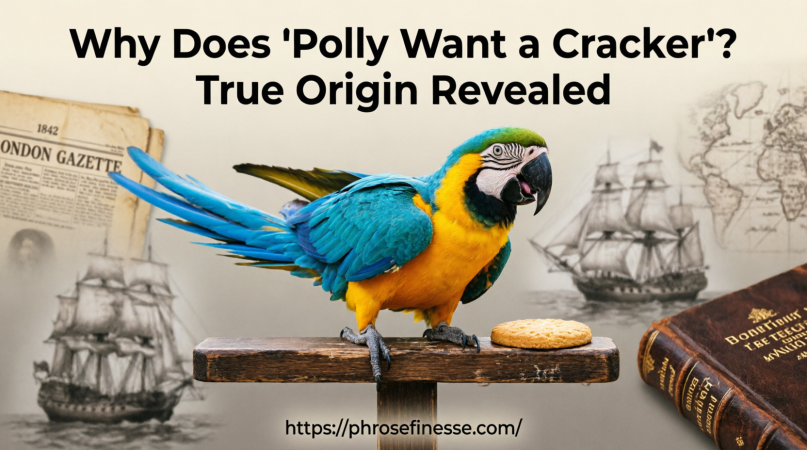
Have you ever wondered why so many people instantly recognize the phrase “Polly Want A Cracker” when talking about parrots? The expression has appeared in popular culture, broadcasting, cartoons, books, and everyday conversations for generations.
In this guide, Why Does “Polly Want A Cracker”? True Origin Revealed explores the fascinating history behind this famous saying, where it came from, and how it became one of the most recognizable phrases associated with talking birds.
The story goes far beyond a parrot asking for a snack. It connects to language history, English usage, grammar, storytelling traditions, and the way phrases spread through media.
Over time, the expression gained popularity through broadcasting, entertainment, and repeated cultural references, creating remarkable consistency in how people imagine parrots speaking.
Understanding its origins also reveals how certain expressions become embedded in everyday communication and remain recognizable across different generations.
In this article, you’ll discover the true meaning and historical roots of “Polly Want A Cracker,” examine the evidence behind its widespread use, and separate fact from folklore.
We’ll also explore its influence on modern language, compare common explanations, and discuss its place in contemporary communication.
While terms such as business communication, formal writing, meetings, project management, scheduling, time management, calendar organization, and online booking rely on clarity and precision, famous expressions like this demonstrate how memorable phrases can shape language and cultural understanding in entirely different ways.
What Does “Polly Want a Cracker” Mean?
At its most basic level, “Polly want a cracker?” is a phrase traditionally taught to pet parrots.
The expression portrays a parrot asking for a treat. While the grammar may sound unusual today, the simplified wording made it easier for birds to imitate. Talking parrots often learn short, repetitive phrases that humans repeat frequently.
For generations, owners taught parrots simple expressions such as:
- Polly want a cracker?
- Hello!
- Pretty bird!
- Good morning!
- Who’s there?
Over time, one phrase stood above the rest.
The words “Polly want a cracker” became shorthand for a talking parrot itself.
How the Phrase Is Used Today
Today, the phrase appears in many contexts:
- Comedy sketches
- Cartoons
- Children’s books
- Advertisements
- Movies
- Everyday jokes
If someone mentions a parrot, chances are someone else will respond with “Polly want a cracker?”
The phrase functions almost like a cultural reflex.
What Is the True Origin of “Polly Want a Cracker”?
One of the biggest misconceptions is that the phrase originated with pirates. Historical evidence suggests otherwise.
The Earliest Known Printed Evidence
Researchers have traced one of the earliest documented appearances of the phrase to 1848.
A satirical publication called The John-Donkey included a cartoon featuring a parrot-like character using language closely associated with the expression.
This evidence matters because it demonstrates that the phrase existed before many later popular explanations emerged.
Why This Discovery Matters
Language historians often rely on printed sources because spoken language rarely leaves records.
When a phrase appears in print, it usually means people were already familiar with it.
That suggests “Polly want a cracker” may have existed in everyday speech even earlier than 1848.
The 1849 Magazine Reference
Another important appearance occurred in 1849 in The Knickerbocker magazine.
The phrase appeared in a humorous context, indicating readers already recognized the reference.
This is a key clue.
Writers generally don’t explain jokes their audience already understands. The fact that readers likely understood the parrot reference suggests the expression had already entered common usage.
How the Phrase Spread Across Society
During the nineteenth century, exotic birds became fashionable pets.
Parrots fascinated people because they could mimic human speech.
As ownership increased, stories and jokes about parrots became more common.
Several factors accelerated the spread of the phrase:
| Factor | Impact |
| Growing pet ownership | Increased exposure to parrots |
| Newspapers | Shared jokes nationwide |
| Stage performances | Popularized animal humor |
| Children’s literature | Introduced phrase to young audiences |
| Advertising | Reinforced the stereotype |
The phrase eventually became inseparable from the public image of parrots.
Why Are Parrots Called “Polly”?
Understanding the phrase requires understanding the name.
Many people assume someone randomly chose Polly for parrots.
The truth goes much deeper.
The History of the Name Poll
Centuries ago, Poll was a common nickname for women named:
- Mary
- Margaret
- Dorothy
- Elizabeth
Nicknames were often transformed into playful forms.
Just as:
- Rob became Bobby
- Will became Willy
- Meg became Peggy
Poll eventually evolved into Polly.
The name became extremely common throughout England.
How Polly Became Associated With Parrots
The connection between Polly and parrots appears in English literature dating back hundreds of years.
Writers frequently assigned human names to animals.
Parrots often received female names because many pet birds were viewed as household companions.
Over time, Polly became the default parrot name.
A Linguistic Snowball Effect
Once enough stories used the name Polly, a cycle developed:
- Writers named parrots Polly.
- Readers saw parrots named Polly.
- Pet owners copied the trend.
- More writers adopted the name.
The pattern repeated for generations.
Eventually, Polly became the parrot equivalent of naming a dog Fido.
Why a Cracker?
Now comes the second half of the mystery.
Why does Polly want a cracker?
Why not fruit, nuts, or seeds?
The answer likely lies in history rather than biology.
Did Parrots Actually Eat Crackers?
Historically, many pet owners fed parrots human food.
Modern bird nutrition emphasizes balanced diets. However, nineteenth-century pet care followed very different standards.
Parrots often received:
- Bread
- Biscuits
- Crackers
- Fruit scraps
- Seeds
- Table leftovers
Crackers were common household foods.
Giving a parrot a small piece of cracker was easy and inexpensive.
As a result, the image of a bird eagerly requesting one felt familiar to audiences.
The Maritime Connection
Some historians point to the age of sailing ships.
Sailors frequently consumed hardtack, a dry biscuit-like cracker designed to last long voyages.
What Was Hardtack?
Hardtack was:
- Extremely durable
- Cheap
- Easy to store
- A staple food aboard ships
Parrots transported on ships may have received pieces of these biscuits.
Although no definitive evidence proves this created the phrase, the connection remains plausible.
Why Crackers Made Sense Culturally
Even if crackers weren’t a favorite parrot food, they made narrative sense.
A cracker was:
- Familiar
- Easy to visualize
- Common in households
- Instantly recognizable
The phrase painted a simple mental picture.
A talking bird asking for a cracker became memorable.
And memorable phrases tend to survive.
See More :Don’t Call Me Late for Dinner Meaning and Origin
Did Pirates Really Teach Parrots to Say It?
Ask most people where the phrase came from and they’ll likely answer:
“Pirates.”
The reality is more complicated.
The Historical Relationship Between Pirates and Parrots
Pirates did encounter exotic birds.
Many traveled through tropical regions where parrots lived naturally.
Colorful birds often appeared among goods transported across oceans.
However, evidence showing pirates commonly kept talking parrots as pets is surprisingly limited.
Popular imagination often exaggerates the relationship.
The Influence of Treasure Island
A major turning point arrived in 1883 with Robert Louis Stevenson’s famous novel:
Treasure Island
The story featured Captain Flint, a talking parrot.
The bird repeatedly shouted memorable phrases.
Readers loved the character.
Soon, parrots and pirates became permanently linked in public imagination.
Fiction Versus Reality
Here’s where confusion begins.
Many people assume:
- Pirates invented the phrase.
- Treasure Island created the phrase.
- Historical pirates taught parrots these words.
None of these claims have strong evidence.
The phrase already existed before Treasure Island was published.
That makes the novel a popularizer rather than the origin.
Common Myths About “Polly Want a Cracker”
Many myths surround this famous saying.
Let’s separate fact from fiction.
| Myth | Reality |
| Pirates invented it | No historical evidence proves this |
| Treasure Island created it | The phrase existed earlier |
| Every parrot was named Polly | Polly became a cultural stereotype |
| Parrots naturally say it | Humans teach the phrase |
| Crackers are ideal parrot food | Modern avian diets recommend healthier options |
| The phrase has a single creator | Its development appears gradual |
Why Can Parrots Mimic Human Speech?
Part of the phrase’s popularity comes from the remarkable abilities of parrots themselves.
Their speech imitation fascinates people.
How Parrots Learn Words
Unlike humans, parrots don’t speak using language in the same way.
Instead, they excel at vocal mimicry.
Their brains are highly adapted for reproducing sounds.
They can imitate:
- Human speech
- Ringing phones
- Doorbells
- Alarms
- Music
- Other animals
Some parrots develop vocabularies exceeding hundreds of words.
Why Mimicry Helps Wild Parrots
In nature, parrots live in social groups.
Communication helps them:
- Identify flock members
- Maintain bonds
- Warn of danger
- Coordinate movement
Mimicking sounds is an extension of these social abilities.
When living with humans, people effectively become part of the bird’s social environment.
Do Parrots Understand What They Say?
This question fascinates scientists.
The answer is nuanced.
Many parrots simply repeat sounds.
Others demonstrate surprising comprehension.
Case Study: Alex the African Grey Parrot
One of the most famous examples is Alex the African Grey Parrot.
Alex participated in decades of cognitive research.
Researchers found he could:
- Identify colors
- Count objects
- Distinguish shapes
- Answer simple questions
His abilities challenged assumptions about animal intelligence.
A Famous Observation
“Alex demonstrated cognitive abilities comparable to young children in several tasks.”
While not every parrot understands language deeply, some clearly connect words with meaning.
How Pop Culture Made the Phrase Famous
Historical origins explain where the phrase came from.
Popular culture explains why it survived.
Hollywood’s Role
Movies expanded the reach of the phrase.
Parrots became convenient comedic characters because they could:
- Interrupt conversations
- Repeat embarrassing secrets
- Deliver punchlines
- Create chaos
The phrase became an instant signal.
No explanation required.
Viewers immediately recognized the joke.
Advertising and Commercial Culture
Advertisers also embraced the expression.
Why?
Because it was:
- Short
- Memorable
- Familiar
- Family-friendly
Brands often borrow cultural shorthand.
“Polly want a cracker” fit perfectly.
Similar Famous Animal Catchphrases
The success of the phrase reflects a broader pattern.
Certain expressions become permanently linked to animals.
| Animal | Famous Phrase |
| Parrot | Polly want a cracker? |
| Dog | Who’s a good boy? |
| Cat | Here kitty kitty |
| Horse | Whoa! |
| Chicken | Cluck cluck |
| Duck | Quack quack |
These phrases function as cultural symbols.
People recognize them instantly.
Why the Phrase Has Endured for More Than 150 Years
Many expressions disappear.
This one survived.
Why?
Several powerful forces worked together.
Simplicity
The phrase contains only four words.
Simple phrases spread quickly.
Humor
A bird requesting a snack feels amusing.
The image remains charming.
Repetition
Generations heard the phrase repeatedly through:
- Books
- Radio
- Newspapers
- Television
- Movies
- Internet memes
Repeated exposure strengthened familiarity.
Strong Visual Imagery
The phrase instantly creates a picture:
A colorful parrot perched on a stand asking for a treat.
Memorable images help language endure.
The Cultural Legacy of “Polly Want a Cracker”
Today, the phrase means far more than its literal words.
It represents:
- Talking parrots
- Animal mimicry
- Childhood nostalgia
- Pirate stereotypes
- Classic humor
- Popular culture history
Few animal expressions have achieved such longevity.
Even people who have never owned a bird recognize it immediately.
That level of cultural recognition is rare.
FAQs
1. Why do parrots say “Polly Want A Cracker”?
Parrots do not naturally say this phrase. They learn it through imitation and training. The expression became popular because owners often taught parrots simple, repetitive phrases that were easy for birds to mimic.
2. Why is the parrot called “Polly”?
The name Polly has long been a common nickname for parrots in English-speaking cultures. Similar to how certain names become associated with particular animals, “Polly” became a traditional name frequently used for pet parrots.
3. Did real parrots commonly ask for crackers?
Not necessarily. While parrots can learn to say almost any phrase, there is little evidence that crackers were a preferred food. The phrase likely became popular because it was simple, memorable, and easy for birds to imitate.
4. Where did the phrase “Polly Want A Cracker” originate?
The exact origin is difficult to pinpoint, but historians trace its popularity to early literature, sailor traditions, and later appearances in entertainment and broadcasting. These influences helped spread the phrase worldwide.
5. Is “Polly Want A Cracker” still used today?
Yes. Although it is less common in everyday speech than in the past, the phrase remains widely recognized in movies, television shows, cartoons, books, and discussions about parrots.
6. Why has the phrase remained so popular for so long?
Its lasting popularity comes from its simplicity, humor, and frequent appearance in popular culture. The phrase is easy to remember, making it a perfect example of how repeated exposure can create long-term cultural consistency and recognition.
Conclusion
The phrase “Polly Want A Cracker” has become one of the most recognizable expressions linked to parrots, but its story is richer than many people realize. Rather than originating from a single source, the saying evolved through a combination of parrot-training practices, popular culture, literature, and broadcasting.
Over time, it became a memorable catchphrase that reinforced the public image of parrots as talkative and entertaining companions.
Understanding the true origin of this famous expression offers valuable insight into how language spreads and endures. Just as rules of English usage, grammar, and formal writing help preserve clarity, repeated cultural references help certain phrases remain relevant across generations.
The enduring popularity of “Polly Want A Cracker” demonstrates the remarkable power of repetition, storytelling, and shared cultural experiences.
Whether you were curious about its historical roots, linguistic significance, or cultural impact, the phrase serves as a fascinating example of how a simple expression can become a lasting part of everyday language. Its continued recognition proves that some sayings never truly fade away.


[…] Read More :Why Does “Polly Want a Cracker”? True Origin Revealed […]