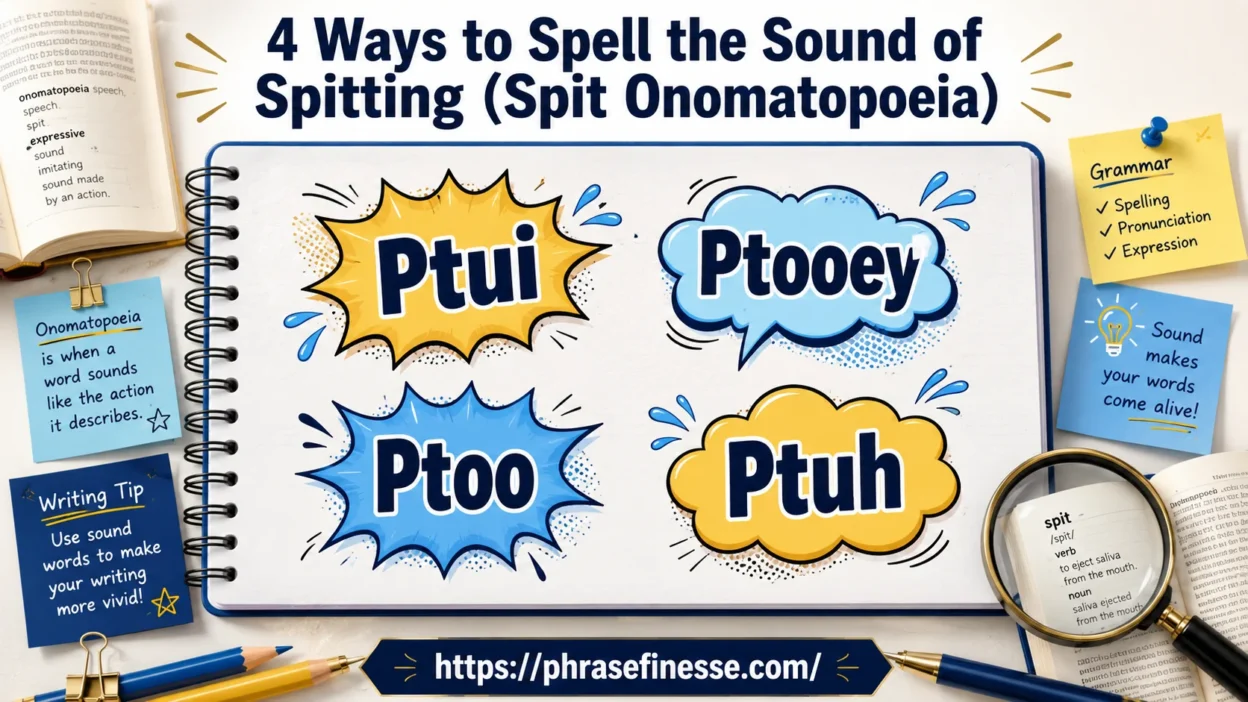
Have you ever wondered how writers accurately represent the sound of someone spitting in dialogue, storytelling, or creative narration? Understanding the 4 Ways To Spell The Sound Of Spitting can make your writing more vivid, realistic, and engaging. Whether you’re crafting fiction, comics, scripts, or descriptive scenes, choosing the right onomatopoeia, sound effect word, and spelling variation helps readers instantly hear the action in their minds.
The English language offers several ways to capture sounds, but not every spelling creates the same effect. In this guide, you’ll learn the most common spellings for the sound of spitting, how they differ in tone, and when each option works best.
We’ll also explore their role in English usage, grammar, creative writing, and formal writing, helping you select the most natural expression for your context. Clear examples will demonstrate how each spelling influences readability and meaning.
Because precise language matters across many forms of communication, from business communication and broadcasting to meetings, project management, and everyday writing, consistency is essential. Even in content related to scheduling, time management, online booking, or maintaining a calendar, accurate word choice improves clarity and professionalism.
By the end of this article, you’ll know exactly which spelling to use and how to apply it effectively for stronger, more expressive writing.
What Is a Spit Onomatopoeia?
An onomatopoeia is a word that imitates a sound.
Common examples include:
- Bang
- Splash
- Buzz
- Meow
- Hiss
- Crack
A spit onomatopoeia works the same way. Instead of describing the action, it attempts to reproduce the sound someone makes while spitting.
For example:
“Ptooey!” he shouted before spitting into the dirt.
The word itself helps readers hear the action rather than simply read about it.
That’s why onomatopoeias are especially common in:
- Fiction
- Graphic novels
- Comics
- Children’s books
- Screenplays
- Video game dialogue
- Humor writing
Why Is There No Single Correct Spelling?
Many sounds in English have standard spellings because they appear frequently in writing.
Spitting is different.
The sound can vary depending on:
- The amount of saliva
- The force of the spit
- The person’s accent
- The emotional context
- Whether mucus is involved
- The distance traveled
Someone spitting in disgust produces a different sound than someone casually spitting after chewing gum.
Because of that variation, writers developed multiple spellings over time.
Factors That Affect Spitting Sounds
| Factor | Effect on Sound |
| Force | Stronger bursts create sharper sounds |
| Emotion | Anger often creates louder sounds |
| Distance | Longer projection changes the sound |
| Mouth Shape | Different mouth positions alter pronunciation |
| Context | Realistic scenes use different spellings than cartoons |
This flexibility explains why you’ll encounter several versions in literature and popular culture.
Ptui: The Classic Literary Spitting Sound
Among all spit onomatopoeias, ptui is arguably the most traditional.
It has appeared in literature, translations, folklore, and historical writing for decades.
How Ptui Sounds
When spoken aloud, it usually sounds similar to:
“Ptoo-ee”
The sound begins abruptly with a burst of air before ending with a short vowel sound.
When Writers Use Ptui
Writers often choose “ptui” when they want to communicate:
- Disgust
- Contempt
- Rejection
- Superstition
- Dramatic emphasis
In some cultures, a variation of “ptui” appears in expressions meant to ward off bad luck.
Example Sentences
- “Ptui!” the old man spat onto the ground.
- She whispered, “Ptui,” after hearing the rumor.
- “Ptui!” cried the merchant in disgust.
Advantages of Ptui
- Feels literary
- Instantly recognizable in many older texts
- Works well in historical fiction
- Conveys strong emotion
Drawbacks of Ptui
- Some readers may not know how to pronounce it
- Can feel old-fashioned
- Less common in modern casual writing
Best Uses
Ptui works particularly well in:
- Historical novels
- Folklore retellings
- Fantasy fiction
- Literary fiction
Ptooey: The Most Expressive Spitting Sound
If spit sounds had personalities, ptooey would be the loudest person in the room.
This version is highly expressive and instantly communicates emotion.
Many readers associate it with exaggerated reactions and dramatic displays of disgust.
How Ptooey Sounds
Most people pronounce it as:
“Ptoo-ee”
The added letters create a longer, more theatrical pronunciation than “ptui.”
Why Writers Love Ptooey
The word practically acts out the emotion on the page.
Readers don’t just see the spit.
They feel the contempt behind it.
Common Emotional Uses
Writers frequently use ptooey to show:
- Disgust
- Revulsion
- Anger
- Mockery
- Rejection
Example Sentences
- “Ptooey!” she shouted after tasting the spoiled soup.
- He spat into the grass. “Ptooey. That’s disgusting.”
- The villain sneered and muttered, “Ptooey.”
Comparison With Ptui
| Feature | Ptui | Ptooey |
| Literary Feel | Strong | Moderate |
| Emotional Intensity | High | Very High |
| Modern Usage | Moderate | Common |
| Humor Potential | Low | High |
| Reader Familiarity | Moderate | High |
Best Uses
Ptooey shines in:
- Children’s books
- Comics
- Humorous fiction
- Dialogue-heavy stories
- Character-driven scenes
Why Sound Effects Matter in Creative Writing
Beginning writers often assume sound effects are minor details.
Experienced writers know better.
A well-chosen onomatopoeia can:
- Improve immersion
- Increase emotional impact
- Strengthen characterization
- Make scenes more memorable
- Enhance pacing
Consider these two examples:
Without sound effect:
He spat onto the sidewalk.
With sound effect:
“Ptooey!” He spat onto the sidewalk.
The second version creates a stronger sensory experience.
Readers don’t simply witness the action.
They hear it.
A Simple Rule for Writers
Use sound effects when they add meaning.
Avoid them when they merely repeat information.
For example:
“Ptooey!” he spat in disgust.
The sound reinforces the emotion.
That’s useful.
But excessive sound effects can make writing feel cartoonish.
Balance is key.
Read More: When to Use a Comma Before and After “Otherwise”: Comma Rules Explained
Choosing the Right Spit Onomatopoeia
Not every spit sound works in every situation.
The best choice depends on:
- Genre
- Audience
- Tone
- Character personality
- Scene intensity
A serious historical novel may benefit from “ptui.”
A humorous comic strip may work better with “ptooey.”
The goal isn’t perfect accuracy.
The goal is helping readers hear the sound you intend them to hear.
“Good onomatopoeia doesn’t copy reality perfectly. It creates the illusion of reality in the reader’s mind.”
In Part 2, we’ll explore the remaining two common spellings—ptoo and ptuh—along with industry usage, examples from fiction, and practical tips for choosing the most effective spit sound for your writing.
4 Ways to Spell the Sound of Spitting (Spit Onomatopoeia)
Spitting is one of those everyday sounds that almost everyone recognizes but few people know how to write. If you’ve ever written fiction, comics, screenplays, or dialogue, you’ve probably stopped and wondered: How do you spell the sound of spitting?
Unlike words such as “bang,” “buzz,” or “hiss,” there isn’t one universally accepted spit onomatopoeia. Different writers hear the sound differently. As a result, multiple spellings have emerged over time.
Some sound dramatic. Others sound realistic. A few are exaggerated for humor or comic effect.
This guide explores the four most common ways to spell the sound of spitting, when to use each one, and how professional writers choose the right version for their audience.
What Is a Spit Onomatopoeia?
An onomatopoeia is a word that imitates a sound.
Common examples include:
- Bang
- Splash
- Buzz
- Meow
- Hiss
- Crack
A spit onomatopoeia works the same way. Instead of describing the action, it attempts to reproduce the sound someone makes while spitting.
For example:
“Ptooey!” he shouted before spitting into the dirt.
The word itself helps readers hear the action rather than simply read about it.
That’s why onomatopoeias are especially common in:
- Fiction
- Graphic novels
- Comics
- Children’s books
- Screenplays
- Video game dialogue
- Humor writing
Why Is There No Single Correct Spelling?
Many sounds in English have standard spellings because they appear frequently in writing.
Spitting is different.
The sound can vary depending on:
- The amount of saliva
- The force of the spit
- The person’s accent
- The emotional context
- Whether mucus is involved
- The distance traveled
Someone spitting in disgust produces a different sound than someone casually spitting after chewing gum.
Because of that variation, writers developed multiple spellings over time.
Factors That Affect Spitting Sounds
| Factor | Effect on Sound |
| Force | Stronger bursts create sharper sounds |
| Emotion | Anger often creates louder sounds |
| Distance | Longer projection changes the sound |
| Mouth Shape | Different mouth positions alter pronunciation |
| Context | Realistic scenes use different spellings than cartoons |
This flexibility explains why you’ll encounter several versions in literature and popular culture.
Ptui: The Classic Literary Spitting Sound
Among all spit onomatopoeias, ptui is arguably the most traditional.
It has appeared in literature, translations, folklore, and historical writing for decades.
How Ptui Sounds
When spoken aloud, it usually sounds similar to:
“Ptoo-ee”
The sound begins abruptly with a burst of air before ending with a short vowel sound.
When Writers Use Ptui
Writers often choose “ptui” when they want to communicate:
- Disgust
- Contempt
- Rejection
- Superstition
- Dramatic emphasis
In some cultures, a variation of “ptui” appears in expressions meant to ward off bad luck.
Example Sentences
- “Ptui!” the old man spat onto the ground.
- She whispered, “Ptui,” after hearing the rumor.
- “Ptui!” cried the merchant in disgust.
Advantages of Ptui
- Feels literary
- Instantly recognizable in many older texts
- Works well in historical fiction
- Conveys strong emotion
Drawbacks of Ptui
- Some readers may not know how to pronounce it
- Can feel old-fashioned
- Less common in modern casual writing
Best Uses
Ptui works particularly well in:
- Historical novels
- Folklore retellings
- Fantasy fiction
- Literary fiction
Ptooey: The Most Expressive Spitting Sound
If spit sounds had personalities, ptooey would be the loudest person in the room.
This version is highly expressive and instantly communicates emotion.
Many readers associate it with exaggerated reactions and dramatic displays of disgust.
How Ptooey Sounds
Most people pronounce it as:
“Ptoo-ee”
The added letters create a longer, more theatrical pronunciation than “ptui.”
Why Writers Love Ptooey
The word practically acts out the emotion on the page.
Readers don’t just see the spit.
They feel the contempt behind it.
Common Emotional Uses
Writers frequently use ptooey to show:
- Disgust
- Revulsion
- Anger
- Mockery
- Rejection
Example Sentences
- “Ptooey!” she shouted after tasting the spoiled soup.
- He spat into the grass. “Ptooey. That’s disgusting.”
- The villain sneered and muttered, “Ptooey.”
Comparison With Ptui
| Feature | Ptui | Ptooey |
| Literary Feel | Strong | Moderate |
| Emotional Intensity | High | Very High |
| Modern Usage | Moderate | Common |
| Humor Potential | Low | High |
| Reader Familiarity | Moderate | High |
Best Uses
Ptooey shines in:
- Children’s books
- Comics
- Humorous fiction
- Dialogue-heavy stories
- Character-driven scenes
Why Sound Effects Matter in Creative Writing
Beginning writers often assume sound effects are minor details.
Experienced writers know better.
A well-chosen onomatopoeia can:
- Improve immersion
- Increase emotional impact
- Strengthen characterization
- Make scenes more memorable
- Enhance pacing
Consider these two examples:
Without sound effect:
He spat onto the sidewalk.
With sound effect:
“Ptooey!” He spat onto the sidewalk.
The second version creates a stronger sensory experience.
Readers don’t simply witness the action.
They hear it.
A Simple Rule for Writers
Use sound effects when they add meaning.
Avoid them when they merely repeat information.
For example:
“Ptooey!” he spat in disgust.
The sound reinforces the emotion.
That’s useful.
But excessive sound effects can make writing feel cartoonish.
Balance is key.
Choosing the Right Spit Onomatopoeia
Not every spit sound works in every situation.
The best choice depends on:
- Genre
- Audience
- Tone
- Character personality
- Scene intensity
A serious historical novel may benefit from “ptui.”
A humorous comic strip may work better with “ptooey.”
The goal isn’t perfect accuracy.
The goal is helping readers hear the sound you intend them to hear.
“Good onomatopoeia doesn’t copy reality perfectly. It creates the illusion of reality in the reader’s mind.”
In Part 2, we’ll explore the remaining two common spellings—ptoo and ptuh—along with industry usage, examples from fiction, and practical tips for choosing the most effective spit sound for your writing.
FAQs About The Sound Of Spitting
1. What is the most common way to spell the sound of spitting?
The most common spelling depends on the context, but words like “ptooey,” “ptui,” “ptoo,” and “pfft” are frequently used to represent the sound of spitting in English writing. Each spelling creates a slightly different effect and tone.
2. Is there an official dictionary spelling for the sound of spitting?
Not always. Many onomatopoeic words are based on how writers interpret sounds. While some forms appear in dictionaries, creative writing often allows flexibility when spelling the sound of spitting.
3. Which spelling should I use in fiction writing?
Choose the spelling that best matches the scene and character. “Ptooey” often suggests disgust, while “ptoo” may sound more neutral. The right choice depends on the emotion and emphasis you want to convey.
4. Are spitting sound words considered onomatopoeia?
Yes. Words used to imitate the sound of spitting are examples of onomatopoeia, a literary device that recreates real-world sounds through written language.
5. Can I use spitting sound spellings in formal writing?
Generally, no. Formal writing, academic documents, and professional reports rarely use onomatopoeia. These spellings are more common in creative writing, storytelling, comics, scripts, and informal content.
6. Why are there multiple ways to spell the sound of spitting?
Sounds are often difficult to capture exactly in writing. Different authors, regions, and writing styles have developed various spellings to reflect subtle differences in pronunciation, emphasis, and emotional tone.
Conclusion
The 4 Ways To Spell The Sound Of Spitting demonstrate how flexible and expressive the English language can be. Although there is no single universally accepted spelling, options such as “ptooey,” “ptui,” “ptoo,” and “pfft” each bring their own nuance to a piece of writing. Understanding these differences helps writers create more vivid scenes and realistic dialogue.
Whether you’re writing fiction, comics, scripts, or descriptive content, selecting the right onomatopoeia can strengthen reader engagement and improve clarity. By considering tone, context, and intended effect, you can confidently choose the spelling that best matches your message and makes your writing more dynamic and memorable.

Emma Brooke is an English language specialist, editor, and content writer at Phrase Finesse, where she helps readers develop stronger writing and communication skills through clear, practical, and engaging content. With a passion for the English language, she specializes in simplifying grammar rules, vocabulary, spelling, punctuation, and word usage for learners at every level.
Emma has extensive experience creating educational content that is accurate, well-researched, and easy to understand. She is particularly skilled at explaining confusing word pairs, grammar concepts, idioms, sentence structure, and effective writing techniques, making complex topics approachable for students, professionals, educators, and English learners worldwide.