
Have you ever wondered whether Address an Issue – Meaning, Usage, and Helpful Examples means solving a problem, discussing it, or simply bringing it to someone’s attention? This common expression appears in business communication, professional emails, meetings, project management, and everyday conversations, yet many English learners still struggle to use it correctly.
Understanding its meaning helps you communicate with greater clarity, consistency, and confidence.
In this guide, you’ll learn exactly what “address an issue” means, when it should be used, and how it differs from similar expressions such as resolve an issue, discuss a problem, or handle a concern. We’ll break down the grammar, explain proper English usage, and provide practical examples for both formal and informal situations.
Whether you’re writing reports, participating in business communication, or improving your formal writing, you’ll discover the most natural ways to use this phrase.
You’ll also find real-world examples covering workplace conversations, customer support, academic writing, and professional correspondence. We’ll explore how the expression fits naturally into contexts involving project management, time management, scheduling, calendar planning, meetings, online booking, and even broadcasting communications.
By the end of this article, you’ll know how to use “address an issue” accurately, avoid common mistakes, and write with greater precision in both spoken and written English.
What Does “Address an Issue” Mean?
The phrase “address an issue” means:
To acknowledge a problem, examine it, and take steps toward handling or solving it.
The key point is that addressing an issue does not necessarily mean the issue has already been solved. Instead, it means that someone has begun dealing with it in a meaningful way.
For example:
- The manager addressed the issue during the meeting.
- The company addressed customer complaints promptly.
- School officials addressed concerns about student safety.
In each example, attention is given to the problem. Action may or may not fully resolve it.
The Core Idea Behind the Expression
When people address an issue, they typically follow three stages:
Issue Identified
↓
Issue Discussed
↓
Action Taken
This sequence helps explain why the phrase is so common in professional communication.
Addressing an issue involves:
- Recognizing a problem exists
- Understanding its causes
- Discussing possible solutions
- Taking corrective action
- Monitoring progress
Without action, a person may merely be discussing the issue rather than addressing it.
Difference Between Discussing and Addressing an Issue
Many people use these expressions interchangeably. However, they are not identical.
| Expression | Meaning | Action Required? |
| Discuss an issue | Talk about a problem | No |
| Address an issue | Take steps to handle a problem | Yes |
| Resolve an issue | Completely solve a problem | Yes |
Consider this example:
Discussion:
The team talked about declining sales.
Addressing:
The team analyzed sales data and implemented a new marketing strategy.
Resolution:
Sales increased by 20%, eliminating the problem.
Notice the progression. Addressing sits between discussion and resolution.
How to Use “Address an Issue” Correctly
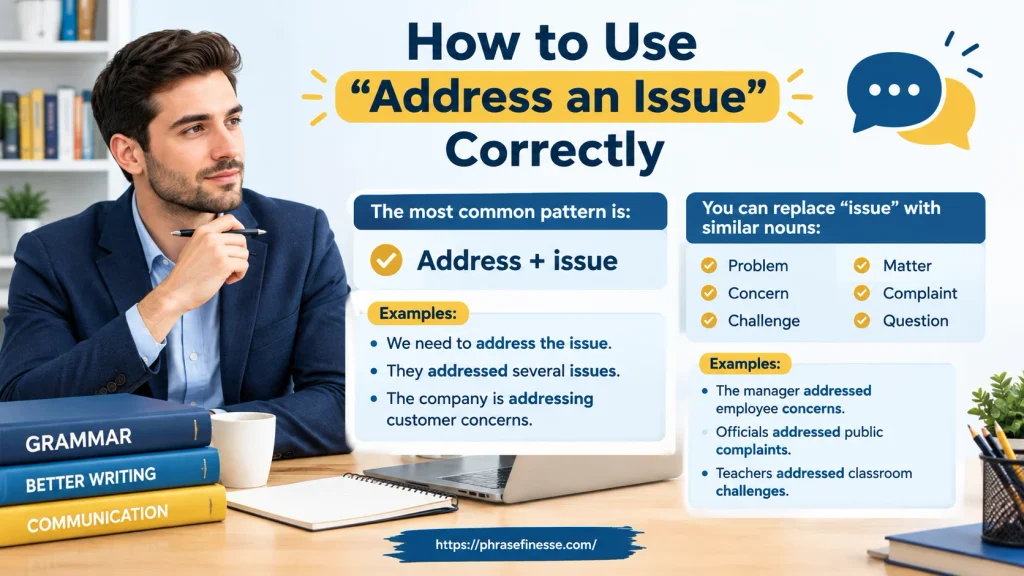
The most common pattern is:
Address + issue
Examples:
- We need to address the issue.
- They addressed several issues.
- The company is addressing customer concerns.
You can replace “issue” with similar nouns:
- Problem
- Concern
- Challenge
- Matter
- Complaint
- Question
Examples:
- The manager addressed employee concerns.
- Officials addressed public complaints.
- Teachers addressed classroom challenges.
Common Grammar Patterns
Present Tense
- We address issues quickly.
- The company addresses customer concerns.
Past Tense
- The team addressed the issue yesterday.
- Management addressed the complaint promptly.
Present Continuous
- We are addressing the issue now.
- Officials are addressing safety concerns.
Future Tense
- The organization will address the issue next week.
- Leaders will address the matter during the meeting.
Formal vs. Informal Usage
The phrase works best in formal and professional contexts.
Formal Examples
- We must address operational inefficiencies.
- The committee addressed policy concerns.
Informal Examples
While possible, it may sound slightly formal:
- Let’s address this problem before dinner.
- We should address what’s bothering you.
In casual conversations, people often prefer:
- Deal with
- Fix
- Handle
- Sort out
Examples of “Address an Issue” in Sentences
Seeing real examples helps you understand usage more naturally.
Workplace Examples
Businesses use this phrase constantly.
Examples:
- The CEO addressed concerns regarding employee retention.
- Human Resources addressed workplace conflicts.
- The company addressed customer complaints within 24 hours.
Mini Case Study
A software company noticed rising customer dissatisfaction.
Instead of ignoring feedback, management:
- Collected customer surveys
- Identified recurring problems
- Improved support systems
- Released software updates
As a result, customer satisfaction increased significantly.
The company successfully addressed the issue before it damaged its reputation.
Academic Examples
Schools and universities frequently use the expression.
Examples:
- The professor addressed questions about the assignment.
- Administrators addressed concerns regarding campus security.
- Researchers addressed limitations in their study.
Academic writing often favors this phrase because it sounds objective and professional.

Everyday Conversation Examples
People also use the phrase in daily life.
Examples:
- We need to address the tension between family members.
- They addressed concerns about neighborhood traffic.
- Let’s address this misunderstanding before it grows.
Although slightly formal, it remains perfectly natural.
Government and Public Policy Examples
Government agencies often use the phrase when discussing societal challenges.
Examples:
- Officials addressed rising unemployment.
- Lawmakers addressed concerns about healthcare access.
- The city addressed infrastructure problems.
Public statements commonly include this wording because it suggests responsibility and action.
When Should You Use “Address an Issue”?
Situations Where the Phrase Fits Naturally
The phrase works particularly well when discussing problem-solving.
Common situations include:
Meetings
- Team meetings
- Board meetings
- Community meetings
Reports
- Business reports
- Academic reports
- Government reports
Emails
- Customer support emails
- Professional correspondence
- Internal communications
Presentations
- Business presentations
- Training sessions
- Public speeches
Situations Where Another Phrase May Work Better
Sometimes alternatives sound more natural.
For example:
Instead of:
We need to address the issue of dirty dishes.
You could simply say:
We need to wash the dishes.
Specific actions often communicate more effectively than broad expressions.
Common Alternatives to “Address an Issue”
Writers and speakers benefit from varying their vocabulary.
Formal Alternatives
| Alternative | Meaning | Best Context |
| Resolve an issue | Solve completely | Business |
| Tackle an issue | Work aggressively | Leadership |
| Examine an issue | Investigate | Academic |
| Respond to an issue | React | Customer service |
| Handle an issue | Manage | General professional use |
Informal Alternatives
These options sound more conversational:
- Deal with a problem
- Fix a problem
- Sort out a problem
- Work through a challenge
- Take care of a concern
Example:
Instead of:
We need to address the issue.
You could say:
We need to sort this out.
Address an Issue vs. Similar Expressions
Understanding these subtle differences improves communication.
Address an Issue vs. Resolve an Issue
Many people assume these phrases mean the same thing.
They don’t.
Address an Issue
- Problem acknowledged
- Action begins
- Solution may not exist yet
Resolve an Issue
- Problem solved
- Desired outcome achieved
| Phrase | Problem Acknowledged | Action Taken | Problem Solved |
| Address an issue | Yes | Yes | Not necessarily |
| Resolve an issue | Yes | Yes | Yes |
Address an Issue vs. Deal With an Issue
These phrases overlap significantly.
However:
Address an issue sounds more formal.
Deal with an issue sounds more conversational.
Examples:
- The board addressed the issue.
- I dealt with the issue this morning.
Both are correct.
Address an Issue vs. Tackle an Issue
The phrase tackle an issue implies stronger action.
Think of a football player tackling an opponent.
The metaphor suggests energy and determination.
Examples:
- The committee addressed the issue.
- The committee tackled the issue aggressively.
The second sentence sounds more proactive.
Read More: Within 30 Days: Meaning, Usage, and 7 Examples
Address an Issue vs. Discuss an Issue
This distinction matters.
Discuss
- Talk about it
- Exchange ideas
- No action required
Address
- Analyze it
- Respond to it
- Take action
A discussion may lead to action.
Addressing requires action.
Common Mistakes When Using “Address an Issue”
Even experienced writers occasionally misuse the phrase.
Assuming It Always Means Solve
This is the most common error.
Consider:
Management addressed employee concerns.
This does not automatically mean employees became satisfied.
It simply means management took action.
Using It for Non-Issues
The word issue implies some form of challenge, concern, or problem.
Less natural:
We addressed the issue of choosing pizza toppings.
More natural:
We discussed pizza toppings.
Not every topic qualifies as an issue.
Overusing the Phrase
Business writing often becomes repetitive.
Instead of repeatedly writing:
- Address the issue
- Address the issue
- Address the issue
Mix in alternatives:
- Resolve
- Handle
- Examine
- Tackle
- Respond to
This improves readability.
Choosing the Wrong Level of Formality
In casual situations, simpler wording often works better.
Formal:
We must address this concern.
Casual:
Let’s fix this.
Match your language to your audience.
Is “Address an Issue” Formal?
Professional Writing
Yes.
The phrase appears frequently in:
- Business communication
- Corporate reports
- Executive summaries
- Performance reviews
Example:
Leadership has taken steps to address operational challenges.
This sounds professional and polished.
Academic Writing
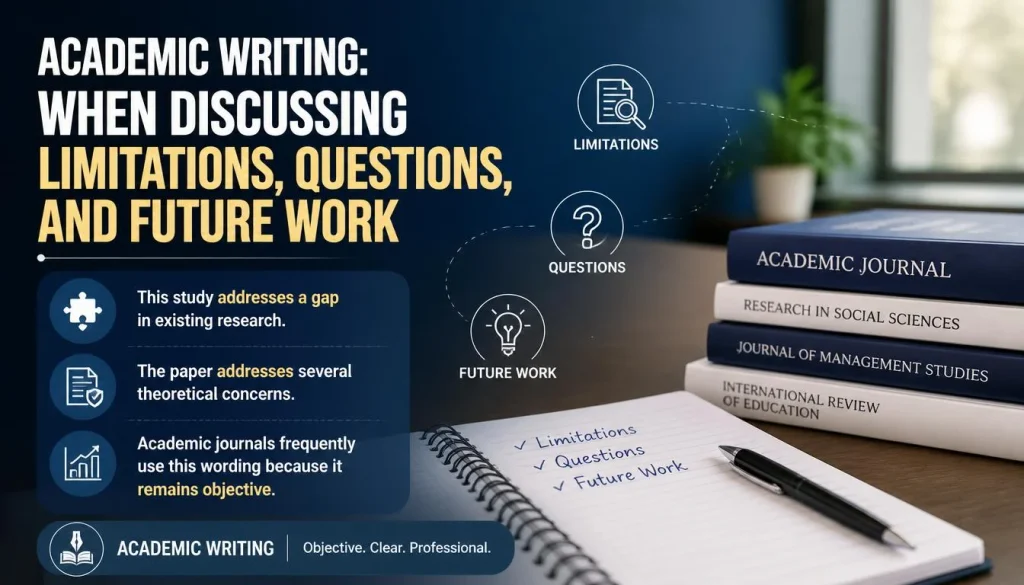
Researchers often use the phrase when discussing limitations, questions, and future work.
Examples:
- This study addresses a gap in existing research.
- The paper addresses several theoretical concerns.
Academic journals frequently use this wording because it remains objective.
Everyday English
Native speakers also use it naturally.
Examples:
- We should address this misunderstanding.
- Let’s address the problem before it gets worse.
The phrase remains understandable in almost any setting.
Real-World Examples From Different Contexts
In a Business Email
Example:
Thank you for bringing this matter to our attention. We are currently addressing the issue and will provide an update within 48 hours.
Why it works:
- Acknowledges the concern
- Shows action
- Sets expectations
In a Team Meeting
Example:
Before moving forward, let’s address the issue affecting project deadlines.
Why it works:
- Focuses attention
- Encourages problem-solving
- Creates accountability
In a School Setting
Example:
School administrators addressed concerns regarding student transportation.
Why it works:
- Demonstrates responsiveness
- Indicates action
- Maintains professional tone
In Public Statements
Example:
Local officials are addressing concerns about road safety.
Why it works:
- Reassures the public
- Signals responsibility
- Communicates ongoing action
Synonyms and Related Phrases Cheat Sheet
| Expression | Formality | Implies Action | Implies Solution |
| Address an issue | Formal-Neutral | Yes | No |
| Resolve an issue | Formal | Yes | Yes |
| Deal with an issue | Neutral | Yes | Sometimes |
| Tackle an issue | Neutral | Yes | No |
| Discuss an issue | Neutral | No | No |
| Examine an issue | Formal | Limited | No |
| Handle an issue | Neutral | Yes | Sometimes |
| Respond to an issue | Formal | Yes | No |
Quick Reference Guide
Meaning
Address an issue means:
Recognize, discuss, and take action regarding a problem, concern, or challenge.
Tone
The phrase is generally:
- Professional
- Neutral
- Formal without sounding overly technical
Common Contexts
You will frequently see it in:
- Business communication
- Government reports
- Academic writing
- Customer service
- Workplace discussions
- Public relations statements
Best Synonyms
Depending on context, consider:
- Resolve
- Handle
- Tackle
- Deal with
- Respond to
- Examine
FAQs
1. What does “address an issue” mean?
“Address an issue” means to deal with, discuss, or give attention to a problem or concern. It doesn’t always mean the issue has been solved—only that it is being acknowledged or handled.
2. Is “address an issue” formal or informal?
The phrase is generally considered neutral to formal. It’s commonly used in business communication, workplace discussions, academic writing, and professional emails, but it also sounds natural in everyday conversations.
3. Does “address an issue” mean the same as “resolve an issue”?
No. Addressing an issue means taking action or discussing the problem, while resolving an issue means finding a complete solution. You can address an issue without resolving it immediately.
4. Can I use “address an issue” in an email?
Yes. It’s a widely accepted phrase in professional emails and formal writing. For example: “I’d like to address an issue regarding the project timeline.”
5. What are some alternatives to “address an issue”?
Depending on the context, you can use:
- Deal with an issue
- Handle a concern
- Discuss a problem
- Respond to an issue
- Resolve a concern (when a solution has been found)
- Tackle a problem
6. Is “address an issue” grammatically correct?
Yes. “Address an issue” is a grammatically correct and widely used English expression. It follows standard English usage and appears frequently in professional documents, workplace communication, and everyday speech.
Conclusion
Understanding “address an issue” goes beyond knowing its dictionary definition. It means recognizing when to discuss, acknowledge, or deal with a problem in a way that suits the situation.
Whether you’re writing a professional email, speaking during meetings, preparing formal writing, or improving your everyday English usage, this phrase helps you communicate clearly and professionally.
As you’ve seen throughout this guide, the best way to use “address an issue” depends on the context and your intended meaning.
By following the examples, grammar tips, and common usage patterns covered in this article, you can avoid confusion and express yourself with greater clarity, consistency, and confidence in both personal and business communication.