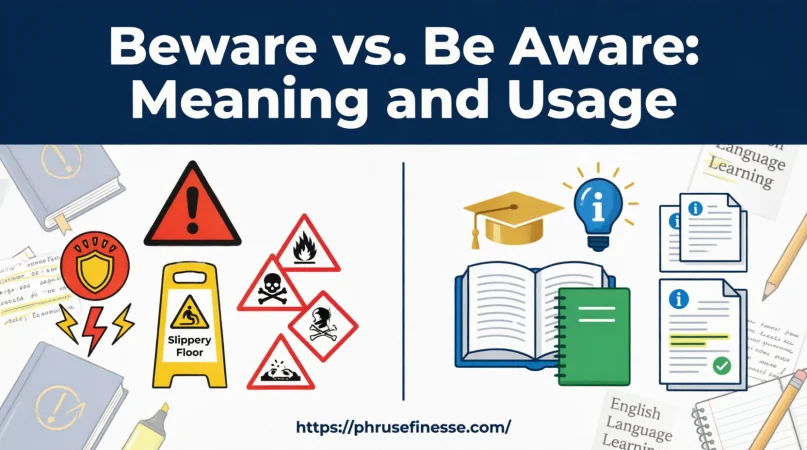
Have you ever paused while writing an email or report and wondered whether to use “beware” or “be aware”? Although these expressions seem similar, they carry different meanings and are used in different situations. In this guide, “Beware” vs. “Be Aware” – Difference Explained (With Examples), you’ll learn when each phrase is appropriate, how native speakers use them, and why choosing the right one improves English usage, grammar, and overall communication.
Understanding the distinction is especially important in business communication, formal writing, and everyday conversations. Whether you are drafting messages about project management, discussing deadlines in meetings, managing a calendar, or sharing updates related to scheduling and time management, the correct phrase helps convey your intended message with greater precision.
Small language choices often make a big difference in professional and academic settings.
This article breaks down the meanings, grammatical functions, and real-world applications of both expressions.
You’ll discover practical examples from workplace communication, online booking systems, broadcasting announcements, and other common contexts. By the end, you’ll understand how to use “beware” and “be aware” with confidence, maintain consistency in your writing, and avoid one of the most common mistakes in modern English.
Quick Answer
The easiest way to understand the difference is this:
| Phrase | Meaning | Purpose |
| Beware | Be careful because danger may exist | Warning |
| Be Aware | Know or understand something | Information |
Example
✅ Beware of pickpockets.
This warns you about a possible threat.
✅ Be aware of local customs.
This simply informs you about something important.
Simple Rule
Think of it this way:
| Situation | Correct Phrase |
| Danger, risk, threat | Beware |
| Information, knowledge, understanding | Be aware |
When danger enters the picture, beware is usually the better choice.
When you’re sharing information, be aware is normally correct.
What Does “Beware” Mean?
The word beware means to be cautious because something dangerous, harmful, or unpleasant might happen.
Unlike many English verbs, beware almost always carries a warning. It tells someone to pay attention and protect themselves from potential trouble.
Dictionary Meaning
Beware: To be on guard against possible danger, harm, or deception.
The word comes from older forms of English that combined the idea of being alert and watchful.
Today, you’ll frequently see it on:
- Warning signs
- Safety notices
- Legal disclaimers
- Consumer alerts
- Travel advisories
Examples of Beware
- Beware of falling rocks.
- Beware of fake investment schemes.
- Beware of online fraud.
- Beware of strong currents.
- Beware of aggressive animals.
Notice a pattern?
Every example contains some form of danger, risk, or negative consequence.
Why “Beware” Sounds Strong
The phrase creates urgency.
When someone hears “beware,” they instinctively think:
“Something bad could happen if I’m not careful.”
That emotional impact makes the word powerful.
For example:
Mild Information
Be aware of icy roads.
Strong Warning
Beware of icy roads.
Both sentences concern safety.
However, the second sounds much more serious.
Common Situations Where “Beware” Is Used
Public Safety Warnings
You’ll often find beware on signs.
Examples:
- Beware of dogs.
- Beware of falling debris.
- Beware of slippery surfaces.
These warnings immediately alert people to potential hazards.
Consumer Protection
Businesses and governments often warn consumers.
Examples:
- Beware of counterfeit products.
- Beware of fraudulent websites.
- Beware of fake customer support calls.
Scammers constantly develop new tricks. As a result, these warnings appear frequently in public awareness campaigns.
Travel Advisories
Tourists often encounter warnings such as:
- Beware of pickpockets.
- Beware of unofficial taxi services.
- Beware of currency exchange scams.
These warnings help travelers avoid common problems.
Online Security
Cybersecurity experts regularly use the word.
Examples include:
- Beware of phishing emails.
- Beware of suspicious attachments.
- Beware of fake login pages.
Because digital threats evolve rapidly, strong warning language remains important.
What Does “Be Aware” Mean?
Unlike beware, be aware focuses on knowledge rather than danger.
When you tell someone to be aware of something, you’re encouraging them to understand, recognize, or remember information.
Danger may exist, but it isn’t required.
Definition
Be aware: To know about something or have understanding of it.
The phrase emphasizes awareness, not fear.
Examples of Be Aware
- Be aware of the company’s refund policy.
- Be aware of local regulations.
- Be aware of upcoming deadlines.
- Be aware of changes to the schedule.
- Be aware of weather forecasts.
Notice something important.
None of these examples necessarily involve danger.
Instead, they involve useful information.
Why “Be Aware” Sounds Softer
This phrase informs rather than warns.
Compare:
Warning
Beware of phishing scams.
Information
Be aware of the latest cybersecurity guidelines.
The first highlights a threat.
The second highlights knowledge.
Common Situations Where “Be Aware” Is Used
Workplace Communication
Managers frequently use this phrase.
Examples:
- Be aware of updated company policies.
- Be aware of reporting requirements.
- Be aware of changes to the project timeline.
The goal is communication rather than warning.
Academic Settings
Teachers often use it when explaining requirements.
Examples:
- Be aware of submission deadlines.
- Be aware of citation guidelines.
- Be aware of examination policies.

Customer Service
Companies regularly inform customers.
Examples:
- Please be aware of processing times.
- Be aware of shipping restrictions.
- Be aware that prices may vary.
Legal and Official Notices
Government agencies often write:
- Be aware of new regulations.
- Be aware of tax deadlines.
- Be aware of eligibility requirements.
Again, information remains the focus.
Beware vs. Be Aware: Side-by-Side Comparison
The differences become clearer when viewed together.
| Feature | Beware | Be Aware |
| Primary Purpose | Warning | Information |
| Implies Danger | Usually | Not necessarily |
| Emotional Tone | Strong | Neutral |
| Common in Warning Signs | Very common | Rare |
| Common in Business Writing | Less common | Very common |
| Focus | Protection | Understanding |
| Suggests Immediate Action | Often | Sometimes |
| Formality | Neutral | Neutral |
Example Pairs
Online Safety
- Beware of phishing emails.
- Be aware of email security policies.
Travel
- Beware of pickpockets.
- Be aware of local customs.
Shopping
- Beware of counterfeit goods.
- Be aware of return policies.
Finance
- Beware of investment scams.
- Be aware of market trends.
The distinction becomes obvious once you focus on danger versus information.
Can “Beware” and “Be Aware” Ever Mean the Same Thing?
In some situations, yes.
Both phrases can encourage caution.
For example:
Sentence One
Beware of fake websites.
Sentence Two
Be aware of fake websites.
Both encourage vigilance.
However, native speakers still perceive a difference.
Subtle Difference in Meaning
Beware
Emphasizes threat.
Be Aware
Emphasizes knowledge.
Think of it like this:
Beware = Protect yourself.
Be aware = Understand this.
That subtle distinction often determines which phrase sounds most natural.
Grammar Rules for “Beware”
English learners sometimes struggle because beware behaves differently from most verbs.
Let’s examine the most common structures.
Beware of + Noun
This is by far the most common pattern.
Examples
- Beware of strangers.
- Beware of online scams.
- Beware of loose cables.
- Beware of hidden fees.
- Beware of misleading advertisements.
This structure appears in most warnings.
Beware + Question Word Clause
Less common but perfectly correct.
Examples
- Beware what you sign.
- Beware who you trust.
- Beware where you click online.
This construction often appears in informal speech or older writing.
Beware That
Technically possible.
However, modern English rarely uses it.
Awkward Example
- Beware that prices may increase.
Better Alternative
- Be aware that prices may increase.
Native speakers generally prefer other construct
Grammar Rules for “Be Aware”
Unlike beware, be aware is extremely flexible.
Be Aware of + Noun
Most common pattern.
Examples
- Be aware of deadlines.
- Be aware of regulations.
- Be aware of costs.
- Be aware of limitations.
- Be aware of expectations.
Be Aware That + Clause
Very common in professional writing.
Examples
- Be aware that delays may occur.
- Be aware that seats are limited.
- Be aware that fees apply.
This structure sounds natural and professional.
See More :Fair vs. Just: Understanding the Real Difference
Be Aware of How, Why, When, or Where
Another common pattern.
Examples
- Be aware of how the process works.
- Be aware of when payments are due.
- Be aware of why regulations exist.
- Be aware of where emergency exits are located.
This flexibility explains why the phrase appears frequently in formal communication.
Common Mistakes English Learners Make
Even advanced learners occasionally confuse these expressions.
Let’s fix the most common errors.
Mistake: Using Beware Without Danger
❌ Beware of tomorrow’s meeting.
The meeting itself isn’t dangerous.
✅ Be aware of tomorrow’s meeting.
Mistake: Using Be Aware for Serious Warnings
❌ Be aware of venomous snakes.
Grammatically correct.
However, it sounds weaker than intended.
✅ Beware of venomous snakes.
Mistake: Confusing Information With Risk
Consider:
Example
Be aware of the parking policy.
This shares information.
Example
Beware of parking scams.
This warns about danger.
Understanding that distinction prevents most mistakes.
Real-Life Examples From Everyday English
Travel
Imagine visiting a busy tourist destination.
You might hear:
- Beware of pickpockets.
- Beware of unofficial tour guides.
- Be aware of local customs.
- Be aware of transportation schedules.
The first two warn.
The last two inform.
Workplace
Employees often receive messages such as:
- Be aware of policy updates.
- Be aware of reporting procedures.
Security teams might also say:
- Beware of suspicious emails.
- Beware of unauthorized software.
Different purpose. Different phrase.
Education
Students often encounter both.
Informational
- Be aware of assignment deadlines.
- Be aware of grading policies.
Warning
- Beware of plagiarism services.
- Beware of academic scams.
Online Safety
Cybersecurity provides excellent examples.
Warning-Based
- Beware of phishing attacks.
- Beware of fraudulent links.
- Beware of fake customer support calls.
Information-Based
- Be aware of password guidelines.
- Be aware of privacy settings.
- Be aware of account recovery options.
Case Study: Why Word Choice Matters
Consider two signs posted outside a construction site.
Sign A
Be aware of falling objects.
Sign B
Beware of falling objects.
Which one grabs attention?
Most people react more strongly to Sign B.
That’s because “beware” immediately communicates danger.
Safety experts often choose wording carefully because stronger language can influence behavior.
A single word can change how seriously readers take a warning.
Synonyms of “Beware”
Sometimes another phrase works better.
| Alternative | Typical Use |
| Watch out | Informal warning |
| Be careful | General caution |
| Stay alert | Ongoing vigilance |
| Exercise caution | Formal situations |
| Take care | Friendly warning |
| Stay vigilant | Security contexts |
Examples
- Watch out for icy sidewalks.
- Stay alert around heavy machinery.
- Exercise caution when investing.
Synonyms of “Be Aware”
These alternatives focus on knowledge.
| Alternative | Meaning |
| Know | Possess information |
| Understand | Grasp meaning |
| Recognize | Identify |
| Realize | Become conscious of |
| Keep in mind | Remember |
| Take note of | Pay attention to |
Examples
- Keep in mind the deadline.
- Understand the requirements.
- Take note of policy changes.
Beware vs. Be Aware in Professional Writing
Professional communication values precision.
Using the wrong phrase can make a message sound overly dramatic or surprisingly weak.
Business Emails
Appropriate
- Please be aware that the deadline has changed.
- Please be aware of updated requirements.
Less Natural
- Beware of the deadline.
A deadline isn’t a threat.
It’s information.
Security Notifications
Appropriate
- Beware of fraudulent emails.
- Beware of unauthorized login attempts.
A genuine risk exists.
Therefore, beware works better.
Customer Communication
Businesses frequently write:
- Be aware of delivery delays.
- Be aware of revised pricing.
- Be aware of service interruptions.
Customers need information, not warnings.
Legal Notices
Both expressions may appear.
Example
- Be aware that regulations have changed.
- Beware of unauthorized sellers.
The choice depends on whether the goal is informing or warning.
Memory Trick to Remember the Difference
Here’s a simple shortcut.
| Word | Think |
| Beware | Danger |
| Be Aware | Information |
Quick Practice Quiz
Choose the best phrase.
A dangerous dog lives next door.
✅ Beware of the dog.
The museum closes at 5 PM.
✅ Be aware of the museum’s closing time.
Scam websites are increasing.
✅ Beware of scam websites.
Company policies have changed.
✅ Be aware of policy updates.
Strong currents exist near the beach.
✅ Beware of strong currents.
FAQs
What Is the Main Difference Between “Beware” and “Be Aware”?
The main difference is that “beware” is a warning about potential danger, risk, or trouble, while “be aware” simply means to have knowledge of or pay attention to something. “Beware” carries a stronger cautionary tone than “be aware.”
Can “Beware” and “Be Aware” Be Used Interchangeably?
No, they cannot always be used interchangeably. For example, “Beware of scams” warns people about a threat, whereas “Be aware of the new policy” only informs them about something important. Using the wrong phrase can change the intended meaning.
Is “Beware” Considered More Formal Than “Be Aware”?
Not necessarily. Both expressions can appear in formal and informal contexts. However, “beware” is often seen in warnings, notices, and safety instructions, while “be aware” is common in professional communication, reports, and informational messages.
What Usually Follows the Word “Beware”?
“Beware” is commonly followed by of and a noun phrase. For example:
- Beware of pickpockets.
- Beware of misleading information.
- Beware of unexpected charges.
This structure clearly identifies the danger or risk.
When Should I Use “Be Aware” in Business Communication?
Use “be aware” when you want to inform someone about important information without creating a sense of danger. For example:
- Please be aware of the revised meeting schedule.
- Be aware of the project deadline next week.
- Team members should be aware of the new guidelines.
Which Phrase Is More Common in Everyday English?
Both are common, but they serve different purposes. “Be aware” appears more frequently in workplace communication, education, and general discussions, while “beware” is mainly used when warning people about risks, hazards, or problems.
Conclusion
Understanding the difference between “beware” and “be aware” can help you communicate more accurately and confidently. While “beware” warns about potential danger or negative consequences, “be aware” simply encourages awareness or attention to information. Choosing the correct phrase improves grammar, strengthens business communication, and ensures greater consistency in both spoken and written English.
By learning when and how to use each expression, you can avoid confusion and convey your message with clarity in professional, academic, and everyday situations.

Emma Brooke is an English language specialist, editor, and content writer at Phrase Finesse, where she helps readers develop stronger writing and communication skills through clear, practical, and engaging content. With a passion for the English language, she specializes in simplifying grammar rules, vocabulary, spelling, punctuation, and word usage for learners at every level.
Emma has extensive experience creating educational content that is accurate, well-researched, and easy to understand. She is particularly skilled at explaining confusing word pairs, grammar concepts, idioms, sentence structure, and effective writing techniques, making complex topics approachable for students, professionals, educators, and English learners worldwide.


