Have you ever paused while writing an email and wondered whether to say “should I” or “shall I”? The distinction may seem small, but choosing the right phrase can improve English usage, strengthen grammar, and make your message sound more natural. In this guide,Should I vs.
Shall I: Difference and Usage Rules , you’ll learn when each expression is appropriate, what it means, and how native speakers use them in everyday and professional situations.
Understanding this difference is especially valuable in formal writing, business communication, and workplace conversations. Whether you’re arranging meetings, managing a calendar, discussing project management tasks, or asking for guidance about scheduling and time management, selecting the correct phrase helps maintain clarity and consistency.
It can also affect how your message is perceived in professional settings, from client emails to team discussions.
This article breaks down the meanings, grammar rules, and real-world examples behind both expressions. You’ll discover how they are used in modern English, where they commonly appear in online booking systems, broadcasting, workplace requests, and everyday conversations.
By the end, you’ll know exactly when to use “should I” and when “shall I” is the better choice, helping you communicate with greater confidence and precision.
Should I vs. Shall I: Quick Difference Explained
Before exploring the details, here is a simple comparison:
| Phrase | Main Meaning | Common Use | Example |
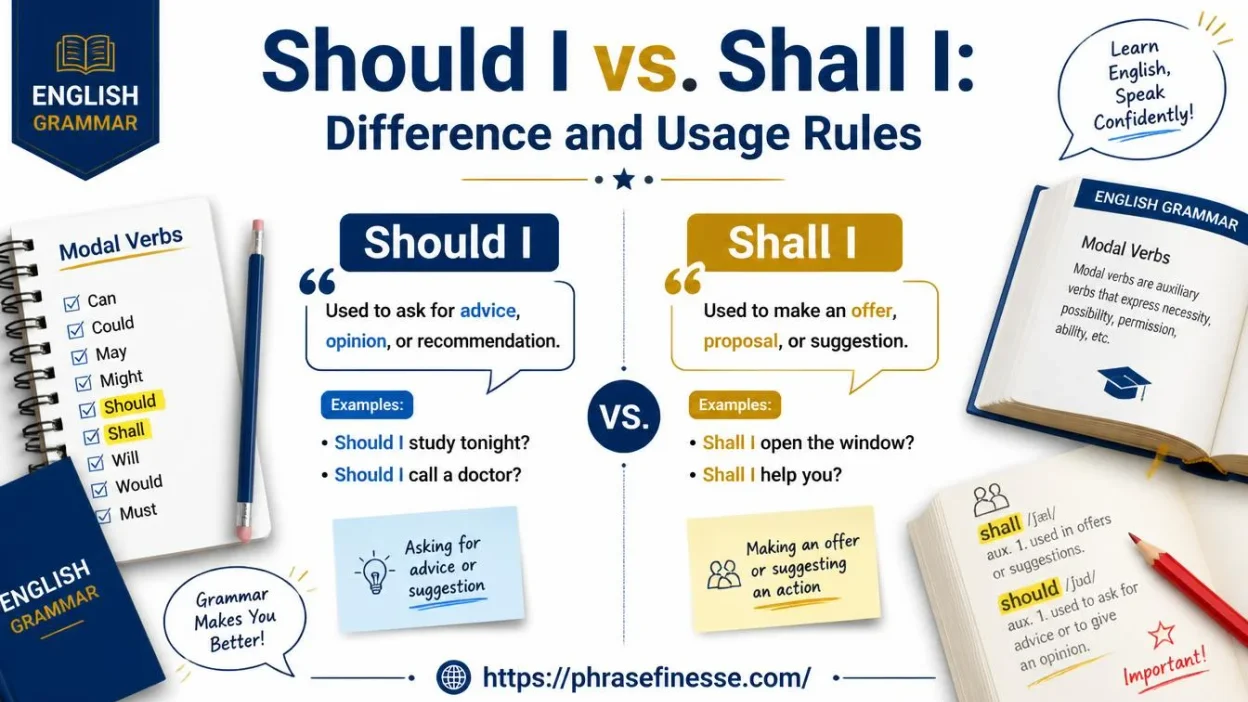
| Should I | Asking for advice or the best choice | Decisions, opinions, recommendations | Should I buy this phone? |
| Shall I | Offering or suggesting an action | Offers, polite requests, suggestions | Shall I open the window? |
| Should I | Asking what is expected | Rules or responsibilities | Should I bring my passport? |
| Shall I | Asking permission to act | Formal or polite situations | Shall I begin the presentation? |
The easiest way to remember the difference:
- “Should I?” asks, “What is the right thing to do?”
- “Shall I?” asks, “Do you want me to do this?”
Should I Meaning and Usage
“Should I” is a question form of the modal verb should. People use it when they need advice, recommendations, or an opinion about a possible action.
The speaker usually has a choice but feels uncertain.
Think of it like asking someone to become your temporary decision guide.
For example:
“Should I move to another city?”
The person asking this question isn’t offering to move someone else. They want another person’s thoughts about whether moving is a good idea.
Other examples:
- Should I learn Spanish?
- Should I apologize to my friend?
- Should I save money or invest it?
- Should I arrive early for the interview?
In each sentence, the speaker wants guidance.
Common Situations Where You Use “Should I”
Should I for Asking Advice
The most common use of “should I” involves asking for recommendations.
People use it when they are comparing choices or trying to make a smart decision.
Examples:
- Should I buy a laptop or a tablet?
- Should I accept this invitation?
- Should I take this online course?
Imagine you’re standing at a crossroads. Both roads are possible, but you want someone experienced to point out the better path.
That’s when “should I” fits naturally.
Should I for Making Personal Decisions
People often use “should I” when discussing life choices.
Examples:
- Should I change my career?
- Should I start exercising regularly?
- Should I move closer to my workplace?
These questions don’t ask someone to take action for you. They ask for perspective.
Should I for Rules and Expectations
Sometimes “should I” asks whether something is expected or appropriate.
Examples:
- Should I remove my shoes before entering?
- Should I bring my ID to the appointment?
- Should I email the manager first?
Here, the speaker wants to know the correct procedure.
Should I for Possible Results
You can also use “should I” when asking about what you can expect.
Examples:
- Should I receive a confirmation email soon?
- Should I expect delays today?
- Should I hear back from them this week?
This usage is slightly different because the speaker is asking about probability or expectation.
What Does “Shall I” Mean?
Shall I Meaning and Usage
“Shall I” is another question form of a modal verb. However, it usually focuses on offering help, making suggestions, or asking for permission before doing something.
The speaker is often ready to take action.
For example:
“Shall I make some coffee?”
The person asking is not looking for advice about coffee. They are offering to prepare it.
Other examples:
- Shall I carry your bag?
- Shall I call a taxi?
- Shall I send the email now?
The phrase often sounds polite and considerate.
Common Situations Where You Use “Shall I”
Shall I for Making an Offer
This is one of the most common uses of “shall I.”
You use it when you want to help someone.
Examples:
- Shall I help you with those boxes?
- Shall I close the door?
- Shall I book the tickets?
The hidden meaning is:
“Would you like me to do this?”
You are offering assistance instead of asking someone to advise you.

Shall I for Asking Permission
Sometimes “shall I” checks whether it is acceptable to begin an action.
Examples:
- Shall I start the meeting?
- Shall I turn on the lights?
- Shall I introduce the speaker?
The person asking already has the ability to act. They simply want approval.
Shall I for Making Suggestions
“Shall I” can also introduce a suggestion.
Examples:
- Shall I order dinner?
- Shall I invite your friends?
- Shall I arrange a meeting?
The speaker proposes an idea and waits for agreement.
Should I vs. Shall I: Main Differences Explained
Although these phrases look similar, their purposes are different.
| Difference | Should I | Shall I |
| Purpose | Requests advice | Offers action |
| Speaker’s position | Unsure about a decision | Ready to do something |
| Common question | “What is the best choice?” | “Would you like me to do this?” |
| Tone | Neutral | Polite or formal |
| Modern frequency | Very common | Less common |
A useful trick:
Use “Should I” when you need an answer.
Example:
“Should I study tonight?”
You need advice.
Use “Shall I” when you want permission or approval.
Example:
“Shall I study tonight?”
This sounds like you are asking someone whether they want you to start studying.
Should I vs. Shall I Examples in Real Conversations
Example: Asking for Advice
Emma: I received a job offer in another city.
Jack: That’s exciting.
Emma: Should I accept it?
Here, Emma wants an opinion. She isn’t asking Jack to make the decision.
Example: Offering Help
Emma: These boxes are heavy.
Jack: Shall I carry one for you?
Jack offers assistance.
Example: Workplace Situation
Manager: The presentation starts in ten minutes.
Assistant: Shall I prepare the documents?
The assistant offers to complete a task.
Example: Personal Decision
Friend A: I’m thinking about joining the gym.
Friend B: Should I join too?
The second person wants advice about their own choice.
Why Is “Shall I” Less Common in American English?
The phrase “shall” has changed over time.
In modern American English, people usually prefer alternatives such as:
- Should I…?
- Do you want me to…?
- Would you like me to…?
For example:
British English:
“Shall I make you some tea?”
American English:
“Should I make you some tea?”
“Do you want me to make you some tea?”
Both are understandable. The difference is mainly about natural usage.
In everyday American conversations, “shall I” can sometimes sound formal, old-fashioned, or influenced by British English.
British English vs. American English: Should and Shall Usage
| Situation | British English | American English |
| Asking advice | Should I call her? | Should I call her? |
| Offering help | Shall I help you? | Should I help you? |
| Suggesting action | Shall we leave? | Should we leave? |
| Formal documents | Shall apply | Shall apply |
Interestingly, “shall we” remains common in both varieties.
Examples:
- Shall we begin?
- Shall we go now?
These phrases sound natural because they involve making a shared suggestion.
Grammar Rules for Should I and Shall I
Both should and shall are modal verbs.
Modal verbs have special grammar rules.
See More :9 Alternatives to “However” With Examples
Rule: Use the Base Verb After Should and Shall
Correct:
- Should I go?
- Should I call?
- Shall I wait?
Incorrect:
- Should I to go?
- Shall I to call?
Modal verbs never use “to” before the main verb.
Rule: Modal Verbs Do Not Change Form
You don’t add:
- -s
- -ed
- -ing
Examples:
Correct:
- Should I leave?
- Should she leave?
- Should they leave?
Incorrect:
- Should she leaves?
- Shall he goes?
Common Mistakes With Should I vs. Shall I
Mistake: Using Shall I When Asking for Personal Advice
Incorrect:
“Shall I leave my job?”
This sounds like you are offering to leave your job.
Better:
“Should I leave my job?”
The second version clearly asks for advice.
Mistake: Using Should I When Offering Help
Example:
“Should I carry your bag?”
This is grammatically correct, but it may sound like you are questioning whether carrying the bag is the right decision.
More natural:
“Shall I carry your bag?”
Mistake: Thinking Should and Shall Have Identical Meanings
They overlap, but they create different impressions.
Compare:
Should I open the window?
Meaning:
- Is opening the window a good idea?
Shall I open the window?
Meaning:
- Would you like me to open it?
The action is the same, but the intention changes.
Should I vs. Shall I in Formal Writing
The word “shall” appears often in legal, business, and official documents.
Examples:
“The employee shall complete the project within thirty days.”
Here, shall expresses an obligation.
However, everyday writing usually avoids this style.
More natural:
“The employee must complete the project within thirty days.”
For normal communication, should often sounds friendlier.
Example:
Formal:
“You shall submit the report.”
Conversational:
“You should submit the report.”
Easy Memory Trick for Should I vs. Shall I
Remember these two questions:
Should I = Advice
Ask yourself:
“Do I need someone’s opinion?”
If yes, use should I.
Examples:
- Should I buy this?
- Should I apply?
- Should I apologize?
Shall I = Action
Ask yourself:
“Am I offering to do something?”
If yes, use shall I.
Examples:
- Shall I help?
- Shall I call?
- Shall I open the door?
Case Study: How One Small Word Changes Meaning
Imagine Sarah and Tom are preparing for a party.
Sarah says:
“Should I make a cake?”
Sarah wants Tom’s opinion. She is deciding whether making a cake is a good idea.
Now compare:
“Shall I make a cake?”
Sarah is offering to make the cake. She is ready to take responsibility for the task.
The words are close, but the intention changes.
This small difference matters because English often depends on context and purpose.
FAQs
Is “shall I” more formal than “should I”?
Yes. “Shall I” is generally considered more formal and is often used when offering help, making suggestions, or asking for instructions. “Should I” is more common in everyday English when seeking advice or recommendations.
Can I use “should I” and “shall I” interchangeably?
Not always. “Should I” asks whether something is the right or advisable action, while “Shall I” asks whether you would like the speaker to do something. Their meanings overlap in some situations, but they are not exact substitutes.
Which phrase is more common in modern English?
“Should I” is far more common in modern English, especially in American English. “Shall I” remains widely used in British English and in formal or professional contexts.
Is “shall I” outdated?
No. Although it is less frequent than it once was, “shall I” is still correct and widely understood. It is commonly used in polite offers, customer service interactions, and formal communication.
When should I use “shall I” in business communication?
Use “shall I” when politely offering assistance or proposing an action. For example: “Shall I schedule the meeting?” or “Shall I prepare the report for tomorrow’s presentation?”
Does “should I” always ask for advice?
Most of the time, yes. “Should I” is used when you want guidance, recommendations, or opinions about the best course of action. For example: “Should I send the email now?” or “Should I update the project timeline?”
Conclusion
The difference between “should I” and “shall I” comes down to purpose and tone. “Should I” is used when asking for advice, guidance, or confirmation that an action is the right choice. “Shall I”, on the other hand, is used when making an offer, seeking instructions, or suggesting an action in a polite and often more formal way.
Understanding this distinction can improve your grammar, enhance English usage, and bring greater consistency to your business communication and everyday conversations. Whether you’re handling scheduling, organizing meetings, managing a calendar, or writing professional emails, choosing the correct phrase helps you communicate clearly and confidently. When in doubt, remember: ask with “should I” when seeking advice, and offer with “shall I” when proposing to act.

Mia Rose is an English language specialist and editorial writer at Phrase Finesse, where she helps readers master grammar, vocabulary, spelling, and effective communication. Passionate about making English simple and practical, she creates well-researched, reader-friendly content that explains complex language concepts in a clear and engaging way.
With extensive experience in English language education, content writing, and editorial review, Mia specializes in grammar, punctuation, word choice, idioms, confusing word pairs, and writing style. Her articles are carefully researched, fact-checked, and designed to help students, professionals, writers, and English learners build confidence in both written and spoken English.