Have you ever paused while writing and wondered whether “Sewed or Sewn?” is the correct word to use? This common question appears in everyday conversations, academic work, and professional documents alike.
Understanding the difference between sewed and sewn is an important part of mastering English usage, improving grammar accuracy, and maintaining clarity in both casual and formal communication.
Although the two words come from the same verb, they are used differently depending on the sentence structure and context. Choosing the correct form helps strengthen formal writing, ensures consistency, and enhances the quality of business communication.
Whether you are describing a handmade garment, a repaired seam, or a completed sewing project, knowing when to use each term can make your writing more polished and professional.
In this guide, you’ll learn the meaning, usage, and grammatical differences between sewed and sewn, along with practical examples that remove confusion. We’ll also explore how precise word choice supports effective communication across areas such as project management, meetings, calendar planning, time management, scheduling, online booking, and even broadcasting, where clear language matters.
By the end, you’ll know exactly which form to use and when to use it with confidence.
What Is the Difference Between Sewed and Sewn?
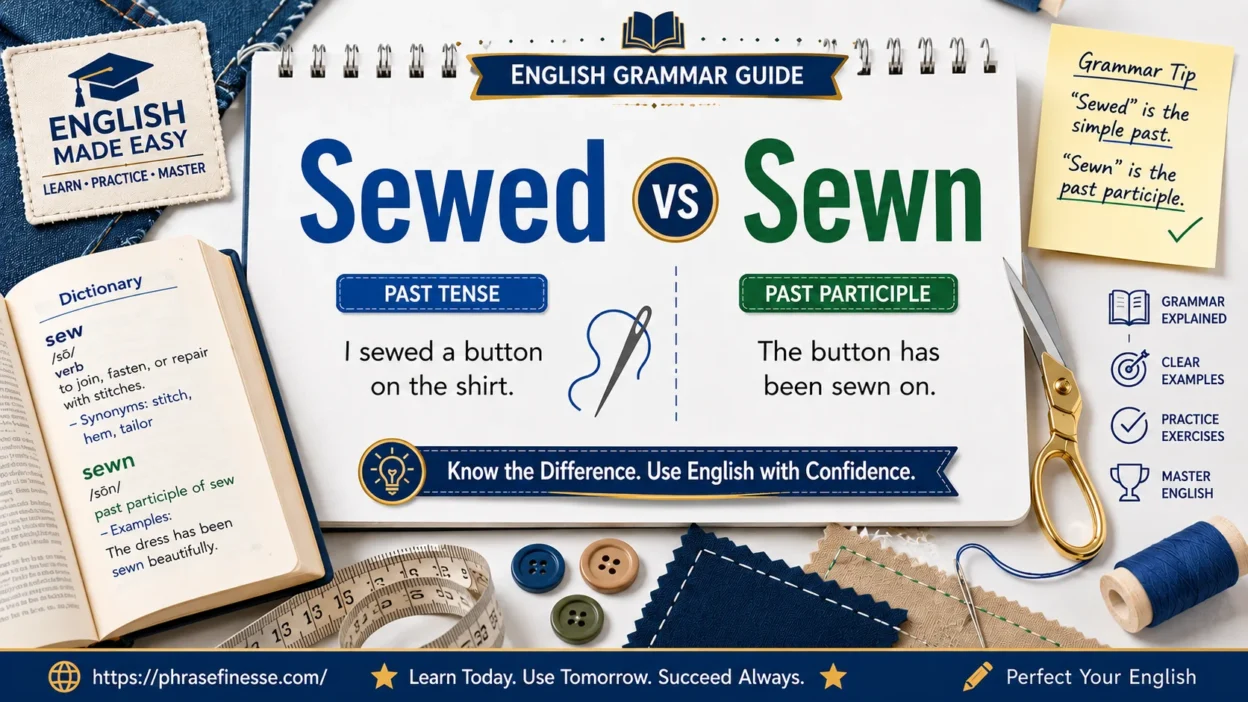
The main difference comes down to grammar, not meaning.
Both words refer to the action of joining fabric, materials, or objects together using thread and a needle. However, they belong to different verb forms.
Quick Answer
- Sewed = simple past tense
- Sewn = past participle
Comparison Table
| Verb Form | Example | Usage |
| Sew | I sew clothes. | Present tense |
| Sewed | I sewed a button yesterday. | Simple past |
| Sewn | The button has been sewn on. | Past participle |
Think of it this way:
- Use sewed when describing something completed in the past.
- Use sewn when the sentence includes helping verbs such as has, have, had, was, were, been, or being.
A Simple Example
Correct:
I sewed a patch onto my backpack yesterday.
Correct:
I have sewn dozens of patches onto backpacks.
The action is identical. The grammar changes.
Understanding the Verb “Sew”
Before discussing the different forms, it’s useful to understand the base verb itself.
What Does “Sew” Mean?
The verb sew means to join, repair, or create something using stitches.
People commonly sew:
- Clothing
- Curtains
- Blankets
- Costumes
- Bags
- Upholstery
- Quilts
The word can also appear in figurative language.
For example:
She sewed the community together through volunteer work.
In this example, no actual stitching takes place. Instead, the word symbolizes bringing people together.
Common Uses of “Sew”
| Context | Example |
| Clothing repair | Sew a button |
| Fashion design | Sew a dress |
| Home decor | Sew curtains |
| Crafts | Sew a quilt |
| Manufacturing | Sew leather products |
Is Sew Regular or Irregular?
This is where things become interesting.
At first glance, “sew” appears to be a regular verb because its simple past tense ends in -ed:
- Sew → Sewed
However, the past participle doesn’t follow the standard pattern.
Instead of:
- Sew → Sewed → Sewed
English often uses:
- Sew → Sewed → Sewn
That makes “sew” similar to verbs such as:
- Show → Showed → Shown
- Sow → Sowed → Sown
- Mow → Mowed → Mown
These verbs blend regular and irregular patterns.
When to Use Sewed
The word sewed functions as the simple past tense.
Use it when describing an action completed at a specific time in the past.
Examples of Sewed
- I sewed the tear last night.
- She sewed a beautiful wedding dress.
- They sewed new curtains for the living room.
- My grandmother sewed quilts for every family member.
- We sewed patches onto our jackets.
Notice something important.
None of these sentences contain helping verbs like has or had.
The action happened and ended in the past.
Common Sentence Structure
The typical pattern looks like this:
Subject + Sewed + Object
Examples:
- Sarah sewed the costume.
- The tailor sewed the hem.
- My mother sewed the pillowcase.
Time Expressions Often Used with Sewed
You will frequently see words and phrases such as:
- Yesterday
- Last week
- Last year
- This morning
- Earlier today
- In 2024
- A few hours ago
Examples:
I sewed the button yesterday.
She sewed the uniform last week.
These time markers signal simple past tense.
When to Use Sewn
The word sewn is the past participle form of sew.
Past participles usually work alongside helping verbs.
Examples of Sewn
- The patch has been sewn onto the jacket.
- She has sewn hundreds of dresses.
- The curtains had already been sewn.
- The logo was sewn into the fabric.
- Every seam was carefully sewn.
Common Structures with Sewn
Has/Have Sewn
Examples:
- I have sewn many costumes.
- They have sewn several quilts.
Had Sewn
Examples:
- She had sewn the dress before the event.
- We had sewn the repairs before selling the tent.
Was/Were Sewn
Examples:
- The labels were sewn into every shirt.
- The emblem was sewn onto the sleeve.
Been Sewn
Examples:
- The edges have been sewn neatly.
- The pockets had been sewn shut.
Why Sewn Sounds More Formal
Native speakers often associate sewn with polished and formal English.
For example:
Informal:
She sewed many dresses over the years.
Formal:
She has sewn many dresses over the years.
Both can be correct depending on the context. The second sentence simply uses a different tense structure.
Sewed vs. Sewn: Side-by-Side Examples
The easiest way to understand the difference is through direct comparison.
| Sewed | Sewn |
| I sewed the button yesterday. | The button has been sewn on. |
| She sewed the skirt last week. | She has sewn many skirts. |
| We sewed the banner overnight. | The banner was sewn overnight. |
| They sewed the costume before the show. | The costume had been sewn before the show. |
What’s Changing?
The action remains exactly the same.
Only the grammatical structure changes.
Compare:
She sewed the dress.
Simple past tense.
She has sewn the dress.
Present perfect tense.
Both sentences are correct. They simply communicate different time relationships.
Read More: First Pass Meaning: Definition, Usage and Examples
Can Sewed Ever Replace Sewn?
This question causes considerable confusion.
In modern English, the past participle sewn remains the preferred and most widely accepted form.
However, some dictionaries acknowledge sewed as an alternative past participle in certain situations.
For example:
The patch was sewed onto the jacket.
This construction exists, but most native speakers would naturally choose:
The patch was sewn onto the jacket.
Which Form Should You Use?
For modern writing:
| Situation | Best Choice |
| Simple past | Sewed |
| Present perfect | Sewn |
| Past perfect | Sewn |
| Passive voice | Sewn |
| Academic writing | Sewn |
| Professional writing | Sewn |
Using sewn as the past participle will almost always sound more natural.
Common Mistakes People Make
Many writers understand the meaning but mix up the grammar.
Let’s examine the most common errors.
Mistake: Using Sewn as a Simple Past Verb
Incorrect:
I sewn the patch yesterday.
Correct:
I sewed the patch yesterday.
The word “yesterday” signals simple past tense.
Mistake: Using Sewed After Helping Verbs
Incorrect:
She has sewed the dress.
Correct:
She has sewn the dress.
After has, use the past participle.
Mistake: Mixing Verb Forms
Incorrect:
The logo was sewed onto the shirt.
Preferred:
The logo was sewn onto the shirt.
Mistake: Memorizing Without Understanding
Many learners attempt to memorize every verb form individually.
A better approach focuses on recognizing patterns.
Ask yourself:
Is there a helping verb?
If yes, you probably need sewn.
If no, you probably need sewed.
Easy Trick to Remember the Difference
Grammar becomes easier when you use mental shortcuts.
The One-Minute Rule
Look for helping verbs.
If you see:
- Has
- Have
- Had
- Was
- Were
- Been
- Being
Use sewn.
Examples:
- Has sewn
- Have sewn
- Had sewn
- Was sewn
- Were sewn
Without helping verbs, use sewed.
Examples:
- I sewed it.
- She sewed it.
- They sewed it.
Quick Formula
| Clue | Correct Form |
| Yesterday | Sewed |
| Last week | Sewed |
| Has | Sewn |
| Have | Sewn |
| Had | Sewn |
| Was | Sewn |
| Were | Sewn |
Memory Phrase
Yesterday I sewed. Today it is sewn.
Many learners find this phrase easy to remember.
Sewed or Sewn in British and American English
Unlike some grammar differences, British English and American English generally agree on this issue.
American English
Examples:
- I sewed the patch.
- The patch was sewn on.
British English
Examples:
- I sewed the patch.
- The patch was sewn on.
The preferred forms remain virtually identical.
Is One Version More Common?
Both varieties strongly favor:
- Sewed as simple past
- Sewn as past participle
You can confidently use these forms regardless of whether you’re writing for a US or UK audience.
Real-Life Examples of Sewed and Sewn
Understanding grammar becomes easier when you see it in practical settings.
Tailoring Example
Simple Past:
The tailor sewed the hem before closing the shop.
Past Participle:
The hem was sewn with precision.
Fashion Industry Example
Simple Past:
Designers sewed every garment by hand.
Past Participle:
The details were sewn into the fabric.
Quilting Example
Simple Past:
My grandmother sewed quilts throughout her life.
Past Participle:
Hundreds of quilts have been sewn by volunteers.
Manufacturing Example
Simple Past:
Workers sewed the leather panels together.
Past Participle:
The panels were sewn using industrial machines.
Case Study: Why Native Speakers Rarely Get Confused
Imagine two sentences.
Sentence A:
Emma sewed a dress last weekend.
Sentence B:
Emma has sewn a dress before.
Most native speakers instantly recognize the second sentence because English uses past participles after helping verbs.
They may never consciously think about grammar rules. Instead, they develop a feel for the language through exposure.
Language learners often benefit from understanding the rule directly.
Once you learn the pattern, choosing between sewed and sewn becomes automatic.
Similar Verbs That Follow the Same Pattern
The confusion surrounding sew isn’t unique.
Several English verbs behave similarly.
Comparison Table
| Base Verb | Past Tense | Past Participle |
| Sew | Sewed | Sewn |
| Show | Showed | Shown |
| Sow | Sowed | Sown |
| Mow | Mowed | Mown/Mowed |
Examples
Show
- She showed me the report.
- She has shown me the report.
Sow
- Farmers sowed seeds last spring.
- Farmers have sown seeds for generations.
Mow
- He mowed the lawn yesterday.
- The lawn had been mown before the party.
Recognizing these patterns makes English grammar easier to master.
Why English Uses Past Participles
Many people ask why English needs forms like “sewn” at all.
The answer lies in how English expresses time and relationships between actions.
Consider these examples:
I sewed the dress.
A completed action in the past.
I have sewn the dress.
The action happened earlier, yet it remains connected to the present.
The dress was sewn yesterday.
The focus shifts from the person performing the action to the object receiving it.
Past participles help English express these subtle differences efficiently.
Frequently Asked Questions
1. What is the difference between sewed and sewn?
Sewed is the simple past tense of the verb sew, while sewn is the past participle. For example, “She sewed a dress yesterday” is correct, whereas “The dress was sewn by hand” uses the past participle form.
2. Is sewn more correct than sewed?
No. Neither word is more correct than the other. The correct choice depends on the sentence structure. Sewed is used as the past tense, while sewn is typically used with helping verbs such as has, have, had, was, or were.
3. Can I say “I have sewed”?
While “I have sewed” is occasionally heard in informal speech, “I have sewn” is the standard and widely accepted form in modern English grammar and formal writing.
4. When should I use sewed in a sentence?
Use sewed when describing a completed action in the simple past tense. For example: “My grandmother sewed a quilt last winter.”
5. When should I use sewn in a sentence?
Use sewn as a past participle, usually with an auxiliary verb. For example: “The buttons were sewn onto the jacket” or “She has sewn several dresses this year.”
6. Why do people confuse sewed and sewn?
Many English verbs have different past tense and past participle forms, which can be confusing. Since both words come from the verb sew, writers often struggle to determine which grammatical form fits a particular sentence.
Conclusion
Understanding the difference between sewed and sewn is essential for accurate English usage and effective communication. While sewed functions as the simple past tense of sew, sewn serves as the past participle and is commonly used with helping verbs. Recognizing this distinction helps improve grammar, strengthens formal writing, and ensures greater consistency in both personal and professional contexts.
Whether you are writing about clothing, crafts, repairs, or any sewing-related activity, choosing the correct form makes your message clearer and more polished. By remembering the simple rule sewed for the past tense and sewn for the past participle you can avoid common mistakes and write with greater confidence.

Alyan Ashraf is an English language writer and editor at Phrase Finesse, where he specializes in grammar, vocabulary, spelling, word usage, and clear communication. Passionate about the English language, he creates practical, research-backed content that helps readers avoid common mistakes and write with greater accuracy and confidence.
Known for his clear writing style and attention to detail, Alyan simplifies complex language topics into easy-to-understand guides filled with real-world examples and actionable insights. His work covers confusing word pairs, grammar rules, idioms, punctuation, and everyday English usage, making learning both accessible and engaging for students, professionals, writers, and non-native English speakers.
Every article Alyan writes is carefully researched, fact-checked, and designed to meet high editorial standards. His goal is to help readers strengthen their English skills, expand their vocabulary, and communicate more effectively in academic, professional, and everyday settings.
Through Phrase Finesse, Alyan is committed to publishing trusted language resources that make mastering English simpler, clearer, and more enjoyable for learners around the world