Have you ever paused while reading a sentence and wondered what “As In” Meaning and Correct Use actually means? This small but powerful expression appears frequently in everyday conversations, professional emails, and academic writing. Yet many English learners and native speakers alike are unsure about its precise function. Understanding as in can improve your English usage, strengthen grammar skills, and help you communicate ideas with greater clarity.
In both casual and professional settings, the phrase as in is often used to clarify, specify, or introduce an example. Whether you are writing reports, handling business communication, participating in meetings, managing a project management workflow, or organizing a calendar, using this expression correctly helps maintain accuracy and consistency. It can also enhance formal writing by making explanations more precise and easier for readers to follow.
This guide explores the meaning of as in, explains when and how to use it correctly, and highlights common mistakes to avoid. You will find clear definitions, practical examples, and usage tips drawn from real-world contexts, including scheduling, time management, online booking, broadcasting, workplace communication, and everyday conversations. By the end, you will know exactly how to use this phrase confidently and naturally in both spoken and written English.
What Does “As In” Mean?
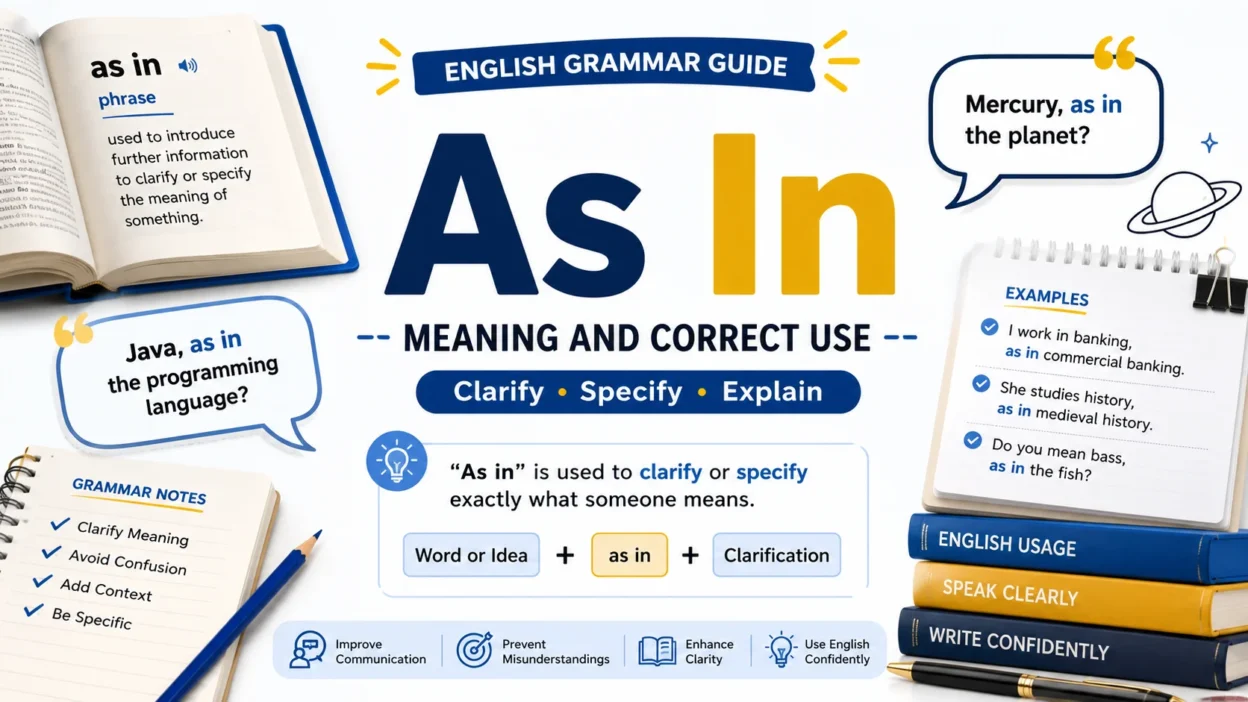
The phrase “as in” is used to clarify, specify, or explain exactly what someone means.
It often introduces additional information that helps the listener or reader understand a word, phrase, or idea more clearly.
Simple Definition
“As in” means “referring to,” “specifically,” or “to clarify what I mean.”
Think of it as a verbal spotlight. It shines extra light on a word or concept that might otherwise be misunderstood.
Example
“Are you talking about Mercury, as in the planet?”
The speaker wants clarification because the word Mercury could refer to several different things.
Without “as in,” the sentence would be less precise.
The Purpose of “As In” in English
The phrase serves several important functions.
Clarifying Meaning
Many English words have multiple meanings.
“As in” helps identify the exact one.
Example:
“I need a bat, as in the animal, not the baseball bat.”
The phrase removes ambiguity immediately.
Narrowing Down a Topic
Sometimes a topic is broad.
“As in” helps make it specific.
Example:
“She studies history, as in European medieval history.”
The listener now understands the exact area being discussed.
Preventing Misunderstandings
Miscommunication often happens when words have multiple interpretations.
Example:
“I mean spring, as in the season.”
Without clarification, someone might think of a metal spring.
Adding Context
The phrase can also provide useful context.
Example:
“He works in medicine, as in emergency medicine.”
The additional information creates a clearer picture.
How “As In” Is Used in English
Although the phrase is short, it appears in many situations.
Using “As In” to Clarify Meaning
This is the most common use.
Examples:
- “I work in banking, as in commercial banking.”
- “She’s involved in law, as in corporate law.”
- “I teach science, as in environmental science.”
In each case, the second phrase specifies the first.
Please Visit for More: The Smiths or The Smiths’ or The Smiths’s? Correct Possessive Form
Using “As In” to Specify a Particular Meaning
Many words have more than one definition.
Examples:
- “Java, as in the programming language?”
- “Turkey, as in the country?”
- “Apple, as in the company?”
The phrase identifies which meaning is intended.
Using “As In” to Explain a Reference
Sometimes a speaker assumes background knowledge.
“As in” helps bridge the gap.
Examples:
- “He’s a real Einstein, as in a genius.”
- “She’s pulling a Sherlock Holmes, as in solving mysteries.”
The listener receives immediate clarification.
Is “As In” an Idiom?
Not usually.
An idiom has a meaning that cannot be understood from the individual words.
For example:
- “Break the ice”
- “Hit the sack”
- “Under the weather”
These expressions mean something different from their literal words.
Why “As In” Is Different
The phrase remains fairly literal.
It essentially means:
- In the sense of
- Referring to
- Specifically
Because the meaning is transparent, linguists generally do not classify it as an idiom.
Grammar of “As In”
Understanding the grammar behind the phrase helps you use it naturally.
What Part of Speech Is “As In”?
“As in” functions as a multi-word phrase rather than a traditional single part of speech.
Its role is explanatory.
It connects a term with additional clarification.
Basic Structure
Word or idea + as in + clarification
Examples:
- Paris, as in Paris, France
- Spring, as in the season
- Mercury, as in the planet
This pattern appears repeatedly in spoken and written English.
Common Sentence Patterns With “As In”
Noun + As In + Clarification
Examples:
- “Amazon, as in the company.”
- “Jordan, as in the country.”
- “Python, as in the programming language.”
Question + As In + Meaning
Examples:
- “Do you mean bass, as in the fish?”
- “You mean cricket, as in the sport?”
- “Is that Java, as in coding?”
Statement + As In + Specific Example
Examples:
- “He works in medicine, as in surgery.”
- “She studies literature, as in Victorian literature.”
- “They specialize in technology, as in cybersecurity.”
“As In” vs. “For Example”
Many writers confuse these expressions.
They are not identical.
“As In” Clarifies
Example:
“I study history, as in military history.”
The speaker clarifies which type of history.
“For Example” Gives Examples
Example:
“I study history, for example, military history and ancient history.”
The speaker provides examples rather than clarification.
Quick Comparison
| Phrase | Main Function |
| As in | Clarifies meaning |
| For example | Provides examples |
| Such as | Lists examples |
| Including | Introduces examples |
“As In” vs. “Meaning”
Both phrases explain something.
However, they sound different.
Example Using “As In”
“You mean Java, as in the programming language?”
Example Using “Meaning”
“You mean Java, meaning the programming language?”
The first sounds more natural in everyday conversation.
The second sounds slightly more formal and explanatory.
“As In” vs. “That Is”
“That is” often appears in formal writing.
Example
“She specializes in cardiology, that is, diseases of the heart.”
Comparison
“She specializes in cardiology, as in heart-related medicine.”
Both work.
However, “that is” generally explains while “as in” clarifies.
“As In” vs. “Namely”
“Namely” introduces precise information.
Example
“Three cities were selected, namely New York, Chicago, and Boston.”
Comparison
“New York, as in New York City?”
The purposes differ.
“Namely” identifies.
“As in” clarifies.
Everyday Examples of “As In”
You probably hear this phrase more often than you realize.
Family Conversations
- “John, as in your cousin John?”
- “The lake, as in the one near our cabin?”
- “Sarah, as in Aunt Sarah?”
Shopping
- “Apple, as in the brand?”
- “Coach, as in the fashion company?”
- “Target, as in the retailer?”
Travel
- “Georgia, as in the U.S. state?”
- “Jordan, as in the Middle Eastern country?”
- “Victoria, as in Australia?”
“As In” in Academic Writing
Students often use “as in” when narrowing down a topic.
Examples
- “Climate change, as in long-term environmental shifts.”
- “Democracy, as in representative democracy.”
- “Economics, as in behavioral economics.”
Academic Tip
Use the phrase sparingly.
Academic writing usually prefers direct definitions.
Still, it can be useful when distinguishing between multiple meanings.
“As In” in Business Communication
Business professionals use the phrase regularly.
Common Workplace Examples
- “Sales, as in software sales?”
- “Marketing, as in digital marketing?”
- “Operations, as in supply chain operations?”
Meeting Example
Imagine a manager says:
“We need more support for development.”
Someone might ask:
“Development, as in software development?”
A single phrase prevents confusion and saves time.
“As In” in Online Communication
Digital communication often lacks context.
“As in” fills the gap.
Social Media Example
“You mean Meta, as in Facebook’s parent company?”
Forum Example
“Rust, as in the programming language?”
Messaging Example
“Paris, as in France?”
The phrase helps people communicate efficiently in short messages.
Common Mistakes When Using “As In”
Many writers misuse the expression.
Let’s look at the biggest errors.
Using “As In” Without Needing Clarification
Incorrect:
“I bought apples, as in fruit.”
The clarification isn’t necessary.
Everyone already understands apples are fruit.
Better:
“I bought apples.”
Confusing It With “For Example”
Incorrect:
“Many fruits, as in apples and oranges, are healthy.”
Better:
“Many fruits, such as apples and oranges, are healthy.”
Repeating Information
Incorrect:
“I work in accounting, as in accounting.”
The phrase adds nothing.
Every clarification should provide useful information.
Overusing It
Using the phrase repeatedly makes writing feel clunky.
Instead of writing:
“He studied science, as in biology. She studied science, as in chemistry. They studied science, as in physics.”
Write:
“They studied different scientific fields including biology, chemistry, and physics.”
Punctuation Rules for “As In”
Writers often wonder whether commas are required.
The answer depends on sentence structure.
When Commas Are Common
Examples:
- “Mercury, as in the planet, is visible tonight.”
- “John, as in your cousin, called earlier.”
The clarification appears as additional information.
When Commas May Be Omitted
Examples:
- “Do you mean Mercury as in the planet?”
- “Java as in the programming language?”
The sentence remains clear without commas.
Practical Rule
If the phrase interrupts the sentence, commas often help readability.
If it flows naturally within the sentence, commas may not be necessary.
Real World Examples of “As In” in Sentences
Workplace Examples
- “You mean support, as in customer support?”
- “Sales, as in enterprise sales?”
- “Development, as in software development?”
School Examples
- “History, as in ancient history?”
- “English, as in literature?”
- “Science, as in chemistry?”
Technology Examples
- “Python, as in coding?”
- “Apple, as in the company?”
- “Windows, as in the operating system?”
Travel Examples
- “Georgia, as in the country?”
- “Jordan, as in the nation?”
- “Turkey, as in the country?”
Everyday Life Examples
- “Spring, as in the season?”
- “Bat, as in the animal?”
- “Bass, as in the fish?”
Case Study: How “As In” Prevents Miscommunication
Consider this short conversation.
Without Clarification
First Person A: “I’m learning Java.”
Second Person B: “That’s a beautiful island.”
Third Person A: “No, I mean the programming language.”
Confusion occurs immediately.
With “As In”
- Person A: “I’m learning Java.”
2. Person B: “Java, as in the programming language?”
3. Person A: “Exactly.”
The phrase solves the problem instantly.
This demonstrates why native speakers rely on it so often.
Can “As In” Start a Sentence?
Yes.
However, it works best in conversations.
Examples
- “As in the capital of France?”
- “As in the software company?”
- “As in the actor from that movie?”
These examples are common in spoken English.
When It Sounds Awkward
Formal writing rarely begins sentences this way.
For example:
“As in the planet Mercury, it has no atmosphere.”
This sounds unnatural.
A clearer sentence would be:
“Mercury has almost no atmosphere.”
Formal and Informal Uses of “As In”
One reason the phrase remains popular is its flexibility.
In Everyday Speech
The phrase sounds completely natural.
Examples:
- “Boston, as in Massachusetts?”
- “Jordan, as in Michael Jordan?”
- “Apple, as in iPhone?”
In Professional Writing
Business writing occasionally uses the phrase for clarification.
Example:
“The proposal focuses on development, as in product development.”
In Academic Writing
Scholars use it less frequently.
However, it can help distinguish concepts with multiple meanings.
In Digital Communication
Text messages and online discussions use it constantly because it provides quick clarification.
Quick Reference Table
| Topic | Explanation |
| Meaning of as in | Referring to, specifically, clarifying |
| Main purpose | Remove ambiguity |
| Formality | Neutral |
| Common use | Clarifying words or concepts |
| Part of speech | Explanatory phrase |
| Commas required? | Sometimes |
| Can it start a sentence? | Yes |
| Same as for example? | No |
| Same as namely? | No |
| Same as that is? | Not exactly |
Helpful Alternatives to “As In”
Sometimes another phrase works better.
Alternatives
- In other words
- Specifically
- Meaning
- Referring to
- Namely
- That is
- To be precise
- More specifically
Examples
Instead of:
“Finance, as in investment banking.”
You could write:
“Finance, specifically investment banking.”
Or:
“Finance, meaning investment banking.”
Choose the option that fits the tone of your writing.
FAQs
1. What does “as in” mean in English?
As in is a phrase used to clarify, explain, or give a more specific meaning to a word, idea, or statement. It often introduces an example or further detail to help the listener or reader understand the intended meaning.
2. How do you use “as in” in a sentence?
You can use as in when you want to provide clarification or specify what you mean. For example: “I need a lighter color, as in pale blue rather than navy.” Here, the phrase helps explain the exact shade being referenced.
3. Is “as in” grammatically correct?
Yes, as in is completely grammatically correct when used appropriately. It is commonly used in both spoken and written English to introduce examples, explanations, or clarifications.
4. What is the difference between “as in” and “for example”?
While both expressions can introduce examples, as in is often used to clarify a specific meaning or interpretation. For example typically introduces one or more examples of a broader concept rather than explaining a particular word or phrase.
5. Can “as in” be used in formal writing?
Yes. As in is acceptable in formal writing, academic papers, professional emails, and business communication when it helps improve clarity. However, writers should use it carefully and only when additional explanation is needed.
6. Why is understanding “as in” important?
Understanding as in helps improve English usage, grammar, and communication skills. Correct usage makes your writing clearer, more precise, and more effective in professional, academic, and everyday contexts.
Conclusion
Although it is a short expression, as in plays an important role in clear and effective communication. It helps speakers and writers clarify meanings, provide specific examples, and avoid misunderstandings. Whether you are working on formal writing, participating in business communication, managing meetings, or simply improving your everyday English, knowing how to use this phrase correctly can make your message more precise and professional.
By understanding the meaning, grammar, and common usage patterns of as in, you can communicate with greater confidence and consistency. Use the examples and tips in this guide as a reference, and you will find it much easier to recognize and apply this useful expression in both spoken and written English.

Emma Brooke is an English language specialist, editor, and content writer at Phrase Finesse, where she helps readers develop stronger writing and communication skills through clear, practical, and engaging content. With a passion for the English language, she specializes in simplifying grammar rules, vocabulary, spelling, punctuation, and word usage for learners at every level.
Emma has extensive experience creating educational content that is accurate, well-researched, and easy to understand. She is particularly skilled at explaining confusing word pairs, grammar concepts, idioms, sentence structure, and effective writing techniques, making complex topics approachable for students, professionals, educators, and English learners worldwide.