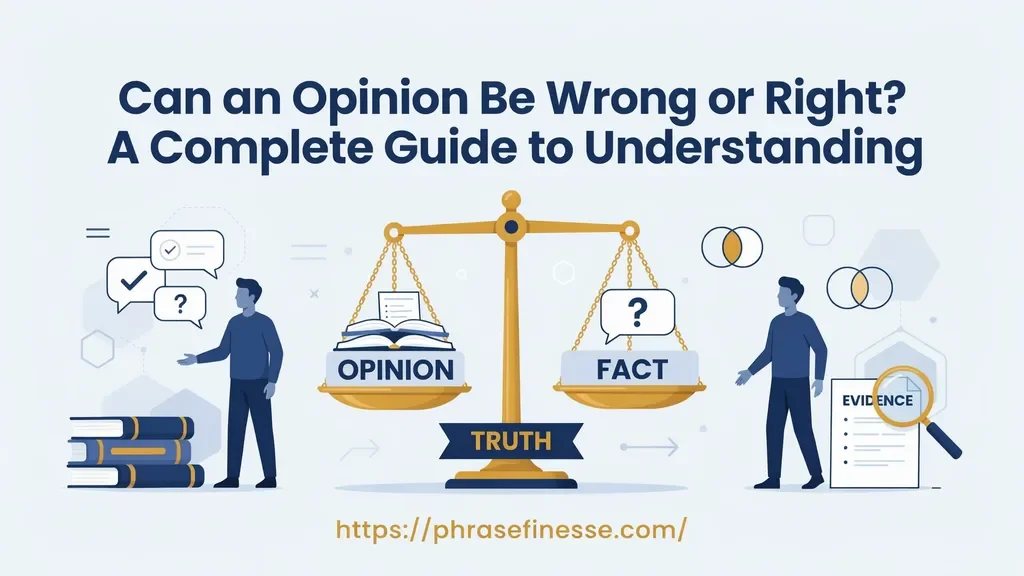
Have you ever heard someone say, “That’s just your opinion,” and wondered whether an opinion can actually be correct or incorrect? The question “Can An Opinion Be Wrong Or Right? Full Explanation” often creates confusion because opinions sit between personal beliefs, facts, and interpretations. In everyday conversations, academic discussions, and even public debates, people disagree about whether opinions should be judged as right or wrong. Understanding this distinction can improve critical thinking, communication, and overall language accuracy.
The answer is not always as simple as many people assume. Some opinions are based on personal preferences, while others rely on evidence, logic, or verifiable information. This difference becomes especially important in areas such as business communication, formal writing, broadcasting, meetings, and project management, where clarity and credibility matter. Even topics like English usage, grammar, and professional decision-making often require people to separate subjective viewpoints from objective facts.
In this article, you will learn what an opinion really is, when it can be challenged, and whether it can reasonably be considered right or wrong. We will also explore how opinions function in everyday contexts, including scheduling, time management, online booking, calendar planning, workplace discussions, and other situations where consistency and sound judgment are important. By the end, you will have a clear understanding of the relationship between opinions, facts, evidence, and truth, helping you communicate with greater confidence and precision
What Is an Opinion?
An opinion is a personal belief, judgment, interpretation, or evaluation about something.
Unlike facts, opinions often involve individual perspectives, values, preferences, and experiences. They reflect how someone thinks about a topic rather than describing something that can always be objectively verified.
For example:
- “Chocolate ice cream tastes better than vanilla.”
- “Remote work is better than office work.”
- “That movie was boring.”
- “The new policy will improve society.”
All of these statements express opinions.
However, not all opinions are created equal. Some rely primarily on personal preference while others involve claims that can be tested against evidence.
Key Characteristics of Opinions
- Based on personal judgment
- Influenced by experiences and beliefs
- Can change over time
- May include emotions and values
- Sometimes supported by evidence
- Sometimes unsupported by evidence
Fact vs Opinion: Understanding the Difference
Many debates become confusing because people mix up facts and opinions.
Understanding the distinction is essential.
What Is a Fact?
A fact is something that can be verified through observation, measurement, or reliable evidence.
Facts remain true whether people agree with them or not.
Examples include:
- Water freezes at 32°F (0°C) under standard conditions.
- Earth orbits the Sun.
- The Pacific Ocean is the largest ocean on Earth.
- Humans need oxygen to survive.
Facts don’t depend on personal feelings.
What Is an Opinion?
An opinion reflects someone’s interpretation, evaluation, or preference.
Examples include:
- Summer is the best season.
- Electric vehicles are the future of transportation.
- Classical music is more relaxing than rock music.
- Online education is better than traditional education.
These statements involve judgment rather than objective certainty.
Fact vs Opinion Comparison Table
| Fact | Opinion |
| Can be verified | Based on judgment |
| Independent of personal belief | Influenced by personal beliefs |
| Objectively true or false | Can vary among individuals |
| Supported by evidence | May or may not have evidence |
| Remains consistent | Can change over time |
Can Opinions Be Wrong?
The short answer is yes, some opinions can be wrong.
Many people assume every opinion deserves equal acceptance. That idea sounds fair on the surface. However, it falls apart when opinions involve factual claims.
An opinion doesn’t become correct simply because someone believes it.
When an Opinion Is Based on False Information
Imagine someone says:
“In my opinion, the Earth is flat.”
This statement is presented as an opinion.
However, it directly contradicts overwhelming scientific evidence. Since the underlying belief is false, the opinion itself rests on inaccurate information.
Here’s another example:
“In my opinion, smoking doesn’t harm health.”
Medical research has repeatedly shown serious health risks associated with smoking. The opinion conflicts with established evidence.
In these situations, the problem isn’t that someone has an opinion. The problem is that the opinion relies on incorrect facts.
Case Study: The Flat Earth Example
| Element | Analysis |
| Opinion | Earth is flat |
| Evidence Available | Satellite imagery, physics, astronomy |
| Scientific Consensus | Earth is spherical |
| Conclusion | Opinion conflicts with verified facts |
This illustrates an important principle:
Opinions based on false premises often lead to incorrect conclusions.
When an Opinion Contradicts Strong Evidence
Not every disagreement involves personal taste.
Some opinions concern measurable reality.
For example:
- Climate change exists.
- Vaccines reduce disease transmission.
- Seat belts save lives.
- Smoking increases cancer risk.
Someone may hold an opinion that rejects these conclusions. Yet decades of evidence support them.
That doesn’t mean people can’t disagree. It means evidence matters.
An evidence-based opinion generally carries more credibility than one based solely on personal belief.
Why Evidence Matters
Evidence acts like a compass.
Without it, opinions can drift anywhere.
With it, opinions stay connected to reality.
Strong opinions often include:
- Research
- Data
- Expert analysis
- Historical examples
- Verified observations
Weak opinions often rely on:
- Assumptions
- Rumors
- Anecdotes
- Emotional reactions
- Misinformation
Can Opinions Be Right?
Yes.
Opinions can be considered right when they align with available evidence, logical reasoning, and accurate interpretation of facts.
However, “right” often exists on a spectrum.
Evidence-Based Opinions
Suppose someone says:
“I believe regular exercise improves overall health.”
This is technically an opinion.
Yet extensive scientific research supports the conclusion.
Because evidence backs the statement, most people would consider it a well-founded and reasonable opinion.
Strong vs Weak Opinions
| Strong Opinion | Weak Opinion |
| Supported by evidence | Lacks evidence |
| Based on reliable sources | Based on rumors |
| Uses logical reasoning | Uses emotional assumptions |
| Open to revision | Ignores contradictory evidence |
| Considers multiple viewpoints | Considers only one viewpoint |
The stronger the evidence, the stronger the opinion.
Are Personal Preferences Ever Wrong?
This is where things become interesting.
Many opinions involve personal preferences rather than factual claims.
Examples include:
- Favorite foods
- Music tastes
- Fashion choices
- Hobbies
- Entertainment preferences
Subjective Opinions
Consider these statements:
- Pizza tastes better than sushi.
- Jazz is more enjoyable than hip-hop.
- Winter is better than summer.
None of these can be objectively proven.
Why?
Because personal preferences depend on individual experiences.
What one person loves, another person may dislike.
Why Preferences Usually Cannot Be Wrong
Preferences don’t describe objective reality.
Instead, they describe personal experiences.
If someone genuinely enjoys classical music more than pop music, that preference isn’t wrong.
It’s simply their experience.
Important Exceptions
Preferences can become problematic when they rely on false assumptions.
For example:
“I dislike that food because it contains an ingredient that is actually not present.”
The preference itself remains personal. However, the reasoning behind it may be mistaken.
The Role of Evidence in Forming Opinions
Evidence serves as the foundation of informed thinking.
The strongest opinions don’t appear out of nowhere.
People build them through observation, research, and experience.
Types of Evidence
Several forms of evidence can support opinions:
Scientific Research
Studies, experiments, and peer-reviewed findings.
Statistical Data
Numbers and measurable trends.
Historical Records
Events documented over time.
Expert Testimony
Insights from qualified specialists.
Personal Experience
Direct observations and lived experiences.
Evidence Strength Comparison
| Evidence Type | Reliability |
| Peer-reviewed studies | Very High |
| Multiple independent studies | Very High |
| Government data | High |
| Expert consensus | High |
| Personal experience | Moderate |
| Anecdotes | Low |
| Rumors | Very Low |
Not all evidence deserves equal weight.
A single anecdote rarely outweighs years of scientific research.
How Cognitive Bias Shapes Opinions
Humans don’t process information perfectly.
Our brains use shortcuts.
Sometimes those shortcuts lead us astray.
These mental shortcuts are known as cognitive biases.
Confirmation Bias
People naturally seek information that supports existing beliefs.
For example:
A person who believes a particular diet works may focus only on success stories while ignoring evidence showing limitations.
Availability Bias
Events that are memorable often seem more common than they actually are.
A dramatic airplane accident receives significant media attention. As a result, some people overestimate the danger of flying despite statistics showing air travel is extremely safe.
Groupthink
People often adopt opinions held by their social groups.
The desire to fit in can sometimes outweigh independent thinking.
Emotional Reasoning
Sometimes people assume:
“I feel strongly about this, therefore it must be true.”
Strong emotions can influence opinions. They cannot replace evidence.
Read More: Musicphile: 6 Words for Someone Who Loves Music
Can Two Opposing Opinions Both Be Correct?
Sometimes yes.
Sometimes no.
The answer depends on the topic.
Situations Where Both Opinions Can Be Valid
Many issues involve values, priorities, and personal experiences.
Examples:
- Best city to live in
- Best career choice
- Best parenting style
- Best vacation destination
Different people value different things.
One person may prioritize salary.
Another may prioritize work-life balance.
Neither perspective is necessarily wrong.
Example
| Person | Priority |
| Person A | High income |
| Person B | Flexible schedule |
Both may choose different careers.
Both choices can be reasonable.
Situations Where Both Cannot Be Correct
Some questions involve objective facts.
For example:
- Does gravity exist?
- Did a historical event occur?
- Is a specific medicine effective?
Opposing claims cannot both match reality if they directly contradict each other.
Reality does not change based on personal preference.
Opinions in Science, Politics, and Society
Different fields treat opinions differently.
Scientific Opinions
Science welcomes disagreement.
However, scientific opinions must withstand evidence.
Scientists regularly challenge ideas through testing and peer review.
Over time, stronger explanations survive while weaker ones disappear.
Political Opinions
Political opinions often combine facts and values.
For example:
- Tax rates
- Government spending
- Immigration policies
- Education reforms
People may agree on facts while disagreeing on priorities.
This creates legitimate differences of opinion.
Social and Ethical Opinions
Ethical questions often involve competing values.
Examples include:
- Privacy versus security
- Freedom versus regulation
- Individual rights versus collective welfare
Reasonable people can reach different conclusions.
That doesn’t mean every conclusion is equally persuasive.
Reasoning still matters.
Why Respecting Opinions Does Not Mean Accepting Every Opinion
A common misunderstanding exists:
Respecting people does not require accepting every belief they hold.
You can respect someone’s right to speak while critically evaluating their ideas.
These are two different things.
Respect the Person
Everyone deserves dignity and fair treatment.
Evaluate the Idea
Ideas should face scrutiny.
Questions worth asking include:
- Is the claim supported by evidence?
- Does the reasoning make sense?
- Are reliable sources involved?
- Could bias be influencing the conclusion?
Strong societies encourage open discussion while maintaining standards for evidence.
The Danger of Treating All Opinions as Equal
Not all opinions have equal support.
Treating them as equal can create problems.
Potential Consequences
- Spread of misinformation
- Poor policy decisions
- Reduced trust in expertise
- Increased polarization
- Resistance to evidence
Imagine a doctor and a random internet commenter discussing a complex medical issue.
Both can express opinions.
However, their opinions do not carry the same level of expertise or evidence.
Context matters.
Knowledge matters.
Evidence matters.
How to Build Stronger Opinions
Strong opinions don’t happen by accident.
They require effort.
Gather Reliable Information
Read credible sources.
Compare viewpoints.
Verify claims before accepting them.
Consider Alternative Perspectives
Challenge your assumptions.
Ask:
“What evidence might prove me wrong?”
This question often reveals blind spots.
Separate Facts from Feelings
Feelings provide valuable information.
However, feelings alone cannot establish truth.
Stay Open to New Evidence
Changing your mind isn’t weakness.
It’s often a sign of intellectual growth.
Use Critical Thinking
Before accepting a claim, examine:
- Source quality
- Evidence quality
- Logical consistency
- Potential bias
Common Misconceptions About Opinions
“All Opinions Are Equal”
They aren’t.
Opinions vary dramatically in evidence, reasoning, and reliability.
“Everyone Is Entitled to Their Own Facts”
People can have different opinions.
Facts remain facts regardless of belief.
“Confidence Means Correctness”
Confidence often creates the illusion of expertise.
Many confident people are wrong.
Many cautious people are right.
“Disagreement Means Someone Is Wrong”
Not necessarily.
People often prioritize different values.
Different priorities can produce different conclusions.
“Opinions Never Change”
Opinions change constantly.
New information, experiences, and evidence shape human thinking throughout life.
FAQs
1. Can an opinion be proven wrong?
Yes, an opinion can be shown to be wrong if it relies on false facts, inaccurate assumptions, or flawed reasoning. However, purely personal preferences usually cannot be proven wrong.
2. Are opinions and facts the same thing?
No. Facts can be verified through evidence and observation, while opinions reflect personal beliefs, judgments, or interpretations. Opinions may be influenced by facts, but they are not facts themselves.
3. Can two opposite opinions both be correct?
In some cases, yes. When opinions involve personal preferences or subjective experiences, two people can hold different views that are both valid. However, if the opinions concern factual claims, evidence may support one view more strongly than the other.
4. Why do people argue about opinions?
People often argue because they believe their opinions are supported by facts, values, experiences, or logic. Disagreements usually occur when individuals interpret information differently or prioritize different evidence.
5. How can I tell whether an opinion is well-supported?
A well-supported opinion is usually backed by reliable evidence, logical reasoning, credible sources, and consistent arguments. The stronger the evidence, the more persuasive the opinion becomes.
6. Should opinions always be respected?
People should generally be treated with respect, but opinions themselves can be questioned, analyzed, and challenged. Respectful discussion allows ideas to be evaluated without attacking the person expressing them.
Conclusion
So, can an opinion be wrong or right? The answer depends on the type of opinion being expressed. Purely personal preferences, such as favorite foods or movies, generally cannot be proven right or wrong because they are based on individual tastes. However, opinions that make factual claims or rely on incorrect information can certainly be challenged and shown to be inaccurate.
Understanding the difference between opinions, facts, evidence, and beliefs is essential for effective communication, critical thinking, and informed decision-making. Whether you are participating in business communication, writing professionally, engaging in public discussions, or simply sharing your thoughts with others, supporting opinions with reliable evidence increases their credibility and value.
The key takeaway is simple: not all opinions are equal. While everyone is entitled to an opinion, strong opinions are usually built on logic, facts, and sound reasoning. By evaluating opinions carefully and remaining open to new evidence, you can develop a more balanced understanding of the world and communicate your ideas with greater confidence.

Mia Rose is an English language specialist and editorial writer at Phrase Finesse, where she helps readers master grammar, vocabulary, spelling, and effective communication. Passionate about making English simple and practical, she creates well-researched, reader-friendly content that explains complex language concepts in a clear and engaging way.
With extensive experience in English language education, content writing, and editorial review, Mia specializes in grammar, punctuation, word choice, idioms, confusing word pairs, and writing style. Her articles are carefully researched, fact-checked, and designed to help students, professionals, writers, and English learners build confidence in both written and spoken English.