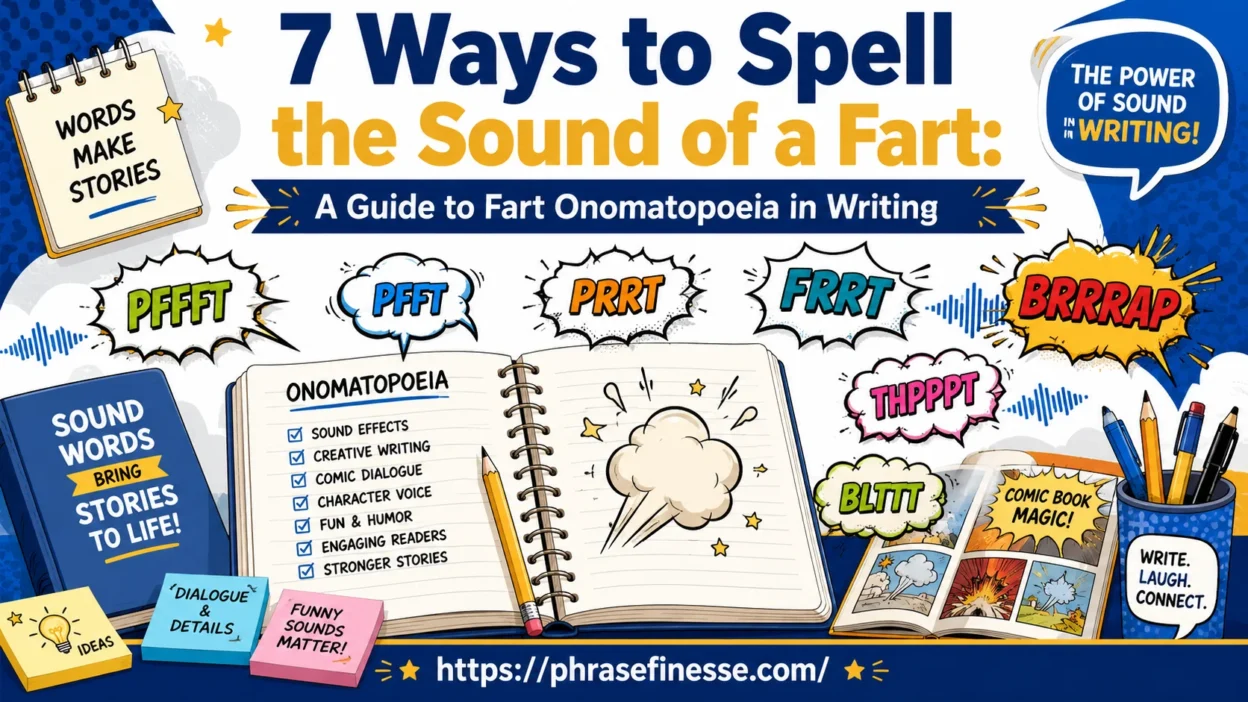
Have you ever struggled to describe a funny sound in writing? Whether you’re crafting dialogue, writing a story, or simply exploring English sound words, knowing the 7 Ways To Spell The Sound Of A Fart can make your writing more vivid, natural, and entertaining. From playful onomatopoeia to expressive sound effects, different spellings capture different tones, volumes, and contexts, helping readers hear the moment in their minds.
In English, onomatopoeia, sound words, creative writing, English usage, grammar, and formal writing all influence how sounds are represented on the page. While some spellings work best in humorous situations, others fit comics, fiction, or casual conversations. Understanding these variations improves writing consistency and helps writers choose the most effective word for their audience and purpose.
This guide explores the 7 Ways To Spell The Sound Of A Fart, explains when each spelling works best, and highlights subtle differences in meaning and style. You’ll also discover practical examples, usage tips, and insights into how sound words function in modern communication. Even in fields such as business communication, broadcasting, meetings, project management, scheduling, time management, calendar planning, and online booking, clear language and attention to detail strengthen overall writing skills, making a solid understanding of expressive English even more valuable.
What Is the Written Sound of a Fart?
The written representation of a fart sound is an example of onomatopoeia.
Onomatopoeia refers to words that imitate sounds.
Examples include:
- Buzz
- Bang
- Splash
- Hiss
- Tick-tock
- Meow
- Woof
Fart sounds work differently because they vary dramatically from one situation to another.
Some are:
- Quiet
- Loud
- Wet
- Dry
- Sharp
- Long
- Vibrating
- Airy
As a result, English developed multiple spellings instead of a single standard version.
Think of it this way.
A tiny squeak and a thunderous blast don’t sound alike. Writing them with the same word would feel inaccurate. That’s why writers choose different spellings depending on the sound they want readers to imagine.
Why Fart Sounds Have So Many Spellings
Unlike dictionary words, sound effects evolve naturally.
Comic books, cartoons, novels, social media posts, and internet memes all contribute to the way people spell sounds.
Several factors influence the spelling:
| Factor | Effect on Spelling |
| Volume | Loud sounds often contain more letters |
| Duration | Longer sounds use extended letter combinations |
| Vibration | Repeated consonants mimic rumbling |
| Wetness | Extra consonants suggest sputtering |
| Humor | Exaggerated spellings increase comedic effect |
| Audience | Children’s books use softer versions |
A writer describing a subtle fart during a serious novel will use a different spelling than a cartoonist drawing a humorous scene.
That’s why there is no official answer.
The best spelling is the one that matches the sound.
Pffft: The Classic Soft Fart Sound
Among all fart sound spellings, pffft is arguably the most common.
It represents a gentle release of air.
The sound feels:
- Light
- Quiet
- Airy
- Brief
Readers instantly recognize it because it appears frequently in comics and humorous fiction.
What Pffft Sounds Like
Imagine letting a little air escape from a balloon.
That’s the general effect.
It lacks vibration and doesn’t sound particularly forceful.
Example Sentences
- The old couch responded with a tiny pffft when he sat down.
- A soft pffft broke the silence during the meeting.
- The dog stretched lazily and released a quick pffft.
Best Uses
- Children’s stories
- Casual comedy
- Lighthearted fiction
- Family-friendly content
Pfft: The Quick Burst Version
Pfft removes one letter yet changes the feel significantly.
The sound becomes shorter and more abrupt.
Instead of lingering, it appears and disappears almost instantly.
What Pfft Sounds Like
Think of squeezing a small amount of air through pursed lips.
The sound is:
- Fast
- Short
- Sudden
- Minimal
Example Sentences
- The chair let out a quick pfft.
- Everyone froze after hearing a suspicious pfft.
- A tiny pfft escaped during the ceremony.
Best Uses
Writers often choose pfft when they want a sound effect that doesn’t dominate the scene.
It works particularly well in dialogue and short-form comedy.
Prrt: The Playful Cartoon Fart Sound
If you’ve read comic strips or watched animated shows, you’ve probably encountered prrt.
This spelling suggests a slight vibration.
That vibration makes it sound funnier.
What Prrt Sounds Like
Picture a small engine starting briefly.
The sound contains:
- Light buzzing
- Gentle vibration
- Moderate volume
- Playful energy
Example Sentences
- The toddler laughed after making a loud prrt noise.
- A cheerful prrt echoed from beneath the blanket.
- The puppy rolled over and went prrt.
Why Cartoonists Love It
Cartoons rely on instantly recognizable sound effects.
The repeated “r” helps readers hear the vibration in their minds.
That mental sound effect strengthens the joke.
Frrt: The Sharp and Sudden Fart Sound
Some sounds don’t linger.
They strike quickly and vanish.
That’s where frrt shines.
What Frrt Sounds Like
This spelling suggests:
- A sharp release
- Moderate force
- Short duration
- Slight vibration
The sound feels more realistic than many exaggerated comic-book versions.
Example Sentences
- A sudden frrt interrupted the conversation.
- The dog twitched and produced a quick frrt.
- A tiny frrt escaped before anyone could react.
Best Uses
- Humor writing
- Everyday storytelling
- Comic scenes
- Character-driven fiction
Many writers prefer frrt because it strikes a balance between realism and comedy.
Brrrap: The Loud and Extended Fart Sound
Now we’re entering dramatic territory.
Brrrap is impossible to ignore.
This spelling suggests a long, loud, vibrating noise.
What Brrrap Sounds Like
Imagine a motorcycle revving briefly.
That’s the effect many readers associate with this spelling.
Characteristics include:
- High volume
- Strong vibration
- Extended duration
- Maximum comedic value
Example Sentences
- The room fell silent after the legendary brrrap.
- A thunderous brrrap echoed across the campsite.
- Nobody could keep a straight face after hearing that brrrap.
Why Writers Use It
Comedy often relies on exaggeration.
A massive fart becomes funnier when the sound effect itself feels oversized.
The spelling visually communicates the joke before readers even finish reading it.
Thpppt: The Wet and Sputtering Version
Not every fart sounds dry.
Some sounds contain moisture or sputtering effects.
That’s where thpppt comes into play.
What Thpppt Sounds Like
This spelling creates the impression of:
- Wetness
- Sputtering
- Uneven airflow
- Messy sound texture
Even without context, readers can usually imagine the difference.
Example Sentences
- The mud bubble burst with a strange thpppt.
- A loud thpppt made everyone look away awkwardly.
- The sound ended with a distinctly wet thpppt.
Common Uses
- Slapstick comedy
- Gross-out humor
- Cartoons
- Comic books
Because the sound feels exaggerated, writers usually reserve it for intentionally humorous scenes.
Blttt: The Motor-Like Fart Sound
Some fart sounds resemble a tiny engine.
That’s exactly what blttt attempts to capture.
What Blttt Sounds Like
This spelling suggests:
- Continuous vibration
- Mechanical buzzing
- Moderate to high volume
- Extended duration
Example Sentences
- The old chair answered with a surprising blttt.
- A dramatic blttt echoed through the hallway.
- The sound lingered as a buzzing blttt.
Best Applications
- Comic strips
- Graphic novels
- Exaggerated humor
- Visual storytelling
The repeating letters create a sense of ongoing vibration that readers can almost hear.
Comparison Table of Common Fart Sound Spellings
The following table highlights the key differences.
| Spelling | Volume | Duration | Vibration | Humor Level |
| Pffft | Low | Short | Low | Moderate |
| Pfft | Low | Very Short | None | Moderate |
| Prrt | Medium | Short | Medium | High |
| Frrt | Medium | Short | Light | High |
| Brrrap | High | Long | Strong | Very High |
| Thpppt | Medium | Medium | Irregular | Very High |
| Blttt | High | Long | Strong | High |
How Writers Choose the Right Fart Sound
Good writers don’t randomly pick a sound effect.
They match the spelling to the situation.
Consider Volume
Ask yourself:
How loud is the sound?
A quiet release might need pfft.
A room-shaking blast might require brrrap.
Consider Duration
Some sounds end immediately.
Others continue for several seconds.
Longer sounds typically use additional letters to communicate length.
Consider Tone
Different stories require different approaches.
A serious novel might use subtle sound descriptions.
A comedy can embrace exaggerated spellings.
Consider Audience
Children’s books generally use softer, friendlier spellings.
Adult comedy often pushes exaggeration much further.
Fart Sounds in Fiction Writing
Novelists rarely rely solely on sound effects.
Instead, they combine sounds with reactions.
For example:
A tiny pfft escaped from the back row. Several heads turned immediately.
Notice how the reaction adds humor.
The sound alone isn’t always enough.
The best scenes combine:
- Sound
- Character response
- Timing
- Context
Together, those elements create a stronger emotional effect.
Fart Sounds in Comic Books
Comic books operate differently.
Visual storytelling requires instant recognition.
Readers glance at a panel for only seconds.
As a result, artists often use larger-than-life sound effects such as:
- BRRRAP
- PRRT
- BLTTT
- THPPPT
Capital letters increase impact.
Bold lettering increases visibility.
The goal is immediate comprehension.
Fart Sounds in Screenplays
Screenwriters usually format sound effects differently.
Example:
PRRT!
John freezes.
Everyone at the dinner table looks toward him.
The capitalization helps production teams identify important audio cues.
Many screenplay writers keep fart sounds short and highly readable.
Fart Sounds in Children’s Books
Children’s books often treat fart humor differently.
Young readers enjoy sound effects because they are easy to understand.
Popular choices include:
- Pfft
- Pffft
- Prrt
These spellings feel playful rather than crude.
That distinction matters when writing for younger audiences.
Alternative Ways to Describe a Fart Without Using Sound Words
Sometimes the funniest approach skips sound effects entirely.
Instead of writing the noise, describe what happened.
Action-Based Descriptions
Examples:
- A sudden burst escaped before he could stop it.
- The silence shattered unexpectedly.
- An unfortunate sound emerged from the corner.
Reaction-Based Descriptions
Examples:
- Everyone stopped talking.
- She buried her face in her hands.
- Laughter spread across the room.
Environmental Descriptions
Examples:
- The peaceful meeting ended abruptly.
- The classroom erupted into giggles.
- The dog looked genuinely confused.
Often these approaches feel more natural than onomatopoeia.
Read More: 7 Other Ways to Say “Sorry to Bother You” in an Email
Common Mistakes When Writing Fart Sounds
Even experienced writers make mistakes.
Using the Same Sound Every Time
Repetition weakens humor.
Mixing different spellings creates variety.
Ignoring Context
A tiny squeak shouldn’t sound like a motorcycle.
Match the spelling to the scene.
Overusing Sound Effects
Too many sound words can overwhelm readers.
Use them strategically.
Choosing Confusing Spellings
Readers should understand the sound immediately.
If they stop to decode it, the joke loses momentum.
Mini Case Study: Why “Brrrap” Feels Funnier Than “Pfft”
Imagine two sentences.
Sentence A:
A quiet pfft escaped during the lecture.
Sentence B:
A thunderous brrrap echoed through the lecture hall.
Most readers find the second sentence funnier.
Why?
Because humor often grows through contrast and exaggeration.
The larger sound creates:
- Higher stakes
- Greater embarrassment
- Stronger imagery
- More dramatic reactions
Comedy writers frequently exploit this principle.
FAQs
1. What is the most common way to spell the sound of a fart?
The most common spelling is “Pfft” or “Fart” itself in casual writing. However, comic books, humorous stories, and online content often use variations such as “Toot,” “Poot,” “Brrt,” and “Parp” to create specific sound effects.
2. Why are there different spellings for the sound of a fart?
Different spellings represent different tones, volumes, and styles of sounds. A short, quiet sound may be written as “Poot,” while a louder or more abrupt sound might appear as “Brrt” or “Parp.” Writers choose the spelling that best matches the situation.
3. Are fart sound spellings considered onomatopoeia?
Yes. These words are examples of onomatopoeia, which are words that imitate or suggest real-life sounds. They help readers imagine the sound being described without needing a lengthy explanation.
4. Which fart sound spelling is best for creative writing?
The best choice depends on the context. “Toot” works well for lighthearted or children’s content, while “Brrt” and “Parp” can create stronger comedic effects in stories, comics, and humorous articles.
5. Do fart sound spellings vary by region?
Yes. Some spellings are more common in certain English-speaking regions. For example, “Parp” is frequently used in British English, while “Toot” and “Poot” are more widely recognized in American English.
6. Can fart sound words be used in formal writing?
Generally, no. These sound words are best suited to creative writing, fiction, comics, social media content, and humorous contexts. Formal or professional documents typically avoid onomatopoeic expressions unless they serve a specific purpose.
Conclusion
Choosing the right spelling for a sound effect can make your writing more engaging and memorable. The 7 Ways To Spell The Sound Of A Fart each bring their own tone, personality, and level of humor, allowing writers to match the sound to the scene. Whether you prefer “Toot,” “Poot,” “Pfft,” “Brrt,” or another variation, understanding these forms of onomatopoeia helps create stronger imagery and more entertaining content. By selecting the spelling that best fits your audience and context, you can add clarity, humor, and creativity to your writing while keeping readers fully engaged.

Alyan Ashraf is an English language writer and editor at Phrase Finesse, where he specializes in grammar, vocabulary, spelling, word usage, and clear communication. Passionate about the English language, he creates practical, research-backed content that helps readers avoid common mistakes and write with greater accuracy and confidence.
Known for his clear writing style and attention to detail, Alyan simplifies complex language topics into easy-to-understand guides filled with real-world examples and actionable insights. His work covers confusing word pairs, grammar rules, idioms, punctuation, and everyday English usage, making learning both accessible and engaging for students, professionals, writers, and non-native English speakers.
Every article Alyan writes is carefully researched, fact-checked, and designed to meet high editorial standards. His goal is to help readers strengthen their English skills, expand their vocabulary, and communicate more effectively in academic, professional, and everyday settings.
Through Phrase Finesse, Alyan is committed to publishing trusted language resources that make mastering English simpler, clearer, and more enjoyable for learners around the world