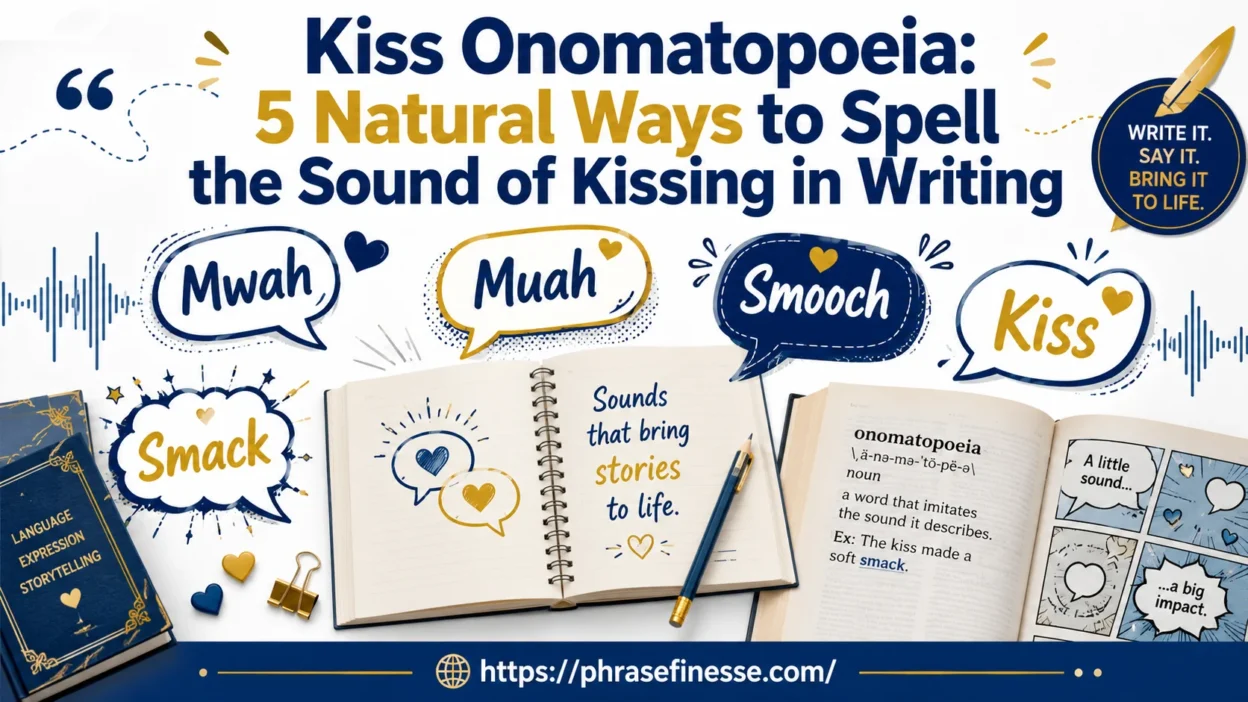
Have you ever paused while writing dialogue and wondered how to spell the sound of a kiss correctly? The topic of 5 Ways To Spell The Sound Of Kissing is more interesting than it first appears. Different writers, editors, and storytellers use different spellings to represent this affectionate sound, and choosing the right one can improve clarity, readability, and natural expression in your writing.
In modern English usage, small details often make a big difference. Whether you’re writing fiction, comics, subtitles, social media content, or even content related to broadcasting, understanding these variations helps maintain consistency and authenticity. Just as precision matters in formal writing, business communication, meetings, project management, scheduling, time management, online booking, and calendar organization, selecting the right sound representation strengthens the overall quality of your text.
This guide explores the most common ways writers spell the sound of kissing, explains when each version works best, and highlights subtle differences in tone and context. By the end, you’ll have a clearer understanding of grammar, style, and usage conventions, helping you choose the spelling that fits your audience and writing purpose with confidence.
What Kiss Onomatopoeia Really Means in Writing
Kiss onomatopoeia refers to written words that imitate or suggest the sound or feeling of a kiss. Unlike real sound effects, kisses are not always audible. So writers rely on stylized spellings to create sensory impact.
Think of it like this:
A kiss is an action. Onomatopoeia turns it into an experience.
Even though the sound is imagined, readers still “hear” it because the brain fills in the gap. That’s why these words matter so much in storytelling, dialogue, and even casual texting.
Why kiss sounds are tricky
Kissing does not produce a single universal sound. It changes based on:
- Lip pressure
- Distance
- Emotion
- Context
- Environment
A soft goodbye kiss sounds nothing like a fast cheek peck. So writers don’t aim for realism alone. They aim for emotional accuracy.
That’s the real goal of kiss onomatopoeia.
Why Writers Use Kiss Onomatopoeia Instead of Plain Description
Plain writing like “he kissed her” gets the job done. But it doesn’t create atmosphere.
Now compare:
- “He kissed her.”
- “He leaned in and went mwah against her cheek.”
The second version adds sound, tone, and personality.
Writers use kiss sounds for three main reasons:
It builds emotional texture
A kiss becomes more than an action. It becomes a moment.
It defines character personality
Some characters say “mwah” while others give a “smack.” That difference tells you a lot.
It shapes tone instantly
Comedy, romance, awkwardness, or drama all shift depending on the sound choice.
As one writing coach puts it:
“Onomatopoeia doesn’t describe sound. It creates presence.”
That’s exactly what kiss sounds do in storytelling.
Read More: 4 Words to Describe the Sound of Coughing
The Five Natural Ways to Spell Kiss Sounds in Writing
Let’s break down the five most commonly used and believable kiss onomatopoeia forms. Each one carries a different emotional weight. Choosing the right one changes the entire scene.
“Mwah” The Classic Air Kiss Sound
“Mwah” is the most recognizable kiss sound in modern writing. You see it everywhere from text messages to dialogue in romance novels.
It represents an air kiss or a playful lip sound.
How it feels in writing
It feels light. Quick. Social. Sometimes flirty but never heavy.
When to use it
- Text messages
- Friendly goodbyes
- Flirty exchanges
- Social media captions
Example in context
“I’ll see you tomorrow, mwah,” she said before hanging up.
Why it works
It mimics the puff of air people exaggerate when they blow a kiss. It’s not realistic sound design. It’s emotional shorthand.
A writer once described it perfectly:
“Mwah is not a sound. It’s a wink you can read.”
That’s exactly its power.
“Muah” The Softer, More Emotional Variation
“Muah” looks similar to “mwah,” but it feels different in tone. It sounds smoother and slightly more intimate.
How it feels in writing
Less playful. More affectionate. Almost whispered.
When to use it
- Romantic texting
- Emotional goodbyes
- Close relationships
- Tender moments
Example in context
“I miss you,” he texted. “Muah.”
Why it works
Dropping the “w” softens the sound visually. Readers interpret that softness emotionally. It feels closer, more personal, less performative.
Think of it like this:
If “mwah” is a wave from across the room, “muah” is a hand squeeze.
“Smack” The Loud and Physical Kiss Sound
“Smack” is the most audible and physical of all kiss onomatopoeia. It often appears in cheek kisses or exaggerated expressions of affection.
How it feels in writing
Bold. Loud. Sometimes funny. Occasionally dramatic.
When to use it
- Cheek kisses
- Comedic scenes
- Exaggerated affection
- Family interactions
Example in context
She grabbed his face and planted a loud smack on his cheek.
Why it works
It creates a clear auditory image. Readers can almost hear the pop of contact.
However, tone matters. Use it in romance carefully. It can feel too harsh if misused.
A good rule:
If the moment feels playful or energetic, “smack” fits. If it feels intimate, it doesn’t.
“Smooch” The Romantic and Emotional Kiss Sound
“Smooch” does not imitate a literal sound. Instead, it captures the feeling of a kiss.
How it feels in writing
Soft. Slow. Romantic. Sometimes nostalgic.
When to use it
- Romantic scenes
- Emotional storytelling
- Long kisses
- Cinematic writing
Example in context
They shared a quiet smooch under the rain before parting ways.
Why it works
It stretches the moment. It slows down time in the reader’s mind.
Unlike “mwah” or “smack,” it doesn’t feel like a sound effect. It feels like an experience.
Writers often use it when emotion matters more than realism.
“Kiss” The Minimalist Representation
Sometimes the simplest option works best.
“Kiss” doesn’t imitate sound. It represents the action cleanly.
How it feels in writing
Neutral. Clear. Direct.
When to use it
- Scripts
- Formal writing
- Descriptive narration
- Scenes where clarity matters
Example in context
He leaned in for a kiss before she stepped back.
Why it works
It avoids stylistic noise. Readers focus on action, not sound imitation.
It works especially well when dialogue already carries emotional weight.
Comparison Table: Choosing the Right Kiss Onomatopoeia
| Sound | Emotional Tone | Best Context | Reader Effect |
| Mwah | Playful, light | Texting, casual affection | Quick emotional cue |
| Muah | Soft, intimate | Romantic messages | Warm closeness |
| Smack | Loud, physical | Comedy, cheek kisses | Strong auditory image |
| Smooch | Romantic, slow | Fiction, storytelling | Emotional immersion |
| Kiss | Neutral, clean | Scripts, narration | Clear action focus |
How Context Changes Everything in Kiss Onomatopoeia
The same kiss can feel completely different depending on context.
Let’s take one idea:
A goodbye kiss
Now watch how tone shifts:
- “Mwah, bye!” → playful and casual
- “Muah, I’ll miss you.” → emotional and soft
- “SMACK!” → comedic or exaggerated
- “They shared a smooch before she left.” → cinematic and romantic
- “He gave her a kiss before leaving.” → neutral and simple
The action never changes. The feeling does.
That’s why experienced writers don’t choose randomly. They match sound to emotional intent.
Think of it like seasoning food. The base dish stays the same. The flavor changes everything.
Common Mistakes Writers Make With Kiss Onomatopoeia
Even simple sound effects can go wrong when used without care.
Overusing “mwah”
It loses meaning when repeated too often. It starts to feel flat instead of playful.
Using “smack” in serious romance
It can break emotional immersion. It feels too loud for intimate moments.
Ignoring character voice
A shy character and a bold character should not use the same kiss sounds.
Forcing sound effects into every kiss
Sometimes silence works better than imitation.
A strong rule in writing:
If the moment already feels powerful, don’t decorate it too much.
Better Writing Practices for Kiss Onomatopoeia
Good writing doesn’t just pick the right word. It understands rhythm and emotion.
Match sound to intent
Ask: what should the reader feel right now?
Keep it natural
Don’t force sound effects into every scene. Use them when they add value.
Let characters shape the sound
A playful character might say “mwah.” A serious one might avoid it entirely.
Vary your choices
Repetition weakens impact. Mix styles when appropriate.
Read it out loud
If it sounds awkward when spoken, it will feel awkward on the page.
Creative Variations Writers Can Experiment With
Once you understand the basics, you can bend the rules a little.
Extended sounds
- “Mwahh” for exaggerated affection
- “Muaah” for dramatic romance
Stylized emphasis
- MWAH! for energetic tone
- smack! for comedic punch
Repetition for effect
- “muah muah” for playful teasing
Emoji integration in dialogue
- “Mwah 💋” in casual texting scenes
These variations work best in informal writing, comics, or dialogue-heavy stories.
Case Studies: How Kiss Onomatopoeia Changes Scenes
Case Study: Romantic Novel Scene
A writer describes a farewell at a train station.
- Version A: “They kissed goodbye.”
- Version B: “They shared a soft smooch before the train pulled away.”
Version B slows time. It adds emotional weight. Readers linger longer in the moment.
Case Study: Comedy Scene
A sitcom-style script uses exaggeration.
- “She grabbed his face and went SMACK on his cheek.”
The loudness creates humor. It breaks tension intentionally.
Case Study: Text Message Exchange
Two characters flirt through messages.
- “Goodnight 🙂 mwah”
- “Muah, sleep well”
The sound replaces physical presence. It builds intimacy across distance.
Each case shows the same truth: tone drives meaning, not spelling alone.
FAQs
1. What is the most common way to spell the sound of kissing?
The most common spelling is “mwah”. It is widely used in text messages, social media posts, dialogue, and casual writing to represent the sound of a kiss. Many writers prefer it because readers instantly recognize its meaning.
2. Is “muah” or “mwah” correct?
Both “muah” and “mwah” are correct. Neither spelling is officially standardized in English dictionaries. The choice usually depends on personal preference, regional usage, or the style of writing.
3. How do authors spell kissing sounds in fiction?
Authors often use spellings such as “mwah,” “muah,” “smooch,” “kiss,” or “smack” depending on the scene. Romantic stories may favor softer spellings like “mwah,” while humorous or exaggerated scenes may use “smooch” or “smack.”
4. Is there an official English word for the sound of a kiss?
No, there is no universally accepted official English word for the sound of a kiss. Most spellings are considered onomatopoeic expressions, meaning they imitate a sound rather than follow a fixed spelling rule.
5. Can I use kissing sound spellings in formal writing?
Generally, kissing sound spellings such as “mwah” or “muah” are best suited for informal writing, dialogue, creative works, comics, and social media. They are rarely appropriate in formal writing or professional documents.
6. Why are there different spellings for the sound of kissing?
Different spellings exist because people hear and interpret sounds differently. Language, culture, writing style, and personal preference all influence how writers choose to represent the sound of a kiss in text.
Conclusion
Understanding the 5 Ways To Spell The Sound Of Kissing can help you write more naturally and effectively, especially in dialogue, creative content, and casual communication. While there is no single correct spelling, options such as “mwah,” “muah,” “smooch,” “smack,” and “kiss” each convey slightly different tones and emotions. The best choice depends on your audience, context, and writing style.
By recognizing these variations, you can improve English usage, maintain consistency, and create more engaging content that sounds authentic to readers. Whether you’re crafting a novel, writing a text message, or adding personality to a character’s dialogue, choosing the right kissing sound can make your writing feel more vivid and memorable.

Mia Rose is an English language specialist and editorial writer at Phrase Finesse, where she helps readers master grammar, vocabulary, spelling, and effective communication. Passionate about making English simple and practical, she creates well-researched, reader-friendly content that explains complex language concepts in a clear and engaging way.
With extensive experience in English language education, content writing, and editorial review, Mia specializes in grammar, punctuation, word choice, idioms, confusing word pairs, and writing style. Her articles are carefully researched, fact-checked, and designed to help students, professionals, writers, and English learners build confidence in both written and spoken English.