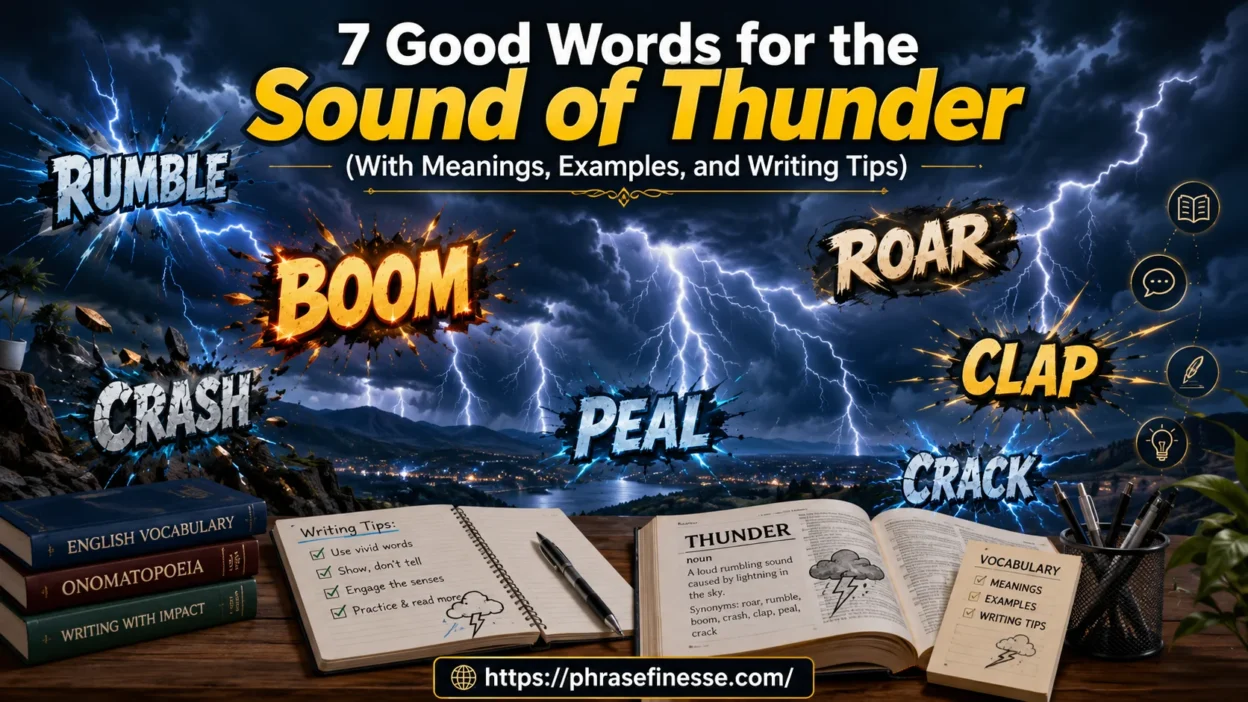
Have you ever heard a storm roll across the sky and wondered how writers capture that powerful sound in words? Understanding 7 Good Words For The Sound Of Thunder (Onomatopoeia) can help you describe thunder more vividly and make your writing feel alive. From dramatic storytelling to everyday English usage, the right onomatopoeic words create stronger imagery and a more engaging reading experience.
Thunder is often represented through expressive sound words such as boom, crash, rumble, and other descriptive terms that imitate real-life noise. Knowing when and how to use these words improves grammar, strengthens formal writing, and adds consistency to your communication. Whether you’re writing fiction, educational content, or creative descriptions, choosing the correct thunder-related vocabulary can make your message more impactful.
In this guide, you’ll discover seven effective words that represent the sound of thunder, along with their meanings, examples, and best-use situations. We’ll also explore how these sound words fit into modern writing contexts, including broadcasting, business communication, project management documentation, and even content related to scheduling, time management, online booking, meetings, and calendar systems where clear and descriptive language matters. By the end, you’ll know exactly which thunder sound word works best for your specific writing purpose.
Quick Answer: 7 Good Words for the Sound of Thunder
| Word | Meaning | Best Used For |
| Rumble | Deep rolling sound | Distant thunder |
| Boom | Loud explosive sound | Powerful thunder |
| Crash | Sudden violent sound | Severe storms |
| Roar | Long continuous loud sound | Intense weather |
| Clap | Sharp burst of thunder | Thunder following lightning |
| Peal | Repeated rolling thunder | Literary descriptions |
| Crack | Sharp splitting sound | Very close thunder |
Rumble: The Classic Word for the Sound of Thunder
If one word dominates descriptions of thunder, it’s rumble.
A rumble is a low, deep, continuous sound that gradually rolls through the air. Because sound travels across different parts of the atmosphere at varying speeds, distant thunder often reaches your ears as a prolonged rolling noise rather than a sudden explosion.
Meaning of Rumble
A rumble suggests:
- Distance
- Depth
- Continuity
- Gradual movement
You can almost picture dark clouds gathering beyond the horizon when you hear the word.
Example Sentences
- Thunder rumbled across the mountains.
- A distant rumble signaled the arrival of the storm.
- The sky continued to rumble long after sunset.
When to Use Rumble
Use rumble when:
- Thunder is far away.
- A storm is approaching.
- You want to create suspense.
- The atmosphere matters more than shock.
Similar Words
- Roll
- Growl
- Murmur
- Reverberation
Why Writers Love This Word
Rumble creates tension. It hints that something bigger may be coming. Horror writers, fantasy authors, and weather reporters frequently use it because it feels natural and realistic.
Boom: A Powerful Thunder Sound Word
While rumble suggests distance, boom delivers impact.
A boom sounds sudden, forceful, and explosive. It captures the moment when thunder announces itself with authority.
Meaning of Boom
Boom describes:
- A loud burst
- A powerful shockwave
- An explosive sound
Readers instantly associate the word with strength.
Example Sentences
- A tremendous boom shook the house.
- Thunder boomed across the countryside.
- One loud boom echoed through the valley.
Best Situations for Using Boom
Choose boom when:
- Thunder sounds powerful.
- Storms are close.
- You want dramatic imagery.
- You need a strong sensory effect.
Boom vs. Rumble
| Feature | Boom | Rumble |
| Duration | Short | Long |
| Intensity | High | Medium |
| Distance | Near or medium | Usually far |
| Effect | Sudden | Rolling |
A boom feels like a punch. A rumble feels like a warning.
Crash: A Violent Description of Thunder
Crash is among the most dramatic words for thunder.
Unlike rumble or boom, crash implies destruction, collision, and raw force.
Meaning of Crash
Crash refers to:
- A violent impact
- A sudden loud noise
- An explosive collision-like sound
The word often creates an emotional reaction because people naturally associate crashes with danger.
Example Sentences
- A crash of thunder startled the campers.
- Thunder crashed overhead throughout the night.
- The storm unleashed a terrifying crash that echoed for miles.
When Crash Works Best
Use crash when:
- Lightning strikes nearby.
- Storm intensity is extreme.
- You’re creating suspense.
- You want readers to feel alarm.
Crash vs. Boom
Many writers treat these words as interchangeable, but subtle differences exist.
A boom sounds powerful.
A crash sounds violent.
Think of a boom as an explosion and a crash as something breaking apart.
Roar: Thunder That Sounds Alive
Roar brings movement and personality to thunder.
The word originally described sounds made by large animals such as lions. Over time, writers began using it for storms because thunder can seem almost alive.
Meaning of Roar
Roar suggests:
- Continuous volume
- Intensity
- Aggression
- Power
Example Sentences
- The storm roared over the coastline.
- Thunder roared through the dark sky.
- The clouds seemed to roar with anger.
Why Roar Creates Strong Imagery
Roar gives weather human-like qualities.
This literary technique, called personification, helps readers connect emotionally with a scene.
Instead of merely hearing thunder, readers experience a storm that appears to have a personality.
Roar vs. Rumble
| Roar | Rumble |
| Aggressive | Calm |
| Continuous | Rolling |
| Intense | Moderate |
| Dramatic | Atmospheric |
Roar works especially well in novels and creative writing.
Clap: The Traditional Thunder Expression
Many people recognize the phrase “a clap of thunder.”
Although modern speakers use it less often than boom or rumble, clap remains one of the most accurate weather-related terms.
Meaning of Clap
A clap refers to:
- A sharp burst of thunder
- A sudden crack-like sound
- Thunder immediately following lightning
Example Sentences
- A loud clap of thunder interrupted the conversation.
- Lightning flashed before a sharp clap echoed overhead.
- The children jumped when they heard the clap of thunder.
What Causes a Clap of Thunder?
Lightning heats surrounding air to extremely high temperatures within fractions of a second.
The air expands rapidly.
That sudden expansion creates shock waves.
Those shock waves become the sharp sounds we recognize as thunder.
When to Use Clap
Use clap when:
- Thunder sounds abrupt.
- Lightning occurs nearby.
- You want precise weather terminology.
Peal: A Literary Word for Thunder
Peal isn’t as common today, yet it remains valuable for descriptive writing.
A peal usually refers to repeated ringing sounds, especially bells. However, writers have long used the term to describe rolling thunder.
Meaning of Peal
Peal suggests:
- Repetition
- Echoing sound
- Rolling intensity
Example Sentences
- Peals of thunder rolled across the hills.
- The night sky erupted with peals of thunder.
- Thunder pealed through the mountains.
Why Peal Feels More Elegant
Compared with crash or boom, peal sounds refined.
You’ll often find it in:
- Historical fiction
- Poetry
- Literary novels
- Nature writing
Modern Usage
While less common in everyday speech, peal remains effective when you want polished and expressive language.
Crack: Sharp and Sudden Thunder
Crack captures thunder at its most startling.
When lightning strikes nearby, thunder often sounds less like a roll and more like something splitting apart.
Meaning of Crack
Crack suggests:
- Sharpness
- Suddenness
- High intensity
- Proximity
Example Sentences
- A crack of thunder shook the windows.
- Thunder cracked directly overhead.
- The storm opened with a violent crack.
Why Crack Indicates Nearby Thunder
The closer lightning occurs, the sharper thunder sounds.
Distant thunder spreads out and becomes a rumble.
Nearby thunder arrives quickly and retains its explosive quality.
That’s why crack often signals that the storm is directly above you.
Crack vs. Clap
| Crack | Clap |
| Sharper | Broader |
| More dramatic | More technical |
| Often literary | Common weather phrase |
| Suggests proximity | Suggests suddenness |
Which Thunder Sound Word Should You Use?
Not every thunder word fits every situation.
The table below helps you choose the most effective option.
| Word | Loudness | Distance | Tone | Common Usage |
| Rumble | Medium | Far | Atmospheric | Very common |
| Boom | High | Medium | Powerful | Common |
| Crash | Very high | Near | Violent | Common |
| Roar | High | Variable | Dramatic | Common |
| Clap | Sharp | Near | Technical | Common |
| Peal | Medium | Variable | Literary | Less common |
| Crack | Very high | Very near | Abrupt | Common |
Other Words Associated With the Sound of Thunder
The English language offers several additional words that can strengthen storm descriptions.
Growl
Growl suggests low, threatening thunder.
Example:
“The clouds growled in the distance.”
Roll
Roll emphasizes movement.
Example:
“Thunder rolled across the plains.”
Reverberate
Reverberate focuses on echoes.
Example:
“The thunder reverberated through the canyon.”
Resound
Resound highlights widespread sound.
Example:
“The thunder resounded throughout the valley.”
Thunderous
Although technically an adjective, thunderous helps strengthen descriptions.
Example:
“A thunderous roar filled the night sky.”
Read More: 5 Natural Ways to Spell the Sound of Kissing in Writing
How Great Writers Describe Thunder
Professional writers rarely rely on one word repeatedly.
Instead, they combine sounds, movement, and sensory details.
Weak Description
“Thunder sounded loud.”
Better Description
“A deep rumble rolled across the hills before a violent crack split the night sky.”
Notice the difference.
The second example creates a complete sensory experience.
Readers can hear it.
They can almost feel it.
Use Distance to Choose Better Thunder Words
Distance changes how thunder sounds.
Understanding this fact improves descriptive writing immediately.
Distant Thunder
Best words:
- Rumble
- Roll
- Growl
Example:
“A low rumble drifted across the horizon.”
Medium-Distance Thunder
Best words:
- Boom
- Roar
Example:
“Thunder boomed over the valley.”
Nearby Thunder
Best words:
- Crack
- Crash
- Clap
Example:
“A crack of thunder rattled the glass.”
Match the Word to the Mood
Thunder doesn’t always create the same emotional effect.
The mood matters.
Suspense
Use:
- Rumble
- Growl
- Roll
Example:
“A faint rumble emerged from the darkening sky.”
Fear
Use:
- Crash
- Crack
Example:
“A violent crash shattered the silence.”
Excitement
Use:
- Boom
- Roar
Example:
“The stadium seemed to shake as thunder roared overhead.”
Mystery
Use:
- Peal
- Rumble
Example:
“Distant peals echoed through the fog.”
Combine Thunder With Other Senses
Strong descriptions engage multiple senses.
Don’t focus solely on sound.
Add the following
Visual Details
- Lightning flashes
- Dark clouds
- Rain curtains
Physical Sensations
- Vibrating windows
- Shaking floors
- Sudden pressure changes
Emotional Reactions
- Nervous anticipation
- Awe
- Fear
- Excitement
Example
“A bright flash illuminated the sky. Seconds later, a deep rumble rolled through the valley. The windows trembled while rain hammered against the roof.”
This description feels more immersive because it combines sight, sound, touch, and movement.
Case Study: Transforming a Basic Thunder Description
Original Version
“There was thunder during the storm.”
The sentence communicates information.
However, it doesn’t create imagery.
Improved Version
“Peals of thunder rolled across the mountains while flashes of lightning illuminated the clouds.”
Advanced Version
“A distant rumble drifted through the valley before a violent crack exploded overhead, shaking the windows and startling everyone inside.”
The final version creates atmosphere, movement, and emotion.
Common Mistakes When Describing Thunder
Even experienced writers make these errors.
Repeating the Same Word
Avoid this:
“Thunder rumbled. The thunder rumbled again. The thunder kept rumbling.”
Instead, vary vocabulary.
Use:
- Rumble
- Boom
- Roll
- Roar
Ignoring Storm Distance
A nearby storm rarely rumbles softly.
Likewise, distant thunder rarely cracks sharply.
Choose words that match reality.
Overusing Dramatic Language
Every storm doesn’t need violent crashes and earth-shaking booms.
Sometimes subtle descriptions feel more realistic.
Forgetting Context
Thunder in a horror story should sound different from thunder in a romantic novel.
Match vocabulary to the scene.
FAQs
1. What is an onomatopoeia for the sound of thunder?
An onomatopoeia is a word that imitates a real sound. For thunder, common examples include boom, crash, rumble, roar, and clap. These words help readers hear the sound through written language.
2. Which word best describes loud thunder?
Boom is often the most popular word for extremely loud thunder. However, crash and clap can also work well when describing sudden, explosive thunder sounds.
3. Why do writers use thunder onomatopoeia?
Writers use thunder onomatopoeia to create vivid imagery and make scenes more immersive. Sound words help readers experience a storm rather than simply read about it.
4. Is “rumble” different from “crash” when describing thunder?
Yes. Rumble usually refers to a long, rolling thunder sound that continues across the sky. Crash describes a sharp, sudden, and powerful burst of thunder.
5. Can thunder have more than one onomatopoeic word?
Absolutely. Thunder produces different sounds depending on the storm’s intensity and distance. That’s why words such as boom, rumble, roar, crack, and crash can all accurately describe thunder in different situations.
6. Are thunder sound words used in formal writing?
Yes, but their use depends on the context. In creative writing, storytelling, and descriptive articles, thunder sound words add detail and engagement. In highly formal writing, they are used more selectively to maintain clarity and professionalism.
Conclusion
Choosing the right word to describe thunder can transform ordinary writing into something far more vivid and memorable. The 7 Good Words For The Sound Of Thunder (Onomatopoeia) discussed in this article each capture a different aspect of thunder, from a deep rumble to a sudden crash or powerful boom. Understanding these subtle differences allows you to select the most accurate word for your context and create stronger imagery for your readers.
Whether you’re improving your English usage, enhancing creative writing, or refining your formal writing skills, thunder-related onomatopoeia can add depth, emotion, and realism to your work. By using these words thoughtfully and consistently, you’ll communicate more effectively while making your descriptions sound natural, engaging, and impactful.

Emma Brooke is an English language specialist, editor, and content writer at Phrase Finesse, where she helps readers develop stronger writing and communication skills through clear, practical, and engaging content. With a passion for the English language, she specializes in simplifying grammar rules, vocabulary, spelling, punctuation, and word usage for learners at every level.
Emma has extensive experience creating educational content that is accurate, well-researched, and easy to understand. She is particularly skilled at explaining confusing word pairs, grammar concepts, idioms, sentence structure, and effective writing techniques, making complex topics approachable for students, professionals, educators, and English learners worldwide.