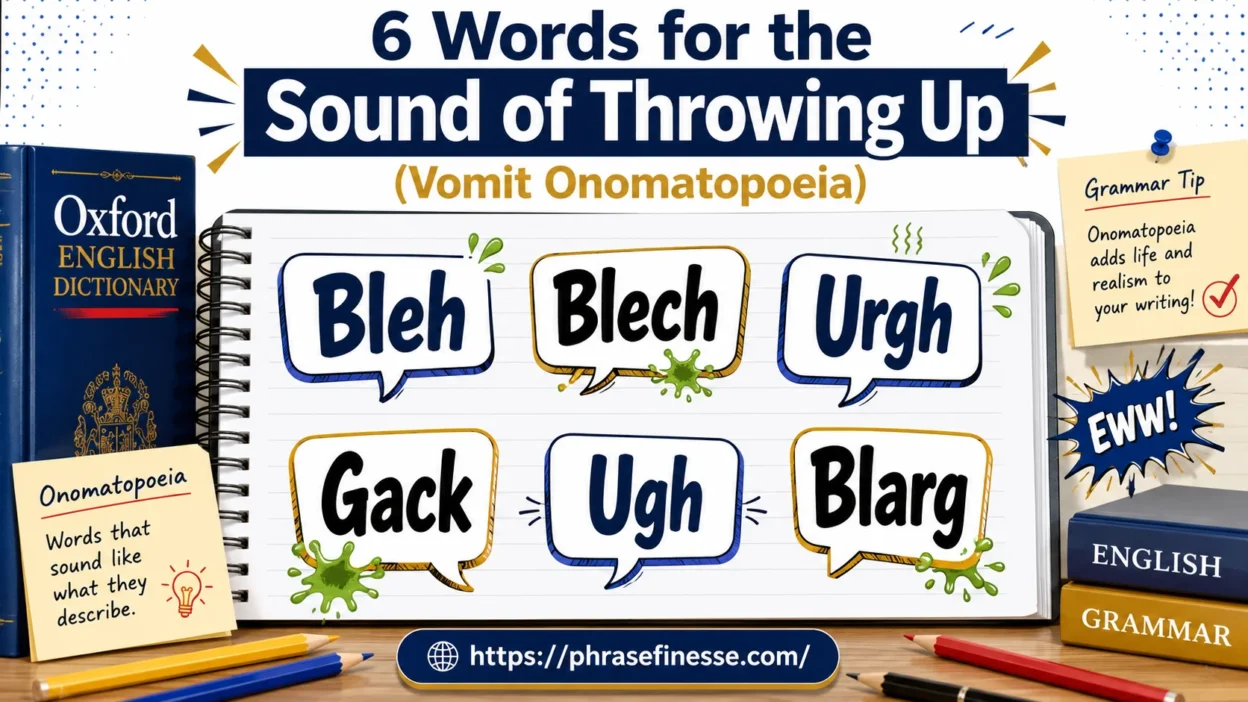
Have you ever struggled to describe the exact sound of throwing up in a story, conversation, or piece of writing? Many people know the experience, yet finding the right word can be surprisingly difficult. That is where 6 Words For The Sound Of Throwing Up becomes useful. From vivid onomatopoeic words to more descriptive expressions, the English language offers several ways to capture these unpleasant but realistic sounds with greater accuracy and impact.
Whether you are improving your English usage, refining your grammar, or enhancing your formal writing, choosing the right term matters. Writers, students, and content creators often need precise vocabulary to create realistic scenes and clear descriptions.
Just as business communication, broadcasting, and professional content rely on word choice for clarity, descriptive writing benefits from selecting the most suitable expression. Understanding these sound-related words also promotes consistency, readability, and stronger communication.
In this guide, you will discover six commonly used words and expressions that represent the sound of vomiting, along with their meanings, usage, and contextual differences. We will also examine how these terms function in everyday speech and written English.
While topics such as scheduling, time management, online booking, meetings, calendar management, and project management may seem unrelated, they all highlight the importance of choosing precise language for the right situation. By the end, you will know which word best fits your context and how to use it naturally and effectively.
What Is an Onomatopoeia?
An onomatopoeia is a word that imitates or suggests the sound associated with an action, object, animal, or event.
Instead of merely describing a sound, an onomatopoeic word attempts to reproduce it.
For example:
| Sound | Onomatopoeia |
| Dog barking | Woof |
| Cat noise | Meow |
| Explosion | Boom |
| Door closing | Slam |
| Water impact | Splash |
| Vomiting | Gack, Bleh, Urgh |
Humans naturally imitate sounds when they speak. Long before formal dictionaries existed, people created words by copying noises they heard around them.
That process still happens today.
Internet slang, comic books, video games, and social media frequently introduce new sound words that eventually become part of everyday language.
Why Vomit Onomatopoeia Matters in Writing
Most writers focus heavily on visual descriptions.
However, sound often creates stronger emotional reactions.
Consider these examples:
Without sound effect:
He suddenly vomited onto the floor.
With sound effect:
“Gack!” He doubled over before vomiting onto the floor.
The second example immediately feels more vivid.
Readers can almost hear the moment.
That’s why sound effects remain popular in:
- Fiction
- Comics
- Graphic novels
- Children’s books
- Screenplays
- Humor writing
- Video game dialogue
- Online storytelling
A well-chosen vomiting sound effect can instantly communicate:
- Disgust
- Nausea
- Illness
- Panic
- Comedy
- Embarrassment
Common Types of Onomatopoeia
Before examining vomit sounds specifically, it helps to understand where they fit within the broader category of sound words.
| Category | Examples |
| Animal Sounds | Bark, Meow, Moo |
| Impact Sounds | Bang, Crash, Slam |
| Water Sounds | Splash, Drip, Gurgle |
| Mechanical Sounds | Click, Buzz, Whirr |
| Human Sounds | Cough, Sneeze, Burp |
| Vomit Sounds | Gack, Bleh, Blech |
Notice something interesting.
Many vomiting sounds don’t attempt to copy the exact sound of vomiting. Instead, they imitate the feelings that occur before, during, or after the act.
That’s one reason why multiple words exist.
Different people hear and interpret the sound differently.
The Most Common Words for the Sound of Throwing Up
Bleh
Among all vomit-related sound effects, bleh ranks among the most recognizable.
People often use it to express:
- Mild nausea
- Disgust
- Distaste
- Revulsion
- Unpleasant taste
Technically, bleh doesn’t always indicate actual vomiting.
Instead, it often represents the feeling that comes immediately before vomiting.
Examples of Bleh
“Bleh. This milk tastes awful.”
“Bleh!” she groaned while covering her mouth.
“I feel sick. Bleh.”
Why Writers Use Bleh
Writers favor bleh because readers instantly understand its emotional meaning.
The word feels casual.
It sounds unpleasant.
Most importantly, it works without becoming overly graphic.
Tone
| Characteristic | Rating |
| Realism | Moderate |
| Humor | High |
| Formality | Very Low |
| Comic Use | Excellent |
Blech
Blech is closely related to bleh.
Many linguists consider it a variation rather than a completely separate word.
The added “ch” sound creates a rougher ending.
As a result, blech often sounds stronger and more forceful.
Examples of Blech
“Blech! That smell is horrible.”
“Blech,” he muttered after tasting the spoiled soup.
Bleh vs. Blech
| Feature | Bleh | Blech |
| Intensity | Lower | Higher |
| Common in Speech | Very Common | Common |
| Disgust Level | Mild | Moderate |
| Comic Effect | High | High |
Best Uses
Blech works especially well when describing:
- Rotten food
- Bad smells
- Gross discoveries
- Mild nausea
Because it sounds harsher than bleh, many writers choose it when they want a stronger reaction without depicting actual vomiting.
Urgh
The word urgh represents discomfort more than vomiting itself.
You may hear someone say it after:
- Seeing something disgusting
- Feeling nauseous
- Experiencing pain
- Encountering a foul odor
Unlike bleh and blech, urgh focuses on the emotional response.
Examples of Urgh
“Urgh. I don’t feel well.”
“Urgh!” he said as the smell reached him.
Why It Works
The drawn-out vowel creates a natural groaning effect.
Readers instinctively understand the feeling.
That’s why urgh appears frequently in:
- Young adult fiction
- Dialogue-heavy novels
- Online conversations
- Social media posts
Strengths
- Easy to understand
- Universally recognizable
- Useful for dialogue
Weaknesses
- Doesn’t necessarily imply vomiting
- Can also represent frustration
Gack
If one word deserves the title of classic comic-book vomit sound, it’s gack.
Many readers immediately associate it with gagging or throwing up.
Unlike bleh and urgh, gack attempts to imitate a physical bodily reaction.
The hard “g” and abrupt ending create a choking-like sound.
Examples of Gack
“Gack!” he shouted before leaning over the sink.
The zombie staggered forward. “Gack!”
Why Gack Sounds Like Vomiting
Several sound patterns contribute:
- Abrupt beginning
- Harsh consonants
- Short delivery
- Gagging resemblance
This combination makes it highly effective in visual storytelling.
Common Uses
| Medium | Frequency |
| Comics | Very High |
| Cartoons | Very High |
| Humor Fiction | High |
| Literary Fiction | Moderate |
| Academic Writing | None |
Mini Case Study
Comic creators frequently choose gack because speech bubbles have limited space.
Instead of writing:
“The character made a choking sound before vomiting.”
They simply write:
“Gack!”
One word delivers the entire message.
That’s efficient storytelling.
Ugh
Although ugh isn’t strictly a vomiting sound, it often appears in vomit-related situations.
Most people use it to communicate:
- Annoyance
- Disgust
- Frustration
- Nausea
Because the meaning varies by context, writers should use it carefully.
Examples of Ugh
“Ugh. I think I’m going to be sick.”
“Ugh, that’s disgusting.”
When Ugh Works Well
Use it when a character experiences:
- Initial nausea
- Mild revulsion
- Emotional disgust
When It Doesn’t
Avoid using ugh as the sole vomiting sound effect if the scene requires realism.
The word is too broad.
Readers may interpret it differently.
Blarg
The internet has introduced countless humorous sound words.
Among them, blarg remains one of the most memorable.
Blarg exaggerates the vomiting experience for comedic effect.
It isn’t meant to sound realistic.
Instead, it’s designed to sound ridiculous.
Examples of Blarg
“Blarg!” the pirate cried after the rough voyage.
“Too many hot dogs. Blarg.”
Modern Internet Usage
Online communities often use blarg when discussing:
- Motion sickness
- Bad food
- Gross experiences
- Comedy sketches
The word thrives because it’s playful.
Nobody expects realism.
Audience Considerations
| Audience | Effectiveness |
| Comedy Readers | Excellent |
| Comic Books | Excellent |
| Children’s Stories | Good |
| Horror Fiction | Weak |
| Medical Writing | None |
Quick Comparison of Vomit Onomatopoeia Words
| Word | Severity | Realism | Humor Level | Most Common Use |
| Bleh | Low | Moderate | High | Mild disgust |
| Blech | Moderate | Moderate | High | Revulsion |
| Urgh | Moderate | Moderate | Medium | Discomfort |
| Gack | High | High | Medium | Vomiting scenes |
| Ugh | Low | Low | Medium | General disgust |
| Blarg | Low | Low | Very High | Comedy |
Other Words Associated With Throwing Up Sounds
Interestingly, many writers avoid pure onomatopoeia altogether.
Instead, they use descriptive verbs that communicate the action more accurately.
The most common examples include:
- Gag
- Retch
- Heave
- Choke
- Gurgle
- Splutter
These words often create more realistic scenes than sound effects alone.
In professional fiction, combining action verbs with selective sound effects usually produces the strongest results.
Read More: Can You Start a Sentence With “Otherwise” Meaning, and Usage
FAQs
1. What is the most common word for the sound of throwing up?
The most common descriptive word is retch, which refers to the involuntary heaving movements and sounds that often occur before or during vomiting. Many writers also use sound-based expressions such as “blech” or “urk.”
2. What is an onomatopoeic word for vomiting?
An onomatopoeic word imitates a real sound. Examples related to vomiting include “blech,” “urk,” “gag,” and “blurgh.” These words attempt to recreate the actual sound someone makes while throwing up.
3. Can I use vomiting sound words in formal writing?
Most sound-imitating words are best suited for creative writing, dialogue, and informal content. In formal writing, terms such as vomit, retch, or regurgitate are generally more appropriate.
4. What is the difference between “gag” and “retch”?
Gag usually refers to a choking or reflex reaction caused by something unpleasant or obstructive. Retch specifically describes the heaving motion and sound associated with trying to vomit.
5. Why do writers use different words for the sound of throwing up?
Different words create different effects. Some add realism, others introduce humor, and some make a scene more dramatic. Using varied vocabulary helps writers avoid repetition and create stronger imagery.
6. Which word is best for creative writing?
There is no single best choice. Blurgh, blech, and urk are popular for expressive or humorous scenes, while retch often works best when realism and accuracy are important.
Conclusion
Finding the right word to describe the sound of throwing up can make your writing more vivid, accurate, and engaging. While many people simply use general terms like vomiting or throwing up, specific onomatopoeic words and descriptive expressions can paint a much clearer picture for readers. The best choice depends on your audience, tone, and context.
The 6 words for the sound of throwing up covered in this article each serve a unique purpose. Some are informal and expressive, while others work better in storytelling, creative writing, or everyday conversation. Understanding these differences helps improve English usage, strengthens grammar, and adds precision to both casual and formal writing.
Ultimately, effective communication comes from choosing words that match the situation. Whether you are writing fiction, creating content, or expanding your vocabulary, these terms can help you describe unpleasant sounds more naturally and confidently.

Mia Rose is an English language specialist and editorial writer at Phrase Finesse, where she helps readers master grammar, vocabulary, spelling, and effective communication. Passionate about making English simple and practical, she creates well-researched, reader-friendly content that explains complex language concepts in a clear and engaging way.
With extensive experience in English language education, content writing, and editorial review, Mia specializes in grammar, punctuation, word choice, idioms, confusing word pairs, and writing style. Her articles are carefully researched, fact-checked, and designed to help students, professionals, writers, and English learners build confidence in both written and spoken English.