Have you ever paused while writing an email and wondered whether “My Wife And I” vs. “My Wife And Me” vs. “Me And My Wife” is the correct choice? It’s a common question in English usage, yet many native speakers still struggle with it. The confusion often appears in everyday conversations, social media posts, professional documents, and even business communication, making it an important grammar topic to understand.
The distinction between these phrases is not just about sounding correct. It affects formal writing, clarity, and overall consistency in communication. Whether you are discussing meetings, project management, scheduling, time management, online booking, calendar updates, or even broadcasting announcements, choosing the right pronoun structure helps your writing appear polished and professional. Understanding when to use “I” and when to use “me” can instantly improve sentence accuracy.
In this guide, you’ll learn the grammatical differences between these commonly confused expressions, discover simple rules that make the choice easier, and see practical examples in real-world contexts. By the end, you’ll know exactly when to use “My Wife And I,” “My Wife And Me,” and “Me And My Wife,” helping you communicate with greater confidence, precision, and grammatical correctness.
The Short Answer
If you’re in a hurry, here’s the rule.
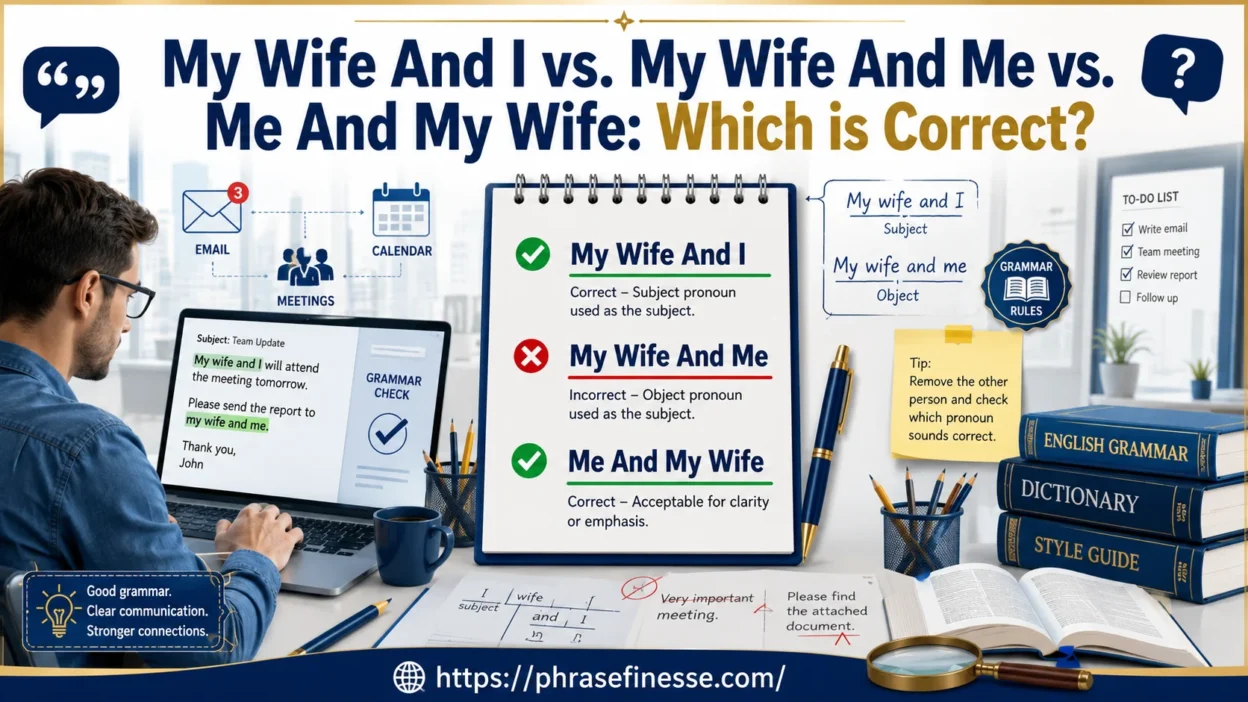
| Phrase | When to Use It | Example |
| My wife and I | Subject of a sentence | My wife and I are traveling next week. |
| My wife and me | Object of a sentence | They invited my wife and me. |
| Me and my wife | Informal speech only | Me and my wife are heading out. |
Most grammar mistakes happen because people memorize one rule and apply it everywhere.
That’s where problems begin.
When to Use “My Wife and I”
Use my wife and I when the phrase performs the action in the sentence.
In grammar terms, it functions as the subject.
Examples
- My wife and I enjoy hiking.
- My wife and I bought a new house.
- My wife and I are attending the conference.
- My wife and I love Italian food.
In every example, the phrase is doing something.
The people are hiking, buying, attending, or loving.
That makes the phrase the subject.
A Quick Test
Remove “my wife” from the sentence.
My wife and I enjoy hiking.
Becomes:
I enjoy hiking.
The sentence still sounds correct.
That’s a strong sign that my wife and I is the right choice.
When to Use “My Wife and Me”
Use my wife and me when the phrase receives the action.
In grammar terms, it functions as an object.
Examples
- They invited my wife and me.
- The manager spoke with my wife and me.
- The tickets were sent to my wife and me.
- The photographer took pictures of my wife and me.
In these examples, someone is acting upon the people involved.
The invitation goes to them.
The manager speaks to them.
The photographer takes pictures of them.
The phrase is receiving the action.
The Same Test Works
Remove “my wife.”
They invited my wife and me.
Becomes:
They invited me.
The sentence remains correct.
That confirms my wife and me is the proper form.
Is “Me and My Wife” Grammatically Correct?
This is where things get interesting.
In formal grammar, me and my wife is generally considered nonstandard when used as a subject.
For example:
❌ Me and my wife went to Florida.
✔ My wife and I went to Florida.
However, millions of native English speakers use me and my wife in everyday conversation.
Language and grammar aren’t always identical.
Many expressions that sound natural in speech wouldn’t appear in formal writing.
Why People Use It
Several factors contribute:
- Regional dialects
- Casual speech patterns
- Family habits
- Cultural influences
- Ease of conversation
In relaxed settings, many people never notice the difference.
That’s perfectly normal.
Still, formal writing follows different standards.
The Grammar Test That Never Fails
If you remember only one thing from this article, remember this test.
Remove the Other Person
Take the sentence and remove “my wife.”
Then see whether I or me sounds correct.
Example One
My wife and I went shopping.
Remove “my wife.”
I went shopping.
Correct.
Therefore:
✔ My wife and I went shopping.
Example Two
The waiter served my wife and me.
Remove “my wife.”
The waiter served me.
Correct.
Therefore:
✔ The waiter served my wife and me.
Example Three
The waiter served my wife and I.
Remove “my wife.”
The waiter served I.
Incorrect.
Therefore:
❌ The waiter served my wife and I.
Understanding Subjects and Objects
Many grammar articles stop at the rule.
Understanding why the rule exists makes it easier to remember.
What Is a Subject?
A subject performs the action.
Think of the subject as the star of the sentence.
Examples:
- My wife and I cooked dinner.
- My wife and I adopted a puppy.
- My wife and I visited Chicago.
The subject acts.
The subject initiates.
The subject drives the sentence.
What Is an Object?
An object receives the action.
Examples:
- They congratulated my wife and me.
- The company rewarded my wife and me.
- The coach spoke to my wife and me.
The action moves toward the object.
The object receives the action.
That’s why “me” belongs there.
Read More: When to Use a Comma Before and After “Otherwise”: Comma Rules Explained
Why “My Wife and I” Sounds More Formal
Many people instinctively use my wife and I because it sounds educated.
Sometimes that’s correct.
Sometimes it isn’t.
Over time, many speakers learned that “my wife and I” often sounds better than “me and my wife.”
As a result, they began using it everywhere.
This phenomenon is called hypercorrection.
What Is Hypercorrection?
Hypercorrection occurs when someone applies a grammar rule too broadly.
For example:
Correct:
- My wife and I went on vacation.
Incorrect:
- Between my wife and I, this is a secret.
The second sentence feels sophisticated.
Unfortunately, it’s wrong.
The preposition between requires an object.
Therefore:
✔ Between my wife and me
❌ Between my wife and I
Hypercorrection explains why many intelligent and educated speakers make this mistake.
Common Hypercorrection Examples
| Incorrect | Correct |
| Between my wife and I | Between my wife and me |
| For my wife and I | For my wife and me |
| With my wife and I | With my wife and me |
| To my wife and I | To my wife and me |
Whenever a preposition appears, check whether the phrase should be an object.
Usually, it should.
“Me and My Wife” in Everyday Conversation
Grammar books often focus on rules.
Real-life speech is different.
Consider these examples:
- Me and my wife are going out tonight.
- Me and my wife love that restaurant.
- Me and my wife just got back from vacation.
You’ll hear sentences like these everywhere.
Friends say them.
Family members say them.
Television characters say them.
Even public figures use them occasionally.
Does That Make Them Correct?
In formal English, no.
In everyday conversation, they’re common and widely understood.
Language experts generally distinguish between:
- Formal correctness
- Informal usage
That’s why context matters.
Formal vs. Informal Usage
Informal Situations
Using “me and my wife” usually won’t cause problems in:
- Text messages
- Casual conversations
- Social media comments
- Family discussions
- Friendly emails
Formal Situations
Use standard grammar in:
- Business communication
- Academic writing
- Job applications
- Legal documents
- Professional presentations
When in doubt, choose the grammatically correct form.
My Wife and I vs. My Wife and Me: Side-by-Side Comparison
The table below summarizes the difference.
| Function | Correct Form | Example |
| Subject | My wife and I | My wife and I arrived early. |
| Direct object | My wife and me | They called my wife and me. |
| Indirect object | My wife and me | She gave my wife and me tickets. |
| Object of preposition | My wife and me | The gift is for my wife and me. |
| Casual speech | Me and my wife | Me and my wife are leaving. |
This chart alone can solve most confusion.
Common Sentences People Get Wrong
Let’s examine some real-world mistakes.
Incorrect
- My wife and me went hiking.
- The gift was for my wife and I.
- Between my wife and I, this is confidential.
- The teacher spoke to my wife and I.
Correct
- My wife and I went hiking.
- The gift was for my wife and me.
- Between my wife and me, this is confidential.
- The teacher spoke to my wife and me.
Notice how the subject uses I, while objects use me.
The pattern remains consistent.
Why “Between My Wife and I” Is Usually Wrong
This mistake deserves special attention because it’s extremely common.
The word between is a preposition.
Prepositions require objects.
Examples include:
- between
- with
- for
- to
- from
- beside
- near
- around
Whenever one of these words appears, you’ll usually need me, not I.
Examples
✔ Between my wife and me
✔ With my wife and me
✔ For my wife and me
✔ To my wife and me
❌ Between my wife and I
❌ With my wife and I
❌ For my wife and I
❌ To my wife and I
A quick glance at the preposition often reveals the correct answer.
Does Word Order Matter?
Another question people ask is whether the order should change.
“My Wife and I” vs. “I and My Wife”
Technically, both are grammatical.
However, English convention places the other person first.
That’s considered more polite.
Therefore:
✔ My wife and I attended the wedding.
Less common:
✔ I and my wife attended the wedding.
The first version sounds more natural.
“My Wife and Me” vs. “Me and My Wife”
The difference involves style and grammar.
Formal:
✔ My wife and me
Informal:
✔ Me and my wife
When writing professionally, place the other person first.
Real-Life Examples
Understanding rules is helpful.
Seeing them in action is even better.
Family Conversation
“My wife and I are hosting Thanksgiving this year.”
Correct because the phrase acts as the subject.
Workplace Email
“The proposal was reviewed by my wife and me.”
Correct because the phrase receives the action.
Wedding Speech
“My wife and I would like to thank everyone for coming.”
Correct because the phrase performs the action.
Social Media Post
“Me and my wife finally visited Hawaii!”
Informal but common.
Legal Document
“The property belongs to my wife and me.”
Correct because the phrase functions as an object.
Memory Tricks That Make Grammar Easy
Grammar doesn’t have to feel complicated.
These shortcuts can help.
Use the Removal Test
Remove the other person.
If “I” works, use my wife and I.
If “me” works, use my wife and me.
Subject Equals I
Subjects perform actions.
Examples:
- My wife and I traveled.
- My wife and I celebrated.
Object Equals Me
Objects receive actions.
Examples:
- They invited my wife and me.
- The gift was for my wife and me.
Watch for Prepositions
Words like:
- to
- for
- with
- from
- between
usually signal that me is needed.
Quick Cheat Sheet
| Situation | Correct Choice |
| Doing the action | My wife and I |
| Receiving the action | My wife and me |
| Following a preposition | My wife and me |
| Casual conversation | Me and my wife |
| Formal writing | My wife and I / My wife and me |
Save this rule and you’ll solve the problem instantly.
FAQs
1. Is “My Wife And I” grammatically correct?
Yes, “My Wife And I” is grammatically correct when the phrase functions as the subject of a sentence. For example, “My wife and I are going on vacation next week.” In this sentence, both people are performing the action.
2. When should I use “My Wife And Me”?
Use “My Wife And Me” when the phrase acts as the object of a verb or preposition. For example, “The manager spoke to my wife and me after the meeting.” Here, the action is being received by both people.
3. Is “Me And My Wife” incorrect?
Not always. “Me And My Wife” can be grammatically correct when it serves as an object, but many style guides prefer placing yourself last, resulting in “My Wife And Me.” When used as a subject, “Me and my wife” is generally considered incorrect in formal English.
4. How can I quickly determine whether to use “I” or “Me”?
A simple trick is to remove “my wife and” from the sentence. If “I” sounds correct alone, use “My Wife And I.” If “me” sounds correct alone, use “My Wife And Me.” For example, “The invitation was sent to me,” so “The invitation was sent to my wife and me.”
5. Is “My Wife And I” more formal than “Me And My Wife”?
Yes. “My Wife And I” is typically preferred in formal writing, professional settings, academic work, and business communication. “Me And My Wife” is more common in casual speech but may sound less polished in formal contexts.
6. Why do people confuse “My Wife And I” and “My Wife And Me”?
The confusion occurs because many people learn that “I” sounds more formal and then overuse it. However, the correct choice depends on the phrase’s grammatical role in the sentence. Understanding the difference between a subject and an object eliminates most mistakes.
Conclusion
Choosing between “My Wife And I,” “My Wife And Me,” and “Me And My Wife” becomes much easier once you understand the role each phrase plays in a sentence. If the phrase is the subject, use “My Wife And I.” If it is the object, use “My Wife And Me.” While “Me And My Wife” may appear in casual conversation, it is generally less preferred in formal and professional writing.
By applying the simple removal test and paying attention to sentence structure, you can avoid common mistakes and improve your grammar, English usage, and writing consistency. Whether you are writing emails, preparing reports, participating in business communication, or simply having everyday conversations, using the correct phrase will make your language clearer, more natural, and more professional.

Alyan Ashraf is an English language writer and editor at Phrase Finesse, where he specializes in grammar, vocabulary, spelling, word usage, and clear communication. Passionate about the English language, he creates practical, research-backed content that helps readers avoid common mistakes and write with greater accuracy and confidence.
Known for his clear writing style and attention to detail, Alyan simplifies complex language topics into easy-to-understand guides filled with real-world examples and actionable insights. His work covers confusing word pairs, grammar rules, idioms, punctuation, and everyday English usage, making learning both accessible and engaging for students, professionals, writers, and non-native English speakers.
Every article Alyan writes is carefully researched, fact-checked, and designed to meet high editorial standards. His goal is to help readers strengthen their English skills, expand their vocabulary, and communicate more effectively in academic, professional, and everyday settings.
Through Phrase Finesse, Alyan is committed to publishing trusted language resources that make mastering English simpler, clearer, and more enjoyable for learners around the world