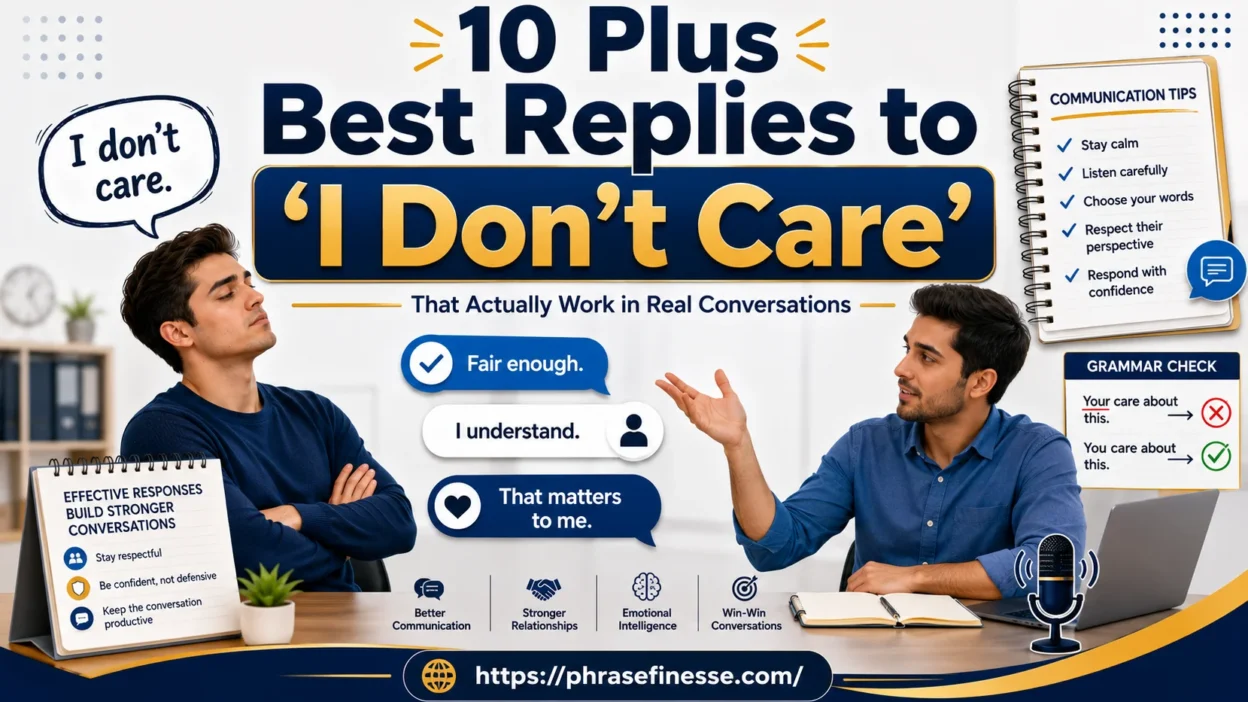
Have you ever faced a moment when someone says “I don’t care” and you’re left searching for the perfect response? A simple phrase can quickly change the tone of a conversation, whether you’re dealing with casual chats, workplace discussions, or formal communication. In this guide, 10 Plus Best Replies To “I Don’t Care” explores smart, funny, and thoughtful ways to respond while keeping your confidence, humor, and communication skills intact.
Knowing how to handle dismissive phrases requires more than quick comebacks. It involves understanding English usage, grammar, tone, and the difference between a playful reply and an unnecessarily harsh reaction.
Whether you’re improving business communication, preparing for meetings, managing project management conversations, or simply refining everyday interactions, the right words can create better connections and maintain consistency in your message.
This article covers a collection of witty replies, clever comebacks, and polite responses to “I don’t care” for different situations, including social conversations, formal writing, online discussions, and professional settings.
From humorous responses to confident statements, you’ll discover how effective language choices can improve time management, scheduling, calendar planning, online booking communication, and even public broadcasting situations where clear expression matters.
Why “I Don’t Care” Feels So Sharp in Conversations
At first glance, “I don’t care” sounds simple. But in real life, it often carries emotional weight.
People usually say it for reasons like:
- They feel overwhelmed
- They want to shut down conflict
- They feel ignored or unheard
- They want control over the conversation
- They genuinely lack interest
However, the impact depends heavily on tone. A calm “I don’t care” sounds neutral. A cold one can feel dismissive or even disrespectful.
Here’s the key insight: you don’t respond to the words alone. You respond to the intent behind them.
The Psychology Behind “I Don’t Care”
Before choosing a reply, you need to understand what’s happening underneath.
Emotional shutdown
Some people say “I don’t care” when they feel emotionally overloaded. Instead of explaining, they shut down. It’s a defense mechanism, not a true reflection of feelings.
Passive resistance
In arguments, “I don’t care” often means:
“I don’t want to engage anymore, but I don’t know how to exit politely.”
Control move
Sometimes, the phrase becomes a power play. It signals:
- “I won’t give you validation”
- “Your opinion doesn’t affect me”
Genuine indifference
Yes, sometimes it’s real. The topic simply doesn’t matter to them.
Understanding this difference helps you choose the right reply to “I don’t care” without overreacting.
Calm and Neutral Replies to “I Don’t Care”
These responses work when you want to avoid escalation. You stay composed and let the moment pass.
“Alright, I understand.”
Short. Clean. No emotional hook. It closes tension without surrendering your position.
“That’s okay.”
This works well when the topic isn’t critical. You don’t force engagement.
“Fair enough.”
This signals acceptance without agreement or disagreement.
“Got it.”
Minimal words. Maximum control.
“No problem.”
This removes pressure instantly.
When to use these replies:
- Minor disagreements
- Casual conversations
- Situations where winning doesn’t matter
These replies show emotional maturity. You don’t chase validation.
Respectful but Assertive Replies to “I Don’t Care”
Now we step up the firmness. These replies protect your voice without creating conflict.
“I hear you, but I still need to say this.”
This keeps your message alive without forcing agreement.
“You don’t have to care, but I do.”
A powerful line. It highlights personal importance without blame.
“That’s fine, but this matters to me.”
You redirect focus back to your perspective.
“I’m not asking for agreement, just a listen.”
This reduces defensiveness and keeps communication open.
“I respect that, but I’ll still share my point.”
Balanced. Calm. Clear.
These replies work best in relationships, friendships, and work settings where silence creates misunderstanding.
Read More: 4 Ways to Spell the Sound of Spitting and Spit Onomatopoeia
Smart and Confident Replies to “I Don’t Care”
These responses shift the energy. You don’t chase. You lead.
“Then I’ll decide what happens next.”
Strong and decisive. It signals independence.
“Alright, I’ll move forward without input.”
Useful in work or planning discussions.
“Noted. I’ll handle it from here.”
Professional and firm.
“That’s your choice, not the final word.”
This subtly rebalances control in the conversation.
“Okay, I’ll adjust accordingly.”
You acknowledge and pivot.
Why these replies work:
- They remove emotional dependence
- They close loops quickly
- They establish leadership energy
Use these when you need clarity, not approval.
Funny and Lighthearted Replies to “I Don’t Care”
Humor can defuse tension—but only when the situation allows it.
“Wow, tough crowd today.”
Light sarcasm, not aggression.
“Good thing I care enough for both of us.”
Playful and confident.
“I’ll inform my feelings they’re irrelevant.”
Absurd humor that softens tension.
“Cool, I’ll pretend you didn’t say that.”
Casual dismissal in a friendly tone.
“That was deeply moving… not.”
Use carefully. Tone matters here.
When NOT to use humor:
- Serious arguments
- Emotional conversations
- Workplace conflicts
Humor works like salt. A little improves the dish. Too much ruins it.
Direct and Honest Replies to “I Don’t Care”
Sometimes you need clarity, not comfort.
“That sounds dismissive.”
Simple truth. No attack.
“You’re shutting this down instead of talking it through.”
This names the behavior clearly.
“Are you saying it doesn’t matter at all?”
Forces clarification.
“That comes across as uninterested.”
Soft but direct observation.
“Let’s be honest. You’re avoiding this topic.”
This challenges avoidance directly.
Use these when:
- Patterns of avoidance repeat
- Miscommunication keeps happening
- You need honesty, not silence
Emotionally Intelligent Replies to “I Don’t Care”
These responses show awareness of emotional states.
“Seems like this isn’t something you want to talk about right now.”
Neutral and understanding.
“I get that you’re not in the headspace for this.”
Respectful and grounded.
“We can revisit this later.”
This creates space instead of pressure.
“Sounds like you’re checked out of this conversation.”
Observational, not accusatory.
These replies reduce conflict by acknowledging emotion instead of fighting it.
Boundary-Ending Replies to “I Don’t Care”
Sometimes the healthiest move is to step away.
“Alright, I won’t push it further.”
You close the loop.
“I’ll leave it here then.”
Simple exit.
“We can revisit this later.”
Keeps the door open.
“No worries. I’m done with this topic.”
Clean emotional exit.
“Okay, conversation closed.”
Final and firm.
When to use these:
- Repeated disrespect
- Emotional exhaustion
- Unproductive arguments
Boundaries protect your mental energy. They don’t weaken your voice. They strengthen it.
Comparison Table: Best Replies to “I Don’t Care” by Situation
| Situation | Best Reply Style | Example |
| Heated argument | Calm neutral | “Alright, I understand.” |
| Workplace issue | Assertive | “I’ll handle it from here.” |
| Friend disagreement | Honest or light humor | “That sounds dismissive.” |
| Disrespect | Direct | “That comes across as uninterested.” |
| Emotional exhaustion | Boundary exit | “I’ll leave it here then.” |
Common Mistakes People Make When Responding to “I Don’t Care”
Avoid these traps if you want emotional control:
Reacting emotionally
Anger gives the other person control over your response.
Over-explaining
The more you explain, the less power your words carry.
Begging for attention
It shifts balance instantly and weakens your position.
Matching their tone
If they go cold and you go colder, the conversation collapses.
Taking it personally
Often, it’s not about you. It’s about their state of mind.
Real-Life Case Study: Turning “I Don’t Care” Into Calm Resolution
Imagine this situation:
A friend says:
“I don’t care what we watch tonight.”
Emotional reaction:
“You never care about anything I pick!”
This escalates instantly.
Calm response:
“Alright, I’ll choose something we both might enjoy.”
What changes?
- No conflict
- No tension
- Decision still happens
- Relationship stays intact
The difference isn’t intelligence. It’s emotional control.
FAQs
1. What are the best replies to “I don’t care”?
The best replies to “I don’t care” depend on the situation and your relationship with the person. You can choose a witty comeback like “Good to know, I’ll update my invisible list,” or a calm response like “That’s okay, but I’d still appreciate your input.” The right reply keeps the conversation balanced without creating unnecessary conflict.
2. How can I respond politely to someone who says “I don’t care”?
You can respond politely by acknowledging their opinion while maintaining respect. Replies such as “I understand, but this matters to me” or “That’s your choice, but I’d like to discuss it further” help you communicate clearly. A respectful response works especially well in professional conversations, meetings, and business communication.
3. Are funny replies to “I don’t care” appropriate in every situation?
No, funny replies work best in casual conversations with friends, family, or people who understand your humor. In serious situations, such as workplace discussions, formal writing, or important decisions, a thoughtful and professional response is usually more effective.
4. What is the difference between a witty reply and a rude comeback?
A witty reply uses humor, confidence, and creativity without attacking the other person. A rude comeback often sounds disrespectful or aggressive. The goal of a clever response is to keep control of the conversation while showing good English usage and emotional awareness.
5. Can these replies be used in professional settings?
Yes, but you should choose carefully. Some clever responses may fit informal workplace conversations, while others should be adjusted for a more professional tone. In areas like project management, scheduling, and team discussions, respectful communication helps maintain trust and productivity.
6. How can I improve my communication skills when responding to dismissive comments?
Improving your responses starts with understanding tone, context, and word choice. Practice active listening, expand your vocabulary, and learn how different phrases affect conversations. Strong communication skills help you handle personal chats, professional interactions, and written communication with more confidence.
Conclusion
Knowing how to respond when someone says “I don’t care” can completely change the direction of a conversation. Instead of reacting emotionally, the right words allow you to show confidence, creativity, and control. Whether you prefer a funny comeback, a clever response, or a polite statement, your choice of language can shape how others view your communication style.
The Best Replies To “I Don’t Care” provide options for different situations, from casual conversations to more professional exchanges. The key is understanding when to use humor, when to stay respectful, and when a simple response works best.
Great communication is not only about what you say but also how you say it. By improving your language skills, grammar awareness, and ability to choose the right tone, you can handle dismissive remarks with confidence while building stronger personal and professional connections.

Alyan Ashraf is an English language writer and editor at Phrase Finesse, where he specializes in grammar, vocabulary, spelling, word usage, and clear communication. Passionate about the English language, he creates practical, research-backed content that helps readers avoid common mistakes and write with greater accuracy and confidence.
Known for his clear writing style and attention to detail, Alyan simplifies complex language topics into easy-to-understand guides filled with real-world examples and actionable insights. His work covers confusing word pairs, grammar rules, idioms, punctuation, and everyday English usage, making learning both accessible and engaging for students, professionals, writers, and non-native English speakers.
Every article Alyan writes is carefully researched, fact-checked, and designed to meet high editorial standards. His goal is to help readers strengthen their English skills, expand their vocabulary, and communicate more effectively in academic, professional, and everyday settings.
Through Phrase Finesse, Alyan is committed to publishing trusted language resources that make mastering English simpler, clearer, and more enjoyable for learners around the world