Have you ever paused while writing and wondered, “Wore or Worn: Which Is Correct?” It’s a common question, even among fluent English speakers. Understanding the difference between these two verb forms is essential for accurate grammar, clear English usage, and confident formal writing.
A small word choice can change the correctness of an entire sentence, making this topic more important than many people realize.
The confusion usually comes from how wore and worn relate to the verb “wear.” While both describe clothing or items someone has used, they serve different grammatical functions.
Knowing when to use each form improves sentence structure, strengthens business communication, and helps maintain consistency in professional and academic writing. Whether you’re drafting emails, reports, or everyday messages, mastering this distinction can make your writing more polished and credible.
In this guide, you’ll learn the key differences between wore and worn, see practical examples, and discover simple rules for using them correctly.
We’ll also explore common mistakes and real-world contexts, including meetings, project management, scheduling, time management, calendar updates, online booking systems, and broadcasting content, where precise language matters. By the end, you’ll know exactly which form to choose and why.
Quick Answer
Here’s the simplest explanation:
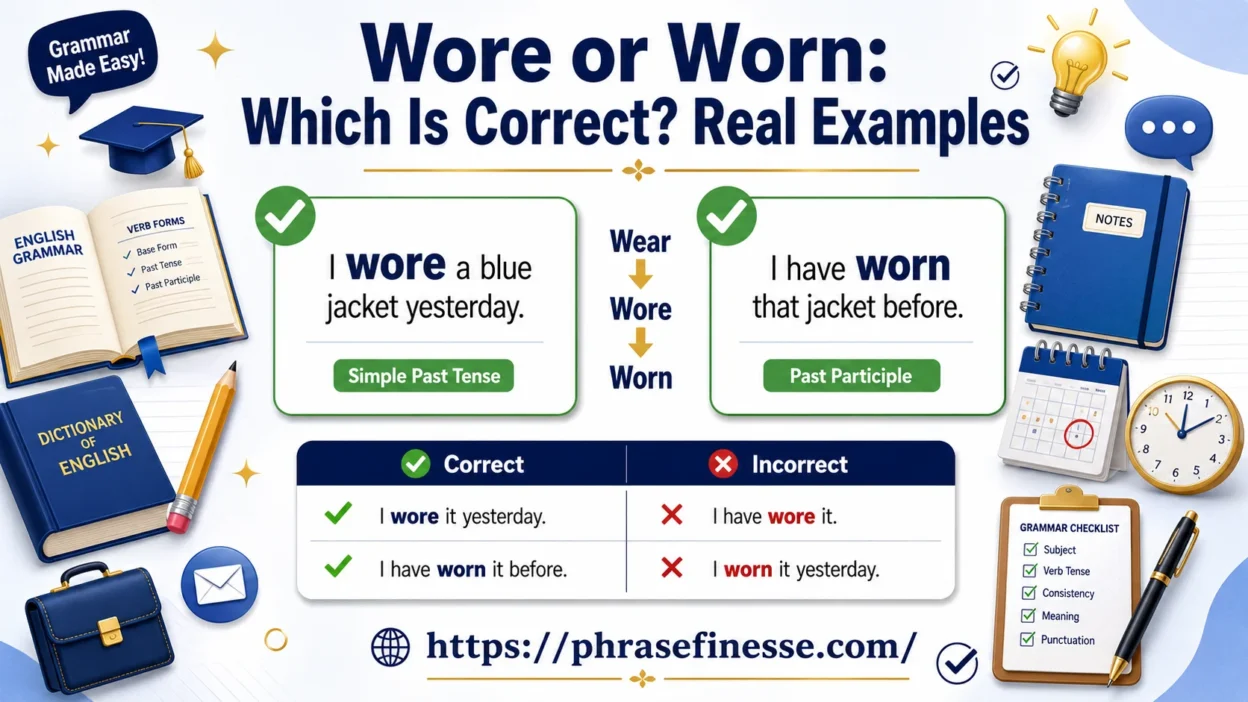
- Wore = Simple past tense of wear
- Worn = Past participle of wear
Examples
✅ I wore a blue jacket yesterday.
✅ I have worn that blue jacket many times.
❌ I have wore that blue jacket many times.
The mistake happens because many people use the simple past form when they actually need the past participle.
Wear, Wore, Worn: Understanding the Verb Forms
Like many common English verbs, wear is an irregular verb.
It doesn’t follow the standard pattern of adding “-ed” to form the past tense.
Complete Conjugation Table
| Verb Form | Word |
| Base Form | Wear |
| Present Tense | Wear/Wears |
| Present Participle | Wearing |
| Simple Past | Wore |
| Past Participle | Worn |
Examples of Every Form
| Tense | Example |
| Present | I wear glasses. |
| Present Continuous | I am wearing glasses. |
| Simple Past | I wore glasses yesterday. |
| Present Perfect | I have worn glasses for years. |
| Past Perfect | I had worn glasses before surgery. |
| Future | I will wear glasses tomorrow. |
| Future Perfect | I will have worn these glasses for ten years. |
Understanding these forms eliminates most confusion immediately.
What Does the Verb “Wear” Mean?
Before diving deeper into wore and worn, it’s helpful to understand the broader meaning of the verb itself.
Most people associate wear with clothing. However, the word has several uses.
Wear Can Mean:
- To have clothing on your body
- To use accessories or jewelry
- To display a facial expression
- To gradually damage something through use
- To become weaker through repeated friction
Examples
- She wears a leather jacket.
- He wears a gold wedding ring.
- The child wore a big smile.
- The tires wear down over time.
- Constant pressure can wear away stone.
Because the word appears in so many situations, mastering its different forms becomes even more important.
When to Use “Wore”
The word wore is the simple past tense form of wear.
Use it when describing something that happened in the past and is now finished.
Key Rule
Use wore without helping verbs such as:
- Have
- Has
- Had
- Been
If the sentence simply refers to a completed past action, wore is usually the correct choice.
Examples
- I wore a suit to the interview.
- She wore red shoes yesterday.
- They wore matching uniforms.
- We wore jackets during the storm.
- He wore sunglasses at the beach.
Notice that every action happened at a specific point in the past.
Common Time Expressions Used With Wore
Certain words often signal that wore is correct.
Examples
- Yesterday
- Last night
- Last week
- Last month
- Last year
- Earlier today
- In 2024
- During the event
Sentences
- I wore boots yesterday.
- She wore a black dress last week.
- We wore costumes during the festival.
- He wore a tie at the conference.
When you see these completed time references, think wore.
When to Use “Worn”
The word worn functions as the past participle of wear.
Unlike wore, it almost always requires a helping verb.
Common Helping Verbs
- Have
- Has
- Had
- Have been
- Has been
- Had been
Examples
- I have worn these shoes before.
- She has worn that dress several times.
- We had worn uniforms throughout school.
- They have worn protective gear for years.
In each example, a helping verb appears before worn.
Why “Worn” Needs a Helping Verb
Think of worn as incomplete by itself.
For example:
❌ I worn a jacket yesterday.
The sentence sounds incorrect because worn needs grammatical support.
Correct version:
✅ I have worn that jacket before.
The helping verb completes the structure.
Wore vs. Worn: Side-by-Side Comparison
The easiest way to understand the difference is to compare them directly.
| Wore | Worn |
| Simple past tense | Past participle |
| Describes completed past actions | Used with helping verbs |
| Usually stands alone | Usually follows have, has, or had |
| I wore a hat yesterday. | I have worn that hat before. |
| She wore black shoes. | She has worn black shoes many times. |
Quick Memory Rule
If you see:
- Have
- Has
- Had
Use worn.
If you don’t see a helping verb and you’re talking about the past, use wore.
Why People Confuse Wore and Worn
English learners and native speakers alike often struggle with these words.
The reason is simple.
Both words refer to actions connected to the past.
Consider these examples:
- I wore the jacket yesterday.
- I have worn the jacket before.
Both sentences involve something that happened earlier.
The difference isn’t time alone.
The difference is grammatical structure.
Irregular Verbs Make Things Tricky
Wear belongs to a family of irregular verbs that follow a similar pattern.
| Base Verb | Past Tense | Past Participle |
| Wear | Wore | Worn |
| Break | Broke | Broken |
| Speak | Spoke | Spoken |
| Write | Wrote | Written |
| Choose | Chose | Chosen |
| Drive | Drove | Driven |
Notice a pattern?
Many past participles end differently from their simple past forms.
Compare
- I spoke. → I have spoken.
- I wrote. → I have written.
- I chose. → I have chosen.
- I wore. → I have worn.
The same rule applies every time.
Common Mistakes and How to Fix Them
Even experienced writers make these errors occasionally.
Let’s examine the most common mistakes.
Using Wore After Have, Has, or Had
Incorrect
❌ I have wore that jacket before.
Correct
✅ I have worn that jacket before.
Why?
Because have requires the past participle.
Using Worn Without a Helping Verb
Incorrect
❌ She worn the blue dress yesterday.
Correct
✅ She wore the blue dress yesterday.
Why?
Because worn cannot stand alone in this sentence.
Mixing Tenses
Incorrect
❌ He has wore glasses for years.
Correct
✅ He has worn glasses for years.
Again, the helping verb demands the past participle.
Forgetting the Difference in Formal Writing
Casual speech sometimes hides grammatical mistakes.
However, academic papers, business emails, resumes, and professional documents require correct usage.
Using the proper form strengthens credibility and improves clarity.
Read More: Stole or Stolen: Which Is Correct? The Complete Grammar Guide
Real-World Examples of Wore
Here are examples you might encounter every day.
Clothing
- I wore a raincoat during the storm.
- She wore a sweater because it was cold.
Work
- He wore a suit to the meeting.
- They wore company uniforms.
Sports
- The team wore special jerseys.
- Players wore protective helmets.
Events
- We wore formal attire at the wedding.
- Guests wore traditional clothing.
Each example refers to a completed action in the past.
Real-World Examples of Worn
Now let’s look at worn.
Personal Experience
- I have worn these boots for years.
- She has worn that necklace many times.
Long-Term Situations
- They have worn uniforms since elementary school.
- He had worn glasses before surgery.
Completed Prior Actions
- We had worn protective equipment before entering the site.
- The athletes had worn similar gear previously.
The helping verbs clearly signal the correct form.
Worn as an Adjective
Here’s where things become interesting.
Worn doesn’t only function as a verb.
It can also act as an adjective.
Examples
- A worn carpet
- Worn furniture
- Worn shoes
- A worn pathway
In these examples, worn describes a condition rather than an action.
Adjective vs. Verb Comparison
| Adjective | Verb |
| The shoes look worn. | I have worn these shoes. |
| The carpet appears worn. | She has worn the coat before. |
| The road is worn. | They had worn protective boots. |
Understanding this distinction helps prevent confusion.
Understanding the Phrase “Worn Out”
One of the most common expressions involving worn is worn out.
The phrase has two primary meanings.
Meaning: Extremely Tired
Examples
- I feel worn out after work.
- She was worn out after the marathon.
- They looked worn out following the trip.
This usage refers to exhaustion.
Meaning: Damaged Through Heavy Use
Examples
- These shoes are worn out.
- The sofa is worn out.
- The tires are worn out.
This meaning refers to physical deterioration.
Why “Worn Out” Uses Worn
The phrase developed from the idea of something gradually losing strength through repeated use.
Over time, the expression expanded to describe human exhaustion as well.
It’s a vivid metaphor.
A person who is “worn out” feels as though life’s constant friction has slowly drained their energy.
Wore vs. Worn in Questions
1. Questions follow the same rules.
1. Questions Using Wore
- What did you wear yesterday?
- Which shoes did she wear?
- What uniform did they wear?
2. Questions Using Worn
- Have you ever worn a tuxedo?
- Has he worn that jacket before?
- Had they worn similar equipment previously?
The helping verbs make the difference obvious.
Wore vs. Worn in Negative Sentences
Negative sentences follow predictable patterns.
Using Wore
- I did not wear a jacket.
- She did not wear glasses.
- We did not wear uniforms.
Using Worn
- I have not worn that jacket.
- She has not worn those shoes.
- They had not worn protective equipment before.
Again, helping verbs indicate when worn should appear.
American English vs. British English
Many grammar differences exist between American and British English.
This isn’t one of them.
The Rule Is Identical
Americans use:
- Wear
- Wore
- Worn
Britons use:
- Wear
- Wore
- Worn
There is no variation in standard grammar.
Whether you’re writing for readers in New York, London, Sydney, Toronto, or Dublin, the rule remains exactly the same.
Quick Test: Can You Choose the Correct Word?
Fill in the blanks.
Questions
- I _____ a coat yesterday.
- She has _____ that dress before.
- We _____ uniforms at school.
- They had _____ safety gear previously.
- He _____ sunglasses at the beach.
- Have you ever _____ a tuxedo?
- She _____ a hat last weekend.
- We have _____ these boots for years.
Answers
- Wore
- Worn
- Wore
- Worn
- Wore
- Worn
- Wore
- Worn
If you got them all right, you’ve mastered the core rule.
Easy Memory Tricks for Wore vs. Worn
Grammar becomes easier when you have shortcuts.
The Helping Verb Rule
Whenever you see:
- Have
- Has
- Had
Use worn.
Examples
- Have worn
- Has worn
- Had worn
This trick solves most situations instantly.
The Yesterday Rule
If the sentence naturally works with:
- Yesterday
- Last week
- Last year
Use wore.
Examples
- I wore it yesterday.
- She wore it last week.
- They wore it last year.
Simple and effective.
The Irregular Verb Pattern Rule
Compare:
| Past Tense | Past Participle |
| Spoke | Spoken |
| Wrote | Written |
| Chose | Chosen |
| Wore | Worn |
Recognizing the pattern makes grammar much easier to remember.
Mini Case Study: Why One Letter Can Change Professional Writing
Imagine a hiring manager reviewing two applications.
Applicant A
“I have wore safety equipment throughout my career.”
Applicant B
“I have worn safety equipment throughout my career.”
The difference seems small.
Yet grammar mistakes often influence perceptions of professionalism, attention to detail, and communication skills.
A single incorrect verb form can distract readers from an otherwise strong message.
That’s why understanding wore vs. worn matters beyond grammar quizzes and classroom exercises.
FAQs
1. What is the difference between wore and worn?
Wore is the simple past tense of the verb wear, while worn is the past participle. You use wore by itself to describe a completed action in the past, and worn with helping verbs such as has, have, had, or was.
Example:
- She wore a blue dress yesterday.
- She has worn that dress many times.
2. Can I use worn without a helping verb?
In most cases, no. Worn is a past participle and usually requires a helping verb.
Correct: He has worn glasses since childhood.
Incorrect: He worn glasses since childhood.
3. Is wore grammatically correct in formal writing?
Yes. Wore is completely correct when referring to a past action. It is commonly used in both casual and formal writing.
Example: The speaker wore a suit during the conference.
4. Why do people confuse wore and worn?
People often confuse them because both words come from the same verb, wear, and both refer to past events. The key difference is that wore is a past-tense verb, while worn functions as a past participle.
5. Which sentence is correct: “I have wore” or “I have worn”?
I have worn is correct.
Correct: I have worn this jacket before.
Incorrect: I have wore this jacket before.
The phrase have worn follows standard English grammar rules for the present perfect tense.
6. How can I remember when to use wore or worn?
A simple trick is to check for a helping verb:
- No helping verb? Use wore.
- Helping verb present (has, have, had, was, were)? Use worn.
Example:
- They wore uniforms yesterday.
- They had worn uniforms before the event.
Conclusion
Understanding the difference between wore and worn is an important part of mastering English usage and improving your grammar skills. While wore serves as the simple past tense of wear, worn functions as the past participle and generally requires a helping verb. Using the correct form enhances clarity, strengthens formal writing, and ensures consistency in professional and everyday communication.
Whenever you are unsure, remember the basic rule: use wore for a completed past action and worn with helping verbs. With a little practice and attention to sentence structure, choosing between these two words becomes simple and natural. Mastering this distinction will help you write with greater confidence, accuracy, and professionalism.

Emma Brooke is an English language specialist, editor, and content writer at Phrase Finesse, where she helps readers develop stronger writing and communication skills through clear, practical, and engaging content. With a passion for the English language, she specializes in simplifying grammar rules, vocabulary, spelling, punctuation, and word usage for learners at every level.
Emma has extensive experience creating educational content that is accurate, well-researched, and easy to understand. She is particularly skilled at explaining confusing word pairs, grammar concepts, idioms, sentence structure, and effective writing techniques, making complex topics approachable for students, professionals, educators, and English learners worldwide.