Have you ever paused while writing a sentence and wondered whether you should use “seen” or “saw”? The confusion between these two words is common, especially when discussing past events. In this guide, Seen or Saw: Which Is Correct? we’ll explain the key differences, correct usage rules, and simple examples to help you choose the right word with confidence.
Understanding the difference between seen and saw improves your English usage, grammar, and overall writing accuracy. While both words relate to the verb “see,” they serve different grammatical roles. Learning how to use these past tense and past participle forms correctly can strengthen your formal writing, business communication, emails, reports, and everyday conversations.
Whether you’re preparing professional documents, managing meetings, organizing a calendar, handling project management tasks, or creating content for online booking, scheduling, or broadcasting platforms, clear language matters. This article will break down the rules behind Seen or Saw, provide practical examples, and help you build consistency in your communication.
Quick Answer
If you’re looking for the fastest explanation, here it is:
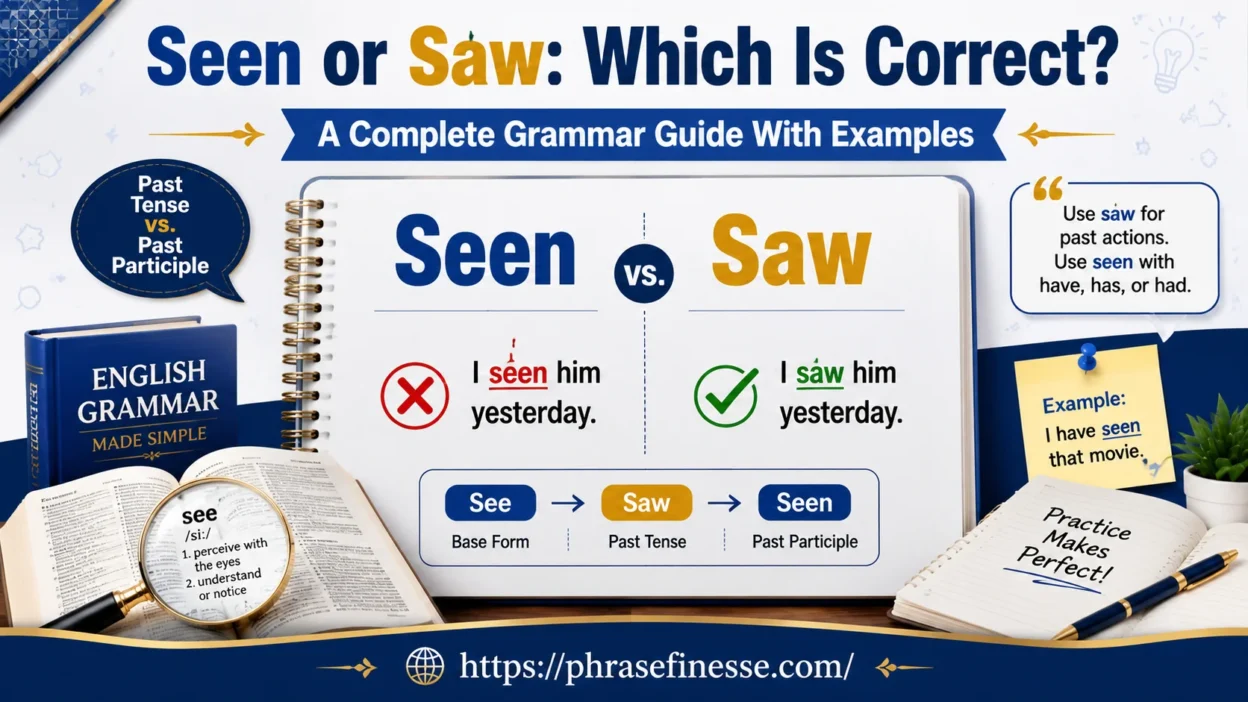
- Saw is the simple past tense of see.
- Seen is the past participle of see and usually requires a helping verb such as have, has, or had.
Correct Examples
✅ 1. I saw the movie yesterday.
✅ 2. She saw a shooting star last night.
✅ 3. I have seen that movie before.
✅ 4. They had seen the warning signs.
Incorrect Examples
❌ I seen the movie yesterday.
❌ She has saw the movie.
A simple rule can save you from most mistakes:
If there is no helping verb, use “saw.” If there is a helping verb, use “seen.”
Understanding the Verb Forms of “See”
To fully understand the difference between Seen or Saw, it helps to look at the complete verb family.
| Verb Form | Word |
| Base Form | See |
| Present Tense | See / Sees |
| Past Tense | Saw |
| Past Participle | Seen |
| Present Participle | Seeing |
Example of Each Form
| Tense | Example |
| Present | I see a bird. |
| Present Singular | She sees a bird. |
| Past | I saw a bird. |
| Past Participle | I have seen a bird. |
| Continuous | I am seeing a bird. |
English contains many irregular verbs, meaning they don’t follow the standard pattern of adding “-ed” to form the past tense.
For example:
| Base | Past | Past Participle |
| Go | Went | Gone |
| Write | Wrote | Written |
| Eat | Ate | Eaten |
| See | Saw | Seen |
Because these forms change completely, they often cause confusion.
What Does “Saw” Mean?
The word saw is the simple past tense of the verb see.
You use it when describing something that happened at a specific time in the past.
Basic Formula
Subject + Saw + Object
Examples
- I saw a rainbow this morning.
- She saw her teacher at the grocery store.
- We saw dolphins during our vacation.
- They saw the accident happen.
Notice that every action occurred at a definite point in the past.
When to Use Saw
Use saw when:
- Talking about a completed action.
- Referring to a specific time in the past.
- No helping verb appears in the sentence.
Examples
✅ 1. I saw him yesterday.
✅ 2. She saw the announcement last week.
✅ 3. We saw the sunset from the mountain.
✅ 4. They saw the results immediately.
Real-Life Examples of Saw
In Conversation
- I saw Sarah at the mall.
- We saw your message earlier.
At Work
- I saw the updated report.
- The manager saw the proposal.
In School
- The students saw the experiment.
- We saw the historical documentary.
Because saw functions independently, it does not require additional verbs.
What Does “Seen” Mean?
Unlike saw, the word seen is a past participle.
Past participles usually work alongside helping verbs.
Common Helping Verbs Used With Seen
- Have
- Has
- Had
- Have been
- Had been
- Has been
Examples
- I have seen that movie.
- She has seen the report.
- They had seen the problem coming.
- We have seen similar results before.
Related Topic: Spoke or Spoken: Which Is Correct?
Why Seen Cannot Usually Stand Alone
Many learners mistakenly use seen by itself.
Incorrect
❌ I seen him yesterday.
❌ We seen the game.
Correct
✅ I saw him yesterday.
✅ We saw the game.
The reason is simple:
Seen is not a standalone past tense verb.
It functions as part of a larger verb phrase.
Examples of Seen in Different Tenses
Present Perfect
- I have seen this before.
- She has seen the email.
Past Perfect
- We had seen the warning signs.
- They had seen the forecast.
Future Perfect
- By tomorrow, I will have seen the results.
Seen or Saw: Key Differences Explained
Although these words are related, their grammatical roles differ significantly.
| Feature | Saw | Seen |
| Verb Type | Past Tense | Past Participle |
| Stands Alone | Yes | Usually No |
| Needs Helping Verb | No | Yes |
| Indicates Past Action | Yes | In Perfect Tenses |
| Example | I saw it. | I have seen it. |
Quick Comparison
| Correct | Incorrect |
| I saw it yesterday. | I seen it yesterday. |
| I have seen it before. | I have saw it before. |
| She saw the movie. | She seen the movie. |
| We had seen the signs. | We had saw the signs. |
A Simple Memory Trick for Seen or Saw
Many grammar experts teach this shortcut:
Think of the “H” Rule
If the sentence contains:
- Have
- Has
- Had
Use seen.
Examples
- Have seen
- Has seen
- Had seen
Never write:
- Have saw
- Has saw
- Had saw
Easy Phrase to Remember
Have Seen, Has Seen, Had Seen
Repeat it several times and the pattern becomes automatic.
Examples of Seen and Saw in Every Major Tense
Understanding tenses makes choosing the correct word much easier.
| Tense | Example |
| Present | I see birds. |
| Past | I saw birds. |
| Present Perfect | I have seen birds. |
| Past Perfect | I had seen birds. |
| Future Perfect | I will have seen birds. |
Present Tense
- I see the mountain.
- She sees the mountain.
Past Tense
- I saw the mountain.
- She saw the mountain.
Present Perfect
- I have seen the mountain.
- She has seen the mountain.
Past Perfect
- I had seen the mountain before moving away.
- She had seen it many times.
Future Perfect
- By next year, I will have seen every national park in the state.
Common Mistakes People Make With Seen and Saw
Grammar mistakes often follow predictable patterns.
Understanding them helps you avoid them.
Mistake: “I Seen It Yesterday”
Incorrect
❌ I seen it yesterday.
Correct
✅ I saw it yesterday.
Why?
The sentence refers to a completed action in the past without a helping verb.
Mistake: “I Have Saw It”
Incorrect
❌ I have saw it before.
Correct
✅ I have seen it before.
Why?
Present perfect tense requires a past participle.
Mistake: Mixing Tenses
Incorrect
❌ I had saw the warning signs.
Correct
✅ I had seen the warning signs.
Past perfect always uses a past participle.
Related Topic: Stole or Stolen: Which Is Correct? The Complete Grammar Guide
Mistake: Informal Speech Entering Formal Writing
In some dialects, phrases like:
- I seen him.
- We seen it.
appear regularly in conversation.
However, standard written English treats these forms as incorrect.
If you’re writing:
- Essays
- Business emails
- Academic papers
- Professional reports
use saw instead.
Why Native Speakers Sometimes Say “I Seen”
Many people assume native speakers always follow grammar rules.
That’s not true.
Certain regional dialects in North America, the United Kingdom, Australia, and other English-speaking regions use forms like:
- I seen him.
- We seen that already.
These expressions are part of local speech patterns.
Important Note
There is a difference between:
- Dialectal speech
- Standard written English
In professional communication, employers, teachers, editors, and publishers expect standard grammar.
Seen or Saw in Questions
Questions follow the same grammatical principles.
Questions Using Saw
When using did, the main verb returns to its base form.
Examples
- Did you see the movie?
- Did she see the message?
- When did you see him?
Notice that saw disappears after did.
Questions Using Seen
Perfect tenses use seen.
Examples
- Have you seen my keys?
- Has she seen the announcement?
- Had they seen the report?
Quick Comparison Table
| Question Type | Example |
| Simple Past | Did you see it? |
| Present Perfect | Have you seen it? |
| Past Perfect | Had you seen it? |
Seen or Saw in Negative Sentences
Negative sentences follow specific tense rules.
Negative Sentences With Saw
Examples
- I didn’t see him.
- She didn’t see the notice.
- They never saw the warning.
Notice again that after didn’t, the verb becomes see.
Negative Sentences With Seen
Examples
- I haven’t seen him.
- She hasn’t seen the notice.
- They hadn’t seen the warning.
The helping verb remains, which means seen stays in place.
Seen or Saw in American and British English
One common question is whether British English and American English use different rules.
The Answer
No.
The grammar remains identical.
American English
- I saw him yesterday.
- I have seen him before.
British English
- I saw him yesterday.
- I have seen him before.
The difference is not grammar.
Instead, British speakers often use the present perfect tense more frequently in everyday conversation.
Example
American English:
- Did you eat yet?
British English:
- Have you eaten yet?
However, the Seen or Saw distinction remains unchanged.
Seen or Saw in Everyday Situations
Let’s explore practical examples.
At Work
Correct
- I saw the latest sales report.
- I have seen the updated proposal.
Incorrect
- I seen the latest report.
- I have saw the proposal.
In School
Correct
- We saw the science demonstration.
- We have seen similar experiments.
In Emails
Correct
- I saw your message this morning.
- I have seen your request and will respond shortly.
These constructions sound professional and polished.
In Casual Conversations
Correct
- I saw your brother yesterday.
- I’ve seen that show before.
Case Study: How One Small Grammar Error Changes Perception
A hiring manager receives two emails.
Email A
I seen your job posting and wanted to apply.
Email B
I saw your job posting and wanted to apply.
The second sentence immediately appears more professional because it follows standard grammar.
Research from communication and business-writing studies consistently shows that grammatical accuracy influences perceptions of credibility, competence, and attention to detail.
A single word can shape how readers evaluate a message.
Easy Test: Should You Use Seen or Saw?
Whenever you’re unsure, ask yourself these questions.
Step 1
Is there a helping verb?
Examples:
- Have
- Has
- Had
If yes, use seen.
Step 2
Are you describing a completed action in the past?
If yes, use saw.
Step 3
Read the sentence aloud.
Does it sound natural?
Quick Decision Chart
Helping Verb Present?
|
YES
|
Seen
|
NO
|
Saw
Practice Quiz: Seen or Saw?
Choose the correct answer.
Questions
- I _____ the movie yesterday.
- She has _____ that movie already.
- We _____ a deer on the highway.
- They had _____ the forecast.
- Have you _____ my phone?
- I _____ him last week.
- She has never _____ snow.
- We _____ the concert on Friday.
- Had they _____ the email?
- I have _____ this mistake before.
Answer Key
- Saw
- Seen
- Saw
- Seen
- Seen
- Saw
- Seen
- Saw
- Seen
- Seen
If you scored 10 out of 10, you’ve likely mastered the difference.
FAQs
1. What is the main difference between seen and saw?
The main difference is their grammatical function. Saw is the simple past tense of the verb “see” and describes an action completed in the past. Seen is the past participle form and usually requires a helping verb such as have, has, or had.
Examples:
- I saw a movie yesterday.
- I have seen that movie before.
2. Can I use seen without a helping verb?
No, seen generally cannot stand alone as the main verb in standard English. It needs an auxiliary verb to make the sentence grammatically correct.
Incorrect:
- I seen that book yesterday.
Correct:
- I saw that book yesterday.
- I have seen that book before.
Using seen correctly helps maintain accuracy in both casual conversations and formal writing.
3. Is saw a past tense or past participle?
Saw is the simple past tense of see. It describes something that happened and finished in the past.
Examples:
- She saw her friend at the meeting.
- They saw the announcement on the calendar.
The past participle form of see is seen, which works with helping verbs.
4. Is it correct to say “I have saw”?
No, “I have saw” is incorrect because have must be followed by the past participle form. The correct phrase is “I have seen.”
Incorrect:
- I have saw that documentary.
Correct:
- I have seen that documentary.
This rule is important for improving English grammar, professional communication, and writing consistency.
5. How can I remember when to use seen and saw?
A simple trick is to check whether you need a helping verb. If the sentence already includes have, has, or had, use seen. If you are describing a completed past action without a helping verb, use saw.
Examples:
- I saw the event last week.
- I have seen the event before.
This quick method can help you avoid common mistakes in everyday and professional writing.
6. Why is understanding Seen or Saw important?
Understanding Seen or Saw improves clarity, accuracy, and confidence in communication. Correct verb usage helps readers understand your message, whether you are writing emails, reports, articles, project updates, or business documents.
Strong grammar skills support better business communication, project management, scheduling, and professional interactions where clear language creates a more reliable impression.
Conclusion
The difference between seen and saw becomes simple once you understand their grammatical roles. Saw is the simple past tense used for completed actions, while seen is the past participle that works with helping verbs like have, has, and had.
Choosing the correct form improves your English usage, strengthens your grammar skills, and helps you communicate more effectively in both personal and professional settings. Whether you’re writing a casual message, preparing formal writing, or managing important business communication, using seen and saw correctly ensures clarity and consistency.
By practicing these rules and reviewing real examples, you can avoid common mistakes and develop stronger command over English verbs. A small grammar improvement can make a big difference in how confidently and professionally you express your ideas.

Emma Brooke is an English language specialist, editor, and content writer at Phrase Finesse, where she helps readers develop stronger writing and communication skills through clear, practical, and engaging content. With a passion for the English language, she specializes in simplifying grammar rules, vocabulary, spelling, punctuation, and word usage for learners at every level.
Emma has extensive experience creating educational content that is accurate, well-researched, and easy to understand. She is particularly skilled at explaining confusing word pairs, grammar concepts, idioms, sentence structure, and effective writing techniques, making complex topics approachable for students, professionals, educators, and English learners worldwide.