
Have you ever worked with someone who seems to focus on problems instead of possibilities? Understanding the right language to describe that behavior can improve both communication and word choice.
In this guide, we’ll explore 6 Words To Describe Someone Who Is Always Negative, helping you choose accurate, natural, and context-appropriate terms for everyday conversations, professional settings, and written communication.
Whether you’re discussing workplace dynamics, personal relationships, or character traits, selecting the correct vocabulary matters. A negative person can influence team morale, business communication, meetings, project management, and even overall time management.
Using precise words also strengthens English usage, improves grammar, and adds clarity to formal writing, making your message more effective and professional.
This article breaks down six useful words, explains their meanings, and shows when each one fits best. You’ll also find practical examples, common usage tips, and subtle differences between similar terms.
Along the way, we’ll connect these descriptions to real-world situations involving consistency, scheduling, calendar planning, online booking, broadcasting, workplace collaboration, and daily communication, giving you a deeper understanding of how negative attitudes can affect different environments.
What Does It Mean to Be a Negative Person?
A negative person consistently focuses on unfavorable outcomes, problems, flaws, or disappointments. Rather than looking for opportunities or solutions, they often dwell on obstacles and setbacks.
Negativity can appear in many forms:
- Constant complaining
- Expecting failure
- Criticizing others frequently
- Distrusting people’s intentions
- Focusing on risks rather than rewards
- Assuming things will go wrong
- Spreading discouragement
Psychologists often distinguish between temporary negativity and habitual negativity. Everyone has bad days. However, a consistently negative individual tends to maintain the same outlook regardless of circumstances.
Consider this example:
Two coworkers receive a promotion opportunity.
One says, “This could be a great chance to grow.”
The other says, “They’ll probably choose someone else anyway.”
The second response reflects a negative mindset. But what specific type of negativity is it? That’s where the words below become useful.
Words to Describe Someone Who Is Always Negative
Pessimistic
Meaning
A pessimistic person expects unfavorable outcomes. They tend to believe things will go badly even when there is little evidence supporting that belief.
The term comes from the Latin word pessimus, meaning “worst.”
When to Use It
Use pessimistic when someone consistently expects failure, disappointment, or bad luck.
Examples include:
- Assuming a project will fail
- Believing plans won’t work
- Expecting rejection before applying
- Focusing on risks instead of possibilities
Example Sentences
- She’s pessimistic about the company’s future despite strong sales.
- Tom is always pessimistic whenever the team starts a new project.
- His pessimistic attitude makes it difficult to stay motivated.
Nuance and Connotation
Unlike many negative words, pessimistic often sounds relatively neutral and professional.
You might hear it in:
- Business meetings
- Academic discussions
- News reports
- Psychological studies
Synonyms
| Synonym | Meaning |
| Defeatist | Expects failure before trying |
| Downbeat | Generally discouraged |
| Fatalistic | Believes outcomes cannot be changed |
| Gloomy | Negative and sad |
Real-Life Example
Imagine an investor who says:
“The market will probably crash soon.”
If they say this every year regardless of economic conditions, others may describe them as pessimistic.
Cynical
Meaning
A cynical person believes people are motivated primarily by selfish interests. They often distrust kindness, generosity, and good intentions.
While pessimism focuses on outcomes, cynicism focuses on people.
When to Use It
Use cynical when someone doubts sincerity or expects hidden motives.
For example:
- Assuming charitable donations are publicity stunts
- Distrusting politicians automatically
- Believing acts of kindness always have strings attached
Example Sentences
- Sarah has become cynical after years in corporate politics.
- His cynical comments dampened everyone’s enthusiasm.
- Many voters feel cynical about election promises.
Nuance and Connotation
Cynicism is often linked to experience. People may become cynical after repeated disappointments.
However, excessive cynicism can create problems:
- Damaged relationships
- Reduced trust
- Difficulty collaborating
- Constant skepticism
Synonyms
| Synonym | Meaning |
| Distrustful | Lacking trust |
| Skeptical | Questioning claims |
| Jaded | Worn out by experience |
| Suspicious | Expecting wrongdoing |
Quote
“A cynic is a man who knows the price of everything and the value of nothing.” — Oscar Wilde
Although exaggerated, the quote highlights how cynicism can overshadow appreciation and optimism.
Case Study
Consider a workplace team celebrating a colleague’s achievement.
Most employees say:
“She worked hard and earned it.”
A cynical coworker might respond:
“She probably got special treatment.”
The focus isn’t on the achievement itself. Instead, it’s on questioning motives and fairness.
Gloomy
Meaning
A gloomy person sees situations through a dark lens. Their negativity often combines pessimism with sadness or emotional heaviness.
When to Use It
Use gloomy when describing someone’s mood or emotional outlook.
Examples include:
- Speaking negatively about future events
- Appearing consistently discouraged
- Focusing on bad news
- Viewing situations with little hope
Example Sentences
- The forecast made him gloomy about the weekend trip.
- She sounded gloomy during the entire conversation.
- His gloomy predictions rarely come true.
Nuance and Connotation
Unlike cynicism, gloominess often carries an emotional component.
A gloomy person may not distrust others. Instead, they simply struggle to see positive possibilities.
Synonyms
- Melancholy
- Somber
- Downcast
- Dejected
Common Usage
Native English speakers often use gloomy when discussing:
- Weather
- Mood
- Predictions
- Atmosphere
Examples:
- “The office felt gloomy after the layoffs.”
- “Don’t be so gloomy. Things might improve.”
Comparison
| Trait | Gloomy | Cynical |
| Emotional sadness | High | Low |
| Distrust of others | Low | High |
| Negative outlook | High | High |
| Focus on motives | Low | High |
Defeatist
Meaning
A defeatist person assumes failure before making an effort. They often give up mentally before the challenge even begins.
When to Use It
Use defeatist when someone believes success is impossible.
Typical examples include:
- Quitting before trying
- Rejecting opportunities automatically
- Discouraging group efforts
- Assuming defeat without evidence
Example Sentences
- His defeatist attitude hurt team morale.
- Don’t be defeatist. We haven’t even started yet.
- The coach criticized the players for their defeatist mindset.
Nuance and Connotation
Defeatism differs from pessimism.
A pessimist expects failure.
A defeatist often accepts failure as inevitable.
That distinction matters.
Synonyms
| Synonym | Meaning |
| Resigned | Accepting defeat |
| Fatalistic | Believing outcomes are fixed |
| Hopeless | Lacking expectation of success |
| Discouraged | Low confidence |
Case Study
Imagine two students preparing for an exam.
Student A says:
“The test will be difficult.”
Student B says:
“There’s no point studying. I’ll fail anyway.”
Student A sounds pessimistic.
Student B sounds defeatist.
The difference lies in willingness to act.
Why It Matters
Defeatist thinking can become self-fulfilling.
When people stop trying, they reduce their chances of success. As a result, the negative prediction often becomes reality.
Cantankerous
Meaning
A cantankerous person is habitually bad-tempered, argumentative, and difficult to please.
This word doesn’t simply describe negativity. It describes negativity combined with irritation and conflict.
When to Use It
Use cantankerous when someone:
- Complains constantly
- Starts arguments frequently
- Reacts irritably
- Finds fault in almost everything
Example Sentences
- The cantankerous neighbor argued about every minor issue.
- He became more cantankerous as the meeting progressed.
- Everyone avoided the cantankerous customer.
Nuance and Connotation
This is one of the stronger words on the list.
It suggests:
- Frustration
- Irritability
- Stubbornness
- Constant dissatisfaction
Synonyms
- Cranky
- Grumpy
- Irritable
- Bad-tempered
Real-Life Example
Many sitcoms feature a cantankerous character.
Think of the older neighbor who:
- Complains about noise
- Criticizes everyone
- Dislikes change
- Argues over trivial matters
That personality fits the definition perfectly.
Interesting Fact
The word cantankerous first appeared in English during the 18th century. Although its exact origin remains uncertain, it has long been associated with argumentative behavior.
Miserable
Meaning
A miserable person appears persistently unhappy and often spreads negativity to those around them.
When to Use It
Use miserable when someone’s unhappiness becomes a defining characteristic of their behavior.
Examples include:
- Constant complaining
- Rarely expressing enjoyment
- Dwelling on disappointments
- Bringing down group morale
Example Sentences
- He seemed miserable throughout the vacation.
- Her miserable attitude affected the whole team.
- Nobody enjoys being around someone who is constantly miserable.
Nuance and Connotation
Unlike cantankerous individuals, miserable people aren’t always argumentative.
Their negativity often stems from:
- Dissatisfaction
- Unhappiness
- Frustration
- Emotional exhaustion
Synonyms
| Synonym | Meaning |
| Joyless | Lacking happiness |
| Unhappy | Not content |
| Discontented | Dissatisfied |
| Morose | Gloomily unhappy |
Case Study
Suppose a group of friends plans a weekend getaway.
Most members express excitement.
One person repeatedly says:
- “The weather will be terrible.”
- “The hotel probably isn’t good.”
- “The trip won’t be worth it.”
Others may describe that person as miserable because they dampen enthusiasm through constant negativity.
Read More :Involved With or Involved In: Key Differences Explained
Comparison Table: Which Word Should You Use?
Choosing the right word depends on the specific type of negativity you’re describing.
| Word | Main Trait | Formality | Strength | Best Used For |
| Pessimistic | Expects bad outcomes | High | Moderate | Outlook and predictions |
| Cynical | Distrusts motives | High | Moderate-Strong | People and intentions |
| Gloomy | Negative and sad | Medium | Moderate | Mood and atmosphere |
| Defeatist | Assumes failure | High | Strong | Challenges and goals |
| Cantankerous | Complains and argues | Medium | Strong | Personality traits |
| Miserable | Persistently unhappy | Medium | Moderate | Emotional behavior |
Negative vs. Similar Words: Key Differences
Negative vs. Pessimistic
A negative person may criticize anything.
A pessimistic person specifically expects bad outcomes.
Example:
- Negative: “This idea has flaws.”
- Pessimistic: “This idea will fail.”
Negative vs. Cynical
Negativity concerns outlook.
Cynicism concerns trust.
Example:
- Negative: “The project won’t work.”
- Cynical: “They’re only doing this for publicity.”
Negative vs. Defeatist
A negative person may complain.
A defeatist person gives up mentally.
Example:
- Negative: “This is difficult.”
- Defeatist: “There’s no point trying.”
Negative vs. Grumpy
Grumpiness is often temporary.
Negativity is usually more persistent.
A person may be grumpy before coffee.
A negative person maintains the same outlook throughout the day.
How Native English Speakers Use These Words
Understanding real-world usage helps you sound more natural.
Workplace
Common choices:
- Pessimistic
- Defeatist
- Cynical
Examples:
- “The manager sounded pessimistic about next quarter.”
- “His defeatist attitude hurt the team’s confidence.”
- “Employees have become cynical after repeated restructuring.”
Everyday Conversations
Common choices:
- Gloomy
- Miserable
- Grumpy
Examples:
- “You’ve been gloomy lately.”
- “Stop being so miserable.”
- “He’s always grumpy in the mornings.”
Literature and Journalism
Writers often choose words carefully to convey nuance.
For example:
- Political analysis often uses cynical.
- Economic forecasts often use pessimistic.
- Character descriptions often use gloomy or cantankerous.
Choosing the Right Word Based on Context
For Professional Communication
Best options:
- Pessimistic
- Defeatist
- Cynical
These words sound precise and professional.
Example:
“The proposal received a pessimistic response from stakeholders.”
For Casual Conversations
Best options:
- Gloomy
- Miserable
- Grumpy
These terms feel more natural in everyday speech.
Example:
“Why are you so gloomy today?”
For Strong Criticism
Best options:
- Cantankerous
- Cynical
These words communicate stronger disapproval.
Example:
“The customer was unusually cantankerous.”
Common Mistakes When Describing Negative People
Using “Cynical” When You Mean “Pessimistic”
Many learners confuse these words.
Remember:
- Pessimistic = expects bad outcomes
- Cynical = distrusts motives
Assuming Negativity Always Means Sadness
Some negative people are not sad.
They may simply:
- Criticize frequently
- Expect failure
- Distrust others
That’s why words like cynical and cantankerous exist.
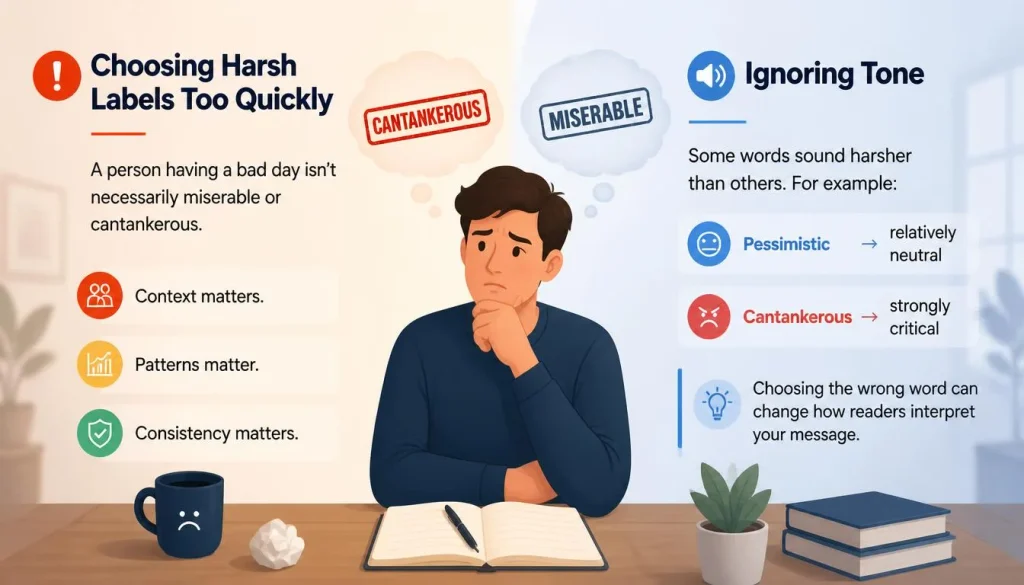
Choosing Harsh Labels Too Quickly
A person having a bad day isn’t necessarily miserable or cantankerous.
Context matters.
Patterns matter.
Consistency matters.
Ignoring Tone
Some words sound harsher than others.
For example:
- Pessimistic → relatively neutral
- Cantankerous → strongly critical
Choosing the wrong word can change how readers interpret your message.
FAQs
1. What is the best word for someone who is always negative?
The best word depends on the context. Common choices include pessimistic, cynical, critical, gloomy, complaining, and defeatist. Among these, pessimistic is often the most widely used because it describes someone who consistently expects unfavorable outcomes.
2. Is being negative the same as being realistic?
Not necessarily. A realistic person evaluates situations based on facts and evidence, while a negative person often focuses on problems, risks, or worst-case scenarios. Realism seeks balance, whereas negativity tends to emphasize unfavorable possibilities.
3. What is the difference between pessimistic and cynical?
A pessimistic person expects things to go badly, while a cynical person distrusts people’s motives and often assumes others act out of self-interest. Although both attitudes can appear negative, cynicism is more focused on skepticism toward people and institutions.
4. Can negative personality traits affect workplace performance?
Yes. Persistent negativity can impact team collaboration, business communication, project management, meetings, and overall workplace morale. It may also reduce productivity by creating unnecessary doubt or discouragement among colleagues.
5. Are there polite ways to describe a negative person?
Yes. Instead of using harsh labels, you can choose softer terms such as cautious, skeptical, reserved, or concerned about risks, depending on the situation. These alternatives often sound more professional and constructive.
6. Why is it important to use the correct word?
Using the right word improves English usage, strengthens formal writing, and ensures clear communication. Different words carry different meanings, so selecting the most accurate term helps readers and listeners understand exactly what you mean.
Conclusion
Choosing the right vocabulary can make your communication more precise and effective. The 6 words to describe someone who is always negative each highlight a different aspect of negativity, from expecting failure to constantly criticizing others.
Understanding these distinctions helps you express ideas more accurately in conversations, workplace discussions, and formal writing.
Whether you’re improving your English vocabulary, enhancing your grammar skills, or simply looking for the most appropriate word, knowing these terms allows you to communicate with greater clarity and confidence.
By using the right description in the right context, you can better explain behaviors, avoid misunderstandings, and strengthen the overall quality of your communication.




[…] Read More :6 Words to Describe Someone Who Is Always Negative […]