Have you ever stopped mid-sentence and wondered whether Compared To vs. As Compared To: What’s the Difference?is the correct expression to use? You’re not alone. These two phrases appear similar, yet they serve different purposes in English usage, grammar, and formal writing.
Understanding the distinction helps you write with greater consistency, improve clarity, and communicate your ideas more effectively in academic, professional, and everyday contexts.
Choosing the right comparison phrase matters more than many writers realize. Whether you’re preparing business communication, managing project management documents, writing emails, creating reports, discussing scheduling, organizing meetings, updating a calendar, explaining time management strategies, describing online booking systems, or writing about broadcasting, accurate language strengthens your message.
Small grammatical choices often influence how natural, polished, and credible your writing appears.
In this guide, you’ll learn the exact difference between compared to and as compared to, when each expression is grammatically appropriate, and the common mistakes writers should avoid.
You’ll also find clear explanations, practical examples, usage tips, and easy comparison tables that make these phrases simple to understand and apply. By the end, you’ll know which expression best fits your sentence and how to use both with confidence in every writing situation.
Quick Answer
If you’re looking for the short answer, here it is:
| Phrase | Best Use | Commonness | Example |
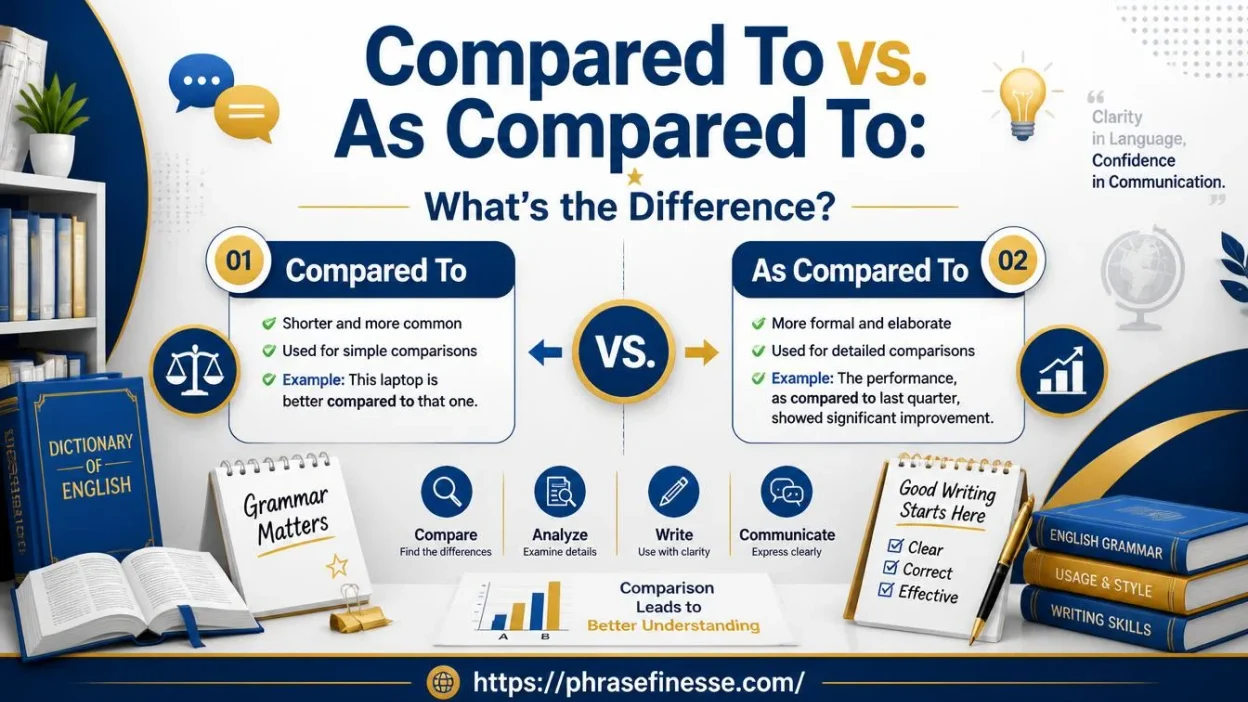
| Compared to | General comparisons, similarities, contrasts | Very common | Compared to last year, sales increased. |
| As compared to | Formal, statistical, or measured comparisons | Less common | Sales increased this year as compared to last year. |
The Main Difference
Compared to is the phrase most native speakers use in everyday conversation and writing.
As compared to often appears in formal reports, research papers, technical documents, and situations involving measurable differences.
In many cases, both expressions are grammatically correct. However, one usually sounds more natural than the other depending on the context.
What Does “Compared To” Mean?
The phrase compared to introduces a comparison between two things.
You can use it to show:
- Similarities
- Differences
- Contrasts
- Analogies
- Relationships
Basic Structure
Subject + compared to + noun/pronoun
Examples
- Compared to my old phone, this one is much faster.
- Compared to winter, summer feels longer.
- Compared to traditional advertising, social media marketing is more affordable.
- Compared to previous generations, modern computers are incredibly powerful.
In these examples, the phrase simply helps readers understand one thing by looking at another.
Why Native Speakers Prefer “Compared To”
One reason compared to is so common is its simplicity.
English naturally favors shorter expressions when they communicate the same meaning.
Consider these two sentences:
- Compared to last month, profits increased.
- As compared to last month, profits increased.
Both are correct.
The first sounds cleaner and more conversational.
That’s why you’ll often find compared to in:
- Newspapers
- Magazines
- Blogs
- Marketing content
- Everyday speech
- Professional emails
What Does “As Compared To” Mean?
The phrase as compared to also introduces a comparison.
The difference lies in emphasis.
Writers often use as compared to when they want to highlight a direct, measurable comparison between two specific items.
Examples
- Revenue increased by 20% as compared to the previous quarter.
- The experimental group showed higher scores as compared to the control group.
- Urban areas have greater population density as compared to rural regions.
Notice something important.
Each example involves data, measurement, or analysis.
That’s where as compared to feels most at home.
Why It Appears in Formal Writing
Academic researchers, analysts, and technical writers often prefer as compared to because it emphasizes the act of comparison itself.
You’ll frequently encounter it in:
- Research studies
- Corporate reports
- Scientific papers
- Government publications
- Statistical analyses
Even then, many editors still replace it with compared to for conciseness.
The Real Difference Between Compared To and As Compared To
Many grammar guides simplify the distinction:
Compared to often introduces a general comparison, while as compared to emphasizes a direct and measurable contrast.
Although subtle, the difference can affect tone.
Side-by-Side Comparison
| Feature | Compared To | As Compared To |
| Everyday conversation | Yes | Rare |
| Business reports | Yes | Common |
| Academic writing | Yes | Common |
| Technical documents | Yes | Common |
| Blog writing | Preferred | Less common |
| Natural speech | Very common | Uncommon |
| Conciseness | Strong | Weaker |
| Formal tone | Moderate | Strong |
Think of It This Way
Imagine two friends discussing weather.
Natural conversation:
Compared to yesterday, today feels cooler.
Now imagine a meteorologist writing a climate report:
Average temperatures decreased by 3°F as compared to the previous reporting period.
Both communicate comparison.
The second sentence sounds more analytical.
When to Use Compared To
Most writers should choose compared to most of the time.
It works in nearly every situation.
Use Compared To for Everyday Comparisons
Examples:
- Compared to my old apartment, this house feels enormous.
- Compared to driving, cycling saves money.
- Compared to coffee, tea contains less caffeine.
These comparisons feel natural and easy to understand.
Use Compared To for Analogies
Analogies explain one thing by relating it to another.
Examples:
- Life is often compared to a journey.
- The human brain has been compared to a computer.
- Running a business is sometimes compared to steering a ship through rough waters.
In these cases, compared to is almost always preferred.
Use Compared To for Contrasts
Examples:
- Compared to last week, traffic was lighter.
- Compared to traditional classrooms, online learning offers more flexibility.
- Compared to older models, the new software performs better.
When to Use As Compared To
Although less common, as compared to still has a place.
Use It in Formal Analysis
Business professionals often use it when discussing performance metrics.
Examples:
- Customer retention improved by 12% as compared to last year.
- Production costs declined as compared to the previous quarter.
Use It in Scientific Writing
Researchers frequently compare groups, experiments, and outcomes.
Examples:
- Participants experienced fewer side effects as compared to the control group.
- The treatment demonstrated higher effectiveness as compared to standard therapy.
Use It in Statistical Reports
Examples:
- Employment rates increased as compared to the previous reporting cycle.
- Household income rose by 8% as compared to the prior year.
Is “As Compared To” Redundant?
Many editors think so.
Here’s why.
The phrase compared to already expresses comparison.
Adding as often doesn’t change the meaning.
Example
Wordy:
Sales increased as compared to last year.
Simpler:
Sales increased compared to last year.
Most readers will understand both versions equally well.
The shorter version simply gets to the point faster.
Why Writers Still Use It
Despite criticism, as compared to remains common because:
- It sounds formal.
- It emphasizes measurement.
- It is traditional in certain industries.
- Some organizations include it in their style preferences.
Editorial Recommendation
If you’re writing for a broad audience, compared to is usually the stronger choice.
If you’re preparing a technical report, as compared to may be acceptable depending on organizational style guidelines.
Compared To vs. Compared With
Another comparison phrase often enters the discussion:
compared with
Many learners wonder whether it differs from compared to.
Traditional Rule
Historically, grammar experts distinguished the phrases this way:
| Expression | Traditional Purpose |
| Compared to | Similarities and analogies |
| Compared with | Detailed analysis and differences |
Examples
Analogy:
Her voice was compared to an angel’s.
Detailed examination:
Compared with last year’s data, this year’s results show significant growth.
Modern Usage
Modern English has largely relaxed this distinction.
Today:
- Compared to is acceptable in most situations.
- Compared with is also acceptable in most situations.
- Context matters more than strict rules.
What Style Guides Say
Several modern style authorities acknowledge that the distinction has become less important over time.
As a result, most professional writers choose whichever phrase sounds more natural.
Maximal vs. Maximum Difference Explained Helpful Examples
Common Mistakes When Using Compared To and As Compared To
Even experienced writers occasionally misuse these expressions.
Let’s look at the most common errors.
Using As Compared To in Casual Writing
Example:
As compared to my brother, I enjoy basketball.
This sounds overly formal.
Better:
Compared to my brother, I enjoy basketball.
Making Sentences Unnecessarily Long
Example:
The company’s financial performance was significantly improved as compared to the prior fiscal period.
Cleaner version:
The company performed significantly better compared to the prior fiscal period.
Shorter writing often creates stronger communication.
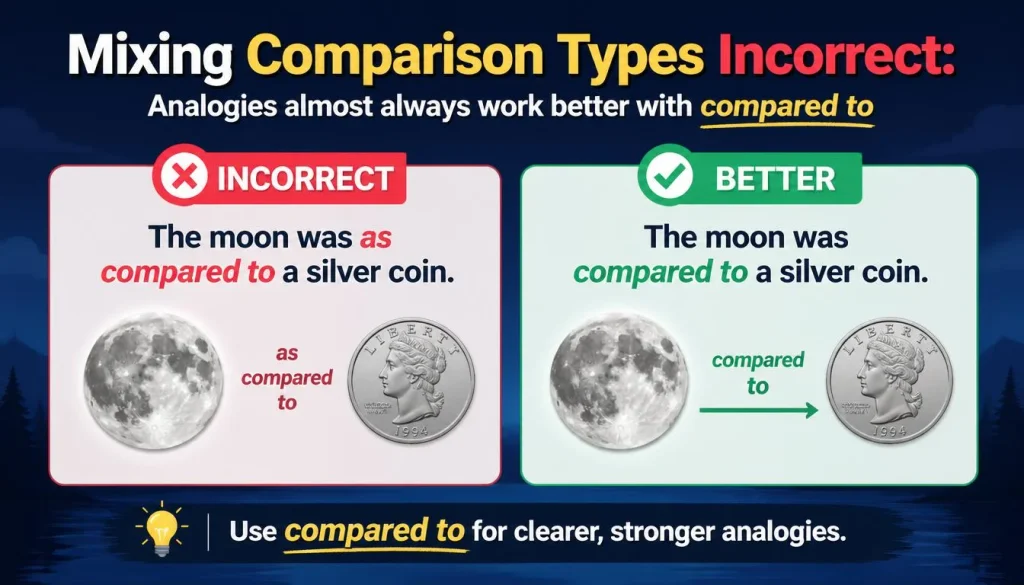
Mixing Comparison Types
Incorrect:
The moon was as compared to a silver coin.
Better:
The moon was compared to a silver coin.
Analogies almost always work better with compared to.
Assuming One Phrase Is Always Wrong
Some writers insist that as compared to should never be used.
That’s inaccurate.
The phrase appears regularly in:
- Academic journals
- Government reports
- Industry publications
- Scientific research
The issue isn’t correctness.
The issue is choosing the expression that best matches your audience.
Real-World Examples of Compared To and As Compared To
Understanding grammar becomes easier when you see it in action.
Business Example
Natural Style
Compared to last year, customer satisfaction increased significantly.
Formal Report Style
Customer satisfaction scores increased by 15% as compared to the previous fiscal year.
Both are correct.
The second simply sounds more analytical.
Education Example
Compared to previous semesters, student participation improved dramatically.
Formal version:
Student participation rates increased as compared to prior academic periods.
Technology Example
Compared to older processors, modern chips consume less power.
Healthcare Example
Recovery times improved as compared to earlier clinical trials.
Sports Example
Compared to last season, the team appears more balanced and disciplined.
Case Study: How Professional Writers Choose Between the Two
Imagine a software company releasing two different documents.
Marketing Blog
The goal is engagement.
The audience includes customers.
Preferred sentence:
Compared to the previous version, the software loads twice as fast.
Why?
Because it sounds natural.
Annual Shareholder Report
The goal is formal analysis.
Preferred sentence:
Software performance improved by 100% as compared to the previous release cycle.
Why?
Because the report emphasizes measurable performance metrics.
Key Lesson
Audience determines choice.
When writing for people, use language that feels natural.
When writing for analysis, slightly more formal wording may be appropriate.
Which Phrase Do Native Speakers Use Most?
The answer is clear.
Native English speakers overwhelmingly prefer compared to.
You’ll hear it daily in:
- Conversations
- Podcasts
- News broadcasts
- YouTube videos
- Business meetings
- Social media discussions
Why It Wins
- Shorter
- Simpler
- Easier to read
- More conversational
- More flexible
That doesn’t mean as compared to is wrong.
It simply occupies a smaller niche within formal writing.
Quick Decision Guide
Use this chart whenever you’re unsure.
| Situation | Best Choice |
| Casual conversation | Compared to |
| Blog article | Compared to |
| Marketing content | Compared to |
| Email communication | Compared to |
| Journalism | Compared to |
| Academic research | As compared to or compared to |
| Statistical reporting | As compared to |
| Technical documentation | As compared to |
| Corporate reporting | As compared to |
Simple Rule
If you’re debating which phrase to choose, compared to is usually the safest option.
FAQs
1. What is the difference between compared to and as compared to?
Compared to is the standard expression used to show similarities or differences between two things. As compared to is a more formal variation that emphasizes the comparison and is often found in academic, technical, or business writing.
Example:
- Sales increased compared to last year.
- This year’s sales are higher as compared to last year’s results.
2. Is as compared to grammatically correct?
Yes. As compared to is grammatically correct, but it is less common than compared to. It is generally preferred in formal reports, research papers, and analytical writing rather than everyday conversation.
3. Which is more common in everyday English?
Compared to is far more common in everyday English usage. Native speakers typically choose it because it sounds shorter, smoother, and more natural in both speech and writing.
4. Can I use compared to and compared with interchangeably?
Often, yes. In many contexts, compared to and compared with have similar meanings. However, some style guides suggest using compared to for highlighting similarities and compared with for examining differences in greater detail.
5. Should I use as compared to in formal writing?
You can use as compared to in formal writing, especially in research papers, business reports, or technical documents where emphasis on the comparison is appropriate. For most other situations, compared to remains the clearer and more concise choice.
6. How can I avoid mistakes when using these expressions?
First, identify the purpose of your comparison. If you simply want to compare two ideas, compared to is usually the best option. If you’re writing a formal analysis that emphasizes the comparison, as compared to may be appropriate. Reading your sentence aloud is also a helpful way to determine which phrase sounds more natural.
Conclusion
Although compared to and as compared to are closely related expressions, they are not always interchangeable. In most everyday and professional writing, compared to is the more natural and widely accepted choice for making direct comparisons or highlighting similarities.
As compared to, on the other hand, is more common in formal, technical, or analytical contexts where an explicit comparison is being emphasized.
Understanding the difference between these phrases improves your English grammar, strengthens formal writing, and helps you communicate with greater clarity and consistency. By following the rules and examples in this guide, you can confidently choose the expression that best fits your sentence and avoid common grammar mistakes.

Emma Brooke is an English language specialist, editor, and content writer at Phrase Finesse, where she helps readers develop stronger writing and communication skills through clear, practical, and engaging content. With a passion for the English language, she specializes in simplifying grammar rules, vocabulary, spelling, punctuation, and word usage for learners at every level.
Emma has extensive experience creating educational content that is accurate, well-researched, and easy to understand. She is particularly skilled at explaining confusing word pairs, grammar concepts, idioms, sentence structure, and effective writing techniques, making complex topics approachable for students, professionals, educators, and English learners worldwide.