Have you ever paused while writing and wondered whether Common Mistakes With “Have Come,” “Have Came,” and “Came” is the correct choice? These forms look similar, but they follow different English grammar rules.
Choosing the right form depends on the tense, sentence structure, and meaning you want to express. A small verb mistake can affect clarity in formal writing, workplace messages, emails, and everyday business communication.
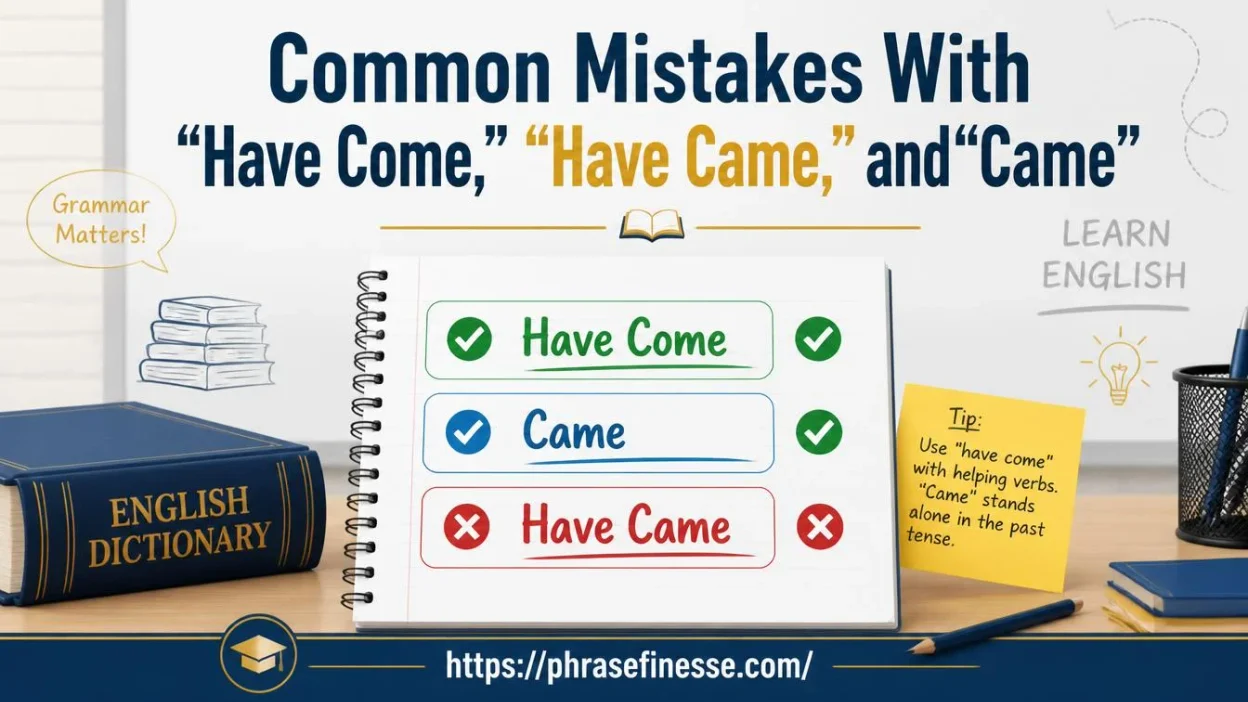
The key is understanding how come, came, and have come function in different contexts. “Came” is the past tense of come, while “have come” uses the present perfect tense. However, “have came” is grammatically incorrect in standard English because have requires the past participle come, not the simple past form came.
Once you understand this distinction, using these verbs becomes much easier and more consistent.
In this guide, you’ll learn the difference between “have come,” “came,” and “have came” with clear explanations and practical examples. We’ll explore how these forms work in sentences involving meetings, scheduling, calendar updates, online booking, broadcasting, time management, and project management.
You’ll also discover common mistakes and simple rules that help you choose the correct form confidently. Whether you’re improving your everyday English usage or polishing professional writing, this guide will help you communicate with greater accuracy and consistency.
Quick answer:
use have come with “have” or “has” when you need the present perfect, use came for a completed action in the simple past, and avoid have came because “came” cannot function as the past participle after “have” or “has.” With a few simple rules and examples, choosing the correct form becomes much easier.
Mistake: Using “Have Came” Instead of “Have Come”
This is the most common error with this verb.
Incorrect:
❌ She has came to the meeting.
Correct:
✅ She has come to the meeting.
Why?
Because “has” needs a past participle, and the past participle of come is still come.
The correct pattern is:
Has + come
Examples:
- He has come home.
- The manager has come to a decision.
- The team has come together.
Not:
- ❌ He has came home.
- ❌ The manager has came to a decision.
- ❌ The team has came together.
Mistake: Using “Have Come” With a Finished Past Time
Many people use present perfect incorrectly with specific past time expressions.
Incorrect:
❌ I have come here yesterday.
Correct:
✅ I came here yesterday.
The word “yesterday” shows a finished time. Therefore, the simple past tense works better.
More examples:
❌ She has come last week.
✅ She came last week.
❌ They have come in 2022.
✅ They came in 2022.
The rule is simple:
Finished past time = use “came.”
Mistake: Using “Came” After “Has” or “Have”
Because came already sounds like a past verb, writers often place it after helping verbs.
Incorrect:
❌ He has came back from work.
Correct:
✅ He has come back from work.
Remember:
- came = simple past
- come = past participle
Examples:
| Wrong Sentence | Correct Sentence |
| She has came home. | She has come home. |
| They have came early. | They have come early. |
| He has came prepared. | He has come prepared. |
Easy Trick To Remember “Have Come” vs. “Came”
Grammar rules become easier when you attach them to simple ideas.
Use this memory trick:
If You See “Have” or “Has,” Think “Come”
Examples:
- I have come.
- She has come.
- They have come.
Never:
- ❌ I have came.
- ❌ She has came.
- ❌ They have came.
If You Mention a Finished Time, Think “Came”
Examples:
- I came yesterday.
- She came last night.
- They came two hours ago.
A quick formula:
| Situation | Correct Choice |
| Connected to the present | Have/has come |
| Finished past event | Came |
| After have/has | Come |
| Specific past time | Came |
Examples of “Have Come” and “Came” in Sentences
Seeing examples in different situations helps you recognize the pattern naturally.
Examples Using “Have Come”
Everyday Conversation
- I have come to pick you up.
- They have come to visit us.
- You have come at the right time.
These sentences focus on the current situation.
For example:
“You have come at the right time.”
This means the person arrived and their arrival matters now.
Personal Growth and Understanding
The phrase “have come to” often describes a change in thoughts or feelings.
Examples:
- I have come to appreciate your advice.
- She has come to understand the situation.
- They have come to realize their mistake.
Here, “have come to” means “gradually reached a point of understanding.”
Formal Writing Examples
“Have come” appears often in professional and academic writing.
Examples:
- Researchers have come to similar conclusions.
- The company has come to a final decision.
- Both sides have come to an agreement.
These sentences describe outcomes that remain important.
Examples Using “Came”
Daily Life Examples
- My brother came home late.
- She came to my office yesterday.
- They came after dinner.
Each sentence describes a completed event.
Travel Examples
- We came to New York last summer.
- She came from a small town.
- They came by train.
The action happened in the past.
Storytelling Examples
Simple past tense is common when telling stories.
Example:
“A stranger came to the village one evening. He carried a small bag and asked for help.”
The writer uses came because the event belongs to a finished story.
“Have Come” in Different Types of Communication
The phrase “have come” appears in many areas of communication. Understanding its usage helps you write more naturally.
Using “Have Come” in Business Communication
Professional communication often discusses decisions, progress, and agreements. In these situations, have come sounds natural.
Examples:
- We have come to an agreement regarding the project timeline.
- The department has come up with a new strategy.
- The company has come a long way since its launch.
Why does it work well?
Business discussions often focus on results that affect the present.
For example:
“The team has come to a solution.”
The solution exists now, so present perfect fits.
See More : True Origin Of “This Is Why We Can’t Have Nice Things” Revealed
Using “Have Come” in Academic Writing
Researchers and writers often use present perfect when discussing developments over time.
Examples:
- Scientists have come to new conclusions.
- Studies have come to similar findings.
- Experts have come to recognize the importance of language skills.
This form highlights ongoing knowledge rather than one finished moment.
Using “Came” in Storytelling and Reports
Simple past works best when describing completed actions.
Examples:
- The visitor came at noon.
- The company came into existence in 1995.
- The team came first in the competition.
The speaker focuses on when something happened.
Case Study: Understanding the Difference Through Real Situations
Imagine two friends discussing a conference.
Conversation A:
Sarah: “Where is John?”
Mike: “He has come to the conference.”
Meaning:
John is at the conference now.
The arrival connects to the present.
Conversation B:
Sarah: “When did John attend the conference?”
Mike: “He came to the conference last Monday.”
Meaning:
The event happened in the past.
The time is finished.
The Difference in One Sentence
“Have come” tells you about a past action that matters now, while “came” simply tells you something happened in the past.
Common Expressions Using “Have Come”
English speakers frequently use several expressions with have come.
“Have Come a Long Way”
Meaning:
To make significant progress.
Examples:
- Technology has come a long way.
- She has come a long way in her career.
- The company has come a long way since its beginning.

“Have Come to an Agreement”
Meaning:
To reach a decision together.
Examples:
- The two companies have come to an agreement.
- The leaders have come to an agreement.
- We have come to a conclusion.
“Have Come to Realize”
Meaning:
To understand something after time or experience.
Examples:
- I have come to realize the value of patience.
- He has come to realize his mistake.
- They have come to understand the problem.
Common Expressions Using “Came”
The simple past form also appears in many everyday phrases.
“Came Across”
Meaning:
Found something by chance.
Examples:
- I came across an interesting article.
- She came across an old photograph.
“Came Up With”
Meaning:
Created or suggested an idea.
Examples:
- He came up with a creative solution.
- The team came up with a new plan.
“Came Back”
Meaning:
Returned.
Examples:
- She came back home early.
- They came back from vacation.
FAQs
1. Is “have came” grammatically correct?
No, “have came” is grammatically incorrect in standard English. After have, has, or had, you need the past participle of the verb. The correct form is “have come.” For example, “They have come to the meeting” is correct, while “They have came to the meeting” is incorrect.
2. Is it “have come” or “came”?
Both “have come” and “came” are correct, but they express different tenses. “Came” is the simple past tense and refers to a completed action in the past. “Have come” is the present perfect tense and connects a past action to the present. For example, “She came yesterday” refers to a specific past event, while “She has come to help us” emphasizes her present relevance.
3. Is “I have came” or “I have come” correct?
“I have come” is correct. The verb come has the same form for its base verb and past participle, while “came” is its simple past form. Therefore, you should say, “I have come to discuss the project,” not “I have came to discuss the project.”
4. When should I use “came” in a sentence?
Use “came” when describing an action that happened and finished in the past. You’ll often use it with a specific past-time expression, such as yesterday, last week, or in 2024. For example, “The manager came to the office yesterday.” This structure works well in everyday English usage and professional formal writing.
5. When should I use “have come”?
Use “have come” when you want to connect a past action with the present. It can describe an experience, a recent development, or an action whose present result matters. For example, “We have come a long way with this project.” The phrase can also appear naturally in business communication, meetings, reports, and project updates.
6. What is the easiest way to remember “come,” “came,” and “have come”?
Remember this simple pattern: come → came → come. Come is the base form, came is the simple past form, and come is the past participle. Therefore, use “came” by itself for simple past sentences, but use “have come” or “has come” with the present perfect. This simple rule helps you maintain grammatical consistency in both casual and professional writing.
Conclusion
Understanding “have come,” “came,” and “have came” becomes much easier once you recognize their grammatical roles. “Came” is the simple past form, while “have come” uses the present perfect tense. “Have came” is incorrect because came cannot function as the past participle after have.
When you’re writing an email, updating a calendar, discussing scheduling, or preparing professional content, choosing the correct verb form improves clarity and credibility. Keep the basic pattern come → came → come in mind, and you’ll avoid one of the most common mistakes involving this irregular verb.

Emma Brooke is an English language specialist, editor, and content writer at Phrase Finesse, where she helps readers develop stronger writing and communication skills through clear, practical, and engaging content. With a passion for the English language, she specializes in simplifying grammar rules, vocabulary, spelling, punctuation, and word usage for learners at every level.
Emma has extensive experience creating educational content that is accurate, well-researched, and easy to understand. She is particularly skilled at explaining confusing word pairs, grammar concepts, idioms, sentence structure, and effective writing techniques, making complex topics approachable for students, professionals, educators, and English learners worldwide.