Have you ever paused while writing an email or speaking in a meeting and wondered whether to use “you” or “yourself”? Although both words refer to the same person, they serve different grammatical purposes, and choosing the wrong one can make your message sound awkward or incorrect.
In this guide You vs. Yourself: Difference & Usage (With Examples), you’ll discover the exact difference between these commonly confused pronouns, along with practical examples that make English usage easier to understand and apply.
Whether you’re drafting formal writing, improving business communication, participating in meetings, or creating content for broadcasting, using the correct pronoun strengthens clarity and professionalism.
The same principle applies when writing about project management, scheduling, time management, online booking, or maintaining a calendar, where precise language helps prevent misunderstandings. Understanding this grammar rule also improves consistency across emails, reports, presentations, and everyday conversations.
In the sections below, you’ll learn when to use “you” as the subject or object of a sentence and when “yourself” functions correctly as a reflexive or emphatic pronoun. You’ll also explore common mistakes, easy-to-follow grammar tips, and 8 real-world examples that show each word in context.
By the end of this article, you’ll be able to choose the right pronoun with confidence and write more naturally in both professional and everyday English.
You vs. Yourself: What’s the Difference?
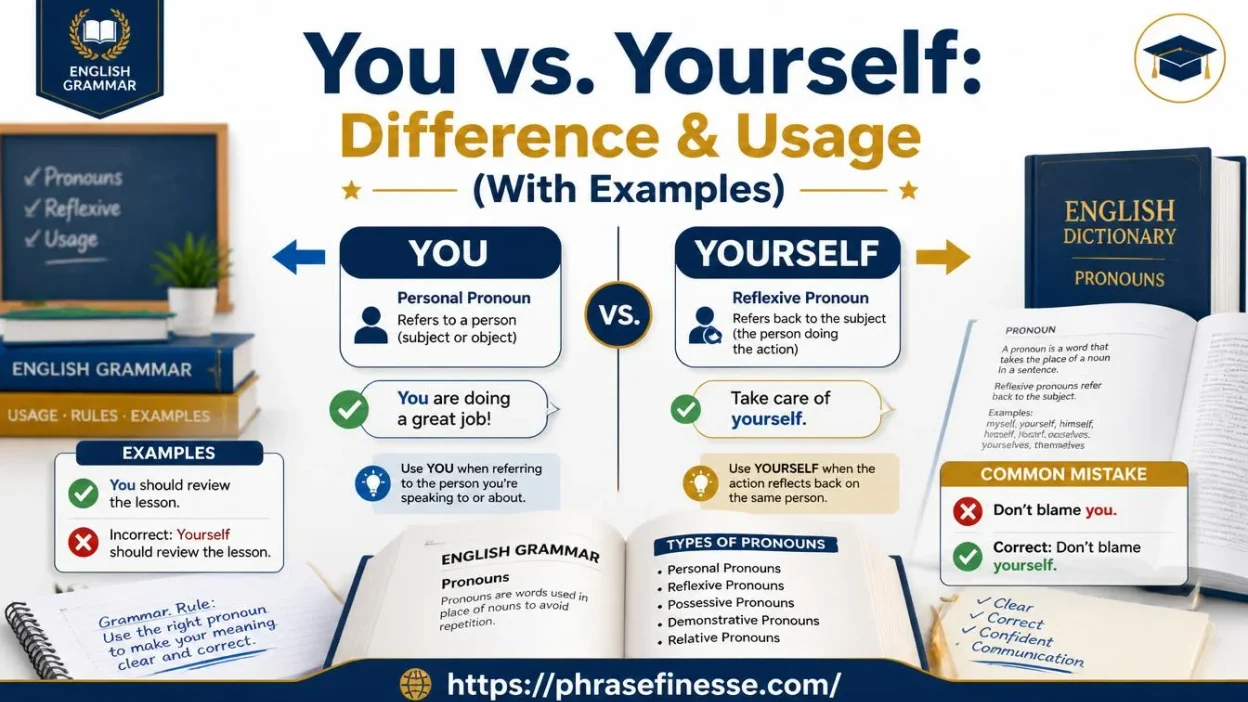
The primary difference between you and yourself lies in their grammatical roles.
- You is a personal pronoun.
- Yourself is a reflexive pronoun or an intensive pronoun.
Here’s a quick overview:
| Word | Type | Primary Function |
| You | Personal Pronoun | Refers directly to the person being addressed |
| Yourself | Reflexive Pronoun / Intensive Pronoun | Refers back to “you” or adds emphasis |
Quick Examples
You
- You should read this book.
- I appreciate you.
- Are you ready?
Yourself
- You taught yourself French.
- You injured yourself playing soccer.
- You yourself made that decision.
The distinction may appear small, but it affects sentence structure and meaning.
What Does “You” Mean?
The word you is one of the most frequently used pronouns in English.
It directly refers to the person or people being spoken to.
Unlike many other pronouns, you can be singular or plural.
Examples
- You are a talented writer.
- You need more practice.
- I saw you yesterday.
- This package is for you.
Notice something important: you does not refer back to itself. It simply identifies the listener or reader.
Using “You” as the Subject
A subject performs the action in a sentence.
Examples:
- You answered correctly.
- You completed the assignment.
- You understand the concept.
In each sentence, you perform the action.
| Sentence | Subject |
| You are early. | You |
| You made a good choice. | You |
| You can improve quickly. | You |
Using “You” as the Object
An object receives the action.
Examples:
- I called you.
- They invited you.
- We appreciate you.
Here, someone else performs the action while you receive it.
More Examples
- The manager emailed you.
- I trust you completely.
- Nobody warned you about the change.
Common Sentence Patterns With “You”
You’ll frequently encounter these structures:
You + Verb
- You matter.
- You succeeded.
- You belong here.
Verb + You
- I respect you.
- We support you.
- They selected you.
Preposition + You
- For you
- With you
- About you
- Near you
Examples:
- This opportunity is for you.
- I’ll work with you.
- We talked about you.
What Does “Yourself” Mean?
Now let’s look at yourself.
This word belongs to a special category called reflexive pronouns.
Reflexive pronouns include:
| Personal Pronoun | Reflexive Pronoun |
| I | Myself |
| You | Yourself |
| He | Himself |
| She | Herself |
| It | Itself |
| We | Ourselves |
| They | Themselves |
A reflexive pronoun reflects the action back to the subject.
Think of it like a boomerang. The action starts with the subject and returns to the same subject.
Using “Yourself” as a Reflexive Pronoun
A reflexive pronoun is necessary when the subject and object refer to the same person.
Formula
You + action + yourself
Examples:
- You taught yourself Spanish.
- You cut yourself.
- You introduced yourself.
- You blamed yourself.
In each sentence:
- The subject is you.
- The object is yourself.
- Both refer to the same person.
Why Reflexive Pronouns Matter
Without reflexive pronouns, many sentences would become unclear.
Consider this example:
You introduced yourself.
The sentence clearly tells us that you performed the introduction and you were also the person being introduced.
Now compare:
You introduced yourself.
This sounds strange and unnatural because English requires a reflexive pronoun when the subject and object are identical.
Real-Life Reflexive Examples
Here are situations where reflexive pronouns naturally occur:
Learning
- You taught yourself coding.
- You trained yourself to type faster.
Personal Development
- You challenged yourself.
- You motivated yourself.
Daily Activities
- You dressed yourself.
- You prepared yourself for work.
Safety
- You injured yourself.
- You burned yourself on the stove.
These examples occur frequently in everyday English.
When “Yourself” Is Used for Emphasis
Not every use of yourself is reflexive.
Sometimes it acts as an intensive pronoun.
An intensive pronoun adds emphasis but does not change the sentence’s core meaning.
Intensive Pronoun Examples
Consider these sentences:
- You yourself approved the proposal.
- You yourself witnessed the event.
- Only you yourself can make that decision.
The word yourself simply adds emphasis.
Remove it:
- You approved the proposal.
- You witnessed the event.
- Only you can make that decision.
The sentence still works.
That’s how you know it’s an intensive pronoun.

Why Writers Use Intensive Pronouns
Writers often use intensive pronouns to:
- Stress responsibility
- Highlight authority
- Add emotional impact
- Emphasize personal involvement
Example
You yourself signed the contract.
This sentence highlights that nobody else signed it.
Reflexive vs. Intensive Use of Yourself
Many learners struggle because the same word performs two functions.
This table makes the distinction clear.
| Sentence | Function |
| You blamed yourself. | Reflexive |
| You taught yourself guitar. | Reflexive |
| You yourself approved it. | Intensive |
| You yourself saw what happened. | Intensive |
Easy Test
Ask yourself:
Does the action return to the subject?
If yes, it’s reflexive.
Does the word simply add emphasis?
If yes, it’s intensive.
Read More:Thank You For Everything: Meaning, Usage, and Alternatives
You vs. Yourself: Side-by-Side Comparison
Here’s a direct comparison.
| Situation | Correct Word | Example |
| Subject of sentence | You | You are welcome. |
| Object of verb | You | I trust you. |
| Object receiving same action as subject | Yourself | You hurt yourself. |
| Emphasis | Yourself | You yourself said that. |
| After prepositions in normal use | You | This gift is for you. |
| Formal emphasis | Yourself | You yourself approved it. |
Why “Yourself” Is Frequently Misused
One of the biggest grammar myths in English is that yourself sounds more professional than you.
This misconception appears everywhere.
You may see phrases like:
- Contact yourself.
- Myself and John attended.
- The report was sent to you.
These constructions often appear in workplaces, corporate emails, and customer service messages.
However, they are usually incorrect.
The Formality Trap
Many people replace ordinary pronouns with reflexive pronouns because they believe it sounds sophisticated.
Unfortunately, grammar doesn’t work that way.
Incorrect
- Please contact yourself for assistance.
- We will notify yourself.
- The manager and yourself attended.
Correct
- Please contact me for assistance.
- We will notify you.
- The manager and you attended.
The correct version sounds cleaner and more natural.
Why People Make This Mistake
Several factors contribute:
Fear of Sounding Informal
People assume reflexive pronouns sound more professional.
Overcorrection
Someone learns grammar rules and applies them where they don’t belong.
Workplace Habits
Incorrect phrases spread through office culture and become normalized.
Common Mistakes With You and Yourself
Understanding mistakes helps prevent them.
Using Yourself as the Subject
Incorrect
Yourself should complete the form.
Correct
You should complete the form.
Yourself cannot normally serve as the sentence subject.
Replacing You With Yourself
Incorrect
We appreciate you.
Correct
We appreciate you.
The verb acts on another person. No reflexive action exists.
Using Yourself Without a Matching Subject
Incorrect
The report was reviewed by yourself.
Correct
The report was reviewed by you.
The subject isn’t you, so the reflexive pronoun doesn’t belong.
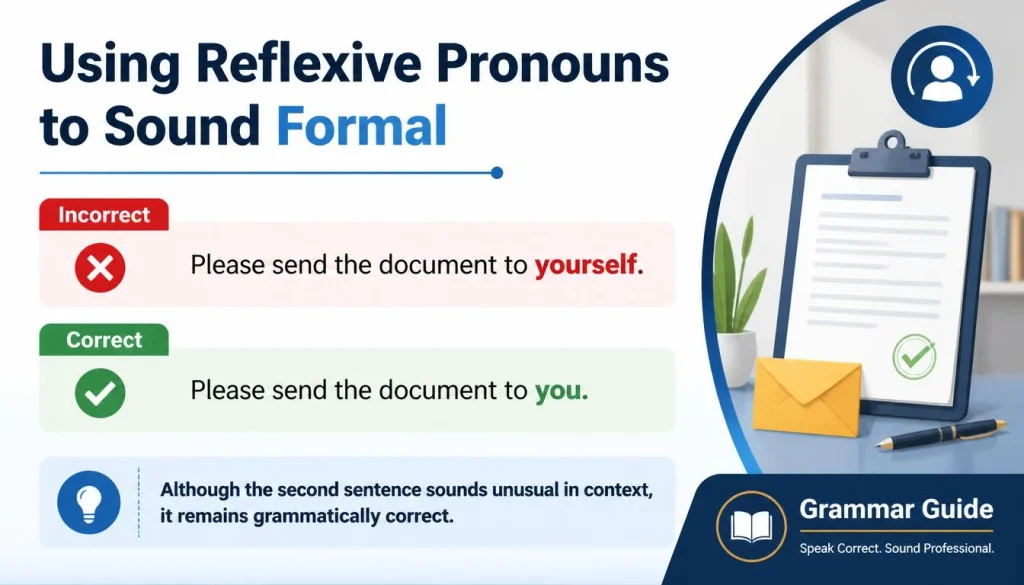
Using Reflexive Pronouns to Sound Formal
Incorrect
Please send the document to yourself.
Correct
Please send the document to you.
Although the second sentence sounds unusual in context, it remains grammatically correct.
Eight Real Examples of You and Yourself
Let’s examine practical examples.
Examples Using “You”
Example 1
You can improve your writing through consistent practice.
Example 2
I appreciate you for your dedication and effort.
Example 3
Are you attending tomorrow’s meeting?
Example 4
The final decision belongs entirely to you.
Examples Using “Yourself”
Example 5
You should be proud of yourself.
Example 6
You taught yourself graphic design.
Example 7
You yourself confirmed the details.
Example 8
Did you prepare yourself for the interview?
These examples demonstrate both reflexive and intensive uses.
Quick Grammar Test: You or Yourself?
Try these sentences.
Question 1
Please contact _____ if you have questions.
Answer: me or you, depending on context.
Not yourself.
Question 2
You should trust _____.
Answer: yourself
The action returns to the subject.
Question 3
Only you _____ can solve this problem.
Answer: yourself
Used for emphasis.
Question 4
I believe in _____.
Answer: you
No reflexive relationship exists.
A Simple Trick to Remember the Difference
Many grammar rules feel complicated.
This one doesn’t have to.
Use this two-step method.
Use “You” When:
- You’re addressing someone directly.
- The word functions as a subject.
- The word functions as an object.
- No action returns to the same person.
Examples:
- You are welcome.
- I called you.
- We support you.
Use “Yourself” When:
- The subject and object are identical.
- The action comes back to the subject.
- You want emphasis.
Examples:
- You hurt yourself.
- You taught yourself.
- You yourself approved it.
How Native Speakers Naturally Use These Words
One of the best ways to understand grammar is through real usage.
Native speakers overwhelmingly prefer you in ordinary conversation.
Examples:
- I trust you.
- We need you.
- Can you help?
They use themselves only when grammar requires it or emphasis adds value.
Examples:
- You introduced yourself.
- You prepared yourself.
- You yourself admitted it.
This pattern remains consistent across formal and informal English.
Related Reflexive Pronouns and Their Usage
The same grammar rule applies to every reflexive pronoun.
| Personal Pronoun | Reflexive Pronoun | Example |
| I | Myself | I taught myself. |
| You | Yourself | You taught yourself. |
| He | Himself | He taught himself. |
| She | Herself | She taught herself. |
| It | Itself | The machine repaired itself. |
| We | Ourselves | We challenged ourselves. |
| They | Themselves | They prepared themselves. |
Learning one reflexive pronoun helps you understand all of them.
Practical Case Study: Business Email Mistakes
Consider this real-world example.
Original Email
Please send the signed agreement to yourself before Friday.
This sounds professional at first glance.
However, it’s grammatically incorrect.
Correct Version
Please send the signed agreement to you before Friday.
Even better:
Please send the signed agreement before Friday.
The revised version removes unnecessary wording and improves clarity.
This example illustrates why reflexive pronouns should never replace ordinary pronouns without a grammatical reason.
Expert Grammar Insight
“Reflexive pronouns should refer back to a previously stated subject. When they don’t, the sentence often becomes awkward or incorrect.”
This principle appears throughout modern English grammar.
Once you understand it, choosing between you and yourself becomes almost automatic.
FAQs
1. What is the main difference between “you” and “yourself”?
“You” is a personal pronoun used as the subject or object of a sentence. “Yourself” is a reflexive pronoun used when the subject and object refer to the same person or to add emphasis.
2. Can I use “yourself” instead of “you” to sound more formal?
No. Using “yourself” in place of “you” doesn’t make your writing more formal. In fact, it’s often considered a grammatical mistake unless the sentence requires a reflexive or emphatic pronoun.
3. When should I use “yourself”?
Use “yourself” when the action reflects back on the subject, such as “You should treat yourself.” You can also use it for emphasis, as in “You yourself solved the problem.”
4. Is it correct to say “Please contact yourself”?
No. The correct phrase is “Please contact you” only if another person is being addressed indirectly, though this construction is uncommon. More naturally, you would say “Please contact me,” “Please contact us,” or “Please contact the appropriate person.” Saying “contact yourself” is grammatically incorrect unless someone is literally contacting themselves.
5. Why do people misuse “yourself” in business communication?
Many people mistakenly believe “yourself” sounds more professional than “you.” However, standard English grammar favors “you” in most business emails and workplace communication unless a reflexive meaning is intended.
6. How can I remember whether to use “you” or “yourself”?
A simple rule is to use “you” for normal subjects and objects. Choose “yourself” only when the action comes back to the same person or when you want to emphasize that person. If removing “yourself” changes the sentence’s meaning, it’s probably being used correctly.
Conclusion
Understanding the difference between “you” and “yourself” is an essential part of mastering English grammar. While “you” functions as a subject or object pronoun, “yourself” is primarily a reflexive or emphatic pronoun that should only be used in specific grammatical situations.
Mixing them up can make your writing sound unnatural or even incorrect.Whether you’re writing business emails, preparing formal documents, participating in meetings, or communicating in everyday conversations, choosing the correct pronoun improves clarity, professionalism, and consistency. By following the explanations and examples in this guide, you’ll avoid common mistakes and use both words confidently in any context.

Mia Rose is an English language specialist and editorial writer at Phrase Finesse, where she helps readers master grammar, vocabulary, spelling, and effective communication. Passionate about making English simple and practical, she creates well-researched, reader-friendly content that explains complex language concepts in a clear and engaging way.
With extensive experience in English language education, content writing, and editorial review, Mia specializes in grammar, punctuation, word choice, idioms, confusing word pairs, and writing style. Her articles are carefully researched, fact-checked, and designed to help students, professionals, writers, and English learners build confidence in both written and spoken English.