
“As Part Of” vs. “As A Part Of”: Meaning and Usage Explained
Have you ever wondered whether“As Part Of” vs. “As A Part Of”: Meaning and Usage Explained are interchangeable? At first glance, these phrases seem nearly identical, but subtle differences in English usage, tone, and sentence structure can affect how naturally your writing sounds.
You may encounter both expressions in business communication, scheduling emails, meeting notices, project updates, or everyday conversations. Knowing when to use each form helps you communicate your meaning with greater clarity and consistency.
In this guide, you’ll learn the practical difference between “as part of” and “as a part of”, including when each expression fits best in formal writing and everyday English. We’ll examine clear example sentences related to scheduling, time management, online booking, broadcasting, meetings, calendar updates, and project management.
These examples will show you how the phrases work in real contexts rather than relying on abstract grammar rules. You’ll also see why “as part of” often sounds more natural when describing an activity, process, plan, or larger arrangement.
By the end of this article, you’ll have a practical understanding of both expressions and the confidence to use them correctly. Whether you’re writing a professional email, updating a project schedule, explaining a meeting plan, or improving your everyday English grammar, context matters.
Instead of memorizing a rigid rule, you’ll learn how meaning, sentence structure, and consistency guide your choice. Let’s explore 18 example sentences that make the distinction simple, useful, and easy to remember.
What Does “As Part Of” Mean?
“As part of” means that something belongs to, happens within, or is included in a larger group, activity, system, plan, or process.
In simple terms, it shows connection and inclusion.
When you use “as part of,” you usually focus on the bigger picture rather than the individual item.
For example:
The company launched a new training program as part of its employee development plan.
This sentence tells us that the training program belongs to a larger development plan. The focus is not only on the training itself but on how it fits into the company’s overall strategy.
Another example:
Students complete internships as part of their degree programs.
Here, the internship is one element included in the entire educational experience.
Meaning of “As Part Of” in Everyday English
The phrase commonly appears when talking about:
- Projects
- Programs
- Events
- Organizations
- Responsibilities
- Research
- Plans
- Processes
You’ll often see it in professional and academic writing because it efficiently explains relationships between smaller elements and larger systems.
Common Examples
| Sentence | Meaning |
| She joined the company as part of the marketing team. | She became included in the marketing team. |
| The survey was conducted as part of a research project. | The survey belonged to a larger research effort. |
| They received free tickets as part of the promotion. | The tickets were included in the promotional offer. |
| He traveled abroad as part of the exchange program. | The travel was included in the program. |
Why “As Part Of” Is So Common in English
One reason “as part of” is widely used is because English speakers often prefer shorter expressions when the meaning remains clear.
Compare these two sentences:
The company introduced new software as part of its digital transformation strategy.
The company introduced new software as a part of its digital transformation strategy.
Both sentences are correct. However, the first one feels smoother and more natural to most speakers.
The phrase “as part of” has become a common fixed expression. It quickly communicates the idea that something belongs to a larger whole.
Think of it like a puzzle.
A puzzle piece does not exist separately from the picture. It gains meaning because it connects with the entire image. In the same way, something done as part of a project gains importance from the larger activity around it.
What Does “As A Part Of” Mean?
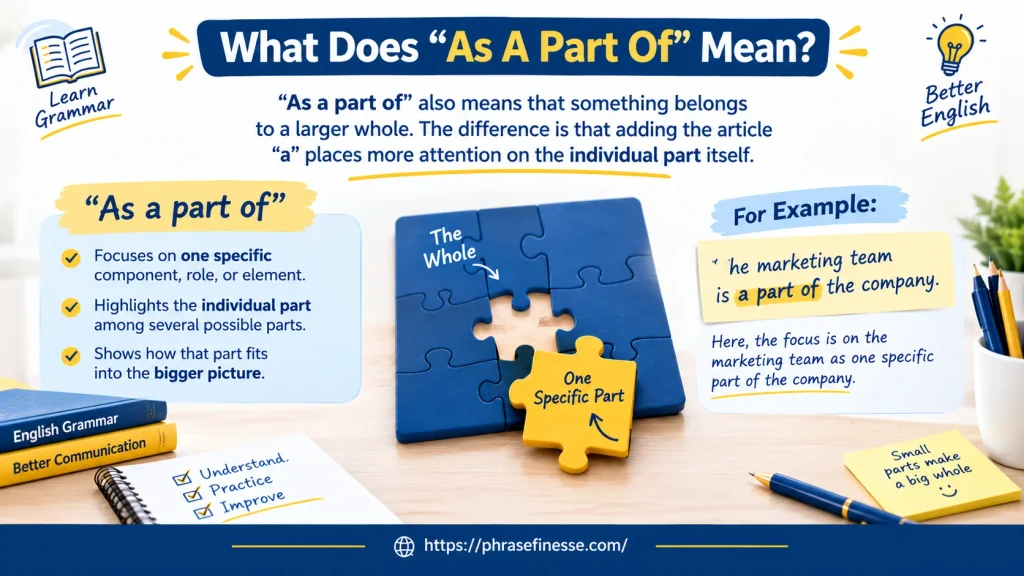
“As a part of” also means that something belongs to a larger whole. The difference is that adding the article “a” places more attention on the individual part itself.
The phrase highlights one specific component, role, or element among several possible parts.
For example:
The engine works as a part of the machine.
This sentence focuses on the engine as one identifiable component of the machine.
Another example:
She considers herself as a part of the community.
Here, the speaker emphasizes her individual identity as one member within the larger community.
Understanding the Role of “A” in “As A Part Of”
The word “a” is an indefinite article. It tells the reader that the noun following it refers to one item among many possible items.
Consider these examples:
A student joined the competition.
This means one student joined among many possible students.
Similarly:
The engine is a part of the machine.
This suggests that the engine is one component among several components.
However, when English speakers use:
The engine is part of the machine.
The focus shifts slightly toward the relationship between the engine and the machine.
The engine belongs to the machine system.
“As Part Of” vs. “As A Part Of”: Main Difference Explained
The difference between these phrases is subtle, but understanding it improves your writing.
| Phrase | Main Focus | Common Meaning |
| As part of | The larger whole | Something is included within a bigger activity or system |
| As a part of | The individual element | Something is one specific piece of a larger whole |
A simple way to remember:
- As part of = belonging
- As a part of = one specific piece
Examples Showing the Difference
Example One
As part of
The company offered free courses as part of its employee benefits program.
The sentence focuses on the benefits program. The courses are one feature included in the program.
As a part of
The company offered free courses as a part of its employee benefits program.
This version highlights the courses as one particular element of the program.
The difference is small. In many situations, both sentences work.
Example Two
As part of
She participated in the conference as part of her professional development.
The conference was included in her broader learning journey.
As a part of
She participated in the conference as a part of her professional development.
This emphasizes the conference as one individual activity within her development.
Is “As Part Of” More Common Than “As A Part Of”?
Yes.
In modern English, “as part of” is much more common than “as a part of.”
Writers and speakers often choose it because it sounds natural, direct, and concise.
For example, professional organizations frequently write:
“This update was released as part of our latest improvement plan.”
Instead of:
“This update was released as a part of our latest improvement plan.”
The second sentence is not wrong. It simply sounds slightly more formal or more focused on the individual item.
When Should You Use “As Part Of”?
Use “as part of” when you want to explain that something is included in a larger activity, system, or plan.
Common Uses of “As Part Of”
Workplace Communication
Businesses often use this phrase when discussing responsibilities, projects, or changes.
Examples:
- Employees receive training as part of the onboarding process.
- The company introduced new policies as part of its safety improvements.
Education
Schools and universities commonly use it.
Examples:
- Students complete practical assignments as part of the course.
- Research experience is offered as part of the program.
Marketing and Business
Companies use the phrase when describing offers and campaigns.
Examples:
- Customers received discounts as part of the holiday promotion.
- The feature was added as part of the software update.
Events and Activities
Examples:
- Volunteers received certificates as part of the event.
- The performance was organized as part of the cultural festival.
When Should You Use “As A Part Of”?
Although less common, “as a part of” works well when you want to emphasize a specific component.
Use it when the individual role or element matters.
Examples:
The website redesign was created as a part of the company’s larger branding strategy.
The redesign is highlighted as one specific element.
She sees her volunteer work as a part of her personal growth.
The volunteer work is presented as one meaningful piece of her life.
Quick Test: Which Phrase Should You Choose?
Ask yourself:
Are you focusing on inclusion in a larger activity?
Use:
✅ As part of
Example:
The meeting was held as part of the annual conference.
Are you focusing on one particular piece or element?
Use:
✅ As a part of
Example:
This chapter serves as a part of the complete guide.
18 Example Sentences: “As Part Of” vs. “As A Part Of”
Examples Using “As Part Of”
The company introduced new policies as part of its safety initiative.
The policies belong to a larger safety plan.
Students learn communication skills as part of the course.
The skills are included in the course structure.
She received training as part of her new position.
The training came with the responsibilities of the job.
The report was published as part of a larger study.
The report belongs to a broader research project.
They traveled abroad as part of the exchange program.
The trip was included within the program.
The feature was added as part of the latest update.
The feature was one element of the update.
He volunteered as part of the community project.
His volunteering was included in the project activities.
The discount was offered as part of the promotion.
The discount belonged to the promotional campaign.
She spoke at the event as part of the organization’s campaign.
Her speech was included in the campaign.
Examples Using “As A Part Of”
The engine works as a part of the larger system.
The engine is identified as one specific component.
He sees himself as a part of the community.
He emphasizes his individual membership.
This document serves as a part of the final proposal.
The document is one specific section.
The painting became a part of the museum collection.
The painting is highlighted as one item in the collection.
She worked as a part of the research team.
Her role is emphasized as one position within the team.
The device operates as a part of the security system.
The device is one identifiable component.
This tradition remains a part of their culture.
The tradition is highlighted as one cultural element.
The new law became a part of the country’s legal framework.
The law is presented as one addition.
The chapter exists as a part of the complete guide.
The chapter is one specific section.
Common Mistakes With “As Part Of” and “As A Part Of”
Although “as part of” and “as a part of” are both correct, many writers misuse them because the difference is subtle. Most mistakes happen when people try to follow a strict rule that does not exist.
English does not always work like a mathematical formula. Sometimes two phrases can be correct while one sounds more natural in a specific situation.
Understanding the common mistakes below will help you choose the right phrase with confidence.
Mistake: Thinking “As A Part Of” Is Always Wrong
One of the biggest misconceptions is that “as a part of” is incorrect.
That is not true.
The phrase is grammatically acceptable. It simply places more attention on the individual part.
For example:
The heart functions as a part of the human body.
This sentence highlights the heart as one specific organ within the larger system of the body.
However:
The heart functions as part of the human body.
This version focuses more on the relationship between the heart and the body as a whole.
Both sentences work.
The choice depends on what you want your reader to notice.
Mistake: Adding “A” When You Do Not Need It
Many learners add “a” because they believe every singular noun requires an article.
That rule is incomplete.
English has many fixed expressions where articles disappear naturally.
For example:
✅ Natural:
The training was provided as part of the program.
Less natural:
The training was provided as a part of the program.
The second sentence is not incorrect, but most native speakers would usually choose the first option.
The phrase “as part of” has become a common expression in English. It works almost like a set phrase.
Mistake: Using “Part” Without Understanding the Meaning
The word “part” can describe different relationships.
Compare these examples:
Example One:
The keyboard is part of the computer.
Meaning: The keyboard belongs to the computer system.
Example Two:
The keyboard is a part of the computer.
Meaning: The keyboard is one specific component of the computer.
The difference is small, but the second sentence draws attention to the keyboard as an individual item.
Mistake: Confusing “Part Of” With “A Part From”
Another common error is using “part from” when you mean “part of.”
Incorrect:
The marketing campaign was a part from the company strategy.
Correct:
The marketing campaign was part of the company strategy.
The phrase “part of” shows belonging or connection.
The phrase “apart from” has a completely different meaning.
“Apart From” vs. “Part Of”: Different Meanings
These two expressions look similar but do different jobs.
| Phrase | Meaning | Example |
| Part of | Included within something | She is part of the team. |
| Apart from | Except for or besides something | Apart from John, everyone attended. |
Notice the difference:
She is part of the team.
She belongs to the team.
Apart from John, everyone attended.
Everyone attended except John.
A small space changes the meaning completely.
“As Part Of” vs. “As A Part Of” in Formal Writing
Many writers wonder which phrase sounds better in professional communication.
In most cases, “as part of” is the stronger choice because it sounds cleaner and more direct.
It appears frequently in:
- Business reports
- Academic writing
- Government documents
- Marketing materials
- News articles
- Workplace emails
For example:
The company introduced a new training system as part of its growth strategy.
This sentence sounds professional and natural.
Using “As Part Of” in Business Writing
Businesses often use this phrase to explain actions, changes, and responsibilities.
Examples:
Employees will receive additional resources as part of the new workplace policy.
The resources belong to the policy changes.
The company acquired new equipment as part of its expansion plan.
The equipment is included within the expansion process.
Why businesses prefer “as part of”
It is:
- Shorter
- Clearer
- Easier to read
- More natural for professional audiences
Using “As Part Of” in Academic Writing
Academic writers often use this phrase when describing research methods, assignments, or educational activities.
Examples:
Participants completed interviews as part of the research process.
Students analyzed historical documents as part of the assignment.
The phrase clearly shows that one activity belongs to a larger academic process.
Using “As A Part Of” When Precision Matters
Although “as part of” is usually preferred, “as a part of” can be useful when you want to point out a particular element.
For example:
The introduction serves as a part of the overall argument.
Here, the introduction is treated as one identifiable section of the argument.
Another example:
The bridge acts as a part of the transportation network.
The bridge is emphasized as one specific structure within the network.
Case Study: How the Meaning Changes in Real Writing
Imagine a company launches a new customer service system.
Version One:
The company introduced chat support as part of its customer service improvements.
Meaning:
Chat support is included in a larger improvement effort.
The focus is on the overall project.
Version Two:
The company introduced chat support as a part of its customer service improvements.
Meaning:
Chat support is highlighted as one particular improvement.
The focus is on the specific feature.
Which Version Should a Business Use?
Usually:
The company introduced chat support as part of its customer service improvements.
Why?
Because business writing often focuses on actions within a larger strategy.
Comparison Table: “As Part Of” vs. “As A Part Of”
| Feature | As Part Of | As A Part Of |
| Grammar | Correct | Correct |
| Popularity | Very common | Less common |
| Main idea | Inclusion | Specific component |
| Tone | Natural and smooth | Slightly more deliberate |
| Common in conversation | Yes | Sometimes |
| Common in business writing | Yes | Yes |
| Focus | The bigger picture | The individual part |
Quick Rules to Remember
If you are unsure, these simple guidelines can help:
Choose “As Part Of” When:
- Something belongs to a larger activity.
- You describe a process or plan.
- You focus on the overall situation.
Examples:
- The workshop was organized as part of the conference.
- She joined the team as part of the project.
- The update was released as part of the improvement plan.
Choose “As A Part Of” When:
- You want to highlight one specific element.
- You are identifying a component.
- The individual part matters.
Examples:
- The engine works as a part of the vehicle.
- The painting became a part of the collection.
- This chapter serves as a part of the complete guide.
A Simple Memory Trick
Think about a movie.
A movie contains many scenes.
If you say:
The scene was included as part of the movie.
You focus on the entire movie.
If you say:
The scene was a part of the movie.
You focus on that specific scene as one piece.
Both are correct.
The difference is where you place the spotlight.
What Does “As Part Of” Mean?
“As part of” means that something belongs to, happens within, or is included in a larger group, activity, system, plan, or process.
In simple terms, it shows connection and inclusion.
When you use “as part of,” you usually focus on the bigger picture rather than the individual item.
For example:
The company launched a new training program as part of its employee development plan.
This sentence tells us that the training program belongs to a larger development plan. The focus is not only on the training itself but on how it fits into the company’s overall strategy.
Another example:
Students complete internships as part of their degree programs.
Here, the internship is one element included in the entire educational experience.
Meaning of “As Part Of” in Everyday English
The phrase commonly appears when talking about:
- Projects
- Programs
- Events
- Organizations
- Responsibilities
- Research
- Plans
- Processes
You’ll often see it in professional and academic writing because it efficiently explains relationships between smaller elements and larger systems.
Common Examples
| Sentence | Meaning |
| She joined the company as part of the marketing team. | She became included in the marketing team. |
| The survey was conducted as part of a research project. | The survey belonged to a larger research effort. |
| They received free tickets as part of the promotion. | The tickets were included in the promotional offer. |
| He traveled abroad as part of the exchange program. | The travel was included in the program. |
Why “As Part Of” Is So Common in English
One reason “as part of” is widely used is because English speakers often prefer shorter expressions when the meaning remains clear.
Compare these two sentences:
The company introduced new software as part of its digital transformation strategy.
The company introduced new software as a part of its digital transformation strategy.
Both sentences are correct. However, the first one feels smoother and more natural to most speakers.
The phrase “as part of” has become a common fixed expression. It quickly communicates the idea that something belongs to a larger whole.
Think of it like a puzzle.
A puzzle piece does not exist separately from the picture. It gains meaning because it connects with the entire image. In the same way, something done as part of a project gains importance from the larger activity around it.
What Does “As A Part Of” Mean?
“As a part of” also means that something belongs to a larger whole. The difference is that adding the article “a” places more attention on the individual part itself.
The phrase highlights one specific component, role, or element among several possible parts.
For example:
The engine works as a part of the machine.
This sentence focuses on the engine as one identifiable component of the machine.
Another example:
She considers herself as a part of the community.
Here, the speaker emphasizes her individual identity as one member within the larger community.
Understanding the Role of “A” in “As A Part Of”
The word “a” is an indefinite article. It tells the reader that the noun following it refers to one item among many possible items.
Consider these examples:
A student joined the competition.
This means one student joined among many possible students.
Similarly:
The engine is a part of the machine.
This suggests that the engine is one component among several components.
However, when English speakers use:
The engine is part of the machine.
The focus shifts slightly toward the relationship between the engine and the machine.
The engine belongs to the machine system.
“As Part Of” vs. “As A Part Of”: Main Difference Explained
The difference between these phrases is subtle, but understanding it improves your writing.
| Phrase | Main Focus | Common Meaning |
| As part of | The larger whole | Something is included within a bigger activity or system |
| As a part of | The individual element | Something is one specific piece of a larger whole |
A simple way to remember:
- As part of = belonging
- As a part of = one specific piece
Examples Showing the Difference
Example One
As part of
The company offered free courses as part of its employee benefits program.
The sentence focuses on the benefits program. The courses are one feature included in the program.
As a part of
The company offered free courses as a part of its employee benefits program.
This version highlights the courses as one particular element of the program.
The difference is small. In many situations, both sentences work.
Example Two
As part of
She participated in the conference as part of her professional development.
The conference was included in her broader learning journey.
As a part of
She participated in the conference as a part of her professional development.
This emphasizes the conference as one individual activity within her development.
Is “As Part Of” More Common Than “As A Part Of”?
Yes.
In modern English, “as part of” is much more common than “as a part of.”
Writers and speakers often choose it because it sounds natural, direct, and concise.
For example, professional organizations frequently write:
“This update was released as part of our latest improvement plan.”
Instead of:
“This update was released as a part of our latest improvement plan.”
The second sentence is not wrong. It simply sounds slightly more formal or more focused on the individual item.
When Should You Use “As Part Of”?
Use “as part of” when you want to explain that something is included in a larger activity, system, or plan.
Common Uses of “As Part Of”
Workplace Communication
Businesses often use this phrase when discussing responsibilities, projects, or changes.
Examples:
- Employees receive training as part of the onboarding process.
- The company introduced new policies as part of its safety improvements.
Education
Schools and universities commonly use it.
Examples:
- Students complete practical assignments as part of the course.
- Research experience is offered as part of the program.
Marketing and Business
Companies use the phrase when describing offers and campaigns.
Examples:
- Customers received discounts as part of the holiday promotion.
- The feature was added as part of the software update.
Events and Activities
Examples:
- Volunteers received certificates as part of the event.
- The performance was organized as part of the cultural festival.
See More : Does “Government” Mean “Mind Control” in Latin? The Truth
When Should You Use “As A Part Of”?
Although less common, “as a part of” works well when you want to emphasize a specific component.
Use it when the individual role or element matters.
Examples:
The website redesign was created as a part of the company’s larger branding strategy.
The redesign is highlighted as one specific element.
She sees her volunteer work as a part of her personal growth.
The volunteer work is presented as one meaningful piece of her life.
Quick Test: Which Phrase Should You Choose?
Ask yourself:
Are you focusing on inclusion in a larger activity?
Use:
✅ As part of
Example:
The meeting was held as part of the annual conference.
Are you focusing on one particular piece or element?
Use:
✅ As a part of
Example:
This chapter serves as a part of the complete guide.
18 Example Sentences: “As Part Of” vs. “As A Part Of”
Examples Using “As Part Of”
The company introduced new policies as part of its safety initiative.
The policies belong to a larger safety plan.
Students learn communication skills as part of the course.
The skills are included in the course structure.
She received training as part of her new position.
The training came with the responsibilities of the job.
The report was published as part of a larger study.
The report belongs to a broader research project.
They traveled abroad as part of the exchange program.
The trip was included within the program.
The feature was added as part of the latest update.
The feature was one element of the update.
He volunteered as part of the community project.
His volunteering was included in the project activities.
The discount was offered as part of the promotion.
The discount belonged to the promotional campaign.
She spoke at the event as part of the organization’s campaign.
Her speech was included in the campaign.
Examples Using “As A Part Of”
The engine works as a part of the larger system.
The engine is identified as one specific component.
He sees himself as a part of the community.
He emphasizes his individual membership.
This document serves as a part of the final proposal.
The document is one specific section.
The painting became a part of the museum collection.
The painting is highlighted as one item in the collection.
She worked as a part of the research team.
Her role is emphasized as one position within the team.
The device operates as a part of the security system.
The device is one identifiable component.
This tradition remains a part of their culture.
The tradition is highlighted as one cultural element.
The new law became a part of the country’s legal framework.
The law is presented as one addition.
The chapter exists as a part of the complete guide.
The chapter is one specific section.
Common Mistakes With “As Part Of” and “As A Part Of”
Although “as part of” and “as a part of” are both correct, many writers misuse them because the difference is subtle. Most mistakes happen when people try to follow a strict rule that does not exist.
English does not always work like a mathematical formula. Sometimes two phrases can be correct while one sounds more natural in a specific situation.
Understanding the common mistakes below will help you choose the right phrase with confidence.
Mistake: Thinking “As A Part Of” Is Always Wrong
One of the biggest misconceptions is that “as a part of” is incorrect.
That is not true.
The phrase is grammatically acceptable. It simply places more attention on the individual part.
For example:
The heart functions as a part of the human body.
This sentence highlights the heart as one specific organ within the larger system of the body.
However:
The heart functions as part of the human body.
This version focuses more on the relationship between the heart and the body as a whole.
Both sentences work.
The choice depends on what you want your reader to notice.
Mistake: Adding “A” When You Do Not Need It
Many learners add “a” because they believe every singular noun requires an article.
That rule is incomplete.
English has many fixed expressions where articles disappear naturally.
For example:
✅ Natural:
The training was provided as part of the program.
Less natural:
The training was provided as a part of the program.
The second sentence is not incorrect, but most native speakers would usually choose the first option.
The phrase “as part of” has become a common expression in English. It works almost like a set phrase.
Mistake: Using “Part” Without Understanding the Meaning
The word “part” can describe different relationships.
Compare these examples:
Example One:
The keyboard is part of the computer.
Meaning: The keyboard belongs to the computer system.
Example Two:
The keyboard is a part of the computer.
Meaning: The keyboard is one specific component of the computer.
The difference is small, but the second sentence draws attention to the keyboard as an individual item.
Mistake: Confusing “Part Of” With “A Part From”
Another common error is using “part from” when you mean “part of.”
Incorrect:
The marketing campaign was a part from the company strategy.
Correct:
The marketing campaign was part of the company strategy.
The phrase “part of” shows belonging or connection.
The phrase “apart from” has a completely different meaning.
“Apart From” vs. “Part Of”: Different Meanings
These two expressions look similar but do different jobs.
| Phrase | Meaning | Example |
| Part of | Included within something | She is part of the team. |
| Apart from | Except for or besides something | Apart from John, everyone attended. |
Notice the difference:
She is part of the team.
She belongs to the team.
Apart from John, everyone attended.
Everyone attended except John.
A small space changes the meaning completely.
“As Part Of” vs. “As A Part Of” in Formal Writing
Many writers wonder which phrase sounds better in professional communication.
In most cases, “as part of” is the stronger choice because it sounds cleaner and more direct.
It appears frequently in:
- Business reports
- Academic writing
- Government documents
- Marketing materials
- News articles
- Workplace emails
For example:
The company introduced a new training system as part of its growth strategy.
This sentence sounds professional and natural.
Using “As Part Of” in Business Writing
Businesses often use this phrase to explain actions, changes, and responsibilities.
Examples:
Employees will receive additional resources as part of the new workplace policy.
The resources belong to the policy changes.
The company acquired new equipment as part of its expansion plan.
The equipment is included within the expansion process.
Why businesses prefer “as part of”
It is:
- Shorter
- Clearer
- Easier to read
- More natural for professional audiences
Using “As Part Of” in Academic Writing
Academic writers often use this phrase when describing research methods, assignments, or educational activities.
Examples:
Participants completed interviews as part of the research process.
Students analyzed historical documents as part of the assignment.
The phrase clearly shows that one activity belongs to a larger academic process.
Using “As A Part Of” When Precision Matters
Although “as part of” is usually preferred, “as a part of” can be useful when you want to point out a particular element.
For example:
The introduction serves as a part of the overall argument.
Here, the introduction is treated as one identifiable section of the argument.
Another example:
The bridge acts as a part of the transportation network.
The bridge is emphasized as one specific structure within the network.
Case Study: How the Meaning Changes in Real Writing
Imagine a company launches a new customer service system.
Version One:
The company introduced chat support as part of its customer service improvements.
Meaning:
Chat support is included in a larger improvement effort.
The focus is on the overall project.
Version Two:
The company introduced chat support as a part of its customer service improvements.
Meaning:
Chat support is highlighted as one particular improvement.
The focus is on the specific feature.
Which Version Should a Business Use?
Usually:
The company introduced chat support as part of its customer service improvements.
Why?
Because business writing often focuses on actions within a larger strategy.
Comparison Table: “As Part Of” vs. “As A Part Of”
| Feature | As Part Of | As A Part Of |
| Grammar | Correct | Correct |
| Popularity | Very common | Less common |
| Main idea | Inclusion | Specific component |
| Tone | Natural and smooth | Slightly more deliberate |
| Common in conversation | Yes | Sometimes |
| Common in business writing | Yes | Yes |
| Focus | The bigger picture | The individual part |
Quick Rules to Remember
If you are unsure, these simple guidelines can help:
Choose “As Part Of” When:
- Something belongs to a larger activity.
- You describe a process or plan.
- You focus on the overall situation.
Examples:
- The workshop was organized as part of the conference.
- She joined the team as part of the project.
- The update was released as part of the improvement plan.
Choose “As A Part Of” When:
- You want to highlight one specific element.
- You are identifying a component.
- The individual part matters.
Examples:
- The engine works as a part of the vehicle.
- The painting became a part of the collection.
- This chapter serves as a part of the complete guide.

A Simple Memory Trick
Think about a movie.
A movie contains many scenes.
If you say:
The scene was included as part of the movie.
You focus on the entire movie.
If you say:
The scene was a part of the movie.
You focus on that specific scene as one piece.
Both are correct.
The difference is where you place the spotlight.
FAQS
1. Is “as part of” or “as a part of” correct?
Both “as part of” and “as a part of” are grammatically correct. However, “as part of” is generally more common and sounds more natural in modern English. You can use either expression when you mean that something belongs to or occurs within a larger group, activity, plan, or process.
2. What does “as part of” mean?
“As part of” means that something is included within a larger group, activity, plan, or process. For example, “As part of the project, we’ll review the monthly schedule” means the schedule review is one element of the overall project.
3. Is “as a part of” more formal than “as part of”?
Not necessarily. “As a part of” can sound slightly more deliberate or emphatic, but it isn’t inherently more formal. In most professional and academic contexts, “as part of” remains the smoother and more concise choice.
4. Can I use “as part of” in formal writing?
Yes. “As part of” works perfectly well in formal writing, including business emails, reports, academic papers, project documentation, and official notices. For example, “As part of our quality-control process, all applications undergo a final review.”
5. Should I always use “as part of” instead of “as a part of”?
No. Although “as part of” is usually the preferred choice, “as a part of” is also grammatically acceptable. Your choice can depend on emphasis, sentence rhythm, and the specific context. When you want concise, natural wording, “as part of” usually works best.
6. What is the difference between “part of” and “a part of”?
Both phrases can describe something belonging to a larger whole. “Part of” often presents the relationship naturally and concisely, while “a part of” can emphasize that something represents one component among several. For example, “Communication is part of project management” sounds broad, while “Communication is a part of the overall strategy” can place more emphasis on it as one specific component.
Conclusion
Understanding “as part of” and “as a part of” doesn’t require memorizing complicated grammar rules. Both expressions can be correct, but “as part of” is usually the more natural and concise choice. You’ll commonly see it in professional writing, scheduling, meetings, project management, and everyday communication.
The key is to consider context, emphasis, sentence flow, and consistency. When you want straightforward wording, “as part of” will often be your best option. When you want to emphasize something as one specific component of a larger whole, “as a part of” may fit naturally.
With the 18 example sentences in this guide, you can now recognize how both expressions work in real-world English. Choose the version that communicates your meaning clearly, sounds natural, and fits the tone of your writing.

Emma Brooke is an English language specialist, editor, and content writer at Phrase Finesse, where she helps readers develop stronger writing and communication skills through clear, practical, and engaging content. With a passion for the English language, she specializes in simplifying grammar rules, vocabulary, spelling, punctuation, and word usage for learners at every level.
Emma has extensive experience creating educational content that is accurate, well-researched, and easy to understand. She is particularly skilled at explaining confusing word pairs, grammar concepts, idioms, sentence structure, and effective writing techniques, making complex topics approachable for students, professionals, educators, and English learners worldwide.