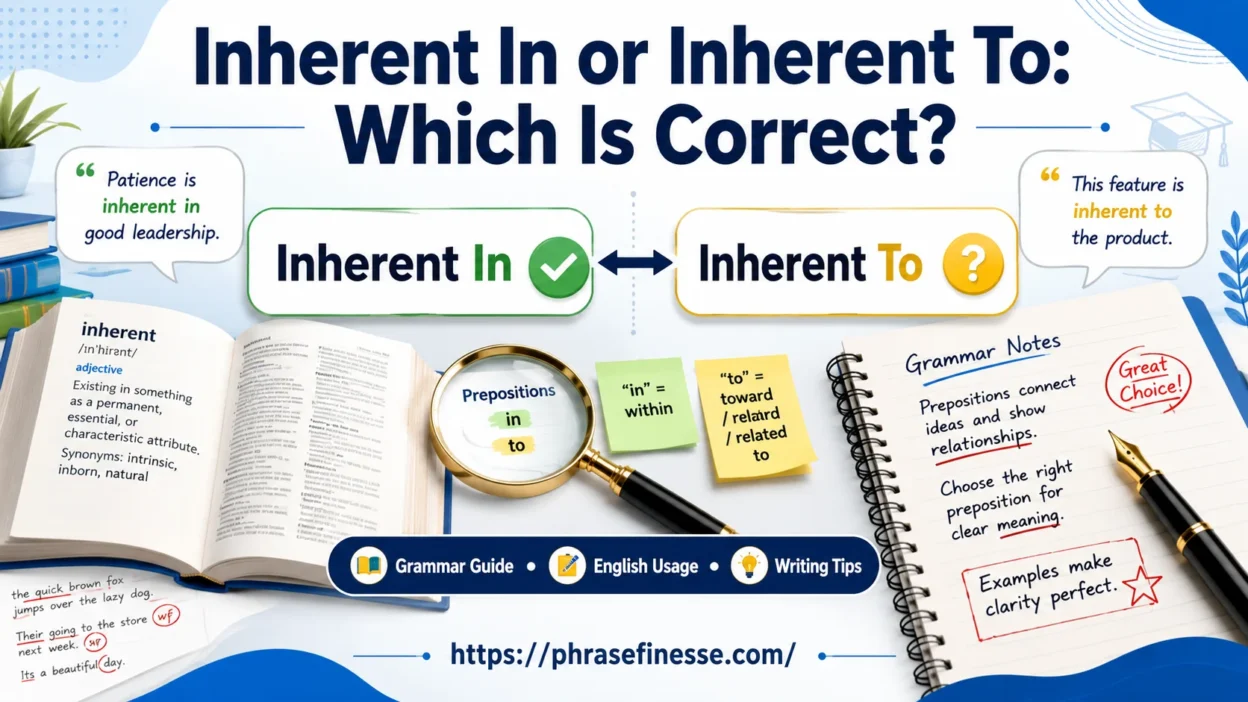
Have you ever wondered whether you should say something is “inherent in” or “inherent to” a person, system, or situation? Choosing the right phrase can make a significant difference in English usage, especially in formal writing, academic content, and professional business communication.
This guide, “Inherent In” Or “Inherent To”: Which Is Correct?, explores the subtle difference between these two expressions and explains how native speakers use them with clarity and consistency.
Understanding the correct use of inherent in and inherent to helps you create more precise sentences across different contexts, from everyday conversations to professional environments involving project management, meetings, scheduling, and time management.
While both phrases describe something that is naturally connected or essential, their usage often depends on whether you want to emphasize an internal quality, built-in characteristic, or fundamental relationship.
In this article, you’ll learn the meanings, grammar rules, and practical examples behind “inherent in” and “inherent to”. We’ll also examine how these phrases appear in formal communication, online booking systems, broadcasting, calendar management, and other real-world situations where accuracy and consistency matter.
By the end, you’ll know which expression fits your sentence naturally and how to use these terms confidently in your writing.
Quick Answer:
When choosing between the two expressions, use this rule:
| Phrase | Status | Recommended? |
| Inherent in | Standard English | Yes |
| Inherent to | Less traditional but increasingly common | Sometimes |
The Preferred Choice
Most dictionaries define inherent as something that exists naturally, permanently, or essentially within something else.
Because of that meaning, the preposition in fits naturally.
Examples:
- Risk is inherent in investing.
- Uncertainty is inherent in scientific research.
- Competition is inherent in free markets.
- Error is inherent in human decision-making.
These sentences sound natural because the quality exists as part of the thing being described.
Why People Use “Inherent To”
Many speakers now use inherent to because it resembles other common adjective-preposition combinations:
- Essential to
- Unique to
- Native to
- Fundamental to
- Important to
As a result, phrases like “Innovation is inherent to entrepreneurship” have become increasingly common in everyday English.
Still, if you’re writing for school, business, publishing, or professional communication, inherent in remains the safer choice.
What Does “Inherent” Actually Mean?
Before discussing prepositions, it’s important to understand the word itself.
Definition of Inherent
Inherent means:
Existing as a natural, essential, or permanent part of something.
An inherent quality cannot easily be separated from the thing that possesses it.
For example:
- Risk is an inherent part of investing.
- Change is inherent in growth.
- Limitations are inherent in every system.
In each case, the quality exists naturally within the subject.
Origin of the Word
The word comes from the Latin term inhaerere, meaning:
To stick in, cling to, or be attached to.
This historical meaning helps explain why inherent in developed as the traditional grammatical construction.
The concept involves something being embedded within something else rather than merely connected to it.
Why the Preposition Matters
Prepositions create relationships between words.
Compare these examples:
- Talent is inherent in the child.
- Talent is inherent to the child.
Both may communicate a similar idea. However, the first version emphasizes that the talent exists within the child. The second emphasizes association.
That subtle distinction explains why many editors still prefer inherent in.
Related Topic:
Why “Inherent In” Is the Traditional and Preferred Form
Most grammar authorities support inherent in because it aligns directly with the word’s meaning.
The Logic Behind “In”
Think about the phrase visually.
When something is inherent, it exists inside the nature of something else.
For example:
- Sugar is inherent in certain fruits.
- Risk is inherent in investing.
- Uncertainty is inherent in forecasting.
The preposition in reinforces the idea of something existing internally.
Common Examples of “Inherent In”
Business Examples
Business environments contain unavoidable realities.
Examples:
- Risk is inherent in entrepreneurship.
- Competition is inherent in capitalism.
- Negotiation is inherent in business transactions.
Education Examples
Learning naturally involves challenges.
Examples:
- Mistakes are inherent in the learning process.
- Curiosity is inherent in effective education.
- Evaluation is inherent in academic systems.
Technology Examples
Technology brings benefits and limitations.
Examples:
- Bugs are inherent in software development.
- Complexity is inherent in large databases.
- Security concerns are inherent in networked systems.
Healthcare Examples
Medical professionals frequently use this structure.
Examples:
- Risk is inherent in surgery.
- Uncertainty is inherent in diagnosis.
- Variation is inherent in biological systems.
Understanding the Grammar Pattern
The most common structure looks like this:
Subject + Be + Inherent In + Noun
Examples:
- Change is inherent in life.
- Risk is inherent in investing.
- Competition is inherent in business.
- Error is inherent in human judgment.
This pattern appears throughout academic, professional, and published writing.
Why Editors Prefer It
Professional editors value consistency.
Because inherent in has centuries of established usage behind it, it tends to attract less criticism and fewer editorial corrections.
When precision matters, writers usually choose the traditional form.
Why Some People Use “Inherent To”
Despite the traditional preference, inherent to continues to appear in modern English.
Why?
Several factors contribute to its growth.
Influence of Similar Expressions
English speakers naturally recognize patterns.
Consider these common phrases:
| Expression | Common Usage |
| Essential to | Very common |
| Critical to | Very common |
| Fundamental to | Very common |
| Native to | Very common |
| Unique to | Very common |
Because these constructions are familiar, many writers unconsciously extend the same pattern to inherent.
Modern Language Trends
Language rarely stands still.
Words and phrases gradually shift through widespread usage.
Many expressions once considered incorrect eventually became accepted because enough people used them consistently.
Some linguists view inherent to as part of that natural evolution.
Is “Inherent To” Wrong?
Not necessarily.
Today, many dictionaries acknowledge that the phrase appears in real-world writing.
However, acceptance does not automatically make it the preferred choice.
Think of it this way:
| Context | Better Choice |
| Academic writing | Inherent in |
| Research papers | Inherent in |
| Legal documents | Inherent in |
| Professional reports | Inherent in |
| Casual conversation | Either |
| Informal blogging | Usually either |
Inherent In vs. Inherent To: Side-by-Side Comparison
The differences become easier to understand when viewed together.
| Feature | Inherent In | Inherent To |
| Traditional usage | Yes | Limited |
| Dictionary support | Strong | Moderate |
| Academic acceptance | High | Lower |
| Formal writing | Preferred | Less preferred |
| Everyday conversation | Common | Common |
| Editorial criticism risk | Low | Higher |
| Historical usage | Extensive | Newer |
Which Sounds More Natural?
Most native English speakers find both understandable.
However, readers often perceive inherent in as slightly more polished and professional.
That’s particularly true among editors, professors, and professional writers.
Real-World Examples of Correct Usage
Let’s examine practical examples.
Examples With “Inherent In”
- Risk is inherent in every investment strategy.
- Competition is inherent in free enterprise.
- Change is inherent in technological progress.
- Error is inherent in human judgment.
- Uncertainty is inherent in weather forecasting.
- Complexity is inherent in large organizations.
These examples align closely with traditional grammar guidance.
Examples Commonly Written With “Inherent To”
- Innovation is inherent to startup culture.
- Adaptability is inherent to survival.
- Flexibility is inherent to remote work.
- Creativity is inherent to artistic expression.
- Experimentation is inherent to scientific discovery.
Many readers won’t notice any issue with these sentences.
Nevertheless, editors often replace to with in during revisions.
Read More: Nicholas’ or Nicholas’s? Correct Possessive Form
Case Study: Academic Writing vs. Everyday Writing
Imagine two writers discussing the same topic.
Academic Research Paper
Sentence:
Risk is inherent in financial markets.
This version follows established academic conventions.
Professors, journals, and editors generally prefer it.
Informal Blog Article
Sentence:
Risk is inherent to financial markets.
Most readers understand the meaning immediately.
In a casual setting, the phrase may pass unnoticed.
Lesson From the Case Study
The difference often comes down to audience expectations.
Formal readers expect traditional grammar.
Informal readers usually focus on meaning.
What Dictionaries and Language Authorities Say
Most respected dictionaries define inherent using language that naturally supports inherent in.
Typical dictionary definitions include phrases such as:
Existing in something as a permanent, essential, or characteristic attribute.
Notice the repeated emphasis on existence within something.
That wording reinforces the relationship implied by in.
What Corpus Data Shows
Language corpora analyze millions of real-world documents.
Across books, journals, newspapers, and scholarly publications, inherent in appears significantly more often than inherent to.
While exact numbers vary by database and year, the pattern remains consistent:
| Source Type | Inherent In | Inherent To |
| Academic journals | Very high | Low |
| Published books | Very high | Low |
| Newspapers | High | Moderate |
| Business reports | High | Moderate |
| Blogs and websites | High | Growing |
The data suggests that inherent in remains dominant.
Common Mistakes Writers Make
Many grammar problems arise from misunderstanding the word’s function.
Treating Both Expressions as Fully Interchangeable
Although both forms exist, they do not carry equal acceptance.
Formal writing still favors inherent in.
Following Familiar Patterns Without Thinking
Writers often copy structures from other adjectives.
For example:
- Essential to
- Fundamental to
- Important to
That habit can lead to inherent to, even when inherent in would sound more natural.
Creating Wordy Sentences
Weak:
The possibility of unforeseen outcomes is something that is inherent in the process.
Stronger:
Unforeseen outcomes are inherent in the process.
The second version is shorter, clearer, and easier to read.
Using “Inherent” When Another Word Fits Better
Sometimes a synonym communicates the idea more precisely.
Better Alternatives to “Inherent”
Depending on context, another word may work better.
Intrinsic
Meaning:
Naturally belonging to something.
Example:
Trust is intrinsic to strong relationships.
Innate
Meaning:
Present from birth.
Example:
Curiosity is innate in children.
Fundamental
Meaning:
Serving as a foundation.
Example:
Communication is fundamental to leadership.
Integral
Meaning:
Necessary for completeness.
Example:
Planning is integral to project success.
Essential
Meaning:
Absolutely necessary.
Example:
Practice is essential for improvement.
Comparison Table
| Word | Meaning | Example |
| Inherent | Existing naturally within | Risk is inherent in investing. |
| Intrinsic | Belonging naturally | Trust is intrinsic to teamwork. |
| Innate | Present from birth | Curiosity is innate in children. |
| Integral | Necessary component | Planning is integral to success. |
| Fundamental | Foundational | Communication is fundamental to leadership. |
| Essential | Required | Practice is essential for mastery. |
Grammar Patterns Every Writer Should Know
Inherent In + Noun
Examples:
- Risk is inherent in investing.
- Change is inherent in growth.
- Competition is inherent in markets.
Inherent Characteristics
You can place inherent directly before a noun.
Examples:
- Inherent risk
- Inherent value
- Inherent limitations
- Inherent complexity
- Inherent uncertainty
Examples in sentences:
- Every investment carries inherent risk.
- Large systems have inherent complexity.
- Human judgment contains inherent limitations.
Inherent Nature
Another common construction:
Examples:
- The inherent nature of competition
- The inherent nature of creativity
- The inherent nature of scientific inquiry
This structure appears frequently in academic and professional writing.
FAQs
1. What is the difference between “inherent in” and “inherent to”?
The difference between “inherent in” and “inherent to” depends on the relationship you want to describe. “Inherent in” usually means that a quality exists within something as a natural part of it. For example, “Creativity is inherent in great design.” On the other hand, “inherent to” emphasizes that something is an essential or inseparable characteristic of a person, system, or concept. For example, “Risk is inherent to investment decisions.”
2. Is “inherent in” more common than “inherent to”?
Yes, “inherent in” is generally more common in everyday and professional writing because it highlights a quality that exists inside something. However, “inherent to” is also correct and frequently appears in academic, technical, and formal contexts where writers want to emphasize a fundamental connection between two things.
3. Can “inherent in” and “inherent to” be used interchangeably?
Not always. Although both phrases express the idea of something being natural or essential, they are not completely interchangeable. “Inherent in” focuses more on an internal quality or feature, while “inherent to” focuses on an essential relationship or characteristic connected to something. Choosing the correct phrase improves clarity and accuracy in formal writing.
4. Which preposition should I use after “inherent”?
The most common prepositions used with inherent are “in” and “to.” Use “inherent in” when describing a quality contained within something. Use “inherent to” when describing a quality that naturally belongs to or is associated with something. Your choice should depend on the meaning and context of the sentence.
5. Are there examples of “inherent in” and “inherent to” in professional communication?
Yes. In business communication, you might write, “Flexibility is inherent in effective project management strategies.” Another example is, “Challenges are inherent to time management when handling multiple deadlines.” These phrases help professionals communicate ideas clearly in reports, presentations, meetings, and other formal settings.
6. How can I remember the difference between “inherent in” and “inherent to”?
A simple way to remember the difference is to think about location and connection. If the quality exists inside something, use “inherent in.” If the quality is naturally connected or attached to something, use “inherent to.” This approach helps you maintain grammatical consistency in your writing.
Conclusion
Understanding the difference between “inherent in” and “inherent to” allows you to write with greater precision and confidence. While both expressions describe qualities that are natural, essential, or unavoidable, their meanings slightly change depending on whether you are highlighting an internal feature or a fundamental connection.
In most situations, “inherent in” works best when describing a quality that exists within something, while “inherent to” is useful when emphasizing a characteristic that belongs naturally to a person, system, or concept. Paying attention to this small grammar distinction can improve your English usage, strengthen your formal writing, and make your communication more effective.
Whether you are writing an academic article, preparing professional documents, managing business communication, or creating content about scheduling, online booking, broadcasting, or calendar systems, using the right phrase builds trust and clarity. Mastering these subtle grammar choices helps you create polished writing that feels natural, accurate, and professional.

Alyan Ashraf is an English language writer and editor at Phrase Finesse, where he specializes in grammar, vocabulary, spelling, word usage, and clear communication. Passionate about the English language, he creates practical, research-backed content that helps readers avoid common mistakes and write with greater accuracy and confidence.
Known for his clear writing style and attention to detail, Alyan simplifies complex language topics into easy-to-understand guides filled with real-world examples and actionable insights. His work covers confusing word pairs, grammar rules, idioms, punctuation, and everyday English usage, making learning both accessible and engaging for students, professionals, writers, and non-native English speakers.
Every article Alyan writes is carefully researched, fact-checked, and designed to meet high editorial standards. His goal is to help readers strengthen their English skills, expand their vocabulary, and communicate more effectively in academic, professional, and everyday settings.
Through Phrase Finesse, Alyan is committed to publishing trusted language resources that make mastering English simpler, clearer, and more enjoyable for learners around the world