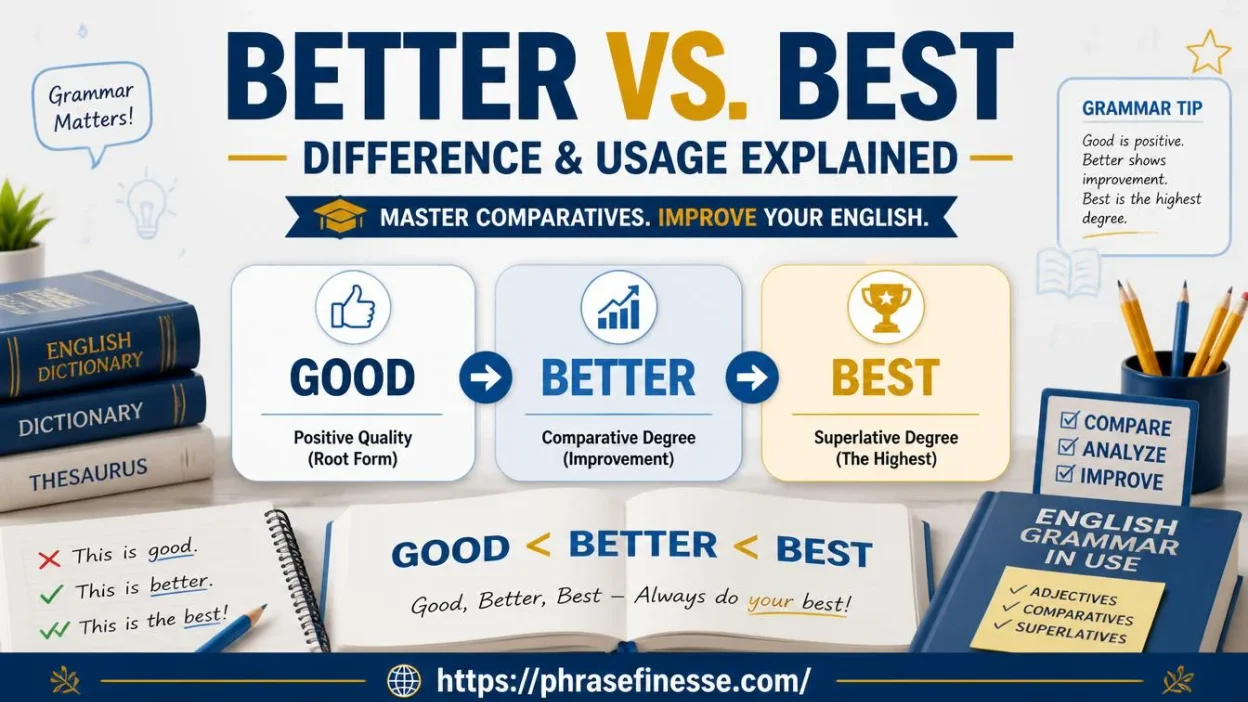
Have you ever paused before writing better or best, wondering which one is actually correct? Better vs. Best, Difference and Usage Explained is a common grammar question because both words compare quality but serve different purposes.
Understanding this distinction improves English usage, strengthens grammar, and helps you communicate with greater consistency in everyday conversations, academic writing, and professional documents.
In this guide, you’ll learn the exact difference between better and best, when each word should be used, and the grammar rules that native speakers naturally follow. Whether you’re writing emails, preparing reports, improving formal writing, or communicating in business communication, choosing the correct comparative or superlative form makes your message clearer and more professional.
You’ll also find practical examples, common mistakes, and easy-to-remember tips that make these rules simple to apply.
You’ll discover how these words appear in real-world situations, including meetings, project management, time management, scheduling, calendar planning, online booking platforms, and broadcasting content.
By the end of this article, you’ll confidently know when to use better instead of best, avoid common grammatical errors, and write with greater precision, clarity, and confidence in every context.
Better vs. Best – The Main Difference
The simplest way to understand the difference is this:
- Better compares two people, things, or situations.
- Best identifies the top option among three or more people, things, or situations.
Quick Example
- This pizza is better than the one we ordered yesterday.
- This is the best pizza in town.
In the first sentence, two pizzas are being compared.
In the second sentence, one pizza stands above all others.
What Does Better Mean?
Better is the comparative form of the adjective good.
You use it when comparing one thing with another.
Examples
- Sarah’s presentation was better than John’s.
- This laptop is better than my old one.
- The weather today is better than yesterday.
- Your second draft looks better than the first.
Think of better as a word that answers the question:
Which of these two is superior?
Whenever only two items are involved, better is usually the correct choice.
What Does Best Mean?
Best is the superlative form of good.
You use it when one person or thing ranks highest in a group.
Examples
- Emma gave the best presentation in the class.
- This is the best restaurant in the city.
- He delivered the best performance of the season.
- That was the best movie I’ve seen this year.
Think of best as answering:
Which one is number one?
When comparing three or more options, best is generally the correct word.
Better vs. Best Comparison Table
| Form | Word | Purpose | Example |
| Positive | Good | No comparison | This is a good book. |
| Comparative | Better | Compare two things | This book is better than that one. |
| Superlative | Best | Compare three or more things | This is the best book here. |
Understanding Comparative and Superlative Adjectives
Before mastering better vs. best, it’s helpful to understand how English comparisons work.
English adjectives generally have three forms:
| Type | Example |
| Positive | Tall |
| Comparative | Taller |
| Superlative | Tallest |
For example:
- Jake is tall.
- Jake is taller than Mike.
- Jake is the tallest player on the team.
The same pattern applies to many adjectives.
However, good is different.
Why Good Becomes Better and Best
Most adjectives add -er and -est.
Examples:
| Positive | Comparative | Superlative |
| Fast | Faster | Fastest |
| Small | Smaller | Smallest |
| Easy | Easier | Easiest |
But good is an irregular adjective.
Its forms are:
| Positive | Comparative | Superlative |
| Good | Better | Best |
English contains several irregular adjectives.
Other Examples
| Positive | Comparative | Superlative |
| Bad | Worse | Worst |
| Little | Less | Least |
| Far | Farther/Further | Farthest/Furthest |
These words don’t follow standard patterns, so they must be memorized.
When to Use Better
Many grammar mistakes happen because people use best when they should use better.
Here’s how to recognize the correct situations.
Comparing Two People
When only two individuals are compared, use better.
Examples
- Mia is better at chess than Alex.
- David is a better writer than Mark.
- Lisa sings better than her sister.
Notice that each sentence compares exactly two people.
Comparing Two Objects
Use better when discussing two things.
Examples
- This phone is better than my previous phone.
- The blue chair is better than the red one.
- Today’s technology is better than what existed twenty years ago.
Comparing Two Choices
People often compare alternatives before making decisions.
Examples
- Option A is better than Option B.
- Taking the train is better than driving during rush hour.
- Investing early is better than waiting.
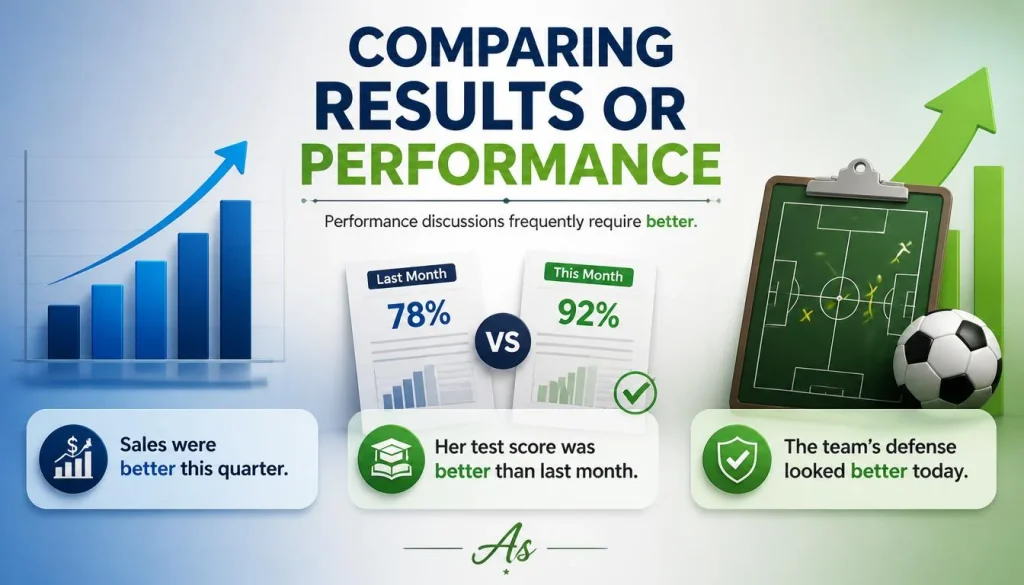
Comparing Results or Performance
Performance discussions frequently require better.
Examples
- Sales were better this quarter.
- Her test score was better than last month.
- The team’s defense looked better today.
Better Usually Works with “Than”
In most cases, better appears alongside than.
Formula
Better + than
Examples
- This solution is better than the previous one.
- Running is better than sitting all day.
- Their proposal is better than ours.
The word than clearly signals a comparison between two things.
When to Use Best
Use best when identifying the highest-ranked person or thing within a group.
Choosing the Top Option
Imagine you’re reviewing several alternatives.
Examples
- This is the best solution available.
- She made the best decision.
- That was the best answer among all submissions.
Here, one option rises above many others.
Ranking People
Examples
- Michael is the best player on the team.
- Sophia is the best student in the class.
- He became the best salesperson in the company.
Each example involves multiple competitors.
Ranking Places
Examples
- Paris is one of the best cities for art lovers.
- This is the best beach in the region.
- That café serves the best coffee in town.
Why We Often Say “The Best”
You’ll notice that best is usually preceded by the.
Examples
- She is the best candidate.
- This is the best route.
- That was the best meal.
The article the helps identify a unique winner.
See More : My Bad Learn If It Is Proper English
Better vs. Best in Sentences
Seeing both words side by side makes the difference obvious.
| Better | Best |
| This camera is better than mine. | This is the best camera in the store. |
| Today feels better than yesterday. | Today has been the best day this month. |
| Her second essay was better. | Her final essay was the best. |
| This route is better than the old route. | This is the best route available. |
How Meaning Changes
Consider these sentences:
Example 1
- Jack is better than Tom.
- Jack is the best player on the team.
The first compares two people.
The second compares Jack with the entire team.
Example 2
- This hotel is better than the one nearby.
- This hotel is the best in the city.
Again, the scope of comparison changes.
Common Mistakes with Better and Best
Even advanced English speakers occasionally make mistakes.
Using Best for Two Things
Incorrect
- Of the two candidates, Sarah is the best.
Correct
- Of the two candidates, Sarah is better.
Only two people are being compared.
Using Better for an Entire Group
Incorrect
- She is the better student in the class.
Correct
- She is the best student in the class.
The comparison involves the whole class.
Forgetting Than
Incorrect
- This option is better the first one.
Correct
- This option is better than the first one.
The word than is required.
Double Comparatives
Incorrect
- This solution is more better.
Correct
- This solution is better.
Because better already expresses comparison.
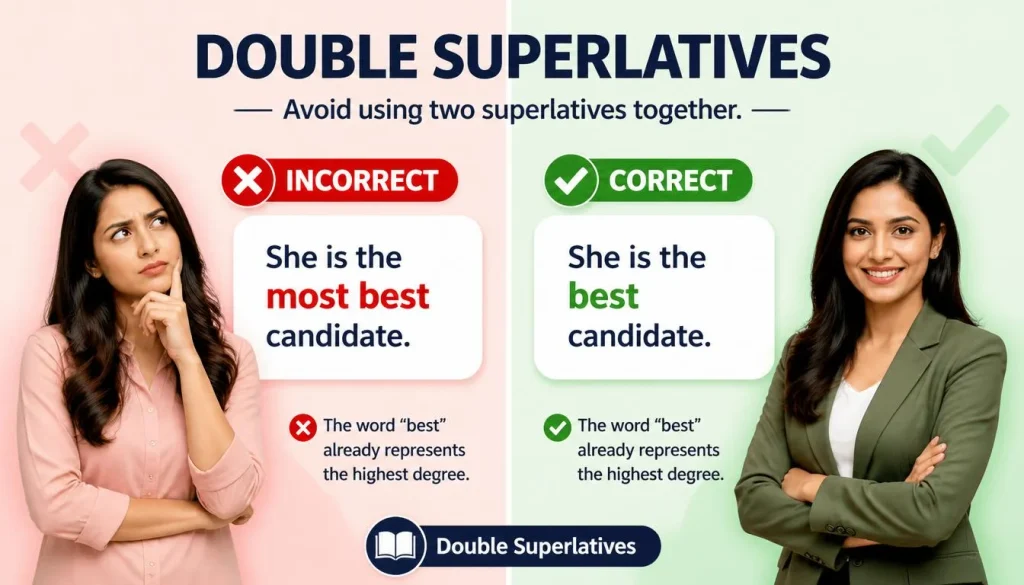
Double Superlatives
Incorrect
- She is the most best candidate.
Correct
- She is the best candidate.
The word best already represents the highest degree.
Better vs. Best in Everyday English
These words appear everywhere.
Understanding their real-world use helps you sound more natural.
Workplace Examples
Performance Reviews
- Your communication skills are better this year.
- She delivered the best results in the department.
Meetings
- This strategy looks better than our previous plan.
- That proposal seems the best option.
Business Emails
- Please choose the best available date.
- Version B appears better than Version A.
Academic Examples
Students frequently encounter comparative and superlative forms.
Examples
- My second essay was better than my first.
- She earned the best grade in the class.
- This explanation is better than the textbook example.
Casual Conversations
Native speakers use these words constantly.
Examples
- Which movie is better?
- What’s the best restaurant nearby?
- I feel better today.
- That was the best vacation ever.
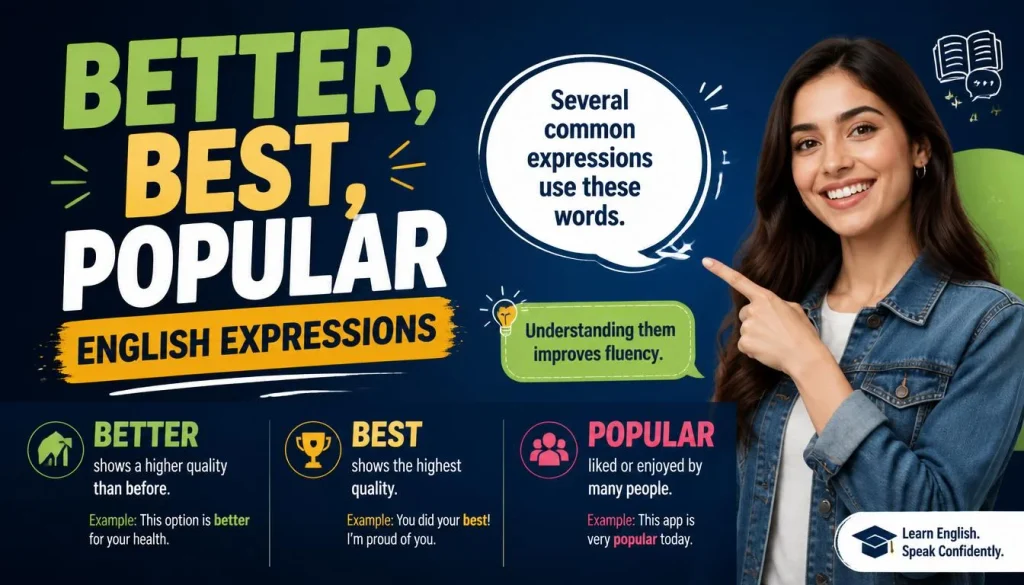
Better, Best, and Popular English Expressions
Several common expressions use these words.
Understanding them improves fluency.
Had Better
Had better expresses strong advice.
Examples
- You had better leave now.
- We had better prepare early.
- She had better call first.
Meaning:
It would be wise to do something.
For the Best
Examples
- Everything worked out for the best.
- The change was ultimately for the best.
Meaning:
The outcome was beneficial.
Best of All
Examples
- The hotel was affordable.
- Best of all, breakfast was free.
Meaning:
The most attractive feature.
Better Off
Examples
- You’re better off saving your money.
- She’s better off working remotely.
Meaning:
In a more favorable situation.
Better Late Than Never
One of the most common English idioms.
Meaning
Doing something late is preferable to never doing it.
Example
- He submitted the report a day late, but better late than never.
Real-World Case Study: Better vs. Best in Marketing
Imagine a company testing three advertisements.
Results
| Ad Version | Conversion Rate |
| Ad A | 4% |
| Ad B | 6% |
| Ad C | 9% |
Correct usage:
- Ad B performed better than Ad A.
- Ad C performed better than Ad B.
- Ad C was the best performing advertisement.
This simple example demonstrates the exact difference between comparative and superlative forms.
Memory Trick for Better vs. Best
A simple rule can prevent most mistakes.
Think of Numbers
Two items?
➡ Use better
Three or more items?
➡ Use best
Visual Diagram
GOOD
│
├── BETTER → Compare 2
│
└── BEST → Compare 3 or More
This shortcut works in nearly every situation.
Better vs. Best Practice Quiz
Choose the correct word.
Questions
- This cake is ______ than the other one.
- She is the ______ singer in the competition.
- My health feels ______ today.
- That was the ______ vacation of my life.
- This route is ______ than the old route.
- Which candidate is the ______ choice?
- His second attempt was ______.
- Emma received the ______ score in class.
- This laptop is ______ than mine.
- That was the ______ performance tonight.
Answers
- Better
- Best
- Better
- Best
- Better
- Best
- Better
- Best
- Better
- Best
FAQs
1. What is the main difference between better and best?
Better is the comparative form of good and compares two people or things. Best is the superlative form and refers to the highest quality among three or more people or things.
2. Can I use best when comparing only two things?
No. When comparing only two options, better is the correct choice. Best should generally be used when there are three or more options or when referring to the highest standard overall.
3. Is it grammatically correct to say “the better option”?
Yes. The better option is perfectly correct when comparing two alternatives. For example, “This laptop is the better option for students.”
4. How can I remember when to use better and best?
A simple rule is:
- Use better for two comparisons.
- Use best for three or more comparisons or to describe the highest-ranked option.
5. Are better and best used in professional writing?
Absolutely. Both words are common in formal writing, business communication, project evaluations, performance reviews, product comparisons, and academic writing. Using them correctly improves clarity and professionalism.
6. What are the most common mistakes with better and best?
The most common errors include using best to compare only two items, confusing comparative and superlative forms, and forgetting the context of the comparison. Checking how many items you’re comparing usually helps you choose the correct word.
Conclusion
Understanding the difference between better and best is an essential part of mastering English grammar. While better compares two people, things, or ideas, best identifies the highest quality or top choice within a group of three or more. Using the correct form makes your writing more accurate, natural, and professional.
Whether you’re drafting emails, preparing reports, participating in business communication, or writing academic content, choosing the right comparative or superlative adjective improves clarity and consistency. With the grammar rules, examples, and common mistakes covered in this guide, you can confidently decide when better or best is the correct choice in any situation.

Emma Brooke is an English language specialist, editor, and content writer at Phrase Finesse, where she helps readers develop stronger writing and communication skills through clear, practical, and engaging content. With a passion for the English language, she specializes in simplifying grammar rules, vocabulary, spelling, punctuation, and word usage for learners at every level.
Emma has extensive experience creating educational content that is accurate, well-researched, and easy to understand. She is particularly skilled at explaining confusing word pairs, grammar concepts, idioms, sentence structure, and effective writing techniques, making complex topics approachable for students, professionals, educators, and English learners worldwide.