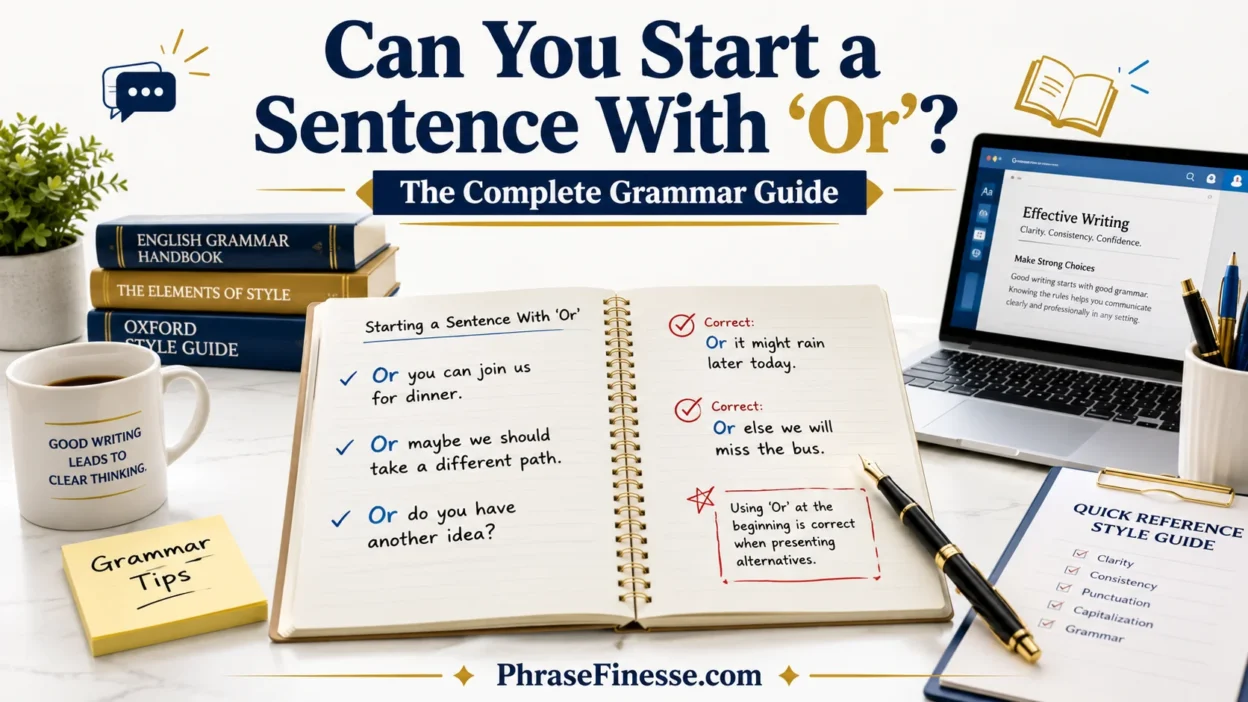
Have you ever wondered whether starting a sentence with “Or” is grammatically correct or just a common writing mistake? The question “Can You Start A Sentence With “Or”? Learn It Here! appears often among students, writers, and professionals who want to improve their English usage. This guide explains when beginning a sentence with “Or” works, when it sounds unclear, and how to use this conjunction effectively in everyday and formal writing.
Understanding the role of “Or” can help you create smoother sentences and maintain consistency in your writing style. Whether you are preparing emails, improving business communication, writing reports, managing project management documents, or creating content for online booking, scheduling, and calendar systems, correct grammar choices make your message clearer. This article explores practical examples, common mistakes, and expert tips to strengthen your grammar skills.
From casual conversations to professional settings like meetings, broadcasting, and workplace communication, knowing how to use sentence starters correctly improves readability and confidence. You’ll discover how sentence structure, punctuation, and grammar rules influence effective writing. By the end, you’ll understand the proper use of “Or” at the beginning of a sentence and apply this knowledge naturally in your daily and professional writing.
Can You Start a Sentence With “Or”?
The Short Answer
Yes.
You can absolutely start a sentence with “or”.
The idea that conjunctions should never begin sentences is one of the most persistent grammar myths in English. In reality, conjunctions such as and, but, or, and yet have started sentences for centuries.
Consider these examples:
- You can submit the report today. Or you can wait until tomorrow.
- We could drive across the state. Or we could fly and save time.
- Finish the project now. Or risk missing the deadline.
Each example is grammatically correct.
The second sentence introduces an alternative that relates directly to the first sentence.
What Grammar Authorities Say
Modern grammar experts generally agree that sentence-initial conjunctions are acceptable.
Several respected writing authorities acknowledge that beginning sentences with conjunctions is standard English usage when done effectively.
Historically, many classroom rules were designed to help beginner writers avoid sentence fragments and run-on sentences. Over time, those teaching shortcuts became mistaken for absolute grammar laws.
The result?
Millions of people still believe starting a sentence with “or” is wrong even though professional publications use it every day.
What Does “Or” Mean at the Beginning of a Sentence?
To use sentence-initial “or” correctly, you must understand its purpose.
At its core, “or” introduces an alternative, possibility, choice, consequence, or contrasting option.
Introducing an Alternative
This is the most common use.
Example:
You can save the file locally. Or you can store it in the cloud.
The second sentence presents another option.
Without “or,” readers may not immediately recognize the relationship between the two ideas.
Creating Emphasis
Starting a sentence with “or” often adds emphasis.
Consider these examples:
- Act now. Or lose the opportunity forever.
- Wear protective equipment. Or face serious injury.
- Back up your data. Or prepare for potential loss.
The period creates a pause.
Then the word “or” delivers impact.
Writers frequently use this technique in marketing, persuasive writing, speeches, and journalism because it draws attention to the alternative outcome.
Continuing a Thought Across Sentences
Sometimes a writer wants to avoid a long sentence.
Instead of writing:
We could launch the campaign next month, or we could delay the release until market conditions improve.
They may write:
We could launch the campaign next month. Or we could delay the release until market conditions improve.
Both versions are correct.
The second version often feels more conversational and easier to read.
Why Some People Think Starting a Sentence With “Or” Is Wrong
The Origins of the Rule
Many grammar myths began in classrooms.
Teachers often simplify rules because beginners need clear guidance.
A student who struggles with punctuation may benefit from avoiding sentence-initial conjunctions temporarily.
The problem arises when temporary learning rules become permanent beliefs.
Over generations, many people started treating writing advice as grammar law.
The Difference Between Teaching Rules and Actual Usage
There is a major difference between:
- Teaching beginners
- Describing how English actually works
Real-world English is flexible.
Professional writers routinely break simplified classroom rules because they understand how language functions.
For example, many teachers once discouraged:
- Starting sentences with “and”
- Starting sentences with “but”
- Ending sentences with prepositions
- Using contractions
Modern writing accepts all of these practices when they improve clarity.
Starting a sentence with “or” belongs in the same category.
Common Confusion With Conjunctions
People often assume conjunctions must stay inside a sentence.
That assumption overlooks an important fact.
A conjunction’s purpose is to connect ideas, not necessarily clauses within a single sentence.
The connection can occur across sentence boundaries.
For example:
We could postpone the event. Or we could move it online.
The relationship remains perfectly clear.
Please Visit For More: Seen or Saw: A Complete Grammar Guide With Examples
Examples of Sentences That Start With “Or”
Let’s look at practical examples.
Everyday Conversation Examples
People naturally use sentence-initial “or” when speaking.
Examples:
- Or maybe I’m wrong.
- Or perhaps we should try another approach.
- Or we could order takeout instead.
- Or maybe the weather will improve tomorrow.
- Or perhaps there’s another explanation.
Notice how natural these examples sound.
Most speakers use them without thinking.
Professional Writing Examples
Business communication often uses sentence-initial “or.”
Examples:
- Contact customer support for assistance. Or visit our help center for self-service solutions.
- Upgrade your plan today. Or continue with the free version.
- Schedule a consultation. Or request a detailed proposal online.
These examples improve readability by breaking long sentences into manageable pieces.
Marketing Examples
Marketing copy frequently uses sentence-initial “or” because it creates rhythm and emphasis.
Examples:
- Join today. Or miss out on exclusive member benefits.
- Start investing now. Or let inflation erode your purchasing power.
- Improve your skills. Or get left behind in a competitive market.
The contrast becomes more dramatic.
Question-Based Examples
Questions can also begin with “or.”
Examples:
- Or should we consider another option?
- Or is there a better solution available?
- Or would a different strategy work better?
- Or are we overlooking an important detail?
This structure commonly appears in interviews, discussions, and conversations.
When You Should Start a Sentence With “Or”
Not every sentence needs “or.”
However, certain situations benefit greatly from it.
To Present Another Choice
When readers must evaluate alternatives, sentence-initial “or” works extremely well.
Example:
You can purchase the annual subscription. Or you can pay month-to-month.
The options become easy to compare.
To Improve Readability
Long sentences create fatigue.
Breaking them apart can improve comprehension.
Instead of:
You can complete the certification course this year or postpone enrollment until next year if your schedule is too busy.
Write:
You can complete the certification course this year. Or postpone enrollment until next year if your schedule is too busy.
The meaning remains clear.
The reading experience improves.
To Create a Conversational Tone
Modern web writing often favors a natural voice.
Sentence-initial “or” helps achieve that goal.
Example:
Maybe the first strategy isn’t working. Or maybe it simply needs more time.
This sounds like a real person speaking.
To Strengthen Persuasive Writing
Persuasive content frequently relies on alternatives.
Example:
Improve your cybersecurity practices today. Or risk becoming the next victim of a data breach.
The consequence becomes more memorable.
When You Should Avoid Starting a Sentence With “Or”
Although it is correct, sentence-initial “or” is not always the best choice.
When No Alternative Exists
“Or” requires an alternative idea.
Incorrect example:
Or the company announced a new product.
Readers immediately wonder:
Alternative to what?
Without context, the sentence feels incomplete.
When It Creates Confusion
Readers should instantly understand the connection.
Poor example:
The meeting lasted two hours. Or the office building was renovated.
These ideas don’t logically relate.
The transition feels random.
In Extremely Formal Documents
Certain legal and technical documents favor traditional structures.
Examples include:
- Contracts
- Regulatory filings
- Patent documents
- Technical specifications
In these contexts, writers often prefer more explicit transitions.
When Overused
A useful technique can become distracting if repeated.
Bad example:
- Or we could try another method.
2. Or we could hire consultants.
3. Or we could postpone the project.
4. Or we could increase spending.
The pattern becomes monotonous.
Variety matters.
Common Mistakes When Using “Or” at the Beginning of a Sentence
Using “Or” Without a Previous Idea
Incorrect:
Or maybe the answer is different.
Correct:
We may need to reconsider our assumptions. Or maybe the answer is different.
The alternative now has context.
Creating False Alternatives
Poor example:
The software launched yesterday. Or the company hired new employees.
These statements are unrelated.
Good alternatives must share a logical connection.
Overusing the Technique
Strong writing relies on variation.
Instead of repeatedly starting sentences with “or,” mix in:
- However
- Instead
- Alternatively
- Perhaps
- Yet
- On the other hand
This creates a more engaging rhythm.
“Or” vs. Other Sentence Starters
Understanding similar conjunctions helps writers choose the right word.
Starting a Sentence With “Or” vs. “And”
| Word | Primary Function |
| Or | Presents alternatives |
| And | Adds information |
Example:
- We can leave today. Or we can leave tomorrow.
- We finished the project. And we submitted it early.
The relationship differs.
Starting a Sentence With “Or” vs. “But”
| Word | Function |
| Or | Alternative |
| But | Contrast |
Example:
- We could increase prices. Or we could reduce costs.
- We wanted to increase prices. But customers resisted.
One offers options.
The other introduces opposition.
Starting a Sentence With “Or” vs. “Because”
“Because” introduces a reason.
Example:
Because demand increased, production expanded.
“Or” introduces a choice.
Example:
Increase production. Or risk running out of inventory.
Different jobs. Different outcomes.
Real Examples From Published Writing
Professional writers frequently begin sentences with conjunctions.
Examples From Books
Novelists use sentence-initial “or” to create dramatic effect, mimic natural speech, and improve pacing.
Example style:
Perhaps she knew the answer. Or perhaps she simply guessed.
The structure creates suspense.
Examples From Journalism
Journalists often break complex thoughts into shorter sentences.
Example style:
Officials could approve the proposal this week. Or they could delay the vote until additional information becomes available.
The format improves readability.
Examples From Digital Content
Online readers scan content quickly.
Because of that, many blogs use shorter sentences and stronger transitions.
Sentence-initial “or” fits naturally within this style.
Quick Rules for Starting a Sentence With “Or”
| Rule | Recommendation |
| Can “or” start a sentence? | Yes |
| Is it grammatically correct? | Yes |
| Must it connect to a previous idea? | Always |
| Does it present an alternative? | Usually |
| Can it improve readability? | Frequently |
| Is it acceptable in professional writing? | Yes |
| Can it appear in formal writing? | Sometimes |
| Can it be overused? | Absolutely |
Practical Examples: Correct vs. Incorrect Usage
| Incorrect Usage | Correct Usage |
| Or maybe the market will change. | The forecast may prove inaccurate. Or maybe the market will change. |
| Or the company expanded internationally. | The company could focus domestically. Or the company could expand internationally. |
| Or the meeting lasted three hours. | We could shorten future meetings. Or we could continue the current format. |
| Or she submitted the application. | She could wait another week. Or she could submit the application immediately. |
Case Study: Why Sentence-Initial “Or” Improves Readability
Consider this sentence:
Customers can renew their membership before expiration or they can wait until renewal notices arrive or they can contact support for manual assistance.
While correct, it feels crowded.
Now look at the revised version:
Customers can renew their membership before expiration. Or they can wait until renewal notices arrive. Or they can contact support for manual assistance.
The options stand out immediately.
Readers process information faster.
This is one reason modern web writing often embraces sentence-initial conjunctions.
What Skilled Writers Know About Starting Sentences With “Or”
Experienced writers focus on communication rather than rigid rules.
They ask questions such as:
- Does this improve clarity?
- Does it sound natural?
- Does it guide the reader effectively?
- Does it create emphasis where needed?
- Does it improve rhythm?
If the answer is yes, sentence-initial “or” becomes a valuable tool.
As writing expert William Zinsser famously emphasized:
“Good writing is clear thinking made visible.”
Clarity always matters more than outdated grammar myths.
FAQs
1. Can you start a sentence with “Or”?
Yes, you can start a sentence with “Or” when it introduces an alternative idea, option, or possibility. Although some traditional grammar rules discouraged this usage, modern English usage accepts it when the sentence remains clear and connected to the previous thought.
Example:
You can submit the form online. Or you can visit the office directly.
2. Is starting a sentence with “Or” considered bad grammar?
No, starting a sentence with “Or” is not automatically incorrect. In modern writing, it is often used for emphasis, clarity, or a natural conversational flow. However, writers should avoid using it too frequently, especially in formal writing, where a more structured approach may be preferred.
3. When should you avoid starting a sentence with “Or”?
You should avoid beginning a sentence with “Or” when it creates confusion or makes the connection between ideas unclear. In professional documents, academic writing, or important business communication, ensure the transition feels natural and improves readability.
4. What is the difference between “Or” at the beginning of a sentence and in the middle?
When “Or” appears in the middle of a sentence, it usually connects two choices or alternatives directly.
Example:
You can schedule a meeting on Monday or Tuesday.
When “Or” starts a sentence, it highlights an alternative option from the previous sentence.
Example:
You can join the meeting online. Or you can attend in person.
5. Can you use “Or” at the beginning of a sentence in professional writing?
Yes, you can use “Or” in professional writing if it improves clarity and flow. Writers in fields like project management, scheduling, and workplace documentation often use sentence starters like “Or” to present options clearly. However, maintaining consistency and a professional tone remains important.
6. What are better alternatives to starting a sentence with “Or”?
Depending on the context, you can replace “Or” with phrases such as “Alternatively,” “Another option is,” “Otherwise,” or “In another case.” These alternatives may sound more formal and are useful for reports, presentations, and detailed explanations.
Conclusion
Starting a sentence with “Or” is completely acceptable when you use it correctly and maintain clear sentence structure. Modern grammar focuses more on readability, meaning, and effective communication rather than strict traditional rules. The key is understanding how “Or” connects ideas and using it with purpose.
Whether you are writing casual messages, professional emails, or detailed content, proper English usage helps your readers follow your ideas easily. In areas like formal writing, business communication, meetings, and project management, clarity and consistency matter more than avoiding a single word at the beginning of a sentence.
By learning when and why to start a sentence with “Or,” you can write with greater confidence and flexibility. Good writing is not about following outdated restrictions; it is about choosing words that create clear, natural, and effective communication.

Emma Brooke is an English language specialist, editor, and content writer at Phrase Finesse, where she helps readers develop stronger writing and communication skills through clear, practical, and engaging content. With a passion for the English language, she specializes in simplifying grammar rules, vocabulary, spelling, punctuation, and word usage for learners at every level.
Emma has extensive experience creating educational content that is accurate, well-researched, and easy to understand. She is particularly skilled at explaining confusing word pairs, grammar concepts, idioms, sentence structure, and effective writing techniques, making complex topics approachable for students, professionals, educators, and English learners worldwide.


