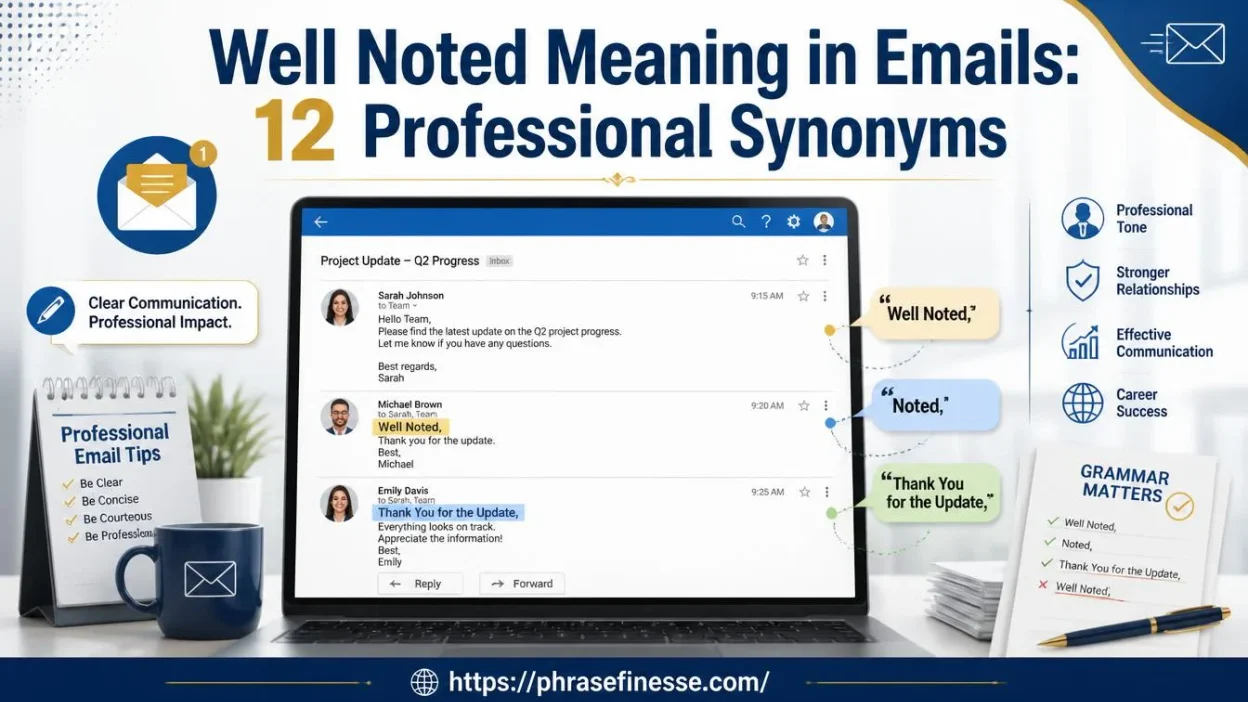
Have you ever received an email that simply says “Well Noted” and wondered what the sender actually means? Understanding the “Well Noted” Meaning In Emails is essential for business communication, formal writing, and professional English usage. While the phrase seems straightforward, its tone, intent, and level of politeness can vary depending on the context, making it important to use it correctly.
In modern workplaces, where meetings, project management, scheduling, calendar updates, and even online booking confirmations happen through email, short acknowledgments save time and keep conversations moving. You may also encounter the phrase in broadcasting updates, client correspondence, or internal team messages.
However, knowing when “well noted” sounds appropriate—and when a more natural alternative works better—helps maintain professionalism, consistency, and clear communication.
This guide explains the exact meaning of “well noted” in emails, how native English speakers interpret it, and whether it sounds polite, formal, or overly brief. You’ll also learn the best situations to use it, common mistakes to avoid, and better alternatives for different professional scenarios.
By the end, you’ll be able to choose the most effective response with confidence while improving your overall email etiquette, grammar, and workplace communication skills.
What Does “Well Noted” Mean in an Email?
The phrase “well noted” means “I have received your message and understood the information you shared.”
When someone writes “well noted” in an email, they usually communicate three things:
- They received the information.
- They understand what was communicated.
- They will remember or consider it moving forward.
For example:
Email:
“The client meeting has been moved from Tuesday to Thursday at 10 AM.”
Reply:
“Well noted. Thank you for the update.”
In this example, the person confirms awareness of the schedule change. They are not necessarily saying they agree with the change or that they have completed any action. They are simply acknowledging the information.
Think of “well noted” as placing a bookmark in your mind. You are saying, “I’ve seen this, I understand it, and I’ll keep it in consideration.”
Breaking Down the Meaning of “Well Noted”
To understand the phrase better, it helps to look at each word separately.
| Word | Meaning in the phrase |
| Well | Properly, clearly, or thoroughly |
| Noted | Recorded, remembered, or acknowledged |
Together, “well noted” suggests that something has been properly acknowledged.
However, modern English communication often favors simpler phrases. Native speakers usually choose expressions that directly explain the purpose of the reply.
For example:
Instead of:
“Well noted.”
Many professionals might write:
“Thanks for the update. I’ll keep this in mind.”
Both messages acknowledge information, but the second one feels warmer and more conversational.
Is “Well Noted” Correct English in Emails?
Yes, “well noted” is understandable and grammatically acceptable, but its naturalness depends on the context.
The phrase appears frequently in:
- International business emails
- Corporate communication
- Customer service messages
- Administrative correspondence
- Formal workplace conversations
However, many native English speakers do not use it often in everyday professional emails. They may consider it slightly formal or influenced by non-native English patterns.
For example:
Less natural:
“Well noted. We will proceed accordingly.”
More natural:
“Thank you for the information. We’ll proceed accordingly.”
The second version sounds more like everyday American business communication.
That does not mean “well noted” is wrong. It simply means that language choices depend on audience, culture, and purpose.
“Well Noted” vs. “Noted”: What Is the Difference?
Many people confuse “well noted” and “noted.” Although they share a similar meaning, their tone differs.
| Phrase | Meaning | Tone | Example |
| Well noted | Information has been understood and remembered | Formal | “Well noted. We’ll consider this during planning.” |
| Noted | Information has been received | Brief and direct | “Noted. I’ll update the file.” |
“Well noted”
This phrase sounds slightly more complete. It emphasizes that the information has been properly understood.
Example:
“The customer requested additional changes.”
“Well noted. We’ll include these revisions.”
“Noted”
This option is shorter and more common in fast workplace communication.
Example:
“Please send the report before 5 PM.”
“Noted. I’ll send it today.”
However, “noted” can sometimes sound cold when used alone. Adding a small phrase can make it friendlier.
Instead of:
“Noted.”
Try:
“Noted, thank you.”
or
“Noted. I appreciate the update.”
When Should You Use “Well Noted” in Emails?
The phrase works best when you need to acknowledge information without adding unnecessary details.

Acknowledging Instructions
One common use of “well noted” is responding to directions.
Example:
Manager:
“Please review the presentation before tomorrow’s meeting.”
Reply:
“Well noted. I’ll review the presentation this afternoon.”
The response shows that you received the instruction and understand the expectation.
Confirming Schedule Changes
Workplaces constantly deal with changing deadlines, meetings, and appointments.
Example:
“The project deadline has been moved to April 20.”
Response:
“Well noted. Thank you for informing me.”
This response works because the sender only needs confirmation that you are aware of the change.
Responding to Formal Business Communication
In formal industries, short acknowledgment phrases are common.
Examples include:
- Legal communication
- Finance updates
- Government correspondence
- Corporate announcements
A short reply can show professionalism without filling the inbox with unnecessary messages.
When Should You Avoid Using “Well Noted”?
Although “well noted” is acceptable, it does not fit every situation.
When You Need to Show Appreciation
The phrase acknowledges information but does not express gratitude.
Compare:
Basic acknowledgment:
“Well noted.”
More appreciative:
“Thank you for sharing this update. I appreciate the information.”
The second option builds stronger professional relationships because it recognizes the sender’s effort.
When You Need to Confirm Action
Sometimes the recipient needs more than acknowledgment.
Imagine your supervisor asks:
“Please update the sales report by Friday.”
A reply saying:
“Well noted.”
does not explain what you will do.
A stronger response would be:
“Understood. I’ll update the sales report and send the revised version by Friday.”
This removes uncertainty.
See More: Should I vs. Shall I: Difference and Usage Rules
In Casual Conversations
“Well noted” may sound too formal when talking with friends or close coworkers.
Instead of:
“Well noted. See you later.”
You would naturally say:
“Got it. See you later.”
or
“Sounds good.”
12 Better Synonyms for “Well Noted” in Professional Emails
The best alternative depends on what you want to communicate. Do you want to show understanding? Appreciation? Action? Confirmation?
Here are 12 stronger options.
Noted
“Noted” is the simplest replacement for “well noted.”
It works well when you only need to confirm receipt.
Example:
“Noted. I’ll update the document accordingly.”
Best for:
- Short workplace replies
- Internal communication
- Quick confirmations
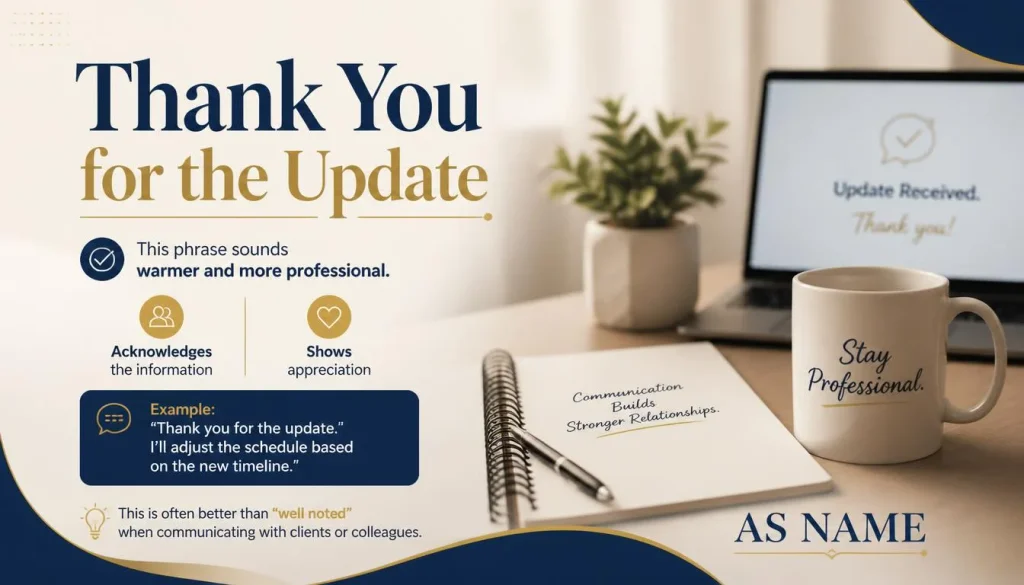
Thank You for the Update
This phrase sounds warmer and more professional.
It does two things:
- Acknowledges the information
- Shows appreciation
Example:
“Thank you for the update. I’ll adjust the schedule based on the new timeline.”
This is often better than “well noted” when communicating with clients or colleagues.
I Understand
Use this when you want to show that you understand instructions or expectations.
Example:
“I understand the new process and will follow the updated guidelines.”
This phrase works especially well when someone explains a procedure.
I Acknowledge Receipt
This is a formal business phrase.
It confirms that you received something, such as:
- Contracts
- Documents
- Reports
- Official notices
Example:
“I acknowledge receipt of the attached agreement.”
This phrase appears often in formal correspondence.
Received, Thank You
This option works well when someone sends files or information.
Example:
“Received, thank you. I’ll review the proposal and share my feedback.”
It sounds professional without feeling distant.
Thanks for Letting Me Know
This phrase creates a friendly professional tone.
Example:
“Thanks for letting me know. I’ll update the calendar.”
Use it for:
- Schedule changes
- Announcements
- General updates
I’ll Keep This in Mind
This phrase shows that you will consider the information in the future.
Example:
“I’ll keep this in mind when preparing the next report.”
It works well when someone provides advice or feedback.
Duly Noted
“Duly noted” is another formal alternative.
It means:
“The information has been properly recorded or acknowledged.”
Example:
“Duly noted. We’ll include your suggestions in the next revision.”
However, be careful. In some situations, “duly noted” can sound cold or even slightly sarcastic.
Understood
“Understood” clearly communicates comprehension.
Example:
“Understood. I’ll complete the task before the deadline.”
It works best when someone gives instructions.
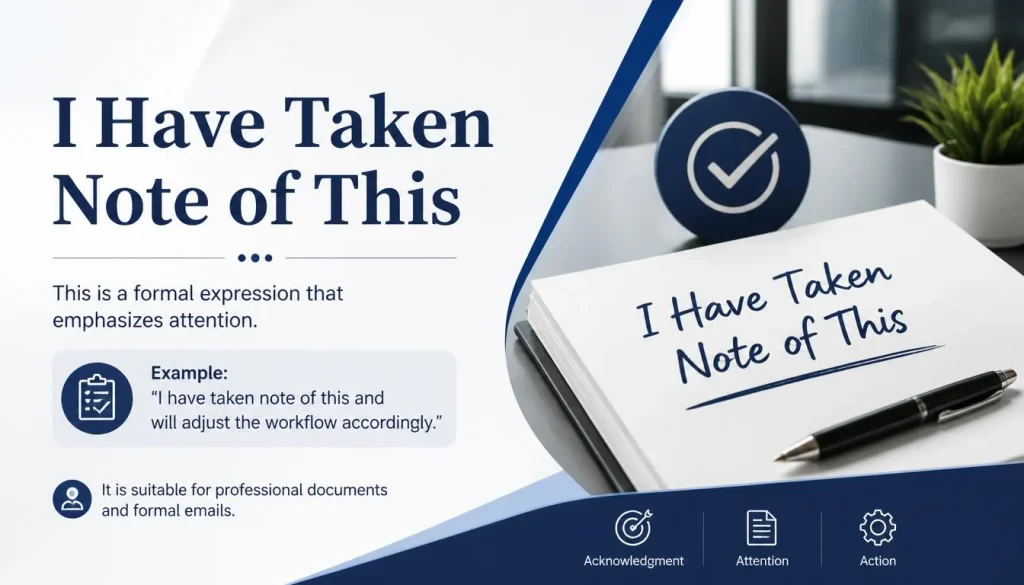
I Have Taken Note of This
This is a formal expression that emphasizes attention.
Example:
“I have taken note of this and will adjust the workflow accordingly.”
It is suitable for professional documents and formal emails.
I’ll Take Care of It
When action is required, this phrase is often better than “well noted.”
Example:
“I’ll take care of it and send you an update once it’s completed.”
It gives the sender confidence that someone is handling the matter.
Confirmed
Use “confirmed” when you verify something.
Example:
“Confirmed. The appointment is scheduled for Monday at 2 PM.”
Remember:
- “Noted” = I received the information.
- “Confirmed” = I verified the information.
Professional Email Examples Using “Well Noted” Alternatives
Example: Receiving Instructions
Original email:
“Please prepare the monthly report by Wednesday.”
Possible replies:
Option 1:
“Well noted. I’ll prepare the report by Wednesday.”
Option 2:
“Understood. I’ll complete the report and share it before the deadline.”
Option 3:
“I’ll take care of it and update you once it’s ready.”
Example: Receiving a Schedule Change
Original email:
“The meeting has been moved to Friday afternoon.”
Better responses:
“Thanks for the update. I’ve adjusted my schedule accordingly.”
or:
“Noted. I’ll attend at the revised time.”
Example: Receiving Documents
Original email:
“Attached is the final contract.”
Professional responses:
“Received, thank you. I’ll review the contract today.”
or:
“I acknowledge receipt of the contract and will provide feedback shortly.”
How to Choose the Right Email Acknowledgment Phrase
Choosing the right phrase depends on your goal.
| Purpose | Best Response |
| Quick acknowledgment | Noted |
| Friendly reply | Thanks for the update |
| Formal receipt | I acknowledge receipt |
| Confirm understanding | I understand |
| Promise action | I’ll take care of it |
| Verify details | Confirmed |
| Show future consideration | I’ll keep this in mind |
A good email response should answer one simple question:
“What does the sender need to know after reading my reply?”
If they only need confirmation, keep it short.
If they need confidence that action will happen, explain the next step.
Common Mistakes When Using “Well Noted”
A simple acknowledgment may leave the reader unsure.
Weak:
“Well noted.”
Better:
“Well noted. I’ll review the changes and respond tomorrow.”
Using It in Every Email
Repeating the same phrase can make your communication feel mechanical.
Professional writing benefits from variety.
Instead of always saying:
“Well noted.”
Rotate between:
- “Thank you for the update.”
- “Understood.”
- “Received, thank you.”
- “I’ll take care of it.”
Confusing Acknowledgment With Agreement
This is an important distinction.
When you write:
“Well noted.”
you are saying:
“I received and understood this information.”
You are not necessarily saying:
“I agree with this decision.”
Those meanings are different.
FAQs
1. Is “well noted” grammatically correct in emails?
Yes. “Well noted” is grammatically correct and commonly used in professional emails to acknowledge that information has been received and understood. However, some native English speakers prefer more natural alternatives such as “Noted, thank you” or “I understand.”
2. Is “well noted” polite or rude?
The phrase is generally considered polite, but it can sound somewhat formal or abrupt if used by itself. Adding a friendly expression like “Thank you” makes it sound more courteous and approachable.
3. Can I use “well noted” in formal business communication?
Yes. “Well noted” is appropriate for business communication, especially when confirming instructions, updates, or important information. Make sure the tone matches the formality of your workplace or client relationship.
4. What are the best alternatives to “well noted” in emails?
Some professional alternatives include:
- Noted, thank you.
- I’ve noted your message.
- Understood.
- Acknowledged.
- I’ve received your email.
- Thanks for letting me know.
These options often sound more natural while keeping your response professional.
5. Does “well noted” mean the same as “understood”?
They are similar but not identical. “Well noted” emphasizes that you’ve acknowledged or recorded the information, while “understood” focuses on your comprehension. In many email situations, either phrase works depending on the context.
6. When should I avoid using “well noted”?
Avoid using “well noted” in casual conversations, emotional discussions, or customer service situations where a warmer response is expected. In these cases, a more personal acknowledgment can help create
Conclusion
Understanding the “Well Noted” Meaning In Emails helps you communicate more clearly and professionally in today’s workplace. Although the phrase is widely used to acknowledge information, its tone can sometimes feel brief or impersonal, depending on the context and your relationship with the recipient. Choosing the right acknowledgment strengthens business communication and reduces the risk of misunderstandings.
Whether you’re responding to meetings, project management updates, calendar invitations, scheduling changes, or routine business emails, it’s important to match your language to the situation. In many cases, alternatives such as “Noted, thank you,” “I’ve received your message,” or “Understood” create a warmer and more natural impression while maintaining formal writing standards and consistency.
By understanding when and how to use “well noted,” you’ll improve your English usage, write more effective emails, and build stronger professional relationships. A thoughtful acknowledgment may seem small, but it contributes to clearer communication and a more polished, confident writing style.




[…] See More :Well Noted Meaning in Emails: 12 Professional Synonyms […]
[…] See More :Well Noted Meaning in Emails: 12 Professional Synonyms […]