Have you ever paused while writing and wondered whether “In The Beginning” Or “At The Beginning”? Difference Explained is the right choice for your sentence? These two phrases look similar, but they serve different purposes in English usage, grammar, and formal writing.
Understanding the distinction helps you communicate ideas with greater clarity, accuracy, and consistency in everyday conversations, articles, emails, and professional content.
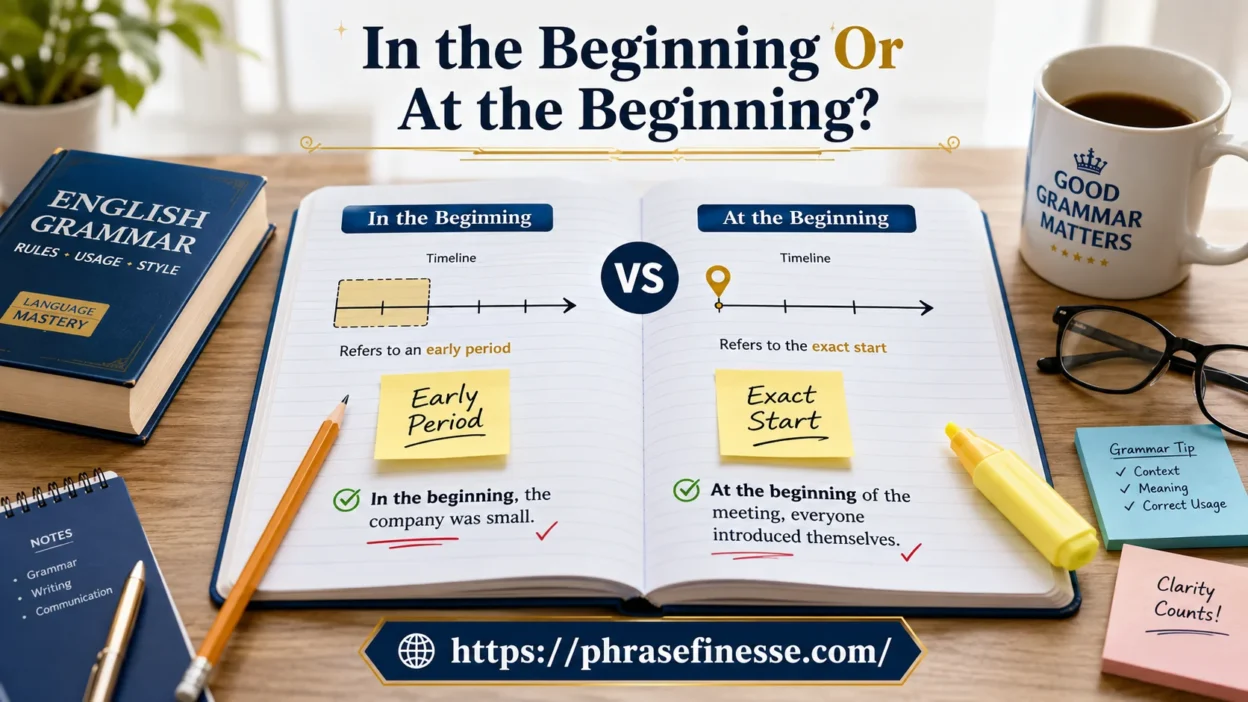
The phrase “in the beginning” usually refers to an earlier period, original stage, or starting point of a story, process, or situation. In contrast, “at the beginning” points to a specific moment or position where something starts.
Whether you are discussing scheduling, time management, business communication, meetings, or project management, choosing the correct phrase can make your message more precise and polished.
This guide will explain the key differences between “in the beginning” and “at the beginning” with clear examples and practical explanations. You’ll learn how these phrases work in different contexts, including calendar planning, online booking, broadcasting, and professional writing.
By the end, you’ll have a better understanding of their usage and feel more confident applying them with grammatical consistency.
Quick Answer:
Here’s the simplest explanation:
| Phrase | Meaning | Use |
| In the beginning | During the early stage of something | Refers to a period of time |
| At the beginning | At the exact starting point | Refers to a specific moment |
Quick Examples
In the beginning:
In the beginning, the company operated from a small garage.
This sentence refers to an early period in the company’s history.
At the beginning:
At the beginning of the meeting, everyone introduced themselves.
This sentence refers to one specific moment when the meeting started.
Easy Rule
If you’re talking about an early phase, use “in the beginning.”
If you’re talking about the exact starting point, use “at the beginning.”
That’s the core distinction.
What Does “In the Beginning” Mean?
The phrase in the beginning refers to the early stage or initial period of a situation, process, project, relationship, story, or event.
Instead of focusing on one precise moment, it focuses on a stretch of time near the start.
Think of it as describing what things were like when something first began.
Definition
In the beginning = during the early part of a period or situation.
Examples
- In the beginning, learning to drive felt overwhelming.
- In the beginning, few people trusted online shopping.
- In the beginning, the startup had only three employees.
- In the beginning, the team struggled to communicate effectively.
Notice something important.
None of these examples point to a single second or minute.
They describe an initial phase.
Why Native Speakers Use “In the Beginning”
Native speakers often choose this phrase when discussing:
- Personal growth
- Business development
- Relationships
- Historical events
- Stories and narratives
- Long-term projects
The expression helps show contrast between the past and the present.
For example:
In the beginning, social media platforms were relatively simple.
The sentence implies that things later changed significantly.
Let’s Explore More: Inherent In or Inherent To: Which Is Correct?
The Historical Importance of “In the Beginning”
One reason this phrase sounds familiar is its appearance in the opening line of the famous book, The Bible.
The phrase:
“In the beginning…”
has influenced English literature, storytelling, speeches, and writing for centuries.
Because of that influence, many people associate the expression with storytelling and historical narratives.
It often sounds slightly more literary and dramatic than “at the beginning.”
What Does “At the Beginning” Mean?
The phrase at the beginning refers to a specific starting point.
Instead of describing a period, it identifies a precise moment where something starts.
Definition
At the beginning = at the exact start of something.
Examples
- At the beginning of the movie, the main character appears.
- At the beginning of the race, all runners stood behind the starting line.
- At the beginning of the semester, students receive course outlines.
- At the beginning of the speech, the speaker thanked the audience.
Each sentence points to a particular moment.
The focus is not on a time period.
The focus is on the starting point itself.
Common Structures With “At the Beginning”
You’ll frequently see:
- At the beginning of the day
- At the beginning of the week
- At the beginning of the meeting
- At the beginning of the chapter
- At the beginning of the year
- At the beginning of the lesson
Notice the pattern:
At the beginning + of + noun
This structure is extremely common in modern English.
In the Beginning vs. At the Beginning: The Main Difference
Understanding the distinction becomes easier when you visualize a timeline.
START ———————————- END
At the beginning
↑
Specific starting point
In the beginning
↑↑↑↑↑
Early period
Comparison Table
| Feature | In the Beginning | At the Beginning |
| Refers to | Early stage | Exact start |
| Time Focus | Period | Point |
| Tone | Narrative, descriptive | Precise, practical |
| Common in Stories | Yes | Sometimes |
| Common in Instructions | Rarely | Very often |
| Usually Followed by “of” | No | Frequently |
Side-by-Side Examples
Example One
In the beginning
In the beginning, the business struggled financially.
Focus: the early phase.
At the beginning
At the beginning of the year, the business launched a new product.
Focus: one specific moment.
Example Two
In the beginning
In the beginning, she felt nervous about public speaking.
Focus: an extended early experience.
At the beginning
At the beginning of the presentation, she introduced herself.
Focus: the exact opening moment.
Example Three
In the beginning
In the beginning, smartphones had limited capabilities.
Focus: the initial era.
At the beginning
At the beginning of the product launch event, the CEO revealed the device.
Focus: one particular point.
Why “In the Beginning” Works Better in Stories
Storytelling often involves change.
Readers want to know:
- What happened first?
- What changed later?
- How did the situation evolve?
That’s exactly where “in the beginning” shines.
Example
In the beginning, the kingdom enjoyed peace and prosperity.
The sentence establishes an initial condition.
Readers immediately expect change.
- Maybe war follows.
2. Maybe a hero appears.
3. Maybe disaster strikes.
The phrase naturally creates narrative momentum.
Literary Effect
Writers frequently use “in the beginning” because it:
- Creates anticipation
- Establishes background information
- Signals a journey or transformation
- Sounds more dramatic
Compare these:
In the beginning, nobody believed him.
Versus:
At the beginning, nobody believed him.
The first version feels more natural because it describes an early phase rather than one exact moment.
Why “At the Beginning” Dominates Everyday English
While “in the beginning” appears often in stories, “at the beginning” is more common in daily conversation.
People regularly discuss:
- Meetings
- Classes
- Workdays
- Events
- Books
- Presentations
These situations usually involve identifiable starting points.
Examples
- At the beginning of class, attendance was taken.
- At the beginning of the conference, organizers shared the schedule.
- At the beginning of the game, fans cheered loudly.
- At the beginning of the interview, candidates introduced themselves.
The phrase sounds practical and precise.
That’s why it’s common in business, education, and professional communication.
Common Mistakes and How to Avoid Them
Even advanced English speakers occasionally misuse these expressions.
Let’s examine the most frequent errors.
Mistake: Using “In the Beginning of”
Many learners write:
❌ 1. In the beginning of the meeting
❌ 2. In the beginning of the book
❌ 3. In the beginning of the year
These constructions sound unnatural.
Correct Versions
✅ 1, At the beginning of the meeting
✅ 2 At the beginning of the book
✅ 3. At the beginning of the year
This is one of the most important rules to remember.
Mistake: Using “At the Beginning” for an Extended Period
Incorrect:
At the beginning, the company struggled for several years.
The phrase suggests one moment.
Yet “several years” describes a long period.
Correct:
In the beginning, the company struggled for several years.
Now the sentence matches the intended meaning.
Mistake: Confusing Point and Duration
Ask yourself:
Am I talking about one moment or an early phase?
If it’s one moment:
Use at the beginning.
If it’s an early phase:
Use in the beginning.
Is “In the Beginning of” Ever Correct?
Technically, English speakers occasionally produce this structure in rare contexts.
However, it is uncommon and usually avoided.
Most native speakers naturally choose alternatives.
Preferred Expressions
Instead of:
In the beginning of the movie
Use:
At the beginning of the movie
Or:
Early in the movie
Or:
During the opening scenes
These options sound much more natural.
Real-World Examples Across Different Contexts
Understanding grammar becomes easier when you see it in action.
Business Examples
In the Beginning
- In the beginning, the company operated from a single office.
- In the beginning, cash flow was a major challenge.
- In the beginning, customer acquisition costs were high.
At the Beginning
- At the beginning of the fiscal year, management announced new goals.
- At the beginning of the meeting, executives reviewed sales data.
- At the beginning of the project, the team established deadlines.
Education Examples
In the Beginning
- In the beginning, many students struggle with algebra.
- In the beginning, learning a language feels slow.
At the Beginning
- At the beginning of the semester, students receive syllabi.
- At the beginning of class, the teacher explains the lesson objectives.
Personal Life Examples
In the Beginning
- In the beginning, long-distance relationships require adjustment.
- In the beginning, moving to a new city can feel overwhelming.
At the Beginning
- At the beginning of our trip, it rained heavily.
- At the beginning of dinner, everyone shared introductions.
Technology Examples
In the Beginning
- In the beginning, the internet connected only a small number of networks.
- In the beginning, mobile phones offered limited functionality.
At the Beginning
- At the beginning of the product demonstration, engineers explained the features.
- At the beginning of the software installation, users accepted the license agreement.
Twenty Example Sentences With Explanations
| Sentence | Correct Phrase | Why |
| The company had only two employees. | In the beginning | Early stage |
| The meeting started with introductions. | At the beginning | Exact start |
| She felt nervous when learning piano. | In the beginning | Initial phase |
| The speaker welcomed guests. | At the beginning | Specific moment |
| Sales were very low. | In the beginning | Ongoing early period |
| The ceremony opened with music. | At the beginning | Opening point |
| Few people knew the brand. | In the beginning | Early development |
| Rules were explained. | At the beginning | Starting moment |
| The project faced obstacles. | In the beginning | Initial stage |
| Attendance was recorded. | At the beginning | Exact start |
The same pattern appears repeatedly.
Period versus point.
That’s the entire distinction.
Alternatives to “In the Beginning”
Sometimes you may want more variety.
These alternatives often work well.
| Alternative | Best Use |
| Initially | Formal writing |
| At first | Conversation |
| Early on | Casual writing |
| In the early stages | Business contexts |
| To start with | Informal speech |
| During the initial phase | Professional writing |
Examples
- Initially, profits were modest.
- Early on, mistakes were common.
- At first, the software seemed complicated.
Alternatives to “At the Beginning”
You can also replace “at the beginning” with several useful expressions.
| Alternative | Typical Context |
| At the start | General |
| At the outset | Formal |
| From the start | Emphasis |
| At the opening | Ceremonies |
| At commencement | Formal events |
Examples
- At the outset of the investigation, evidence was limited.
- At the start of the day, priorities were reviewed.
- From the start, she understood the challenge.
Mini Quiz: Test Your Understanding
Choose the correct phrase.
Question One
_____ the project, funding was limited.
Answer: In the beginning
Reason: Describes an early phase.
Question Two
_____ the presentation, the presenter outlined the agenda.
Answer: At the beginning of
Reason: Refers to a specific starting moment.
Question Three
_____ learning French, pronunciation seemed difficult.
Answer: In the beginning
Reason: Describes an initial period.
Question Four
_____ the movie, viewers meet the protagonist.
Answer: At the beginning of
Reason: Specific point in the film.
Question Five
_____ the company’s history, growth was slow.
Answer: In the beginning
Reason: Refers to an early stage.
FAQs
1. What is the difference between “in the beginning” and “at the beginning”?
The main difference is related to time and context. “In the beginning” refers to an early period, original stage, or the start of a situation over time. “At the beginning” refers to a specific point or moment when something starts. For example, “In the beginning, the company had only a few employees” describes an early phase, while “At the beginning of the meeting, the manager introduced the new plan” refers to a specific moment.
2. Is “in the beginning” grammatically correct?
Yes, “in the beginning” is grammatically correct. It is commonly used when talking about the early stages of an event, story, relationship, project, or process. This phrase often appears when describing how something started or changed over time.
3. Is “at the beginning” used for specific events?
Yes, “at the beginning” is used when referring to a particular starting point. It commonly appears with nouns such as meetings, calendar events, schedules, projects, and documents. For example, “Please review the instructions at the beginning of the report.”
4. Can I use “in the beginning” and “at the beginning” interchangeably?
No, these phrases are not always interchangeable. Although both refer to a starting point, they express different meanings. Using the wrong phrase can affect the clarity of your sentence, especially in formal writing, business communication, and professional documents.
5. Which phrase should I use in professional communication?
Choose the phrase based on your intended meaning. Use “at the beginning” when referring to a specific starting moment, such as the beginning of a meeting, presentation, or project management task. Use “in the beginning” when discussing an early stage or historical background.
6. How can I remember the difference between “in the beginning” and “at the beginning”?
A simple way to remember is that “at” points to a specific location or moment, while “in” describes a period or stage. Think of “at the beginning” as a point on a timeline and “in the beginning” as a period near the start. This approach improves your English usage and helps you write with greater accuracy and confidence.
Conclusion
Understanding the difference between “in the beginning” or “at the beginning” helps you communicate more effectively in both casual and professional settings. While “in the beginning” describes an early stage or original period, “at the beginning” identifies a specific starting point in time or order.
Using these phrases correctly improves your grammar, strengthens your formal writing, and creates clearer communication in areas like business communication, scheduling, meetings, and project management. Small grammar choices often create a big impact on how readers understand your message.
By learning when to use “in the beginning” and “at the beginning,” you can write with better precision, confidence, and consistency. Whether you are preparing a report, organizing a calendar, creating content, or communicating online, choosing the right phrase will make your writing more natural and professional.