Have you ever paused while writing an email or preparing for a meeting and wondered which phrase sounds correct: “Take A Decision” or “Make A Decision”? This common language question often creates confusion for learners and native speakers alike.
In this guide, Take a Decision vs. Make a Decision: Which Is Correct? , you’ll discover which expression is more natural, where each phrase is used, and how to choose the right one in different contexts of English usage, grammar, and formal writing.
Although both expressions relate to the act of choosing between options, their usage varies across regions and communication styles. Understanding this distinction can improve business communication, strengthen consistency in your writing, and help you sound more confident in professional settings.
Whether you are discussing project management, planning meetings, managing a calendar, or making choices involving scheduling and time management, selecting the appropriate phrase matters more than many people realize.
This article breaks down the meaning, grammar, regional preferences, and real-world examples of both expressions. You’ll learn how these phrases appear in everyday conversations, workplace discussions, online booking systems, broadcasting, and other professional environments.
By the end, you’ll clearly understand when to use each phrase and avoid one of the most common mistakes in modern English.
Take a Decision vs. Make a Decision: The Short Answer
If you’re looking for the quick answer, here it is:
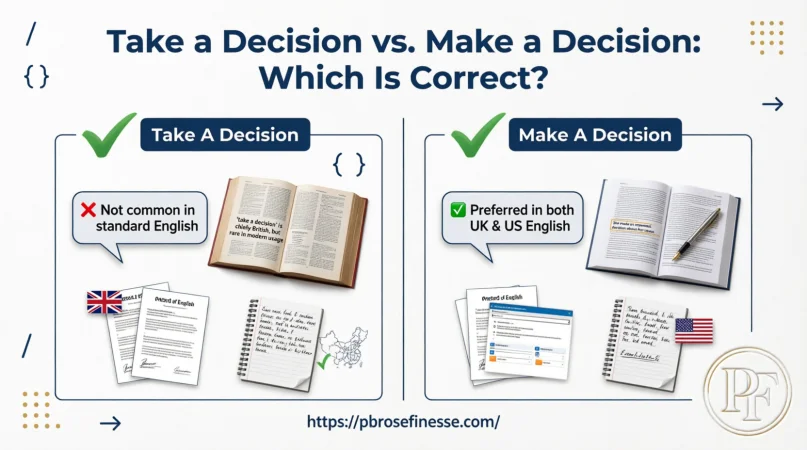
- “Make a decision” is the standard expression in American English.
- “Take a decision” is more common in British English, especially in formal settings.
- Both phrases are correct.
- Neither expression changes the meaning significantly.
- The main difference is regional preference and tone.
Quick Comparison
| Phrase | American English | British English | Formality |
| Make a decision | Very common | Common | Neutral |
| Take a decision | Rare | Common | More formal |
If you’re writing for an international audience, “make a decision” is generally the safest option.
What Does “Make a Decision” Mean?
The phrase “make a decision” means to choose a course of action after considering different options.
When you make a decision, you actively create a conclusion. This usage fits naturally with many English collocations involving the verb make, such as:
- Make a plan
- Make a choice
- Make an effort
- Make a commitment
- Make progress
In each case, the speaker is producing or forming something. A decision works the same way.
Dictionary Meaning
Most major English dictionaries define make a decision as:
To choose something after thinking carefully about available options.
This phrase dominates everyday conversation throughout the United States and appears frequently in newspapers, books, websites, and business communication worldwide.
Examples of “Make a Decision”
Consider these examples:
- We need to make a decision before Friday.
- She finally made a decision about her college major.
- The company will make a decision after reviewing all applications.
- I can’t make a decision until I have more information.
- They made the decision to expand into international markets.
Notice how natural these sentences sound. For most English speakers worldwide, this is the default expression.
Common Patterns with “Make a Decision”
English speakers often use the phrase in predictable structures.
1. Make a decision about something
- We must make a decision about the budget.
- She needs to make a decision about her future career.
2. Make a decision to do something
- They made a decision to relocate the office.
- He made a decision to study abroad.
3. Make a final decision
- The board will make a final decision next week.
Make an informed decision
- Consumers should have enough information to make an informed decision.
These combinations appear constantly in professional and academic writing.
What Does “Take a Decision” Mean?
The phrase “take a decision” has essentially the same meaning as “make a decision.”
Someone who takes a decision chooses a particular course of action after consideration.
The difference isn’t meaning. It’s usage.
While Americans overwhelmingly prefer make a decision, British English speakers often use take a decision, especially in formal environments such as:
- Government departments
- Corporate boardrooms
- Public institutions
- Official reports
- Committee meetings
Examples of “Take a Decision”
- The committee will take a decision next month.
- Ministers have taken a decision regarding the proposal.
- The board took a strategic decision to reduce costs.
- Management took the decision to postpone the launch.
In British contexts, these examples sound perfectly natural.
In American contexts, however, they may sound slightly unusual or overly formal.
Why Does “Take a Decision” Exist?
Language evolves differently across regions.
Historically, British English developed several formal administrative expressions that became standard within institutions and government organizations.
Many linguists believe “take a decision” emerged through influences from European administrative language patterns, where equivalent phrases commonly use verbs similar to “take.”
Over time, the expression became firmly established in British formal English.
Today, it remains widely accepted throughout the United Kingdom and many Commonwealth countries.
The Real Difference Between “Take a Decision” and “Make a Decision”
The most important point is this:
The difference is not grammatical. The difference is regional and stylistic.
- Both phrases mean the same thing.
2. Both are correct.
3. Both are understood by native speakers.
However, they create slightly different impressions.
Side-by-Side Comparison
| Feature | Make a Decision | Take a Decision |
| Meaning | Choose something | Choose something |
| American English | Standard | Uncommon |
| British English | Common | Common |
| Everyday Conversation | Very common | Less common |
| Formal Documents | Common | Very common |
| Business Communication | Common | Common |
| International Audience | Preferred | Less preferred |
Think of it this way:
If English were clothing, make a decision would be a versatile outfit you can wear almost anywhere.
Take a decision would be a formal suit that appears more often in specific regions and professional settings.
Why “Make a Decision” Is More Common Worldwide
One reason make a decision dominates globally is the influence of American English.
American media reaches billions of people through:
- Movies
- Television
- News outlets
- Social media
- Educational materials
- Business publications
As a result, many English learners encounter make a decision far more often than take a decision.
Global Business Influence
International companies frequently adopt wording that sounds natural to the broadest audience possible.
Because of that, you’ll often see phrases such as:
- Make a strategic decision
- Make an investment decision
- Make a hiring decision
- Make a purchasing decision
These expressions appear in countless business documents around the world.
British English vs. American English Usage
Understanding regional differences helps you choose the most appropriate wording.
How British English Uses These Phrases
British speakers generally accept both expressions.
However, take a decision often appears in:
- Government communication
- Legal documents
- Board meetings
- Corporate reports
- Institutional announcements
Example
A British organization might write:
The committee has taken the decision to revise the policy.
This sentence sounds entirely natural in the UK.
How American English Uses These Phrases
In the United States, make a decision dominates almost every context.
Americans rarely say take a decision during normal conversation.
Example
An American company would likely write:
The committee has made the decision to revise the policy.
This wording sounds more familiar to American readers.
Which Phrase Should You Use?
The answer depends on your audience.
Use “Make a Decision” When:
- Writing for international readers
- Creating website content
- Writing marketing materials
- Communicating with American audiences
- Speaking informally
- Writing emails
- Producing educational content
Use “Take a Decision” When:
- Following British English conventions
- Writing official reports
- Preparing formal organizational documents
- Matching company style guides
- Communicating within British institutions
For most writers, make a decision remains the best choice.
Common Mistakes People Make
Even advanced English learners sometimes misunderstand these expressions.
Let’s examine the most common errors.
Assuming “Take a Decision” Is Incorrect
This misconception appears frequently online.
Many learners believe only make a decision is correct.
That’s not true.
British English has used take a decision for decades, and respected publications continue to use it today.
Mixing Regional Styles
Consistency matters.
Consider this example:
- The board has taken a decision regarding the merger.
- The CEO made a decision afterward.
While not technically wrong, switching styles within the same document may feel inconsistent.
Choose one convention and stick with it.
Using Overly Formal Language
Sometimes writers use take a decision because it sounds sophisticated.
However, simpler language often communicates more effectively.
Instead of:
Management has taken a decision concerning workforce optimization initiatives.
You could write:
Management has decided to improve staffing efficiency.
The second version is clearer and easier to understand.
Alternative Ways to Say “Make a Decision”
English offers several useful alternatives.
These expressions can help diversify your writing.
| Expression | Formality | Usage Frequency |
| Decide | Neutral | Very High |
| Make a decision | Neutral | Very High |
| Reach a decision | Neutral to Formal | High |
| Come to a decision | Neutral | High |
| Arrive at a decision | Formal | Moderate |
| Choose | Neutral | Very High |
| Determine a course of action | Formal | Moderate |
Decide
The simplest option.
Examples
- We need to decide today.
- She decided to accept the offer.
- They decided against moving.
Read More :3 Terms for Questions You Already Know
Reach a Decision
Often used in meetings and negotiations.
Examples
- The committee reached a decision after three hours.
- Both sides reached a decision quickly.
Come to a Decision
A conversational alternative.
Examples
- Have you come to a decision yet?
- They finally came to a decision.
Arrive at a Decision
More formal and often used in reports.
Examples
- Investigators arrived at a decision based on evidence.
- The panel arrived at a unanimous decision.
Real-World Examples of Both Expressions
Seeing both phrases in context helps clarify their usage.
Examples Using “Make a Decision”
- The manager must make a decision before noon.
- Investors made a decision based on market trends.
- Parents often make decisions that affect their children’s future.
- The company made a difficult decision during the recession.
- We need to make a decision quickly.
Examples Using “Take a Decision”
- The board will take a decision next week.
- Government officials took a decision regarding public funding.
- Directors took the decision after extensive consultation.
- The committee took a decision unanimously.
- Senior management took a strategic decision to expand operations.
Side-by-Side Comparisons
| British Style | American Style |
| The board took a decision. | The board made a decision. |
| Ministers took a decision. | Ministers made a decision. |
| Management took a strategic decision. | Management made a strategic decision. |
| The committee took a decision yesterday. | The committee made a decision yesterday. |
Notice that the meaning remains identical.
Only the wording changes.
Case Study: International Business Communication
Imagine a technology company operating in:
- London
- New York
- Toronto
- Sydney
Its internal British team might naturally write:
The board has taken a decision regarding expansion.
However, when communicating globally, the company may choose:
The board has made a decision regarding expansion.
Why?
Because international readers are more likely to recognize and expect that wording.
This small adjustment improves clarity without changing meaning.
What Major Dictionaries and Language Experts Say
Leading dictionaries generally recognize both expressions.
Language authorities consistently note that:
- Make a decision is the dominant form in American English.
- Take a decision is accepted and common in British English.
- Neither phrase is grammatically wrong.
- Context and audience should guide your choice.
As many style experts point out:
The best expression is usually the one your audience expects to hear.
That’s excellent advice for any writer.
How Native Speakers Actually Use These Phrases
Real-world usage reveals an important trend.
Everyday Conversations
Most native speakers say:
- I made a decision.
- We need to make a decision.
- Have you made a decision yet?
Formal Meetings
British speakers may say:
- The committee took a decision.
- Directors took a strategic decision.
Online Content
Most websites use:
- Make a decision
- Decision-making
- Informed decision
- Better decision
As a result, online readers often find make a decision more familiar.
Decision-Making: Related Expressions You Should Know
While learning these phrases, it helps to understand related vocabulary.
Decision-Making
- Effective decision-making improves productivity.
- Strong decision-making skills help leaders succeed.
Decision Maker
- She is the primary decision maker.
- Senior decision makers attended the meeting.
Decision Process
- Every organization has a decision process.
- Understanding the decision process improves efficiency.
Strategic Decision
- Companies regularly make strategic decisions.
- Boards often take strategic decisions.
These expressions appear frequently in business English.
Quick Memory Trick
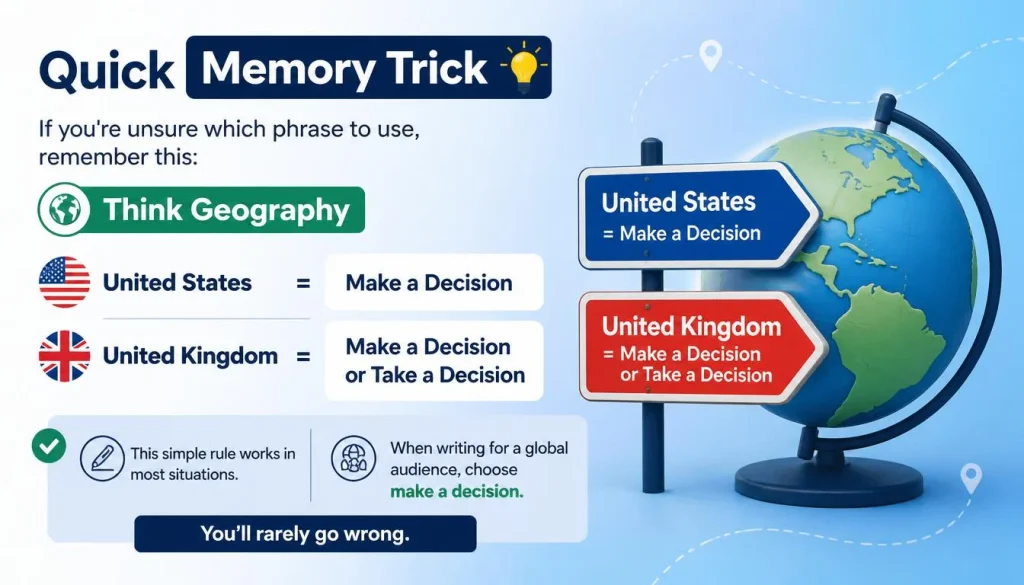
If you’re unsure which phrase to use, remember this:
Think Geography
United States = Make a Decision
United Kingdom = Make a Decision or Take a Decision
This simple rule works in most situations.
When writing for a global audience, choose make a decision.
You’ll rarely go wrong.
FAQs
1. Is “make a decision” grammatically correct?
Yes, “make a decision” is grammatically correct and is the most widely used expression in modern English. It is especially common in American English, professional writing, and everyday conversations.
2. Is “take a decision” wrong?
No, “take a decision” is not wrong. It is a standard expression in British English and is often used in government, legal, and formal contexts. However, it may sound less natural to American English speakers.
3. Which is more common: “make a decision” or “take a decision”?
“Make a decision” is generally more common worldwide. It appears more frequently in business documents, academic writing, media publications, and online content.
4. Can I use both expressions interchangeably?
In many situations, yes. Both phrases mean choosing a course of action. However, regional preferences matter. If your audience is primarily American, “make a decision” is usually the safer choice.
5. Why do British speakers say “take a decision”?
The phrase “take a decision” has long been established in British English and is particularly associated with formal and institutional language. It reflects traditional usage patterns that differ from American English conventions.
6. Which phrase should I use in professional writing?
For international audiences, “make a decision” is generally recommended because it is more universally recognized. If you are writing for a British audience or following UK style guidelines, “take a decision” may also be appropriate.
Conclusion
The debate between “take a decision” and “make a decision” is less about correctness and more about regional preference and context. Both expressions convey the same basic idea—choosing between alternatives—but “make a decision” dominates in global English and is especially common in business communication, formal writing, and everyday speech.
Meanwhile, “take a decision” remains a respected and widely accepted choice in British English, particularly in formal and governmental settings.
Understanding this distinction helps you communicate with greater clarity, consistency, and confidence. When in doubt, consider your audience and the style of English you are using. By choosing the expression that best fits the situation, you can ensure your writing sounds natural, professional, and grammatically accurate.

Mia Rose is an English language specialist and editorial writer at Phrase Finesse, where she helps readers master grammar, vocabulary, spelling, and effective communication. Passionate about making English simple and practical, she creates well-researched, reader-friendly content that explains complex language concepts in a clear and engaging way.
With extensive experience in English language education, content writing, and editorial review, Mia specializes in grammar, punctuation, word choice, idioms, confusing word pairs, and writing style. Her articles are carefully researched, fact-checked, and designed to help students, professionals, writers, and English learners build confidence in both written and spoken English.