Have you ever ended an email with “Talk To You Then” Meaning: Usage, Examples & Alternatives and wondered whether it sounds professional enough? This common closing works well in many situations, but its tone can vary depending on the context.
Whether you’re arranging meetings, confirming a calendar invitation, or maintaining clear business communication, choosing the right sign-off helps you leave a polished and confident impression.
Understanding the meaning of “Talk to you then” is more important than many writers realize. In professional settings, subtle differences in English usage, grammar, formal writing, and consistency can influence how your message is received.
A thoughtful closing also supports effective scheduling, strong time management, and smooth collaboration across project management tasks, virtual discussions, and even online booking confirmations where timing and clarity matter.
In this guide, you’ll learn exactly when “Talk to you then” is appropriate, what it truly communicates, and when a more formal alternative is the better choice. We’ll also explore three professional email closings, practical examples, and expert writing tips that improve clarity in broadcasting, workplace correspondence, and everyday business emails.
By the end, you’ll know how to choose the most suitable phrase for every professional situation with confidence.
What Does “Talk To You Then” Mean?
The phrase “talk to you then” means:
“I will speak with you at the future time we have already discussed.”
The key idea is that both speakers already know the time being referenced.
For example:
Person A: Let’s have a meeting tomorrow at 2 PM.
Person B: Sounds good. Talk to you then.
In this example, “then” refers to tomorrow at 2 PM.
Breaking Down the Phrase
| Word | Meaning |
| Talk | To speak or communicate |
| To | Shows direction toward someone |
| You | The person being addressed |
| Then | At that particular future time |
When combined, the phrase means:
“I will communicate with you at that previously mentioned time.”
Why People Use “Talk To You Then” So Often
Language naturally favors efficiency.
Instead of repeating a scheduled time, English speakers often use shorter expressions that rely on context.
Consider these examples:
Repetitive Version
- I’ll call you Friday at 3 PM.
- Yes, I’ll talk to you Friday at 3 PM.
Natural Version
- I’ll call you Friday at 3 PM.
- Great. Talk to you then.
The second version sounds smoother and more conversational.
This is one reason the phrase appears frequently in:
- Emails
- Text messages
- Business meetings
- Phone calls
- Virtual conferences
- Interviews
- Customer service conversations
When Do People Say “Talk To You Then”?
The phrase almost always appears after a future time has already been mentioned.
After Scheduling a Call
One of the most common situations.
Example:
“We’ll discuss the proposal Tuesday morning.”
“Perfect. Talk to you then.”
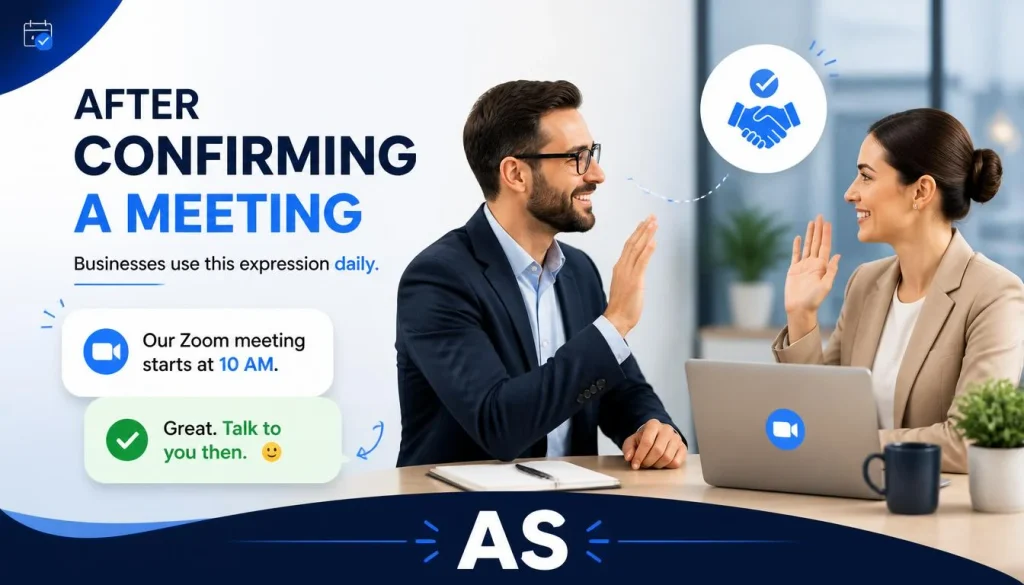
After Confirming a Meeting
Businesses use this expression daily.
Example:
“Our Zoom meeting starts at 10 AM.”
“Great. Talk to you then.”
After Arranging an Interview
Recruiters frequently use this phrase.
Example:
“Your interview is scheduled for Thursday.”
“Thank you. Talk to you then.”
At the End of an Email Exchange
It serves as a polite closing.
Example:
“I’ve booked our meeting for next Monday.”
“Excellent. Talk to you then.”
During Personal Conversations
Friends and family use it just as often.
Example:
“Let’s catch up Saturday evening.”
“Sounds good. Talk to you then.”
Is “Talk To You Then” Grammatically Correct?
Yes.
“Talk to you then” is completely grammatically correct.
Native English speakers use it every day.
The phrase works because “then” functions as an adverb referring to a specific future time that has already been established.
Grammar Structure
| Part | Role |
| Talk | Main verb |
| To | Preposition |
| You | Object |
| Then | Adverb of time |
The phrase is technically a shortened form of:
“I will talk to you then.”
English speakers often omit subjects when ending conversations because the meaning remains obvious.
Similar Shortened Expressions
- See you then.
- Talk soon.
- Catch you later.
- See you later.
- Speak with you tomorrow.
All of these are grammatically acceptable.
How To Use “Talk To You Then” Correctly
A simple rule makes usage easy.
Formula
Future Time Mentioned + Talk To You Then
Correct Examples
- Our call is scheduled for 4 PM. Talk to you then.
- Let’s meet next week. Talk to you then.
- I’ll send the details before Friday. Talk to you then.
- The interview starts at noon. Talk to you then.
Incorrect Examples
- Talk to you then. ❌ (No future time established)
- Talk to you then yesterday. ❌
- Talk to you then last week. ❌
The word “then” should point toward a future moment, not a past one.
Professional Use of “Talk To You Then”
Many people wonder whether this phrase sounds professional.
The answer is yes.
It strikes a balance between friendliness and professionalism.
That’s why professionals use it in:
- Business emails
- Meeting confirmations
- Sales calls
- Client communications
- Internal team chats
- Project discussions
Example in a Client Email
“Thank you for confirming the appointment. We look forward to discussing your requirements on Wednesday at 1 PM. Talk to you then.”
This sounds professional without feeling stiff.
Example in Workplace Messaging
“Our weekly check-in starts at 9:30.”
“Got it. Talk to you then.”
Simple. Efficient. Professional.
Why It Works Well in Business Communication
Business communication values clarity.
The phrase helps accomplish three things:
It Confirms the Schedule
The listener knows the arrangement remains active.
It Ends Conversations Smoothly
Nobody has to repeat information.
It Maintains a Friendly Tone
Unlike highly formal phrases, it feels approachable.
Comparison Table
| Phrase | Formality Level |
| Talk to you then | Neutral Professional |
| Speak with you then | Professional |
| I look forward to speaking with you then | Formal |
| We shall communicate at that time | Very Formal |
| Catch you then | Casual |
Using “Talk To You Then” in Emails
Email communication often benefits from concise closings.
Effective Email Example
Hello Sarah,
Thank you for confirming the meeting.
I’ve added the event to my calendar for Thursday at 11 AM.
Talk to you then.
Best regards,
James
This closing feels professional without sounding robotic.
When It Fits Best
Use it when:
- A meeting has been scheduled
- A phone call is planned
- An interview is confirmed
- A consultation has been arranged
When Another Phrase May Be Better
In highly formal situations, consider:
- I look forward to speaking with you then.
- I look forward to our discussion.
- I appreciate your time and look forward to our meeting.
“Talk To You Then” in Casual Conversations
Outside the workplace, the phrase becomes even more common.
Friends use it daily.
Family members use it frequently.
Neighbors use it.
Students use it.
Almost everyone does.
Examples
Friend:
“Let’s grab coffee Saturday.”
“Perfect. Talk to you then.”
Sibling:
“I’ll call after work.”
“Okay. Talk to you then.”
Parent:
“See you at dinner tonight.”
“Talk to you then.”
The phrase sounds natural because it feels warm and uncomplicated.
See Moer :Do You Capitalize After an Ellipsis? Grammar Guide With Examples
Examples of “Talk To You Then” in Sentences
Seeing examples in context helps solidify understanding.
Workplace Examples
- Our project review starts Monday morning. Talk to you then.
- We’ll finalize the budget next week. Talk to you then.
- The client meeting begins at 2 PM. Talk to you then.
- Let’s discuss the proposal Friday afternoon. Talk to you then.
- The strategy session is tomorrow. Talk to you then.
Email Examples
- Thanks for scheduling the meeting. Talk to you then.
- Looking forward to our discussion. Talk to you then.
- I’ve added the appointment to my calendar. Talk to you then.
- Thank you for your time today. Talk to you then.
- Everything is confirmed. Talk to you then.
Text Message Examples
- Saturday works for me. Talk to you then.
- Sounds good. Talk to you then.
- I’ll call after practice. Talk to you then.
- Let’s reconnect next week. Talk to you then.
- Dinner at seven? Talk to you then.
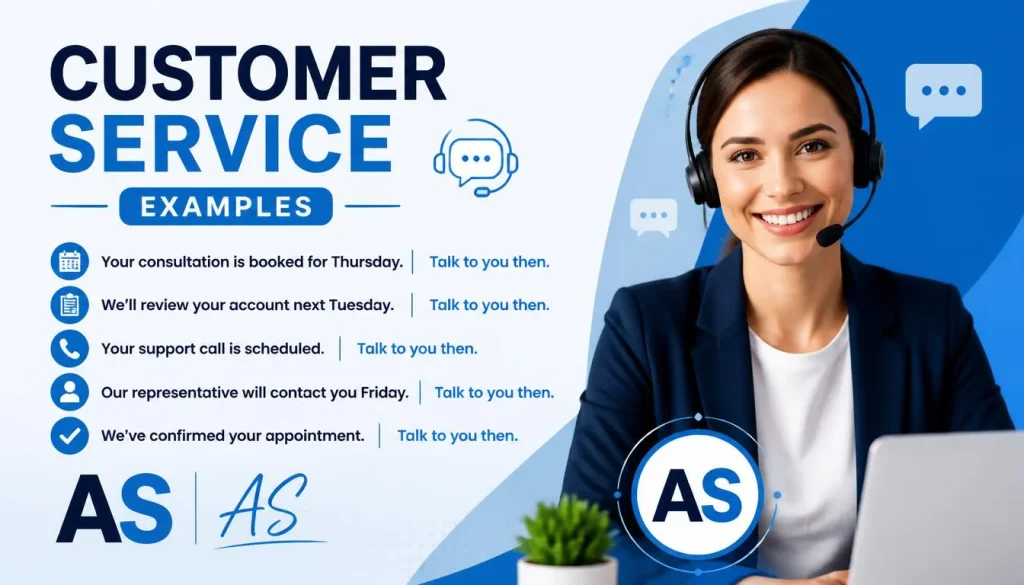
Customer Service Examples
- Your consultation is booked for Thursday. Talk to you then.
- We’ll review your account next Tuesday. Talk to you then.
- Your support call is scheduled. Talk to you then.
- Our representative will contact you Friday. Talk to you then.
- We’ve confirmed your appointment. Talk to you then.
Tone and Meaning Variations
The exact tone depends on context.
Friendly Tone
Among friends, the phrase feels warm and casual.
Example:
“Can’t wait to hear about your trip. Talk to you then.”
Professional Tone
At work, it sounds polite and efficient.
Example:
“We’ll review the quarterly report Wednesday. Talk to you then.”
Neutral Tone
Sometimes it’s simply functional.
Example:
“The appointment is confirmed. Talk to you then.”
Can “Talk To You Then” Ever Sound Rude?
Generally, no.
However, tone and context can influence perception.
Example
Imagine someone writes:
“Fine. Talk to you then.”
Depending on the surrounding conversation, that response could sound annoyed.
The phrase itself isn’t rude.
The emotional tone comes from the rest of the message.
Common Alternatives to “Talk To You Then”
English offers many alternatives.
Some sound more formal.
Others sound more casual.
Professional Alternatives
| Alternative | Best Situation |
| I look forward to speaking with you then | Formal emails |
| I’ll speak with you then | Business conversations |
| Looking forward to our discussion | Meetings |
| We’ll connect then | Team communication |
| Speak with you soon | Professional but friendly |
Casual Alternatives
- Talk soon
- Catch you later
- Catch you then
- Chat soon
- See you then
- Speak soon
- Talk later
“Talk To You Then” vs. “Talk To You Later”
Many people confuse these expressions.
They are not identical.
Talk To You Then
Refers to a specific scheduled time.
Example:
“Our call is Friday at 3 PM.”
“Talk to you then.”
Talk To You Later
Refers to an unspecified future time.
Example:
“I’m heading out now.”
“Okay, talk to you later.”
Comparison
| Phrase | Specific Time Mentioned? |
| Talk to you then | Yes |
| Talk to you later | No |
“Talk To You Then” vs. “See You Then”
These phrases share similarities.
However, they aren’t interchangeable in every situation.
Talk To You Then
Focuses on communication.
See You Then
Focuses on physical presence or visual interaction.
Example
Phone Call:
- Talk to you then. ✔
- See you then. Possible but less precise.
In-Person Meeting:
- Talk to you then. ✔
- See you then. ✔
“Talk Soon” vs. “Talk To You Then”
The distinction lies in certainty.
Talk Soon
Future contact is expected but unscheduled.
Talk To You Then
Future contact has already been scheduled.
Comparison Table
| Expression | Scheduled Time? | Tone |
| Talk to you then | Yes | Neutral |
| Talk soon | No | Friendly |
| Talk later | No | Casual |
| See you then | Yes | Neutral |
| Catch you later | No | Informal |
Common Mistakes People Make
Even simple expressions can be misused.
Using It Without Mentioning a Time
Incorrect:
“Talk to you then.”
Correct:
“Our meeting is tomorrow. Talk to you then.”
The listener needs a reference point.
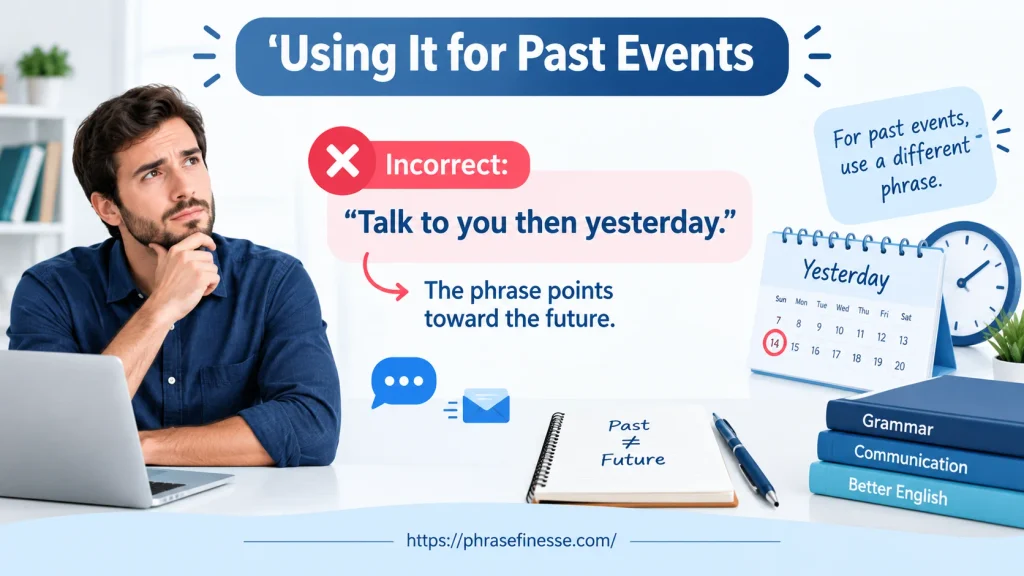
Using It for Past Events
Incorrect:
“Talk to you then yesterday.”
The phrase points toward the future.
Using It in Extremely Formal Documents
While professional, the phrase isn’t ideal for:
- Legal agreements
- Academic research papers
- Government notices
More formal wording may be preferable.
Real-World Communication Case Study
Scenario: Client Meeting Confirmation
A consulting firm schedules dozens of meetings every week.
Their original emails ended with:
“We shall engage in discussion at the previously agreed-upon time.”
Clients found the wording overly formal.
The company switched to:
“Talk to you then.”
The result?
- Faster responses
- Friendlier communication
- Improved client engagement
The lesson is simple.
Modern communication often benefits from clarity and natural language.
Quick Usage Cheat Sheet
| Situation | Recommended Phrase |
| Scheduled phone call | Talk to you then |
| Client meeting | Talk to you then |
| Job interview | Talk to you then |
| Friend catch-up | Talk to you then |
| Formal business email | I look forward to speaking with you then |
| Team meeting | Talk to you then |
| Family plans | Talk to you then |
FAQs
1. What does “Talk to you then” mean in an email?
“Talk to you then” means you expect to speak with the recipient at a previously agreed time. It’s commonly used after confirming a meeting, phone call, or scheduled discussion.
2. Is “Talk to you then” professional?
Yes, it can be professional in informal or semi-formal workplace communication. However, for formal emails, phrases like “I look forward to speaking with you” are usually more appropriate.
3. What are formal alternatives to “Talk to you then”?
Some of the best formal alternatives include:
- I look forward to speaking with you.
- I look forward to our meeting.
- I look forward to discussing this further.
These options sound more polished while conveying the same message.
4. Can I use “Talk to you then” after scheduling a meeting?
Absolutely. It’s a common closing after confirming a meeting or call because it acknowledges the agreed time and signals that you’ll continue the conversation then.
5. Is “Talk to you then” suitable for clients?
It depends on your relationship with the client. For long-term clients or casual business relationships, it’s perfectly acceptable. For first-time or highly formal communication, a more professional closing is often a better choice.
6. Should I use “Talk to you then” in every email?
No. Use it only when a future conversation has already been scheduled. If no meeting or call has been arranged, choose a closing that better matches your purpose, such as “Please let me know if you have any questions” or “I look forward to your response.”
Conclusion
While “Talk to you then” is a natural and friendly email closing, it isn’t always the best choice for every professional situation. Understanding its meaning and tone allows you to decide whether it fits the context or whether a more formal alternative would create a stronger impression.
When writing business emails, your closing should match the level of professionalism expected by the recipient. Alternatives such as “I look forward to speaking with you,” “I look forward to our meeting,” or “I look forward to discussing this further” often sound more polished while still expressing the same intention.
Choosing the right phrase improves business communication, supports clear scheduling, and helps maintain professionalism and consistency in every email.

Mia Rose is an English language specialist and editorial writer at Phrase Finesse, where she helps readers master grammar, vocabulary, spelling, and effective communication. Passionate about making English simple and practical, she creates well-researched, reader-friendly content that explains complex language concepts in a clear and engaging way.
With extensive experience in English language education, content writing, and editorial review, Mia specializes in grammar, punctuation, word choice, idioms, confusing word pairs, and writing style. Her articles are carefully researched, fact-checked, and designed to help students, professionals, writers, and English learners build confidence in both written and spoken English.

[…] Read More :“Talk To You Then” Meaning: Usage, Examples & Alternatives […]