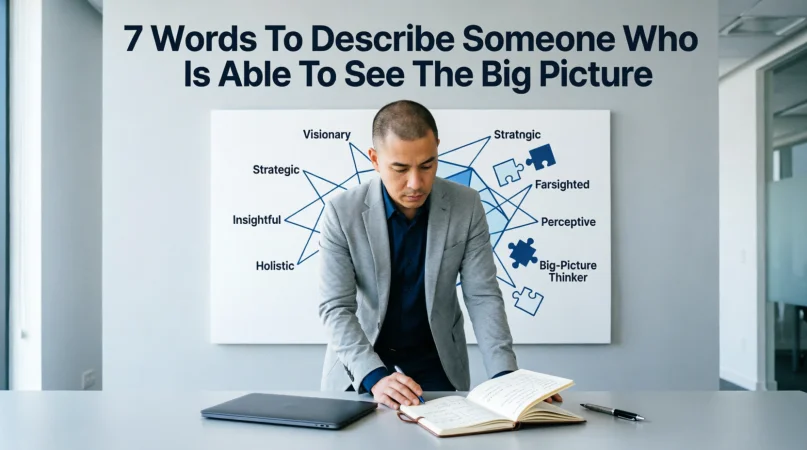
7 Words To Describe Someone Who Is Able To See The Big Picture helps you explain how people understand details, context, and wider goals clearly. When talking about people with the ability to see the big picture, you need clear words to describe how they understand situations.
These people can see the bigger pictures without losing sight of important details. This article uses best synonyms, synonyms for you, and useful language, vocabulary, and description to help you describe them and refer to them naturally. Depending on the context, terms such as broad-minded, visionary, strategic thinker, forward-thinking, holistic thinker, insightful, perceptive, and analytical can express different forms of perspective.
A broad perspective, wider perspective, long-term vision, strategic vision, overall view, and global perspective show how their understanding, awareness, insight, reasoning, and thinking connect. Their perspective-taking can remain contextually relevant, while semantic relevance, contextual language, and NLP terms help explain related personality traits and cognitive ability.
In practical situations, someone with this ability looks beyond the details, understands how parts fit together, and uses that view for strong leadership, effective teamwork, and better decision-making. They can understand smaller elements while grasping the bigger picture, strategize efficiently, explore alternatives, help teams communicate ideas clearly, and turn plans into actionable steps toward success.
Their decisions can contribute to a cohesive whole while enhancing their skill in problem-solving, critical thinking, and organizational skills. They also connect ideas, action, and effective decisions, while leadership and teamwork benefit from supporting others empathetically and encouraging discussion. Through communication, collaboration, and empathy, they improve coordination and team success.
This overall understanding reflects strategic thinking, holistic thinking, broader perspective, big-picture thinking, contextual awareness, comprehensive view, and interconnectedness. These are useful words we can use when someone can connect separate details and understand what they mean together.
Quick Answer:
| Word or phrase | What it emphasizes | Best context |
| Visionary | Future possibilities and direction | Leadership, innovation |
| Strategic | Long-term plans and outcomes | Business, planning |
| Insightful | Deep understanding of complex situations | Analysis, discussion |
| Farsighted | Future consequences and wise decisions | Planning, decisions |
| Holistic | The whole system rather than isolated parts | Problem-solving, systems |
| Perceptive | Recognizing patterns and things others miss | People, situations, analysis |
| Big-picture thinker | Overall perspective and broader goals | General and professional use |
These words overlap, but they aren’t interchangeable.
For example, calling someone strategic suggests that the person thinks about goals, resources, choices, and consequences. Calling someone visionary places more emphasis on imagining what could happen in the future. Cambridge defines strategic in business as relating to how an organization decides what it wants to achieve and plans actions and resources over time.
That distinction matters when you’re writing a resume, recommendation, performance review, professional email, or personal description.
What Does It Mean to See the Big Picture?
Seeing the big picture means looking beyond one task or isolated problem and considering the larger context.
Imagine you’re working on a product launch. A detail-focused person might concentrate on fixing a typo, adjusting a button, or checking a spreadsheet. Those details matter. However, a big-picture thinker asks different questions:
- What is the main goal?
- Who will use the product?
- How does this project support the business?
- What could happen six months from now?
- Which problems could affect the final result?
- What should the team prioritize first?
- How does one decision affect another?
Big-picture thinking doesn’t mean ignoring details. Instead, it means understanding which details matter most and how they influence the final outcome.
Indeed describes big-picture thinking as focusing on the entirety of an idea rather than each individual detail. It also notes that big-picture thinking and detail-oriented thinking can work together rather than functioning as strict opposites.
Think of a puzzle.
A detail-oriented person may carefully examine individual pieces. A big-picture thinker keeps checking the completed image to understand where those pieces belong. The strongest problem-solving often requires both approaches.
Visionary
Visionary is one of the strongest words for someone who can imagine a larger future.
A visionary person doesn’t simply understand the current situation. They can picture how an industry, organization, product, or society might develop. Cambridge defines visionary as having the ability to imagine how something will develop in the future and plan appropriately.
That makes visionary particularly useful when someone’s big-picture thinking involves innovation or long-term possibilities.
What Does Visionary Mean?
A visionary person tends to look beyond today’s limitations.
They may ask:
- What could this become?
- What will people need in the future?
- Where is this industry heading?
- What new possibility hasn’t anyone explored?
- What should we build now for a future need?
The word often carries a sense of imagination. It can describe entrepreneurs, leaders, designers, researchers, writers, and innovators.
However, visionary doesn’t simply mean smart. Someone can be highly intelligent without having a strong ability to imagine future possibilities.
Example Sentences With Visionary
She is a visionary leader who sees opportunities long before they become obvious.
His visionary approach helped the team think beyond its immediate sales targets.
The company needs a visionary thinker who can define its long-term direction.
Visionary vs. Strategic
These words overlap, but their focus differs.
A visionary tends to imagine the destination.
A strategic thinker focuses more heavily on how to get there.
For example, someone might envision a completely new product category. That’s visionary thinking. Creating a realistic plan involving budgets, timelines, competitors, and resources is strategic thinking.
Strategic
Strategic describes someone who thinks about goals, choices, resources, risks, and long-term results.
This word fits especially well in professional settings. Cambridge explains that strategic relates to deciding what an organization wants to achieve and planning actions and resources over time.
If someone regularly connects today’s decisions with tomorrow’s outcomes, strategic can be an excellent choice.
What Does Strategic Mean?
A strategic thinker doesn’t simply ask, “What should we do?”
They ask:
“What should we do now to create the result we want later?”
That small change in perspective can dramatically affect decision-making.
For example, a manager might reject a quick solution because it creates bigger maintenance problems later. Instead, they choose a slightly slower option that supports the organization’s long-term goals.
That’s strategic thinking.
Example Sentences With Strategic
Maria takes a strategic approach to every major project.
His strategic thinking helped the team prioritize its most important objectives.
She’s strategic enough to consider both immediate needs and long-term consequences.
Why Strategic Works Well in Professional Writing
The word strategic sounds natural in:
- Resumes
- Performance reviews
- Business reports
- Leadership profiles
- Cover letters
- Job interviews
- Project descriptions
Instead of writing:
He is good at seeing the big picture.
You could write:
He uses strategic thinking to connect daily priorities with long-term business goals.
The second version gives the reader more information.
Insightful
Insightful describes someone who understands complicated situations in a clear and meaningful way.
Cambridge defines insightful as showing a clear and usually original understanding of a complicated problem or situation.
This makes the word especially useful when someone’s ability to see the big picture comes from deep understanding rather than future planning.
What Does Insightful Mean?
An insightful person can look at scattered information and recognize what it means.
They may notice:
- A hidden connection
- An underlying problem
- A recurring pattern
- A useful implication
- A contradiction
- A deeper cause behind a visible issue
For example, imagine a team experiencing falling sales.
A basic observation might be:
“Sales are down.”
An insightful observation might be:
“Customers aren’t necessarily rejecting the product. They may be struggling to understand its value compared with newer alternatives.”
That second observation goes beneath the surface.
Example Sentences With Insightful
Her insightful analysis revealed the underlying issue behind the project’s delays.
He offered an insightful perspective that connected several problems the team had treated separately.
The manager is known for asking insightful questions during difficult discussions.
Insightful vs. Perceptive
These words are close cousins.
Perceptive emphasizes noticing and understanding things others may miss. Cambridge defines it as being very good at noticing and understanding things that many people don’t notice.
Insightful emphasizes the quality or depth of the resulting understanding.
So, someone can be perceptive because they notice a subtle change in team behavior. Their explanation of why that change matters may be insightful.
Farsighted
Farsighted describes someone who thinks carefully about the future and makes decisions based on long-term consequences.
Cambridge gives the figurative meaning as having good judgment about what will be needed in the future and making wise decisions accordingly.
This makes farsighted particularly useful when you want to emphasize long-range judgment.
What Does Farsighted Mean?
A farsighted person looks beyond the immediate payoff.
They might ask:
- What happens next year?
- What could this decision create later?
- Will this solution still work as circumstances change?
- What resources will we need in the future?
- Are we solving the problem or merely postponing it?
For example, a business that invests in employee training during a slow period may be making a farsighted decision. The investment could strengthen skills before future demand increases.
Example Sentences With Farsighted
Her farsighted planning helped the organization prepare for future growth.
Choosing a scalable system was a farsighted decision.
His farsighted approach prevented the company from becoming dependent on a short-term solution.
Farsighted vs. Visionary
The distinction is subtle but useful.
A visionary imagines a possible future.
A farsighted person makes decisions with future consequences in mind.
Visionary thinking can sound more imaginative. Farsighted thinking sounds more practical and judgment-based.
Holistic
Holistic describes an approach that considers the whole rather than treating individual parts in isolation.
Cambridge defines holistic as dealing with or treating the whole of something or someone rather than just one part.
This word can describe someone who thinks holistically, although it usually describes an approach, perspective, or method rather than a person’s personality by itself.
What Does Holistic Mean?
Imagine a company has a high employee turnover rate.
A narrow approach might examine salaries alone.
A holistic approach could consider:
- Compensation
- Management
- Workload
- Career growth
- Workplace culture
- Scheduling
- Training
- Employee expectations
The goal isn’t simply to identify one variable. It’s to understand how the entire system operates.
That’s why holistic works well when discussing complex problems.
Example Sentences With Holistic
She takes a holistic approach to solving organizational problems.
His holistic perspective helped the team understand how several departments affected one another.
The company needs a more holistic strategy that considers customers, employees, and long-term growth.
Important Usage Note
Calling someone “a holistic person” can sound awkward depending on the context.
Instead, use phrases such as:
- A holistic thinker
- A holistic approach
- A holistic perspective
- Someone who thinks holistically
That phrasing sounds more precise.
See More :You All vs. All of You: The Real Difference
Perceptive
Perceptive describes someone who notices important things that other people might overlook.
According to Cambridge, a perceptive person is particularly good at noticing and understanding things that many people don’t notice.
That ability can contribute strongly to big-picture thinking.
What Does Perceptive Mean?
A perceptive person may notice a subtle pattern before others recognize it.
For example, during a meeting, everyone might focus on a missed deadline. A perceptive team member notices that three recent deadlines slipped after responsibilities changed.
That observation shifts the discussion.
The problem may not be employee effort. The real issue could be the new workflow.
Perception helps reveal the pattern. Big-picture thinking helps explain why the pattern matters.
Example Sentences With Perceptive
She’s a perceptive manager who quickly recognizes patterns within the team.
His perceptive observations helped identify the real source of the problem.
A perceptive leader can notice small signals before they become larger problems.
Perceptive vs. Insightful
A simple way to remember the difference:
Perceptive = noticing and understanding what others miss.
Insightful = producing a deep understanding of what something means.
They often appear together, but they aren’t identical.
Big-Picture Thinker
Sometimes the simplest phrase is also the most accurate.
Big-picture thinker directly describes someone who naturally focuses on the broader context instead of becoming absorbed in individual details.
This phrase works particularly well when you don’t want to imply that the person is necessarily visionary, farsighted, or strategic.
What Does Big-Picture Thinker Mean?
A big-picture thinker considers:
- Overall objectives
- Wider consequences
- Relationships between different factors
- Long-term outcomes
- Context
- Priorities
- The purpose behind individual tasks
For example, a project manager may understand that a delayed design review isn’t merely a missed task. It could affect development, testing, marketing, launch timing, and customer expectations.
That’s big-picture thinking.
Example Sentences With Big-Picture Thinker
She’s a strong big-picture thinker who keeps the team’s long-term goals in view.
He’s a big-picture thinker who understands how individual projects support the company’s broader strategy.
The role requires someone who can balance detailed execution with big-picture thinking.
This phrase is especially useful when writing naturally. It doesn’t force you to choose a more specialized adjective when the broader description is enough.
Words Related to Seeing the Big Picture
Several other words can describe parts of big-picture thinking. However, each carries a slightly different meaning.
| Word | Main idea | Difference from “big-picture thinker” |
| Forward-thinking | Preparing for future possibilities | More focused on future change |
| Strategic | Planning around goals and outcomes | More focused on decisions and resources |
| Visionary | Imagining what could exist | More imaginative and future-oriented |
| Analytical | Examining information logically | More focused on breaking information down |
| Detail-oriented | Carefully handling specifics | Focuses on parts rather than the whole |
| Open-minded | Considering different perspectives | Focuses on willingness to consider alternatives |
| Systems thinker | Understanding interconnected parts | Focuses strongly on relationships within a system |
The distinction becomes important when you’re describing someone’s actual strength.
For instance, analytical doesn’t automatically mean big-picture. Someone can analyze a spreadsheet brilliantly while missing the broader business context.
Likewise, detail-oriented isn’t the opposite of intelligent or strategic. Detail-oriented work often supplies the evidence that big-picture decisions need.
Big-Picture Thinker vs. Detail-Oriented Person
These two approaches often get treated as opposites. That’s misleading.
A successful project usually needs both.
| Big-picture thinking | Detail-oriented thinking |
| Focuses on overall goals | Focuses on specific tasks |
| Considers long-term effects | Checks immediate requirements |
| Connects different areas | Examines individual components |
| Sets priorities | Verifies execution |
| Looks for broader patterns | Finds specific errors |
| Considers context | Examines precision |
Indeed notes that big-picture and detail-oriented thinking can complement each other in workplace settings.
Consider a website redesign.
The big-picture thinker might ask whether the new site improves the customer journey and supports business goals.
The detail-oriented thinker might check whether every link works, every heading follows the style guide, and every page loads correctly.
Neither role makes the other unnecessary.
The best results come when someone can move between the two levels.
How to Describe a Big-Picture Thinker in Professional Writing
Simply writing “big-picture thinker” can work, but stronger writing connects the trait to an observable behavior.
On a Resume
Avoid vague statements such as:
Great big-picture thinker.
Instead, describe what that thinking accomplishes:
Connects cross-functional projects with long-term business objectives to improve planning and resource allocation.
A results-oriented resume should focus on measurable accomplishments rather than unsupported claims.
If you have real numbers, use them.
For example:
Developed a long-term workflow strategy that reduced project delays by 18%.
The number gives the reader evidence instead of empty praise.
In a Performance Review
A performance review can emphasize context and decision-making:
She consistently connects daily priorities with broader team objectives and anticipates how short-term decisions may affect future projects.
This sounds stronger because it explains how the person demonstrates big-picture thinking.
In a Recommendation Letter
Use concrete behavior:
He consistently looked beyond individual assignments to understand how each project contributed to the department’s wider goals.
That sentence demonstrates the quality instead of simply naming it.
In an Interview
A useful structure is:
Situation → Bigger-picture problem → Decision → Result
For example:
“Our team was focused on reducing this month’s expenses. I noticed that one proposed cut would increase maintenance costs later. I recommended a different approach that protected the immediate budget while reducing long-term costs.”
That answer demonstrates strategic and farsighted thinking without simply claiming those traits.
Real-World Examples of Big-Picture Thinking
Workplace Example
A marketing team wants to increase website traffic.
A narrow approach might focus only on publishing more articles.
A big-picture thinker considers the entire customer journey:
Search visibility → Website experience → Useful content → Trust → Conversion → Customer retention
That broader view can reveal problems that traffic numbers alone won’t show.
Project Example
A project manager notices that one milestone keeps slipping.
Instead of repeatedly pushing the deadline, they examine dependencies between teams.
Perhaps the real bottleneck sits upstream.
That shift from “How do we fix this task?” to “Why does this task keep becoming a problem?” demonstrates broader thinking.
Leadership Example
A leader receives complaints about a new process.
A reactive response might immediately reverse the process.
A big-picture response considers the wider context:
- Why was the process introduced?
- What problem was it designed to solve?
- Which part is causing friction?
- What alternatives exist?
- What happens if the process changes again?
The leader can then modify the system without abandoning the original objective.
Personal Decision Example
Suppose you’re considering a job with a higher salary.
A big-picture approach doesn’t stop at the paycheck.
You might also consider:
- Commute
- Schedule
- Career growth
- Learning opportunities
- Job stability
- Benefits
- Work environment
- Future opportunities
The bigger picture turns a simple comparison into a more complete decision.
How to Choose the Right Word
Choosing the right synonym becomes easier when you identify what kind of big-picture thinking you’re describing.
| If the person mainly… | Use this word |
| Imagines future possibilities | Visionary |
| Plans around long-term goals | Strategic |
| Understands complex situations deeply | Insightful |
| Thinks carefully about future consequences | Farsighted |
| Considers an entire system | Holistic |
| Notices patterns others miss | Perceptive |
| Focuses naturally on the overall context | Big-picture thinker |
This distinction prevents your writing from sounding like a thesaurus dump.
For example, don’t call someone visionary simply because they plan projects well. If their strength lies in resource planning and long-term execution, strategic may describe them more accurately.
Likewise, don’t call someone holistic when you simply mean they notice future trends.
Precision makes descriptions more credible.
Common Mistakes When Describing Someone Who Sees the Big Picture
Treating Every Synonym as Identical
The seven terms overlap, but their emphasis differs.
Visionary points toward future possibilities. Strategic points toward plans and outcomes. Perceptive points toward noticing patterns.
Using the wrong word can weaken an otherwise strong description.
Assuming Big-Picture Thinkers Ignore Details
They don’t have to.
In fact, strong big-picture thinking often depends on understanding which details matter.
The goal isn’t to ignore the trees. It’s to understand how the trees form the forest.
Using “Holistic” as a Personality Label
Holistic generally works better with words such as approach, view, perspective, or thinking.
For example:
She takes a holistic approach to organizational problems.
That’s more precise than:
She is holistic.
Using “Visionary” Too Freely
Visionary is a strong word.
It suggests an ability to imagine future development and plan accordingly.
If someone simply performs thoughtful long-term planning, strategic or farsighted may fit better.
Making Unsupported Claims
Calling someone “an exceptional strategic thinker” tells the reader very little.
Show the evidence instead.
Explain what the person noticed, what they considered, what they changed, and what happened afterward.
That approach makes professional writing much more persuasive.
Why Big-Picture Thinking Matters at Work
Big-picture thinking can help people connect everyday tasks with broader goals.
Indeed notes that understanding the bigger picture can support prioritization, goal setting, time management, and decision-making in professional settings.
It can also help people avoid a common workplace trap: confusing activity with progress.
Someone might complete ten tasks and still fail to move an important project forward.
A big-picture thinker asks:
“Which task actually moves us closer to the outcome?”
That question changes priorities.
It also helps teams distinguish urgent work from important work. Those aren’t always the same thing.
How to Develop Big-Picture Thinking
Big-picture thinking isn’t limited to people with naturally broad perspectives. You can practice it deliberately.
Start With the End Goal
Before diving into tasks, identify the desired outcome.
Ask:
What does success actually look like?
This creates a reference point for every later decision.
Connect Tasks to Outcomes
For each major task, ask:
How does this contribute to the larger goal?
If you can’t identify a connection, reconsider its priority.
Consider Multiple Perspectives
Look at the situation from the perspective of customers, coworkers, managers, partners, and other affected groups.
Indeed recommends considering different perspectives when developing big-picture thinking skills.
Think Beyond the Immediate Result
Before making an important decision, consider its second-order effects.
Ask:
- What happens immediately?
- What happens next?
- What could this create later?
- Could solving one problem create another?
That simple habit can reveal consequences that a rushed decision might miss.
Step Back Before Solving the Problem
Sometimes the fastest way to solve a problem is to stop working on it for a moment.
Instead of immediately fixing the visible issue, identify the larger system around it.
A recurring problem may signal a process flaw rather than an individual mistake.
7 Words To Describe Someone Who Is Able To See The Big Picture: Final Comparison
The best word depends on the specific quality you’re trying to highlight.
Visionary works when someone imagines future possibilities.
Strategic fits someone who connects decisions with long-term goals.
Insightful suits someone who understands complicated situations deeply.
Farsighted emphasizes wise decisions based on future consequences.
Holistic describes someone who considers an entire system rather than isolated parts.
Perceptive highlights the ability to notice meaningful patterns others overlook.
Big-picture thinker remains the clearest general phrase when you simply want to describe broad perspective.
The key is context.
If you’re writing a resume, choose a word that matches an actual skill and In case If you’re describing a leader, explain how that person connects immediate actions with larger objectives. If you’re writing casually, big-picture thinker may be all you need.
Good vocabulary doesn’t merely sound impressive. It tells the reader exactly what you mean.
FAQs
What is a word for someone who sees the big picture?
Visionary is a strong word for someone who understands the larger goal and thinks beyond immediate details. Other options include strategic, insightful, perceptive, and forward-thinking.
What does it mean to see the big picture?
Seeing the big picture means understanding how individual details connect to a larger situation. A person with this ability can focus on long-term goals without getting distracted by minor issues.
Is “visionary” a positive word?
Yes, visionary is generally positive. It describes someone who develops original ideas and understands what could happen or become possible in the future.
What is another word for a big-picture thinker?
Strategic thinker is a useful alternative. It describes someone who considers long-term goals, broader consequences, and how different factors work together.
How do you describe someone who thinks beyond the details?
You can describe them as broad-minded, strategic, perceptive, insightful, or forward-thinking. The best choice depends on whether you want to emphasize their judgment, vision, or long-term thinking.
Why is seeing the big picture important?
Seeing the big picture helps people make better decisions, solve complex problems, and understand long-term consequences. It also helps them avoid becoming too focused on individual details.
Conclusion
Someone who can see the big picture understands more than what’s happening right now. They recognize patterns, connect important details, and consider where a situation may lead.
Words like visionary, strategic, perceptive, insightful, broad-minded, forward-thinking, and big-picture thinker can describe this quality in different ways. Choose the word that best matches the person’s specific strength and context.

Emma Brooke is an English language specialist, editor, and content writer at Phrase Finesse, where she helps readers develop stronger writing and communication skills through clear, practical, and engaging content. With a passion for the English language, she specializes in simplifying grammar rules, vocabulary, spelling, punctuation, and word usage for learners at every level.
Emma has extensive experience creating educational content that is accurate, well-researched, and easy to understand. She is particularly skilled at explaining confusing word pairs, grammar concepts, idioms, sentence structure, and effective writing techniques, making complex topics approachable for students, professionals, educators, and English learners worldwide.


[…] Read More :7 Words To Describe Someone Who Is Able To See The Big Picture […]