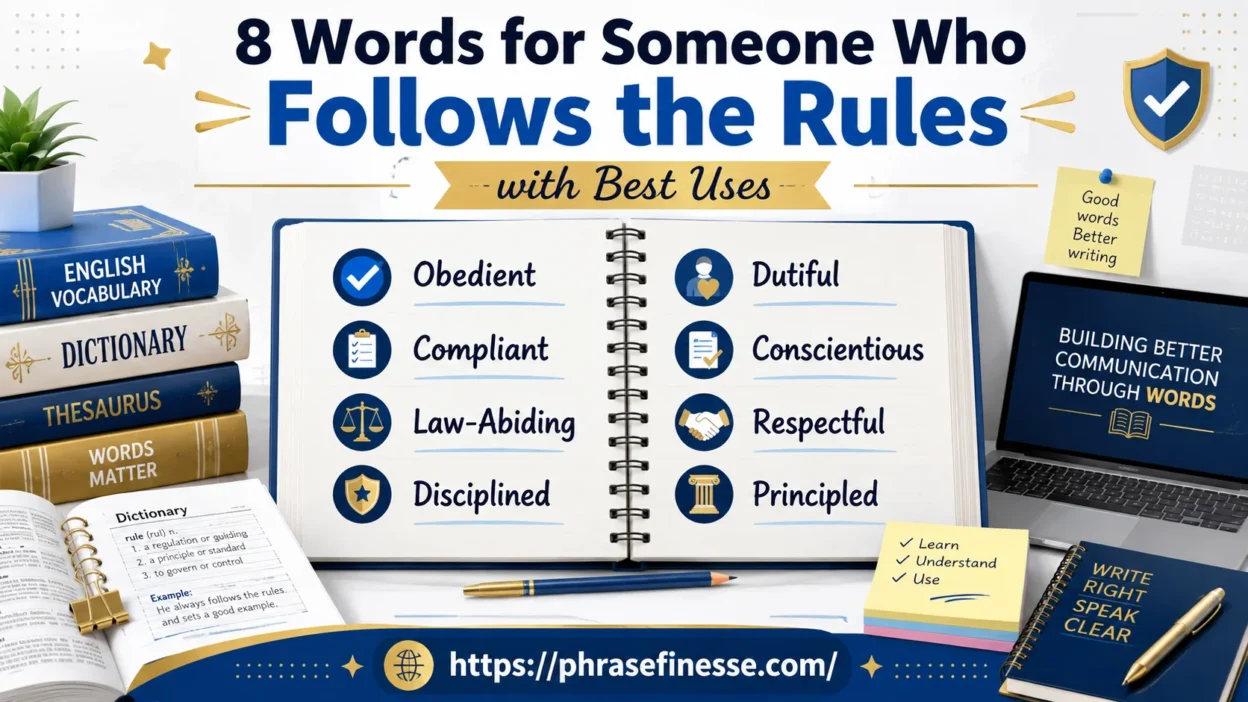
Have you ever wondered what to call a person who always follows instructions, respects policies, and sticks to established standards? If so, this guide to 8 Words For Someone Who Follows The Rules will help you expand your vocabulary with precise and context-appropriate alternatives.
Whether you’re discussing workplace behavior, academic settings, or everyday interactions, choosing the right term can improve English usage, formal writing, and overall communication.
Language becomes more effective when it reflects the exact meaning you intend to convey. In professional environments involving business communication, project management, meetings, scheduling, and time management, describing a rule-abiding individual accurately can add clarity and professionalism.
The same applies to contexts such as online booking, calendar organization, broadcasting, and other tasks where consistency, reliability, and adherence to procedures matter.
In this article, you’ll discover eight useful words that describe someone who follows rules, along with their meanings, nuances, and practical examples.
We’ll also explore when each term works best, helping you strengthen your vocabulary, improve grammar, and communicate with greater confidence in both casual conversations and professional settings.
Why Finding the Right Word Matters
Not everyone who follows rules does so for the same reason.
Consider these examples:
- A student follows classroom rules because they respect authority.
- An employee follows company policies because they value professionalism.
- A citizen follows laws because they believe in social order.
- A soldier follows commands because discipline is essential.
All of these people follow rules. However, the motivation behind their behavior differs.
That’s why selecting the most accurate synonym helps improve communication. The right word creates a clearer picture for readers and listeners.
Quick Comparison Table: Words for Someone Who Follows the Rules
| Word | Meaning | Tone | Best Used For |
| Obedient | Willing to follow commands | Neutral | Children, pets, authority relationships |
| Compliant | Following regulations or requests | Formal | Business, legal, healthcare |
| Law-abiding | Respecting laws | Positive | Citizens and communities |
| Disciplined | Showing self-control | Positive | Students, athletes, professionals |
| Dutiful | Performing responsibilities faithfully | Positive | Family, military, work |
| Conscientious | Careful and responsible | Very Positive | Professional environments |
| Respectful | Showing regard for rules and authority | Positive | Social and workplace settings |
| Principled | Guided by strong moral standards | Strongly Positive | Ethics and character discussions |
Obedient
Obedient describes a person who willingly follows instructions, commands, or authority.
The word often appears when discussing children, students, employees, military personnel, or even pets.
Meaning of Obedient
An obedient person listens carefully and follows directions without unnecessary resistance.
They tend to respect authority figures and comply with expectations.
Examples
- The child was obedient and completed all assigned chores.
- She remained obedient to the team’s guidelines.
- The recruits were trained to be obedient during critical operations.
Strengths of This Word
The term clearly communicates compliance and respect for authority.
However, it can sometimes imply a lack of independent thinking depending on context.
Best Situations to Use It
Use obedient when emphasizing someone’s willingness to follow instructions rather than their personal judgment.
Compliant
Compliant is one of the most common professional and legal terms for someone who follows rules.
Organizations frequently use this word when discussing regulations, standards, and requirements.
Meaning of Compliant
A compliant person follows established policies, procedures, or regulations.
Unlike obedient, compliant sounds more formal and less emotional.
Examples
- The company remained compliant with government regulations.
- Employees must stay compliant with workplace safety standards.
- The patient was compliant with medical instructions.
Where You Often See This Word
Common industries include:
- Healthcare
- Finance
- Manufacturing
- Corporate governance
- Information technology
- Human resources
Example in Business
Imagine a company handling customer data.
If employees follow privacy regulations correctly, auditors may describe the organization as compliant.
That single word communicates adherence to a complex set of rules and standards.
Read More: 7 Best Ways to Politely Ask Someone to Be Patient
Law-Abiding
When discussing people who follow laws, law-abiding is often the most accurate term.
Meaning of Law-Abiding
A law-abiding person respects legal systems and avoids criminal activity.
The phrase highlights civic responsibility and good citizenship.
Examples
- Most law-abiding citizens pay taxes on time.
- The community consists largely of law-abiding residents.
- He built a reputation as a law-abiding businessman.
Why This Word Is Powerful
The term instantly communicates trustworthiness.
Unlike obedient or compliant, it focuses specifically on legal behavior rather than workplace rules or personal instructions.
Common Contexts
You will often encounter this phrase in discussions about:
- Public policy
- Crime prevention
- Citizenship
- Government programs
- Community development
Disciplined
Disciplined goes beyond simply following rules.
It suggests self-control and personal commitment.
Meaning of Disciplined
A disciplined person consistently follows standards, routines, and expectations even when nobody is watching.
This distinction matters.
They follow rules because they believe in the value of structure rather than because someone forces them to comply.
Examples
- Successful athletes are highly disciplined.
- She maintained a disciplined study schedule.
- The executive followed a disciplined decision-making process.
Characteristics of Disciplined People
Many disciplined individuals demonstrate:
- Self-control
- Consistency
- Focus
- Reliability
- Accountability
- Persistence
Real-World Example
Elite athletes often wake up before sunrise for training.
No coach stands beside them every minute.
Their commitment comes from internal discipline rather than external pressure.
That’s what makes disciplined such a powerful word.
Dutiful
Dutiful describes someone who fulfills obligations responsibly and faithfully.
Meaning of Dutiful
A dutiful person takes responsibilities seriously and performs them without complaint.
The word often suggests loyalty and dedication.
Examples
- She was a dutiful daughter who cared for her parents.
- The officer remained dutiful throughout his service.
- He fulfilled his duties in a dutiful manner.
Difference Between Dutiful and Obedient
Although both words involve following expectations, there is a subtle distinction.
| Dutiful | Obedient |
| Motivated by responsibility | Motivated by authority |
| Focuses on obligations | Focuses on commands |
| Often voluntary | Often directive-based |
| Stronger sense of commitment | Stronger sense of compliance |
Why Writers Like This Word
Dutiful often carries a positive emotional tone.
It suggests honor, commitment, and responsibility rather than mere compliance.
Conscientious
Many language experts consider conscientious one of the strongest compliments in professional settings.
Meaning of Conscientious
A conscientious person is careful, responsible, and attentive to details.
They follow rules because they genuinely care about doing things correctly.
Examples
- She is a conscientious employee.
- The accountant remained conscientious when reviewing financial records.
- He completed every task in a conscientious manner.
Traits of Conscientious Individuals
Common qualities include:
- Accuracy
- Dependability
- Organization
- Integrity
- Thoroughness
- Accountability
Workplace Importance
Employers highly value conscientious workers because they require less supervision and often produce higher-quality results.
Research in organizational psychology consistently identifies conscientiousness as one of the strongest predictors of workplace success.
Case Study: The Conscientious Employee
Consider two employees.
Both follow company policies.
One follows them only because management monitors performance.
The other follows them because accuracy matters personally.
The second employee demonstrates conscientious behavior.
That distinction often leads to greater trust and career advancement.
Respectful
Respectful focuses on attitude rather than strict compliance.
Meaning of Respectful
A respectful person values rules, traditions, boundaries, and authority figures.
They understand why guidelines exist and act accordingly.
Examples
- The students remained respectful throughout the event.
- She was respectful of company policies.
- He showed respectful behavior toward community regulations.
Benefits of Respectfulness
Respectful people often:
- Build stronger relationships
- Earn trust quickly
- Reduce workplace conflict
- Improve collaboration
- Create positive environments
Why Respect Matters
Rules alone rarely create harmony.
Respect creates the willingness to honor those rules and the people behind them.
Principled
Among all the words on this list, principled carries the strongest moral dimension.
Meaning of Principled
A principled person follows rules because their values align with ethical standards.
They act according to deeply held beliefs.
Examples
- She is a principled leader.
- The judge remained principled despite public pressure.
- He made a principled decision even when it was difficult.
What Makes Someone Principled?
Principled individuals often demonstrate:
- Integrity
- Honesty
- Fairness
- Consistency
- Accountability
- Moral courage
Example
Imagine a manager who refuses to manipulate financial reports despite pressure from executives.
That person isn’t merely compliant.
They are principled.
Their actions stem from ethics rather than external enforcement.
How These Words Differ
At first glance, these words seem similar.
However, each highlights a different aspect of rule-following behavior.
Focus Comparison
| Word | Primary Focus |
| Obedient | Following commands |
| Compliant | Following regulations |
| Law-abiding | Following laws |
| Disciplined | Self-control |
| Dutiful | Responsibility |
| Conscientious | Carefulness |
| Respectful | Regard for authority |
| Principled | Moral values |
Understanding these differences helps you select the most precise word for your situation.
Positive and Negative Connotations
Not every synonym carries the same emotional tone.
Strongly Positive
- Principled
- Conscientious
- Disciplined
- Dutiful
Generally Positive
- Respectful
- Law-abiding
Neutral
- Compliant
- Obedient
Important Note
Context determines whether a word feels complimentary or critical.
For example:
“She is a disciplined professional.”
This sounds highly positive.
Meanwhile:
“He is blindly obedient.”
This may sound less flattering because it suggests limited independent judgment.
Choosing the Best Word for Different Situations
For Workplace Writing
Best options:
- Conscientious
- Compliant
- Disciplined
For Character Descriptions
Best options:
- Principled
- Dutiful
- Respectful
For Legal Contexts
Best option:
- Law-abiding
For Educational Settings
Best options:
- Obedient
- Disciplined
- Respectful
For Leadership Discussions
Best options:
- Principled
- Conscientious
Choosing the right term creates stronger communication and a more accurate description.
Common Mistakes When Describing Rule-Following People
Many writers use these words interchangeably.
That can create confusion.
Mistake: Using Obedient for Professionals
Instead of:
- “She is an obedient executive.”
Consider:
- “She is a conscientious executive.”
The second option sounds more professional and accurate.
Mistake: Using Compliant for Ethical Decisions
Instead of:
- “He was compliant with his values.”
Consider:
- “He was principled.”
Compliance relates to rules.
Principles relate to ethics.
Mistake: Using Law-Abiding in Workplace Contexts
Instead of:
- “She is a law-abiding employee.”
Consider:
- “She is a disciplined employee.”
Law-abiding specifically relates to legal conduct.
The Psychology Behind Following Rules
Human behavior researchers have long studied why people follow rules.
Several factors influence compliance and rule-following.
Internal Motivation
People follow rules because they believe those rules are beneficial.
This often leads to:
- Discipline
- Conscientiousness
- Principle-driven behavior
External Motivation
People follow rules because they want rewards or wish to avoid punishment.
This often leads to:
- Obedience
- Compliance
Social Motivation
People follow rules because they want acceptance from others.
This often leads to:
- Respectful behavior
- Community cooperation
The strongest and most sustainable form of rule-following typically comes from internal motivation.
When people believe in the value of a rule, they are more likely to follow it consistently.
Famous Examples of Rule-Following Characteristics
Throughout history and modern society, many respected figures have been known for discipline, integrity, and responsibility.
Traits Commonly Associated With Successful Individuals
| Trait | Benefit |
| Discipline | Consistent performance |
| Conscientiousness | Higher quality work |
| Integrity | Increased trust |
| Responsibility | Greater reliability |
| Respectfulness | Better relationships |
| Principle-driven behavior | Ethical leadership |
These traits often overlap and reinforce one another.
A disciplined person may also be conscientious.
A principled person may also be dutiful.
The most respected individuals typically combine several of these qualities.
Quick Reference List: 8 Words for Someone Who Follows the Rules
If you need a fast answer, here are the top options:
- Obedient
- Compliant
- Law-abiding
- Disciplined
- Dutiful
- Conscientious
- Respectful
- Principled
Each word carries a slightly different meaning. Choosing the right one depends on whether you’re emphasizing authority, responsibility, self-control, legal behavior, or moral values.
FAQs
1. What is a word for someone who follows the rules?
Several words can describe someone who follows the rules, including compliant, obedient, disciplined, law-abiding, dutiful, and conscientious. The best choice depends on the specific context and tone you want to convey.
2. Is being rule-following considered a positive trait?
In most situations, yes. Following rules often demonstrates responsibility, reliability, consistency, and respect for established standards. These qualities are highly valued in workplaces, schools, and professional environments.
3. What is the difference between “obedient” and “compliant”?
Obedient usually refers to willingly following instructions or authority figures, while compliant often means adhering to rules, regulations, or requirements. “Compliant” is commonly used in business, legal, and professional contexts.
4. Which word is best for a professional setting?
Words like conscientious, disciplined, and compliant are often preferred in professional settings. They highlight qualities such as attention to detail, accountability, and adherence to workplace policies.
5. Can “law-abiding” describe someone who follows all rules?
Not exactly. Law-abiding specifically refers to someone who obeys laws. It does not necessarily imply following every workplace policy, school rule, or personal guideline.
6. Why is it important to know different words for someone who follows the rules?
Using a variety of terms improves English usage, strengthens formal writing, and helps you communicate more precisely. Different words carry different shades of meaning, allowing you to match your language to the situation.
Conclusion
Choosing the right word to describe a person who follows rules can make your writing and speech more accurate and engaging. As we’ve explored in these 8 Words For Someone Who Follows The Rules, each term carries its own nuance, whether it emphasizes obedience, discipline, reliability, or compliance. Understanding these distinctions can enhance your grammar, improve business communication, and strengthen your overall vocabulary.
The next time you need to describe someone who consistently respects guidelines, follows procedures, or values consistency, you’ll have a range of precise alternatives to choose from. By selecting the most appropriate word for the context, you can communicate more clearly and effectively in both professional and everyday situations.

Emma Brooke is an English language specialist, editor, and content writer at Phrase Finesse, where she helps readers develop stronger writing and communication skills through clear, practical, and engaging content. With a passion for the English language, she specializes in simplifying grammar rules, vocabulary, spelling, punctuation, and word usage for learners at every level.
Emma has extensive experience creating educational content that is accurate, well-researched, and easy to understand. She is particularly skilled at explaining confusing word pairs, grammar concepts, idioms, sentence structure, and effective writing techniques, making complex topics approachable for students, professionals, educators, and English learners worldwide.