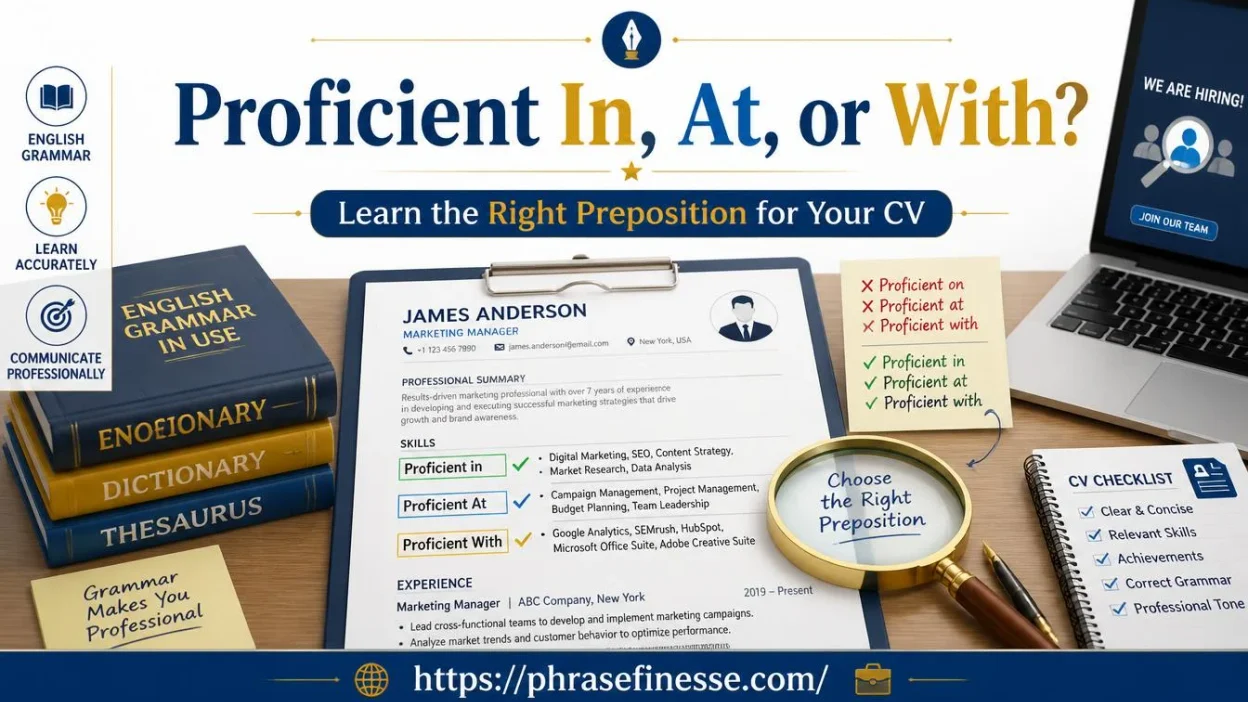
Have you ever paused while writing your CV and wondered whether you should say Proficient In or At, or With? Learn the Right Preposition for Your CV? That small choice can make a noticeable difference in professional writing, English usage, and the overall credibility of your resume.
Using the correct preposition demonstrates strong grammar, improves formal writing, and helps employers quickly understand your skills with greater consistency and confidence.
Choosing between proficient in, proficient at, and proficient with is easier once you understand how each expression works in real-life contexts. In this guide, you’ll learn the grammar rules, common usage patterns, and practical examples for CVs, cover letters, and workplace communication.
You’ll also discover how these prepositions apply to skills such as project management, time management, business communication, scheduling, meetings, calendar organization, online booking systems, and broadcasting, ensuring your writing sounds natural and professional.
By the end of this article, you’ll know exactly when to use each preposition, avoid common mistakes, and write stronger, more polished job application documents.
With 28 practical examples, expert explanations, and easy-to-follow comparisons, you’ll gain the confidence to describe your abilities accurately while improving your English grammar, resume writing, and overall professional communication.
What Does “Proficient” Mean?
Before discussing prepositions, it’s important to understand the word itself.
Proficient means having a high degree of skill, competence, or expertise in a particular area. Someone who is proficient can perform tasks effectively without constant supervision or assistance.
Dictionary Meaning of Proficient
A proficient person demonstrates:
- Strong knowledge
- Practical experience
- Consistent performance
- Competence in applying skills
- Ability to work independently
Example
- A person who speaks Spanish fluently may be proficient in Spanish.
- An accountant who prepares financial statements accurately may be proficient in accounting.
- A designer who uses Photoshop daily may be proficient with Adobe Photoshop.
Think of proficiency as being beyond beginner level. You don’t just know something exists—you can actually use it effectively.
Is It Proficient In, At, or With?
The Short Answer
The correct preposition depends on what follows the word proficient.
| Expression | Best Use | Example |
| Proficient in | Subjects, fields, languages, areas of expertise | Proficient in English |
| Proficient at | Activities, tasks, actions | Proficient at public speaking |
| Proficient with | Tools, software, equipment | Proficient with Microsoft Excel |
Here’s a simple rule:
In = knowledge
At = performance
With = tools
Once you remember that formula, choosing the correct preposition becomes much easier.
When to Use Proficient In
Among all three options, proficient in is the most common and widely accepted phrase in professional communication.
Why Proficient In Is So Common
The preposition in typically refers to knowledge, expertise, specialization, or mastery within a field.
You are proficient in something when that thing represents an area of knowledge or study.
Common Examples of Proficient In
- Proficient in English
- Proficient in Spanish
- Proficient in accounting
- Proficient in project management
- Proficient in data analysis
- Proficient in financial reporting
- Proficient in software development
- Proficient in digital marketing
Resume Examples
Strong Examples
- Proficient in business communication and professional writing.
- Proficient in financial analysis and forecasting.
- Proficient in customer relationship management.
- Proficient in data visualization techniques.
Weak Examples
- Proficient with English.
- Proficient at accounting.
These alternatives sound unnatural because English and accounting represent fields of knowledge rather than tools or activities.
Why Recruiters Prefer Proficient In
Hiring managers frequently scan resumes in seconds.
The phrase proficient in immediately signals expertise in a subject area. It has become the standard wording across industries.
For example:
| Better Choice | Less Natural Choice |
| Proficient in French | Proficient with French |
| Proficient in accounting | Proficient at accounting |
| Proficient in cybersecurity | Proficient with cybersecurity |
When to Use Proficient At
While less common than proficient in, proficient at is completely correct.
The Grammar Behind Proficient At
The preposition at usually focuses on activities, tasks, actions, or performance.
It answers the question:
What are you good at doing?
Common Examples
- Proficient at public speaking
- Proficient at negotiating contracts
- Proficient at problem-solving
- Proficient at managing teams
- Proficient at conflict resolution
- Proficient at troubleshooting technical issues
Real-World Examples
Sales Professional
- Proficient at building client relationships.
- Proficient at closing high-value deals.
Manager
- Proficient at team leadership.
- Proficient at employee development.
Customer Service Representative
- Proficient at handling customer complaints.
- Proficient at resolving service issues.
Why Proficient At Appears Less Often on Resumes
Most resumes emphasize knowledge and qualifications.
As a result, people naturally use proficient in more frequently.
However, when discussing performance-based abilities, proficient at often sounds more precise.
Compare these examples:
| Sentence | Natural? |
| Proficient at public speaking | Yes |
| Proficient in public speaking | Also acceptable |
| Proficient at negotiating | Yes |
| Proficient in negotiating | Acceptable but less direct |
When to Use Proficient With
The preposition focuses on tools, systems, equipment, software, or technology.
Understanding Proficient With
You are usually proficient with something that you operate, use, manage, or handle.
Think about physical or digital tools.
Common Examples
- Proficient with Microsoft Excel
- Proficient with Salesforce
- Proficient with QuickBooks
- Proficient with Adobe Photoshop
- Proficient with CRM platforms
- Proficient with laboratory equipment
- Proficient with AutoCAD
Professional Examples
Marketing Specialist
- Proficient with Google Analytics.
- Proficient with HubSpot.
Graphic Designer
- Proficient with Adobe Illustrator.
- Proficient with Figma.
Software Engineer
- Proficient with Git.
- Proficient with Docker.
Healthcare Professional
- Proficient with electronic health record systems.
Why Employers Value Tool Proficiency
Modern workplaces depend heavily on software and technology.
Recruiters often search for tool-specific keywords.
For example, a company hiring an accountant may specifically look for candidates who are:
- Proficient with QuickBooks
- Proficient with SAP
- Proficient with Oracle Financials
In these cases, proficiency communicates practical hands-on experience.
Proficient In vs. Proficient At vs. Proficient With
The differences become clearer when viewed side by side.
| Phrase | Focus | Common Usage |
| Proficient in | Knowledge or expertise | Languages, subjects, disciplines |
| Proficient at | Performance or activity | Tasks, actions, skills |
| Proficient with | Tools or systems | Software, equipment, technology |
Which Form Sounds Best on a CV or Resume?
The answer depends on what you’re describing.
Use Proficient In For
- Languages
- Academic subjects
- Professional disciplines
- Areas of expertise
Examples:
- Proficient in English
- Proficient in accounting
- Proficient in digital marketing
Use Proficient At For
- Tasks
- Activities
- Performance-based abilities
Examples:
- Proficient at negotiating
- Proficient at conflict resolution
- Proficient at strategic planning
Use Proficient With For
- Software
- Technology
- Equipment
- Systems
Examples:
- Proficient with Microsoft Office
- Proficient with Salesforce
- Proficient with project management tools
See More :Well Noted Meaning in Emails: 12 Professional Synonyms
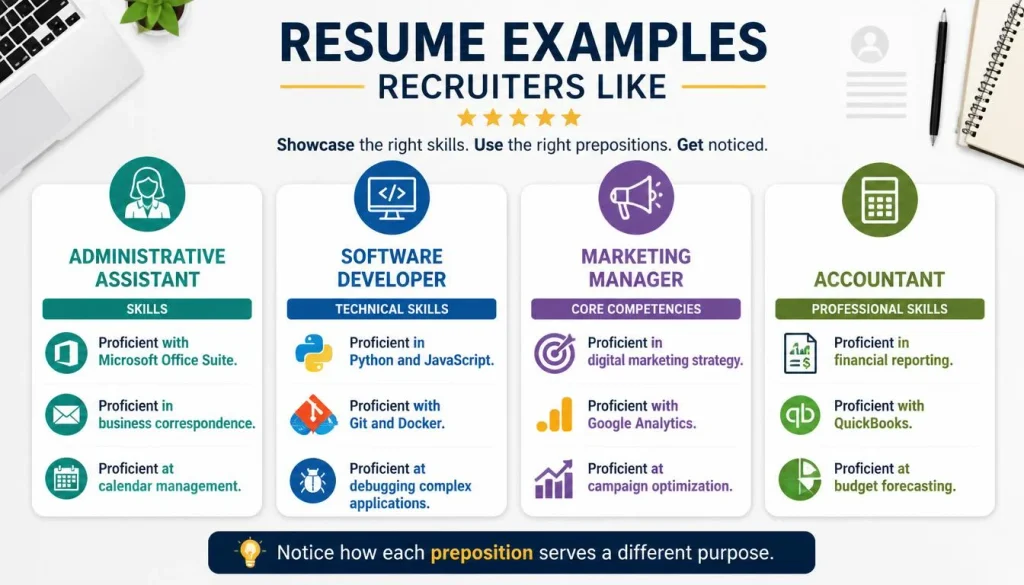
Resume Examples Recruiters Like
Administrative Assistant
Skills
- Proficient with Microsoft Office Suite.
- Proficient in business correspondence.
- Proficient at calendar management.
Software Developer
Technical Skills
- Proficient in Python and JavaScript.
- Proficient with Git and Docker.
- Proficient at debugging complex applications.
Marketing Manager
Core Competencies
- Proficient in digital marketing strategy.
- Proficient with Google Analytics.
- Proficient at campaign optimization.
Accountant
Professional Skills
- Proficient in financial reporting.
- Proficient with QuickBooks.
- Proficient at budget forecasting.
Notice how each preposition serves a different purpose.
Common Mistakes to Avoid
Even experienced professionals sometimes misuse these phrases.
Using Proficient With for Languages
Incorrect:
- Proficient with English
- Proficient with French
Correct:
- Proficient in English
- Proficient in French
Languages represent knowledge areas, not tools.
Using Proficient At for Software
Less Natural:
- Proficient at Microsoft Excel
Better:
- Proficient with Microsoft Excel
Excel is a software application, making with the stronger choice.
Overstating Your Skill Level
Many applicants label themselves proficient after minimal exposure.
Employers often test skills during interviews.
Skill-Level Comparison
| Level | Meaning |
| Beginner | Limited experience |
| Intermediate | Working knowledge |
| Advanced | Strong competence |
| Proficient | Consistent high-level performance |
| Expert | Deep specialization and mastery |
Honesty always wins.
Claiming proficiency without evidence can create problems later.
Being Too Vague
Weak statement:
- Proficient in computer skills.
Stronger statement:
- Proficient with Microsoft Excel, Power BI, and Tableau.
Specific details build credibility.
Real-World Case Studies
Case Study: Marketing Coordinator
Original Resume
- Proficient in software.
- Proficient in marketing.
The statements are vague.
Improved Resume
- Proficient with Google Analytics, HubSpot, and SEMrush.
The revised version immediately tells recruiters what skills the candidate possesses.
Case Study: Customer Service Manager
Original Resume
- Proficient at communication.
Improved Resume
- Proficient at resolving customer complaints and managing escalations.
The second version demonstrates practical ability rather than making a broad claim.
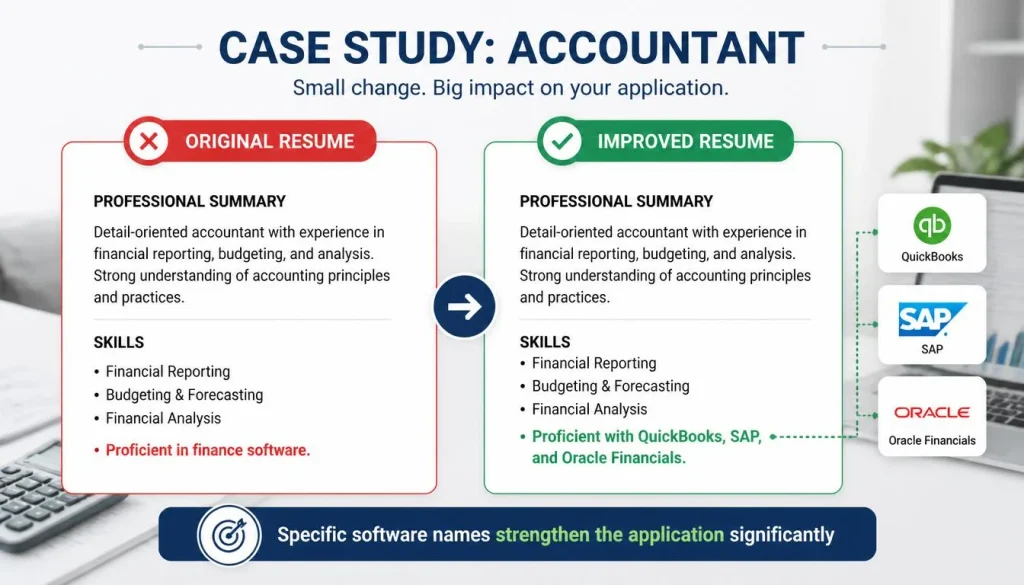
Case Study: Accountant
Original Resume
- Proficient in finance software.
Improved Resume
- Proficient with QuickBooks, SAP, and Oracle Financials.
Specific software names strengthen the application significantly.
Alternative Ways to Say Proficient on a Resume
Repeating the word proficient multiple times can make your resume sound repetitive.
Fortunately, several alternatives work well.
Strong Resume Synonyms
| Alternative | Example |
| Skilled in | Skilled in project management |
| Experienced in | Experienced in financial analysis |
| Adept at | Adept at client negotiations |
| Competent in | Competent in data analysis |
| Experienced with | Experienced with Salesforce |
| Advanced knowledge of | Advanced knowledge of Excel |
| Highly capable in | Highly capable in strategic planning |
Examples
Instead of:
- Proficient in project management.
You might write:
- Skilled in project management methodologies.
Instead of:
- Proficient with Excel.
You could write:
- Advanced knowledge of Microsoft Excel.
These alternatives often sound more dynamic and persuasive.
Expert Tips for Listing Skills on a CV
Match Skills to the Job Description
Many employers use Applicant Tracking Systems (ATS).
The software scans resumes for keywords.
If a job posting requests:
- Salesforce
- CRM management
- Data analysis
Include those exact skills when appropriate.
Be Specific
Specific skills outperform generic descriptions.
Compare:
Weak
- Proficient with software.
Strong
- Proficient with Salesforce, HubSpot, and Microsoft Dynamics.
Specificity creates confidence.
Back Up Your Claims
Anyone can write “proficient.”
Evidence proves it.
Examples:
- Increased customer retention by 25% using Salesforce.
- Built Excel dashboards that reduced reporting time by 40%.
- Managed digital campaigns generating 500,000 monthly impressions.
Results make proficiency believable.
Use Consistent Formatting
Keep skill descriptions uniform.
Example:
Proficient in data analysis
Proficient in project management
Proficient with Microsoft Excel
Proficient with Power BI
Consistency improves readability.
Avoid Buzzword Overload
Recruiters see countless resumes filled with vague phrases.
Examples include:
- Hard worker
- Team player
- Results-oriented
- Go-getter
Concrete skills always carry more weight than generic buzzwords.
Why Correct Prepositions Matter More Than You Think
A single preposition won’t determine whether you get hired.
However, strong communication skills influence hiring decisions.
Small language choices create subtle impressions.
When recruiters see:
- Proficient in English
- Proficient with Salesforce
- Proficient at conflict resolution
The wording feels natural and polished.
When prepositions don’t fit, the resume can sound awkward even if the candidate is qualified.
Grammar won’t land the job by itself. Yet clear communication often helps candidates stand out in competitive hiring markets.
FAQs
1. Which is correct: proficient in, proficient at, or proficient with?
All three are grammatically correct, but they are used differently. Proficient in is the most common choice for describing knowledge or expertise in a subject. Proficient at emphasizes skill in performing a task, while proficient with is typically used for tools, software, equipment, or technology.
2. Should I write proficient in Microsoft Excel or proficient with Microsoft Excel on my CV?
Both are acceptable, but proficient in Microsoft Excel is generally preferred on resumes because it highlights your expertise in using the software. Proficient with Microsoft Excel is also natural when emphasizing familiarity with the tool itself.
3. Is proficiency appropriate for a resume?
Yes. Use proficient when referring to activities or tasks, such as proficient at problem-solving, proficient at public speaking, or proficient at managing projects. However, it appears less frequently on CVs than proficient in.
4. Can I say proficient in communication skills?
Yes. This is a common and professional phrase. You can also be more specific by writing proficient in business communication, proficient in written communication, or proficient in client communication to make your CV stronger.
5. What is the difference between proficient and proficiently?
Proficient is an adjective that describes a person’s level of skill, while proficiently is an adverb that describes how an action is performed. For example:
- She is proficient in data analysis.
- She completed the task proficiently.
6. Which preposition do employers expect to see on a CV?
In most professional resumes and job applications, proficient in is the standard and most widely accepted choice. It sounds natural, professional, and aligns with common business writing conventions.
Conclusion
Choosing the correct preposition after proficient may seem like a small detail, but it can significantly improve the clarity and professionalism of your writing.
In most situations, proficient in is the best choice for describing expertise, proficient at works well for specific activities or tasks, and proficient with is ideal when referring to software, tools, or equipment.
By understanding these distinctions and applying the examples in this guide, you can write a stronger CV, communicate your skills more accurately, and avoid common grammar mistakes.
Whether you’re updating your resume, writing a cover letter, or improving your everyday professional English, using the right preposition will help your qualifications stand out with confidence and precision.

Alyan Ashraf is an English language writer and editor at Phrase Finesse, where he specializes in grammar, vocabulary, spelling, word usage, and clear communication. Passionate about the English language, he creates practical, research-backed content that helps readers avoid common mistakes and write with greater accuracy and confidence.
Known for his clear writing style and attention to detail, Alyan simplifies complex language topics into easy-to-understand guides filled with real-world examples and actionable insights. His work covers confusing word pairs, grammar rules, idioms, punctuation, and everyday English usage, making learning both accessible and engaging for students, professionals, writers, and non-native English speakers.
Every article Alyan writes is carefully researched, fact-checked, and designed to meet high editorial standards. His goal is to help readers strengthen their English skills, expand their vocabulary, and communicate more effectively in academic, professional, and everyday settings.
Through Phrase Finesse, Alyan is committed to publishing trusted language resources that make mastering English simpler, clearer, and more enjoyable for learners around the world