Have you ever wondered whether “Much More” is being used correctly in a sentence? While the phrase seems simple, many writers and speakers misuse it in everyday English usage, grammar, and formal writing. Understanding “Much More” – Meaning & Correct Use can help you communicate with greater clarity, consistency, and confidence in both professional and casual contexts.
The expression “much more” is commonly used to emphasize a greater amount, degree, or extent of something. You’ll often encounter it in business communication, meetings, project management, and workplace discussions involving scheduling, time management, and calendar planning. It also appears frequently in marketing content, broadcasting, customer support messages, and online booking platforms where precise language matters.
In this guide, you’ll learn the exact meaning of “much more,” how to use it correctly in different situations, and the common mistakes to avoid. We’ll explore practical examples, grammar rules, and real-world applications to improve your writing and speaking skills. By the end, you’ll know when “much more” is the right choice and how to use it naturally for clear, professional, and effective communication.
What Does “Much More” Mean?
The phrase “much more” means a significantly greater amount, degree, quantity, or extent than something else.
The word “more” already indicates an increase or comparison. Adding “much” strengthens that comparison and shows that the difference is substantial rather than small.
Simple Definition
Much more = considerably more, significantly more, or far more.
Consider these examples:
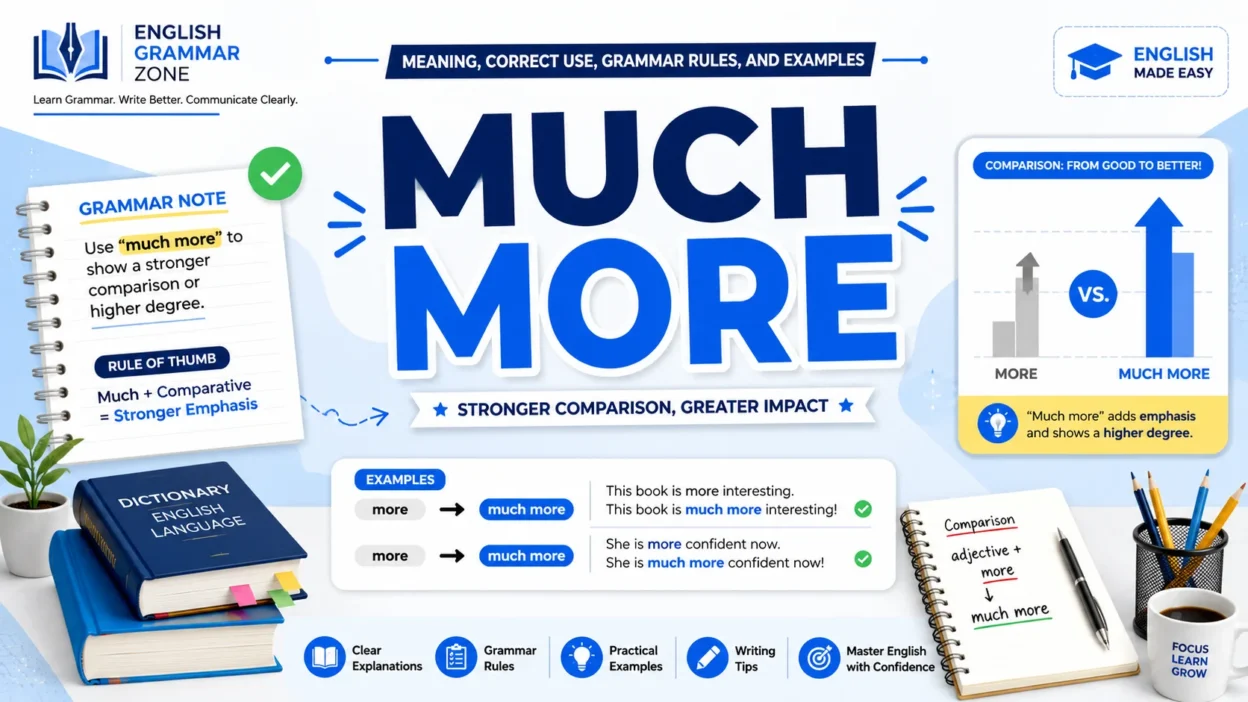
- This laptop is more expensive than that one.
- This laptop is much more expensive than that one.
The second sentence suggests a noticeably larger price difference.
Why Native Speakers Use It So Often
Native English speakers frequently use “much more” because it adds emphasis without making a sentence complicated.
Instead of saying:
The project was more difficult than expected.
You can say:
The project was much more difficult than expected.
The second sentence communicates a stronger and clearer message.
Quick Examples
| Sentence | Meaning |
| The exam was much more difficult. | The difficulty increased significantly. |
| We need much more time. | We need a larger amount of time. |
| She is much more confident now. | Her confidence has improved greatly. |
| The new software works much more efficiently. | Efficiency increased substantially. |
How “Much More” Functions in Grammar
To use “much more” correctly, you need to understand its grammatical role.
In most cases, “much” acts as an intensifier.
An intensifier strengthens the word that follows it.
Basic Formula
The most common structure is:
Much + More + Comparative Form
Examples:
- Much more effective
- Much more reliable
- Much more useful
- Much more expensive
Why It Works
The word “more” creates the comparison.
The word “much” increases the strength of that comparison.
Think of it like this:
| Phrase | Strength |
| More | Normal comparison |
| Much More | Strong comparison |
| Significantly More | Very strong comparison |
Visual Diagram
More
↓
Greater than something else
Much More
↓
Far greater than something else
When to Use “Much More”
The phrase works best when you want to highlight a meaningful difference.
Comparing Two Things
Comparisons represent the most common use.
Examples:
- This phone is much more powerful than the previous model.
- Summer is much more popular than winter for tourism.
- Electric vehicles are becoming much more common.
The comparison becomes stronger and easier for readers to understand.
Emphasizing a Difference
Sometimes the difference between two things is small.
Other times it is enormous.
Compare these examples:
- The second option is more practical.
- The second option is much more practical.
The second sentence suggests a larger gap in practicality.
Discussing Quantities
“Much more” frequently appears with quantities and amounts.
Examples:
- We need much more money.
- They invested much more effort.
- The company requires much more data.
- Students now have access to much more information.
Formal and Informal English
One reason “much more” is so useful is its flexibility.
It works in:
- Academic papers
- Business reports
- Emails
- Presentations
- Everyday conversations
- News articles
Examples:
Formal
The revised methodology proved much more effective than the original approach.
Informal
This movie is much more fun than the last one.
Read More: Sewed or Sewn? Difference Explained with Helpful Examples
Common Sentence Patterns with “Much More”
Understanding sentence patterns helps you avoid mistakes.
Much More + Comparative Adjective
This structure appears most often.
Examples:
- Much more expensive
- Much more comfortable
- Much more efficient
- Much more attractive
- Much more reliable
Example Sentences
- The new engine is much more efficient.
- Online banking is much more convenient.
- The updated design looks much more professional.
- Remote work became much more common after 2020.
Much More + Noun
Here, “much more” refers to a larger amount of something.
Examples:
- Much more experience
- Much more patience
- Much more information
- Much more energy
- Much more confidence
Example Sentences
- She has much more experience than I do.
- We need much more information before deciding.
- Parents often develop much more patience over time.
Much More + Adverb
This pattern modifies actions.
Examples:
- Much more quickly
- Much more carefully
- Much more efficiently
- Much more effectively
Example Sentences
- The system processes data much more quickly.
- Employees now communicate much more effectively.
- The machine operates much more efficiently.
Much More Than
The phrase “much more than” introduces direct comparisons.
Examples:
- The project cost much more than expected.
- She earns much more than her coworkers.
- Success requires much more than talent.
This structure appears frequently in professional writing.
Difference Between “More” and “Much More”
Many learners assume these phrases mean exactly the same thing.
They don’t.
Both involve comparison. However, the strength differs significantly.
What “More” Means
“More” simply indicates an increase.
Example:
This route is more convenient.
The sentence tells us there is a difference.
It doesn’t tell us how large that difference is.
What “Much More” Means
“Much more” indicates a substantial increase.
Example:
This route is much more convenient.
Now the reader understands that the difference is significant.
Side-by-Side Comparison
| Phrase | Meaning | Strength |
| More | Greater amount | Moderate |
| Much More | Significantly greater amount | Strong |
| Far More | Stronger comparison | Very Strong |
| Considerably More | Formal strong comparison | Very Strong |
Example Set
More
This chair is more comfortable.
Much More
This chair is much more comfortable.
The first sentence suggests improvement.
The second suggests a dramatic improvement.
Difference Between “Much More” and “Many More”
This distinction causes confusion even among advanced learners.
The key difference involves countable and uncountable nouns.
Use “Much More” with Uncountable Nouns
Uncountable nouns cannot normally be counted individually.
Examples include:
- Water
- Money
- Information
- Time
- Knowledge
- Energy
Correct examples:
- We need much more water.
- She has much more experience.
- They spent much more money.
Use “Many More” with Countable Nouns
Countable nouns can be counted individually.
Examples include:
- Books
- Cars
- Students
- Houses
- Employees
Correct examples:
- We need many more chairs.
- The company hired many more employees.
- She read many more books this year.
Comparison Table
| Much More | Many More |
| Much more water | Many more bottles |
| Much more time | Many more hours |
| Much more information | Many more facts |
| Much more money | Many more dollars |
| Much more energy | Many more athletes |
Easy Rule
Ask yourself:
Can I count it individually?
If yes, use many more.
If no, use much more.
Difference Between “Much More” and “Far More“
These phrases often appear interchangeable.
In many situations, they are.
Similarities
Both phrases:
- Intensify comparisons
- Sound natural
- Work in formal writing
- Work in casual speech
Examples:
- The solution is much more effective.
- The solution is far more effective.
Both are grammatically correct.
Subtle Difference
“Far more” often sounds slightly stronger and more formal.
Compare:
The updated software is much more reliable.
The updated software is far more reliable.
The second sentence feels slightly more emphatic.
Frequently Asked Questions
1. What does “much more” mean?
“Much more” means a significantly greater amount, degree, or extent of something. It is used to add emphasis when comparing two things or highlighting an increase.
2. Is “much more” grammatically correct?
Yes, “much more” is grammatically correct when used to emphasize a comparative idea. For example, “This solution is much more effective than the previous one.”
3. Can “much more” be used in formal writing?
Absolutely. “Much more” is widely accepted in formal writing, academic papers, professional emails, and business communication when used appropriately.
4. What is the difference between “more” and “much more”?
“More” simply indicates a higher amount or degree, while “much more” adds stronger emphasis. For example, “The new system is more efficient” is weaker than “The new system is much more efficient.”
5. Can “much more” be used without a comparison?
Yes. Although it often appears in comparisons, “much more” can also refer to additional information or greater significance. For example, “The project involves budgeting, planning, and much more.”
6. What are some common mistakes when using “much more”?
Common mistakes include using “much more” where no emphasis is needed, creating redundant comparisons, or placing it awkwardly within a sentence. Reading the sentence aloud can help ensure it sounds natural and clear.
Conclusion
Understanding much more is essential for clear and effective communication. This versatile expression helps emphasize stronger comparisons and appears regularly in English usage, formal writing, business communication, and everyday conversations. Whether you’re discussing time management, project management, meetings, online booking, or general comparisons, using much more correctly can make your message more precise and impactful.
By following the grammar rules, reviewing practical examples, and avoiding common mistakes, you can confidently use much more in any context and improve the overall quality of your writing and speech.

Mia Rose is an English language specialist and editorial writer at Phrase Finesse, where she helps readers master grammar, vocabulary, spelling, and effective communication. Passionate about making English simple and practical, she creates well-researched, reader-friendly content that explains complex language concepts in a clear and engaging way.
With extensive experience in English language education, content writing, and editorial review, Mia specializes in grammar, punctuation, word choice, idioms, confusing word pairs, and writing style. Her articles are carefully researched, fact-checked, and designed to help students, professionals, writers, and English learners build confidence in both written and spoken English.