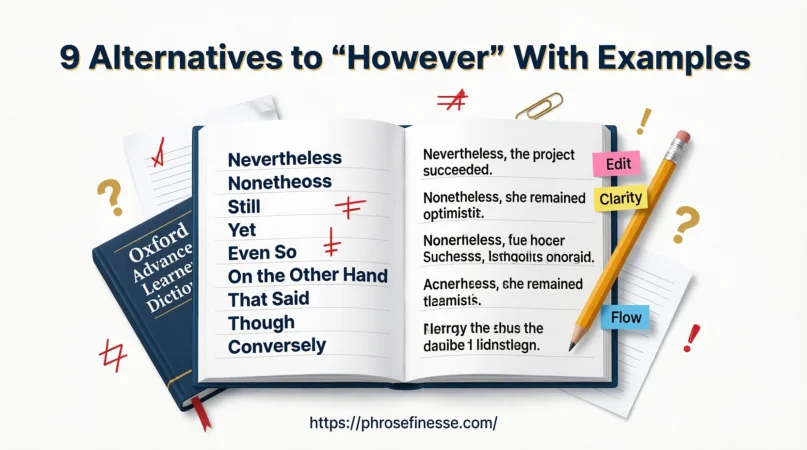
Have you ever repeated the word “however” so often that your writing starts to feel predictable? Finding fresh alternatives can make your sentences more engaging, professional, and natural.
In this guide, we’ll explore 9 Alternatives to “However” With Examples to help you improve English usage, strengthen your grammar, and create more effective formal writing. Whether you’re writing emails, articles, reports, or professional documents, choosing the right transition words can improve clarity and consistency.
Strong business communication depends on precise language and smooth transitions. While “however” is a useful contrast word, using the same expression repeatedly can make your writing feel repetitive.
This article explains powerful synonyms for however and shows how each alternative works in different situations, including meetings, project management, scheduling, and professional conversations. You’ll learn how to select words that match your tone, purpose, and audience.
From everyday sentences to advanced formal writing, the right transition can change how readers understand your message. We’ll cover alternatives that work across emails, presentations, broadcasting, online booking platforms, reports, and business documents.
By understanding these grammar choices and applying them correctly, you can create clearer communication, better structure, and more polished writing that supports effective time management and professional success.
What Does “However” Mean?
Before exploring alternatives, it’s helpful to understand exactly what “however” does.
Definition of “However”
However is a transitional adverb used to introduce a contrast, contradiction, or unexpected idea.
For example:
The project was expensive. However, it delivered excellent results.
The second sentence presents information that contrasts with what readers might expect from the first sentence.
When to Use “However”
You’ll commonly see however in:
- Academic essays
- Research papers
- Business reports
- Professional emails
- News articles
- Formal presentations
Because it sounds professional and neutral, writers often choose it by default.
Common Problems With Overusing “However”
Using the same transition repeatedly can create several issues:
| Problem | Impact |
| Repetition | Writing feels predictable |
| Monotony | Readers lose engagement |
| Lack of nuance | Different types of contrast sound identical |
| Weak style | Writing appears formulaic |
Strong writers vary their transitions based on context and tone.
Quick Comparison Table of Alternatives to “However”
| Alternative | Formality | Best Use |
| Nevertheless | Very Formal | Academic and analytical writing |
| Nonetheless | Formal | Emphasizing persistence despite obstacles |
| Still | Neutral | Everyday communication |
| Yet | Neutral | Concise contrasts |
| Even So | Neutral | Unexpected outcomes |
| On the Other Hand | Neutral | Comparing viewpoints |
| That Said | Semi-Formal | Qualifications and exceptions |
| Though | Informal | Conversational writing |
| Conversely | Formal | Opposing relationships |
Nevertheless: A Strong Formal Alternative to “However”
Among all alternatives, nevertheless is one of the closest substitutes.
Meaning of Nevertheless
Nevertheless means despite that or in spite of what was just stated.
It introduces a contrast while emphasizing that the second point remains true.
When to Use Nevertheless
Use it when writing:
- Research papers
- Formal reports
- Academic discussions
- Analytical articles
Examples of Nevertheless
The evidence was limited. Nevertheless, researchers continued the investigation.
The market declined significantly. Nevertheless, investors remained optimistic.
She lacked experience. Nevertheless, she earned the promotion.
Why Writers Choose Nevertheless
The word carries more weight than however.
Compare:
The task was difficult. However, we completed it.
The task was difficult. Nevertheless, we completed it.
The second version sounds more determined and emphatic.
Nonetheless: Similar but Slightly More Flexible
Many writers wonder whether nonetheless and nevertheless are interchangeable.
In most cases, they are.
Meaning of Nonetheless
Nonetheless means despite what has just been said.
It acknowledges a challenge while highlighting a result that occurred anyway.
Examples of Nonetheless
The budget was reduced. Nonetheless, the team met every deadline.
Rain was forecast throughout the day. Nonetheless, thousands attended the festival.
Competition increased dramatically. Nonetheless, sales continued growing.
Nevertheless vs. Nonetheless
| Feature | Nevertheless | Nonetheless |
| Formality | Slightly higher | Slightly lower |
| Common in academia | Yes | Yes |
| Common in journalism | Moderate | High |
| Everyday usage | Rare | More common |
Most readers will perceive both as equally professional.
Still: Simple, Natural, and Effective
Sometimes the best replacement for however is also the simplest.
Why “Still” Works
Still creates contrast without sounding formal.
It feels natural in speech and writing.
Examples of Still
The restaurant was crowded. Still, we found a table quickly.
The hike was exhausting. Still, the view made it worthwhile.
Prices increased. Still, customers continued purchasing the product.
Advantages of Using Still
- Easy to understand
- Natural flow
- Works in most contexts
- Less formal than “however”
Because of its simplicity, still often improves readability.
Yet: The Concise Alternative
If brevity matters, yet deserves attention.
Meaning of Yet
Yet introduces a contrast between two connected ideas.
Unlike however, it often joins clauses directly.
Examples of Yet
The task seemed impossible, yet they succeeded.
He trained for months, yet lost the competition.
The solution was simple, yet highly effective.
Why Writers Love Yet
Good writing often removes unnecessary words.
Compare:
The software was expensive. However, it saved money over time.
With:
The software was expensive, yet it saved money over time.
The second sentence feels tighter and more elegant.
Even So: Highlighting Unexpected Outcomes
Some contrasts involve surprise.
That’s where even so becomes useful.
Meaning of Even So
Even so means despite that fact.
It highlights outcomes that seem unexpected given previous information.
Examples of Even So
The weather forecast predicted storms. Even so, the event proceeded as planned.
The company faced criticism. Even so, customer loyalty remained strong.
She had little preparation time. Even so, her presentation impressed everyone.
Best Situations for Even So
Use it when:
- Expectations are challenged
- Results seem surprising
- Outcomes defy assumptions
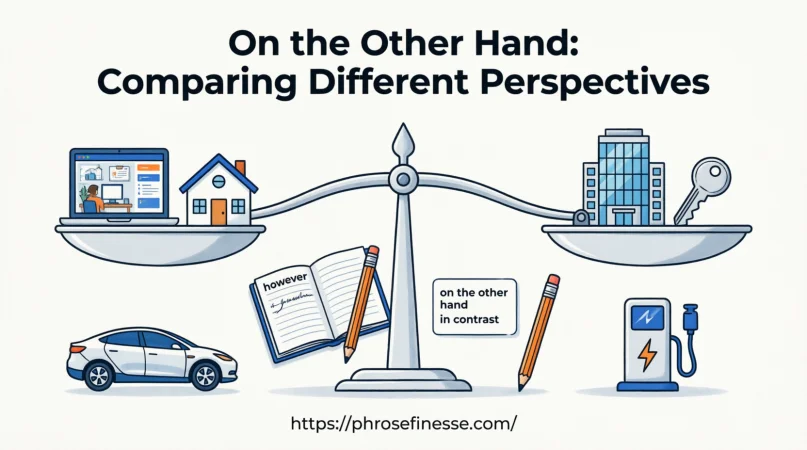
On the Other Hand: Comparing Different Perspectives
Not every contrast involves contradiction.
Sometimes you’re comparing alternatives.
Meaning of On the Other Hand
This phrase introduces another side of an issue.
It helps readers evaluate multiple viewpoints.
Examples
Remote work offers flexibility. On the other hand, office work encourages spontaneous collaboration.
Buying a home builds equity. On the other hand, renting provides greater mobility.
Electric vehicles reduce emissions. On the other hand, charging infrastructure remains limited in some regions.
Why It Works
The phrase signals balance.
Readers immediately understand that another perspective is coming.
See More :For Me or Myself? Correct Usage Explained
That Said: A Modern Professional Alternative
Business writers increasingly use that said.
Meaning of That Said
The phrase acknowledges a previous statement while introducing an exception or qualification.
Examples
The software is powerful. That said, new users may face a learning curve.
The investment carries risks. That said, long-term prospects remain strong.
Customer satisfaction improved significantly. That said, support response times still need improvement.
Why Professionals Prefer It
That said sounds:
- Natural
- Modern
- Professional
- Conversational
It bridges formal and informal communication effectively.
Though: Casual and Conversational
When writing informally, though often sounds more natural than however.
Meaning of Though
Though introduces contrast in a relaxed, conversational manner.
Examples
I wasn’t planning to buy it. Though, the discount changed my mind.
The movie was long. It was entertaining, though.
The project took longer than expected. The results were worth it, though.
Unique End-of-Sentence Usage
One advantage of though is flexibility.
For example:
I didn’t enjoy the beginning. The ending was excellent, though.
Very few alternatives work naturally in this position.
Conversely: Ideal for Opposite Relationships
Conversely works best when discussing direct opposites.
Meaning of Conversely
It introduces information that contrasts logically with the previous point.
Examples
Larger companies often prioritize stability. Conversely, startups typically prioritize growth.
Urban areas usually have greater public transportation access. Conversely, rural communities may depend more heavily on personal vehicles.
High-risk investments may generate large returns. Conversely, low-risk investments generally offer lower returns.
When to Use Conversely
This word is particularly effective in:
- Academic writing
- Research
- Data analysis
- Comparative discussions
How to Choose the Right Alternative to “However”
Choosing the best replacement depends on context.
For Academic Writing
Best choices:
- Nevertheless
- Nonetheless
- Conversely
Example:
The hypothesis appeared unsupported. Nevertheless, further research revealed additional evidence.
For Business Writing
Best choices:
- That Said
- Nevertheless
- Nonetheless
Example:
Revenue increased substantially. That said, operating costs also rose.
For Casual Writing
Best choices:
- Still
- Though
- Yet
Example:
It was expensive. Still, I don’t regret buying it.
For Persuasive Writing
Best choices:
- Nevertheless
- Even So
- Yet
Example:
The challenge is significant. Nevertheless, the opportunity outweighs the risk.
Common Mistakes When Replacing “However”
Many writers make substitution errors.
Using Formal Words in Casual Conversations
Imagine saying:
Nevertheless, I’ll meet you at the coffee shop.
It’s correct, but sounds unusually formal.
In conversation, still or though works better.
Confusing Comparison With Contrast
On the other hand compares alternatives.
However introduces contradiction.
These functions overlap sometimes, but they’re not identical.
Ignoring Tone
Each alternative creates a different impression.
| Word | Tone |
| Nevertheless | Formal |
| Nonetheless | Professional |
| Still | Friendly |
| Yet | Concise |
| Even So | Reflective |
| That Said | Modern |
| Though | Casual |
| Conversely | Analytical |
Choosing the wrong tone can make writing feel awkward.
Incorrect Punctuation
Many alternatives have different punctuation rules.
Examples:
Correct:
The evidence was limited. Nevertheless, the conclusion remained valid.
Correct:
The evidence was limited; nevertheless, the conclusion remained valid.
Correct:
The evidence was limited, yet the conclusion remained valid.
Understanding punctuation improves clarity.
However vs. Its Most Common Alternatives
| Word | Contrast | Formality | Typical Use |
| However | Yes | Formal | General writing |
| Nevertheless | Yes | Very Formal | Academic |
| Nonetheless | Yes | Formal | Professional |
| Still | Yes | Neutral | Everyday communication |
| Yet | Yes | Neutral | Concise writing |
| Even So | Yes | Neutral | Unexpected outcomes |
| On the Other Hand | Comparison + Contrast | Neutral | Balanced discussions |
| That Said | Qualification | Semi-Formal | Business writing |
| Though | Yes | Informal | Conversation |
| Conversely | Opposite Relationship | Formal | Analysis |
Are There Times When “However” Is Still the Best Choice?
Absolutely.
Replacing however isn’t always necessary.
Great writing values precision more than variety.
Situations Where “However” Excels
- Academic papers
- Legal documents
- Formal reports
- Technical writing
- Scientific publications
Its neutrality remains valuable.
Avoid Replacing It Just for Variety
Consider this example:
The experiment failed. However, researchers identified important findings.
The sentence is clear and effective.
Changing it merely to avoid repetition may not improve the writing.
Strong writers choose words based on meaning, not novelty.
Real-World Case Study: Improving a Repetitive Paragraph
Original Version
The product was expensive. However, customers purchased it frequently. However, support costs remained low. However, satisfaction scores increased significantly.
The repeated transition feels robotic.
Improved Version
The product was expensive. Nevertheless, customers purchased it frequently. Support costs remained low. Even so, satisfaction scores increased significantly. That said, management continued monitoring performance.
The paragraph now flows naturally and provides richer nuance.
Quick Reference Cheat Sheet
Use These Instead of “However”
| If You Want To… | Use |
| Sound highly formal | Nevertheless |
| Sound professional | Nonetheless |
| Sound natural | Still |
| Be concise | Yet |
| Show surprising results | Even So |
| Compare viewpoints | On the Other Hand |
| Add a qualification | That Said |
| Sound conversational | Though |
| Show opposites | Conversely |
FAQs
1. What are the best words to use instead of “however”?
Some effective alternatives to “however” include nevertheless, nonetheless, although, yet, still, on the other hand, conversely, despite this, and that said. The best choice depends on the sentence structure, tone, and level of formal writing required.
2. Is “however” considered a formal word?
Yes, “however” is considered a formal and widely accepted transition word. It is commonly used in academic writing, professional emails, reports, and business communication. However, using different alternatives can make your writing more engaging and prevent repetition.
3. Can I replace “however” with “but” in every sentence?
No, “but” and “however” are not always interchangeable. While both show contrast, “but” is more common in casual conversations, whereas “however” is often preferred in professional and academic contexts. Understanding the difference improves your grammar and overall English usage.
4. Which alternative to “however” is best for professional writing?
For professional documents, options like nevertheless, nonetheless, that said, and on the other hand often work well. These words create a smooth transition in reports, presentations, emails, and project management documents while maintaining a polished tone.
5. Can using different transition words improve my writing?
Yes, using a variety of transition words improves readability, flow, and consistency. Effective transitions help readers follow your ideas more easily, whether you are creating articles, managing meetings, preparing schedules, or writing professional messages.
6. How do I know which word to use instead of “however”?
Choose an alternative based on the relationship between your ideas. Use nevertheless to show contrast despite a situation, although to introduce a condition, and on the other hand to present another viewpoint. Considering context helps you make better grammar choices and communicate clearly.
Conclusion
Choosing the right alternative for “however” can make your writing more dynamic, professional, and easier to understand. Although “however” remains a valuable transition word, relying on it too frequently can limit the variety and natural flow of your sentences.
The 9 Words To Use Instead Of “However” discussed in this article provide flexible options for different writing situations. Whether you are creating business emails, academic content, reports, presentations, or everyday messages, these alternatives help you express contrast with greater precision.
Improving your use of transition words, grammar, and formal writing techniques takes your communication skills to the next level. By selecting words that match your purpose and audience, you can create clearer messages, stronger connections with readers, and more confident professional communication.