Have you ever wondered if there’s a warmer or more professional way to express your gratitude after visiting someone or attending an event? If so, this guide to “Thank You for Having Me”: Other Ways to Say It will help you choose the perfect phrase for every situation.
Whether you’re writing a follow-up email, thanking a host after meetings, or sending a note after a social gathering, using the right words strengthens business communication, improves English usage, and leaves a lasting impression.
The expression “Thank You for Having Me” works well in many situations, but it isn’t always the best fit. Depending on the tone, audience, and purpose, a different phrase may sound more genuine, formal, or memorable.
In this article, you’ll discover practical alternatives, learn when to use each one, and understand how they improve formal writing, everyday conversations, and professional correspondence. You’ll also see real-world examples that promote grammar, consistency, and confident communication.
Beyond providing useful alternatives, this guide explains subtle differences in meaning, tone, and context so you can express appreciation naturally and effectively. Whether you’re thanking a client after meetings, following up after an online booking, acknowledging hospitality during broadcasting events, or maintaining professionalism in project management, choosing the right wording matters.
We’ll also explore how thoughtful language supports scheduling, time management, calendar invitations, and workplace etiquette, helping you communicate with clarity, confidence, and respect.
Is It Correct to Say “Thank You for Having Me”?
Yes, “Thank you for having me” is completely correct.
The phrase is commonly used when someone invites you to their home, event, meeting, celebration, or gathering. It acknowledges their hospitality and expresses appreciation for the invitation.
For example:
“Thank you for having me. I had a wonderful evening.”
The expression is polite, versatile, and suitable in both casual and formal situations.
However, language becomes more powerful when it’s specific. Instead of using the same phrase repeatedly, you can tailor your gratitude to match the occasion.
What Does “Thank You for Having Me” Mean?
At its core, the phrase means:
- Thank you for inviting me.
- Thank you for welcoming me.
- Thank you for including me.
- Thank you for your hospitality.
- Thank you for making me feel comfortable.
The exact meaning often depends on the context.
For example:
| Situation | Intended Meaning |
| Dinner party | Thank you for hosting me |
| Business meeting | Thank you for inviting me |
| House stay | Thank you for your hospitality |
| Wedding | Thank you for including me |
| Networking event | Thank you for the opportunity |
When Should You Use “Thank You for Having Me”?
The phrase works well in many settings:
Social Gatherings
- Birthday parties
- Family reunions
- Holiday celebrations
- Cookouts
- Friendly get-togethers
Professional Events
- Business lunches
- Conferences
- Networking events
- Team gatherings
- Corporate functions
Personal Hospitality
- Overnight visits
- Weekend stays
- House guests
- Vacation invitations
Even though the phrase works almost everywhere, choosing a more specific alternative often leaves a stronger impression.
Best Alternatives to “Thank You for Having Me”
Let’s explore the most effective alternatives and learn when to use each one.
I Appreciate Your Hospitality
This phrase focuses directly on the host’s kindness and effort.
Hospitality involves much more than opening a door. It includes planning, preparing food, creating a welcoming environment, and making guests feel comfortable.
Best Situations
- Overnight visits
- Formal dinners
- Family gatherings
- Professional dinners
Examples
- “I appreciate your hospitality. Everything was wonderful.”
- “Thank you again. I truly appreciate your hospitality.”
- “Your hospitality made the entire experience enjoyable.”
Tone
Formal to semi-formal
This expression sounds sincere and polished without feeling stiff.
Thank You for Your Warm Welcome
Sometimes what people remember most isn’t the food or event. It’s how they were treated.
This phrase emphasizes the feeling of being welcomed.
Best Situations
- First-time visits
- New workplaces
- Community events
- Family introductions
Examples
- “Thank you for your warm welcome. I felt comfortable immediately.”
- “I appreciate your warm welcome and generosity.”
- “Thank you for making me feel at home.”
Tone
Friendly and professional
The phrase highlights emotional connection and friendliness.
It Was a Pleasure Being Your Guest
This expression sounds refined and respectful.
It acknowledges both the invitation and the overall experience.
Best Situations
- Formal dinners
- House stays
- Weddings
- Professional gatherings
Examples
- “It was a pleasure being your guest this weekend.”
- “Thank you again. It was a pleasure being your guest.”
- “We thoroughly enjoyed our time. It was a pleasure being your guests.”
Tone
Formal
This option works particularly well in written messages.
Thank You for Inviting Me
Simple. Direct. Effective.
Sometimes straightforward language is the best choice.
Best Situations
- Parties
- Events
- Celebrations
- Group activities
Examples
- “Thank you for inviting me. I had a great time.”
- “I appreciate the invitation.”
- “Thanks for including me.”
Tone
Universal
Few expressions work in as many situations as this one.
I Had a Wonderful Time
Rather than focusing solely on the invitation, this phrase highlights the experience itself.
Best Situations
- Birthday parties
- Family gatherings
- Celebrations
- Vacations
Examples
- “I had a wonderful time. Thank you again.”
- “Everything was fantastic. I had a wonderful time.”
- “The evening was lovely. I had a wonderful time.”
Tone
Warm and conversational
This phrase often feels more personal than “Thank you for having me.”
I Truly Appreciate the Opportunity
This alternative works exceptionally well in professional settings.
The focus shifts from hospitality to opportunity.
Best Situations
- Job interviews
- Business meetings
- Speaking engagements
- Networking events
Examples
- “I truly appreciate the opportunity to meet with your team.”
- “Thank you. I appreciate the opportunity to participate.”
- “I am grateful for the opportunity to contribute.”
Tone
Professional
Business communication often benefits from this phrasing.
Thank You for Including Me
Inclusion matters.
Whether it’s a celebration, project, or event, being invited often means being valued.
Best Situations
- Team events
- Weddings
- Celebrations
- Volunteer activities
Examples
- “Thank you for including me in the celebration.”
- “I appreciate being included.”
- “It meant a lot to be part of the event.”
Tone
Friendly and sincere
This phrase acknowledges belonging and connection.
I’m Grateful for Your Kindness
Some hosts go above and beyond.
When someone’s generosity stands out, this phrase feels especially meaningful.
Best Situations
- Extended stays
- Significant assistance
- Personal support
- Family hospitality
Examples
- “I’m grateful for your kindness and generosity.”
- “Thank you. I’m truly grateful for everything you’ve done.”
- “Your kindness made all the difference.”
Tone
Heartfelt and personal
This expression communicates deeper appreciation.
Thank You for Making Me Feel Welcome
Great hosts make guests feel comfortable immediately.
This phrase recognizes that effort.
Best Situations
- New environments
- Professional teams
- Family introductions
- Community groups
Examples
- “Thank you for making me feel welcome.”
- “I appreciated how comfortable everyone made me feel.”
- “You made the experience enjoyable from the start.”
Tone
Warm and genuine
This alternative often feels more personal than a generic thank-you.
I Enjoyed Every Moment
This expression focuses entirely on the experience.
It’s positive, memorable, and enthusiastic.
Best Situations
- Weddings
- Parties
- Vacations
- Celebrations
Examples
- “I enjoyed every moment. Thank you again.”
- “The evening was wonderful. I enjoyed every moment.”
- “What a fantastic event. I enjoyed every minute.”
Tone
Casual and enthusiastic
Perfect when you genuinely had a great time.
Quick Comparison Table of Alternatives
| Alternative | Formality | Best For |
| I Appreciate Your Hospitality | High | House stays, dinners |
| Thank You for Your Warm Welcome | Medium | Visits, introductions |
| It Was a Pleasure Being Your Guest | High | Formal occasions |
| Thank You for Inviting Me | Medium | Most situations |
| I Had a Wonderful Time | Casual | Parties and gatherings |
| I Truly Appreciate the Opportunity | Professional | Business settings |
| Thank You for Including Me | Medium | Group events |
| I’m Grateful for Your Kindness | High | Personal hospitality |
| Thank You for Making Me Feel Welcome | Medium | New environments |
| I Enjoyed Every Moment | Casual | Celebrations |
How to Choose the Right Alternative
Choosing the best phrase depends on three factors:
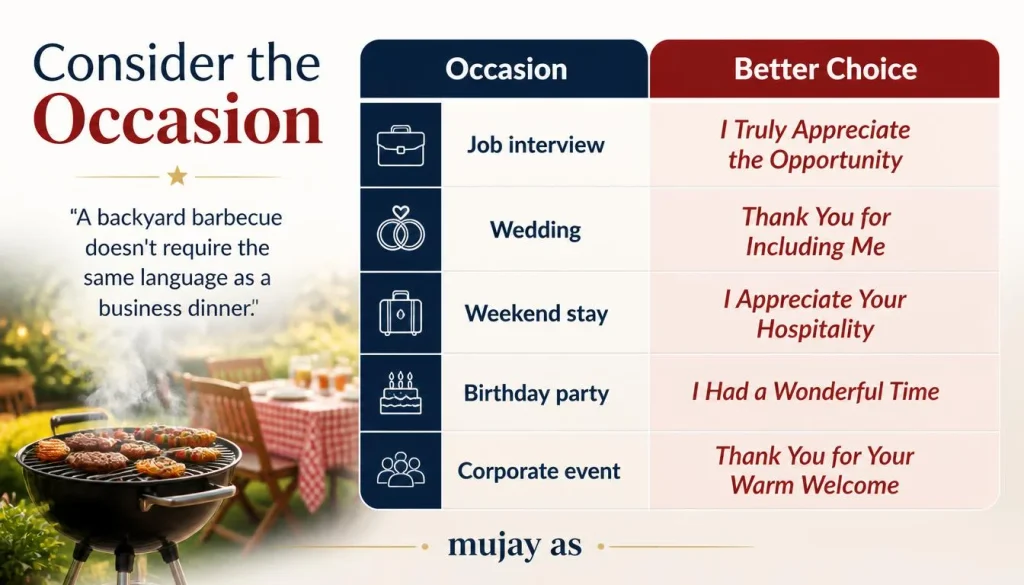
Consider the Occasion
A backyard barbecue doesn’t require the same language as a business dinner.
For example:
| Occasion | Better Choice |
| Job interview | I Truly Appreciate the Opportunity |
| Wedding | Thank You for Including Me |
| Weekend stay | I Appreciate Your Hospitality |
| Birthday party | I Had a Wonderful Time |
| Corporate event | Thank You for Your Warm Welcome |
Consider Your Relationship
Close friends often appreciate natural, relaxed language.
Professional contacts may expect more polished wording.
Friends
- I had a wonderful time.
- Thanks for inviting me.
- I enjoyed every moment.
Professional Contacts
- I appreciate your hospitality.
- It was a pleasure being your guest.
- I truly appreciate the opportunity.
Read More :Do You Capitalize After an Ellipsis? Grammar Guide With Examples
Consider the Host’s Effort
The greater the effort, the more specific your gratitude should be.
Someone who planned an elaborate dinner, organized accommodations, or coordinated a major event deserves more than a generic thank-you.
Common Mistakes When Thanking a Host
Even well-intentioned gratitude can fall flat.
Here are common mistakes to avoid.
Using Generic Responses
A simple “Thanks” isn’t always enough.
Compare:
Generic:
“Thanks.”
Specific:
“Thank you for making everyone feel welcome. The evening was fantastic.”
Specificity creates impact.
Ignoring the Experience
The best thank-you messages mention something memorable.
Examples:
- The meal
- The conversation
- The atmosphere
- The event itself
People appreciate knowing what stood out.
Being Overly Formal
Formal language can feel awkward among close friends.
For example:
“I sincerely appreciate your distinguished hospitality.”
That sounds more like a diplomatic speech than a friendly thank-you.
Instead:
“I had a great time. Thanks for having me.”
Natural language often works best.
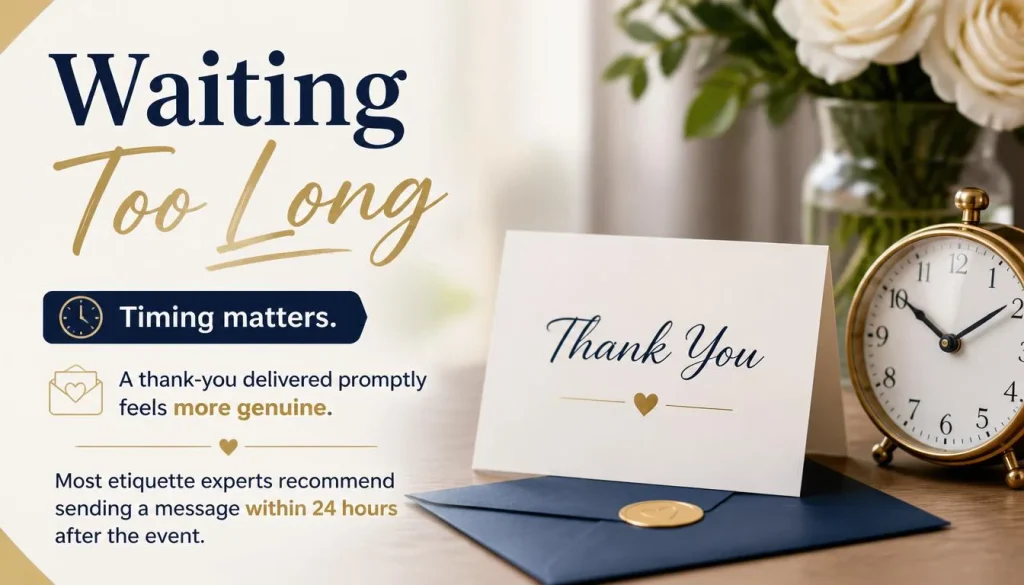
Waiting Too Long
Timing matters.
A thank-you delivered promptly feels more genuine.
Most etiquette experts recommend sending a message within 24 hours after the event.
Examples of Thank-You Messages After Being Hosted
Here are practical examples you can adapt.
After a Dinner Party
Thank you for inviting me. The food was incredible and the conversation was even better. I had a wonderful time and truly appreciate your hospitality.
After Staying at Someone’s House
Thank you for your kindness and hospitality during my stay. You made me feel completely at home. I appreciate everything you did and look forward to seeing you again soon.
After a Business Event
Thank you for the opportunity to attend the event. I enjoyed meeting everyone and learning more about the organization. I truly appreciate your warm welcome.
After a Family Gathering
Thank you for including me in the celebration. It was wonderful spending time with everyone. I enjoyed every moment and appreciate all the effort that went into making the day special.

After a Networking Event
Thank you for inviting me to the event. I made valuable connections and gained useful insights. I appreciate the opportunity and hope to stay in touch.
Why Personalized Gratitude Matters
Researchers studying social relationships consistently find that gratitude strengthens personal and professional connections.
A thoughtful thank-you does more than acknowledge kindness.
It:
- Builds trust
- Strengthens relationships
- Encourages future invitations
- Creates positive memories
- Demonstrates emotional intelligence
Think of gratitude as social glue.
Small expressions of appreciation often produce lasting impressions.
Sample Thank-You Formula That Always Works
Whenever you’re unsure what to say, use this simple framework:
Thank the host
+
Mention a specific detail
+
Express appreciation
+
End warmly
Example
Thank you for inviting me. I especially enjoyed our conversation after dinner. I appreciate your hospitality and hope to see you again soon.
This formula works in nearly every situation.
When Should You Send a Thank-You Message?
Timing can amplify your message.
Immediately After Leaving
A verbal thank-you is always appropriate.
Within 24 Hours
A text message or email reinforces your appreciation.
Within a Few Days
A handwritten note can create an even stronger impression for formal occasions.
Best Communication Method by Situation
| Situation | Best Method |
| Casual dinner | Text message |
| Family gathering | Text or phone call |
| Overnight stay | Text, email, or handwritten note |
| Business event | |
| Wedding | Handwritten note |
FAQs
1. Is “Thank You for Having Me” grammatically correct?
Yes. “Thank You for Having Me” is completely grammatically correct and is a natural way to express appreciation after visiting someone, attending an event, or being invited to a meeting or gathering.
2. What can I say instead of “Thank You for Having Me”?
You can use alternatives such as “I Really Appreciate Your Hospitality,” “Thank You for the Invitation,” “It Was a Pleasure Being Your Guest,” “I Had a Wonderful Time,” or “Thank You for Your Warm Welcome.” Choose the phrase based on the level of formality and the situation.
3. Is “Thank You for Having Me” appropriate in professional emails?
Absolutely. It works well in business communication, especially after meetings, networking events, client visits, interviews, or conferences. For a more formal tone, you can also say “Thank you for your hospitality” or “I appreciate the opportunity to meet with you.”
4. When should I say “Thank You for Having Me”?
Use this expression after someone hosts you at their home, invites you to an event, welcomes you to their office, or includes you in a professional or social gathering. It shows gratitude and helps strengthen personal and professional relationships.
5. Can I use “Thank You for Having Me” in casual conversations?
Yes. It is suitable for casual conversations with friends, relatives, neighbors, or colleagues. It sounds warm, polite, and sincere without being overly formal.
6. Why should I learn alternative ways to say “Thank You for Having Me”?
Using different expressions makes your communication more engaging and natural. It also improves your English usage, enhances formal writing, demonstrates a stronger vocabulary, and helps you adapt your language to different audiences and situations.
Conclusion
Knowing 10 Other Ways to Say “Thank You for Having Me” allows you to express gratitude with greater confidence and authenticity. While the original phrase is polite and widely accepted, choosing an alternative that matches the occasion can make your appreciation feel more personal, professional, or heartfelt.
Whether you’re thanking a host after a dinner party, following up after meetings, or writing a professional email, the right expression leaves a positive and lasting impression.
By understanding the tone and context of each alternative, you’ll improve your grammar, strengthen business communication, and communicate with greater consistency in both personal and professional settings. Keep these expressions in your vocabulary, and you’ll always have the perfect way to show genuine appreciation.