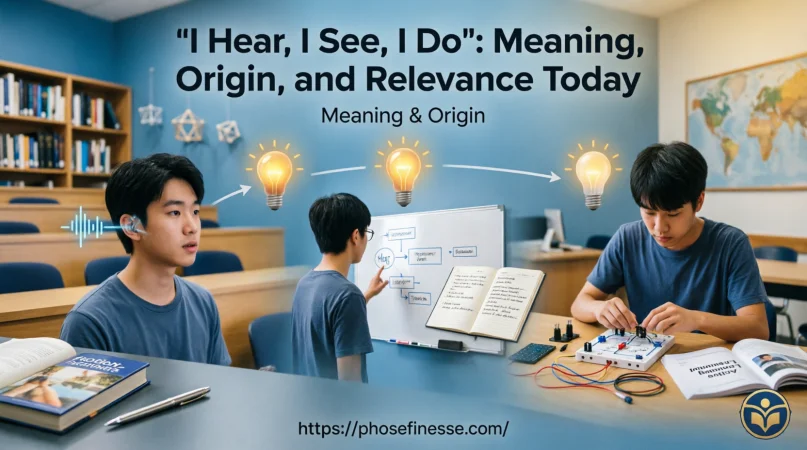
Have you ever wondered why some lessons stay with you for life while others disappear within minutes? The timeless quote “I Hear or I See or I Do”: Meaning, Origin, and Relevance Today .” captures the power of experiential learning, active participation, and practical understanding in a way that still resonates today.
Whether you’re exploring its meaning, origin, or everyday relevance, this guide explains why these words continue to inspire learners, educators, and professionals across different fields.
Although this famous saying focuses on learning through action, its message extends far beyond the classroom. It influences business communication, project management, meetings, time management, scheduling, calendar planning, and even online booking systems where clear instructions and hands-on experience improve results.
You’ll also discover how the quote relates to English usage, grammar, formal writing, broadcasting, and the importance of consistency in both personal and professional communication.
In this article, you’ll explore the meaning behind “I Hear And I Forget. I See And I Remember. I Do And I Understand.”, examine its historical background, understand common interpretations, and learn how to apply its wisdom in real-life situations.
By combining practical examples with clear explanations, this guide delivers accurate, reader-focused insights that satisfy search intent while providing valuable, trustworthy information you can confidently use.
What Does “I Hear and I Forget. I See and I Remember. I Do and I Understand.” Mean?
At its core, the quote highlights three progressively deeper levels of learning:
| Learning Method | Result |
| Hearing | Temporary awareness |
| Seeing | Improved memory |
| Doing | True understanding |
The statement suggests that simply hearing information often isn’t enough for long-term retention. Seeing something demonstrated improves recall. Yet genuine comprehension develops when you actively participate and gain firsthand experience.
Think about learning to ride a bicycle.
You could listen to detailed explanations about balance for hours. You might even watch dozens of videos. Nevertheless, the moment you climb onto a bicycle and begin pedaling, everything changes. Through action, theory becomes reality.
That simple example perfectly illustrates the wisdom behind the quote.
The Core Message Behind the Quote
The central lesson is straightforward:
People learn best when they actively engage with what they are learning.
The quote emphasizes:
- Experiential learning
- Active participation
- Practical application
- Skill development through practice
- Deeper comprehension through experience
Rather than treating learning as passive absorption, the saying encourages involvement.
Knowledge becomes meaningful when you use it.
A Modern English Interpretation
If translated into modern everyday language, the quote might sound like this:
“Listening helps, watching helps more, but actually doing something teaches you best.”
This interpretation explains why educators, trainers, coaches, and leaders frequently reference the saying when discussing effective learning strategies.
Who Said “I Hear and I Forget. I See and I Remember. I Do and I Understand.”?
One of the most common questions surrounding this quote concerns its authorship.
Many people attribute it to Confucius, the renowned Chinese philosopher who lived between 551 BCE and 479 BCE.
Confucius
Confucius profoundly influenced education, ethics, leadership, and social philosophy throughout East Asia and beyond.
Because the quote aligns closely with Confucian educational principles, it is frequently credited to him.
Did Confucius Actually Say It?
Surprisingly, historians have found no direct evidence that Confucius ever spoke or wrote these exact words.
The saying does not appear in the primary Confucian texts commonly associated with his teachings.
While the quote reflects ideas found within Confucian philosophy, scholars generally agree that the exact wording likely emerged much later.
This distinction is important.
Confucius may have inspired the sentiment, but the modern version appears to be a later adaptation.
Similar Ideas in Confucian Philosophy
Although the exact phrase remains uncertain, Confucian teachings often emphasized:
- Learning through practice
- Self-improvement through action
- Reflection and experience
- Continuous personal development
These concepts strongly resemble the message conveyed by the quote.
The Origin and History of the Quote
Tracing the precise origin of the quote proves challenging.
Many historians believe the statement evolved gradually through centuries of educational thought.
Several variations have appeared over time, including:
- “What I hear, I forget.”
2. “What I see, I remember.”
3. “What I do, I know.”
Another popular variation reads:
“Tell me and I forget. Teach me and I may remember. Involve me and I learn.”
Although often linked to Confucius, Benjamin Franklin, and various educators, definitive evidence remains elusive.
Why the Quote Endured
Some sayings survive because they express universal truths.
This quote endured because virtually everyone has experienced its wisdom firsthand.
Think about:
- Learning to swim
- Driving a car
- Playing a musical instrument
- Speaking a foreign language
- Cooking a recipe
In each case, practice matters more than theory alone.
That universal reality keeps the quote relevant century after century.
Breaking Down the Quote Line by Line
Understanding each part individually reveals why the statement remains so powerful.
“I Hear and I Forget”
Listening introduces information.
However, hearing something once rarely guarantees retention.
Research consistently shows that people forget significant amounts of information shortly after hearing it unless they actively review or apply it.
Examples include:
- A lecture attended months ago
- Directions given verbally
- Names introduced at a meeting
- Facts memorized before an exam
Without reinforcement, memory fades.
This isn’t a flaw. It’s simply how human memory works.
“I See and I Remember”
Visual experiences create stronger mental impressions.
When people see information, they often process it more effectively.
Examples include:
- Watching a cooking demonstration
- Viewing a diagram
- Observing a science experiment
- Seeing a map instead of hearing directions
Visual learning provides context and structure.
The brain often remembers images more easily than spoken words.
“I Do and I Understand”
This final line contains the quote’s most important insight.
Action transforms information into understanding.
When you perform a task yourself:
- Mistakes become lessons
- Concepts become concrete
- Knowledge becomes usable
- Skills become automatic
Understanding develops through experience.
That’s why apprenticeships, internships, laboratories, simulations, and practical training remain so effective.
What Modern Research Says About Learning by Doing
Interestingly, modern educational research strongly supports the quote’s message.
Active Learning vs. Passive Learning
Active learning requires participation.
Passive learning involves receiving information without engagement.
Passive Learning Examples
- Listening to lectures
- Reading without note-taking
- Watching videos passively
Active Learning Examples
- Solving problems
- Conducting experiments
- Teaching others
- Participating in discussions
- Practicing skills
Research consistently finds that active learning improves:
- Retention
- Understanding
- Critical thinking
- Long-term performance
Experiential Learning Theory
Educational theorist David Kolb developed a model known as Experiential Learning Theory.
The model suggests learning occurs through a cycle:
Experience
↓
Reflection
↓
Conceptual Understanding
↓
Experimentation
↓
New Experience
According to this framework, experience serves as the foundation for meaningful learning.
The quote aligns remarkably well with this theory.
Why Hands-On Learning Works
Several cognitive processes explain why learning by doing proves effective.
Multiple Brain Systems Engage
Hands-on activities activate:
- Motor skills
- Visual processing
- Problem-solving
- Emotional engagement
This creates stronger memory pathways.
Immediate Feedback Accelerates Learning
When you practice a skill, feedback arrives instantly.
You quickly discover:
- What works
- What doesn’t
- What needs adjustment
That feedback loop speeds improvement.
Real-Life Examples of “I Hear and I Forget. I See and I Remember. I Do and I Understand.”
The quote appears everywhere once you start looking.
Learning to Drive
A driving manual explains traffic rules.
Watching someone drive provides context.
Actually driving teaches judgment, timing, and control.
No amount of reading can fully replace time behind the wheel.
Learning a New Language
Many language learners spend years studying grammar.
Then they struggle during real conversations.
Why?
Because speaking requires active use.
Fluency develops through interaction.
You learn by speaking.
Learning a Musical Instrument
A beginner can watch thousands of piano tutorials.
Yet finger coordination develops only through practice.
Musicians understand this truth well.
Improvement happens at the keyboard, not merely on YouTube.
Learning to Cook
Recipes provide instructions.
Cooking shows provide demonstrations.
However, genuine culinary skill develops through preparing meals yourself.
Burning a few pancakes often teaches more than reading ten recipes.
How Teachers Use This Principle in Education
Modern education increasingly embraces active learning strategies.

Classroom Demonstrations
Teachers often demonstrate concepts before asking students to practice them.
For example:
- Science experiments
- Mathematical problem-solving
- Language exercises
Demonstrations bridge theory and application.
Project-Based Learning
Project-based learning places students in real-world scenarios.
Examples include:
- Designing prototypes
- Conducting research projects
- Creating presentations
- Solving community problems
Students learn while doing.
Laboratory Learning
Science education relies heavily on experimentation.
Students don’t simply read about chemistry.
They conduct experiments.
That experience strengthens understanding.
Collaborative Activities
Group projects encourage:
- Communication
- Critical thinking
- Problem-solving
Active participation deepens learning.
See More :Do You Capitalize After an Ellipsis? Grammar Guide With Examples
How the Quote Applies Beyond School
The wisdom extends far beyond education.
Business and Workplace Training
Successful companies increasingly prioritize practical training.
New employees learn through:
- Simulations
- Shadowing
- Mentorship
- Real-world assignments
Organizations recognize that experience builds competence faster than lectures alone.
Leadership Development
Leadership books provide valuable insights.
However, leadership develops through practice.
Leading teams teaches lessons no textbook can fully replicate.
Experience reveals nuances that theory cannot capture.
Sports and Coaching
Athletes understand this principle instinctively.
Watching game footage helps.
Practice builds skill.
Competition creates mastery.
Every elite athlete learns through repetition.
Personal Growth
Growth often requires action.
Reading about confidence differs from speaking publicly.
Reading about entrepreneurship differs from starting a business.
Action creates transformation.
Common Misunderstandings About the Quote
Although powerful, the quote sometimes gets oversimplified.
Does Hearing Have No Value?
Absolutely not.
Listening remains essential.
Before you can practice effectively, you often need information and guidance.
The quote doesn’t dismiss hearing.
Instead, it highlights its limitations when used alone.
Does Experience Replace Study?
Not entirely.
The most effective learning combines:
- Study
- Observation
- Practice
Each element contributes something valuable.
Knowledge and experience work together.
Does Everyone Learn Identically?
No.
People have different strengths and preferences.
Some learners benefit more from visual tools.
Others thrive through discussion.
Still, practical application generally improves understanding regardless of individual learning style.
Similar Quotes About Learning and Experience
Many thinkers expressed comparable ideas.
“Tell Me and I Forget. Teach Me and I May Remember. Involve Me and I Learn.”
This variation appears frequently in educational settings.
The message closely mirrors the original quote.
Participation drives learning.
Aristotle’s Perspective
Ancient Greek philosophy often emphasized learning through action.
Aristotle argued that people develop virtues through practice rather than theory alone.
His approach aligns closely with experiential learning principles.
John Dewey’s Educational Philosophy
Educational reformer John Dewey championed learning through experience.
He believed education should actively engage students rather than simply deliver information.
Many modern teaching methods draw from this philosophy.
Why This Quote Remains Relevant Today
You might assume that a centuries-old educational idea would lose relevance.
Instead, it has become more important than ever.

Information Is Everywhere
Modern learners face information overload.
Videos, articles, podcasts, and courses appear endlessly.
Yet information abundance doesn’t guarantee understanding.
Knowledge must be applied.
The Modern Economy Rewards Skills
Employers increasingly value demonstrated competence.
Degrees matter.
Skills matter more.
People who can perform tasks effectively often gain significant advantages.
Interactive Learning Continues Growing
Technology increasingly supports hands-on learning.
Examples include:
- Virtual simulations
- Interactive courses
- Coding platforms
- Language learning apps
- Professional certification labs
These tools embrace the principle behind the quote.
How to Apply “I Hear and I Forget. I See and I Remember. I Do and I Understand.” in Your Own Life
Understanding the quote is useful.
Applying it creates results.
Turn Knowledge Into Action Quickly
After learning something new:
- Test it
- Practice it
- Use it immediately
The faster you apply knowledge, the better you retain it.
Create Small Experiments
Don’t wait for perfect conditions.
Experiment.
For example:
- Write after studying writing techniques
- Speak after learning language rules
- Invest after studying investing basics
- Cook after reading recipes
Small actions produce meaningful growth.
Build Practice Into Every Learning Goal
Ask yourself:
“How can I use this today?”
That simple question transforms passive learning into active growth.
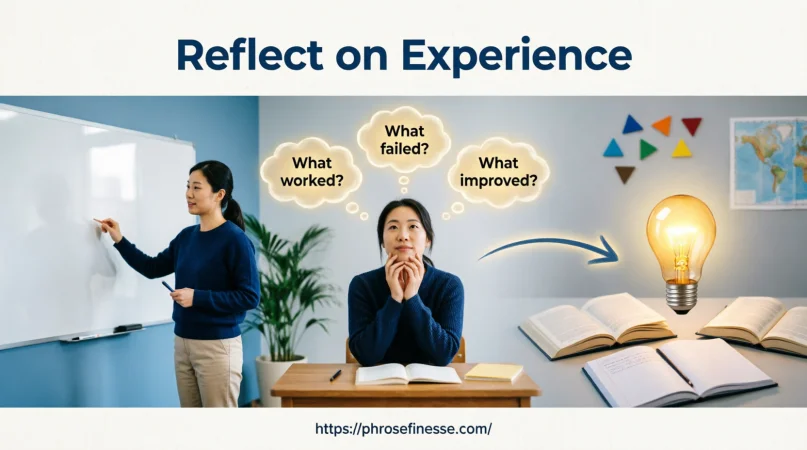
Reflect on Experience
Action matters.
Reflection matters too.
After practicing a skill, consider:
- What worked?
- What failed?
- What improved?
- What should change next time?
Reflection converts experience into wisdom.
Key Lessons From the Quote
| Lesson | Why It Matters |
| Hearing introduces ideas | Creates awareness |
| Seeing improves recall | Strengthens memory |
| Doing creates understanding | Builds practical knowledge |
| Experience accelerates growth | Improves retention |
| Practice develops mastery | Converts theory into skill |
| Reflection deepens learning | Turns experience into wisdom |
FAQs
1. What does “I Hear And I Forget. I See And I Remember. I Do And I Understand.” mean?
The quote means that active experience is the most effective way to learn. Hearing information may not be enough, seeing it improves memory, but actually doing it creates lasting understanding.
2. Who originally said “I Hear And I Forget. I See And I Remember. I Do And I Understand.”?
The quote is commonly attributed to Confucius, but there is no definitive historical evidence proving he originally said these exact words. Many scholars consider the attribution uncertain.
3. Why is this quote still popular today?
Its message aligns with modern ideas about experiential learning, skill development, and hands-on education. It is widely used in schools, workplaces, leadership training, and professional development.
4. Can this quote be used in professional or academic writing?
Yes. The quote is appropriate in presentations, essays, speeches, and formal writing, especially when discussing learning, education, teamwork, leadership, or workplace training. If accuracy is important, mention that its attribution to Confucius is widely believed but not confirmed.
5. How does this quote apply to the workplace?
In professional settings, employees often learn more effectively through practical experience than through instructions alone. This principle supports better project management, business communication, meetings, and hands-on training.
6. What is the main lesson behind this quote?
The central lesson is that knowledge becomes meaningful through action. Listening and observing are valuable first steps, but practicing what you learn leads to confidence, mastery, and true understanding.
Conclusion
The quote “I Hear And I Forget. I See And I Remember. I Do And I Understand.” remains one of the most powerful reminders that learning by doing creates lasting knowledge. While hearing information introduces new ideas and seeing them improves recall, applying those ideas through real experience leads to genuine understanding.
That simple progression explains why the quote continues to influence education, business communication, project management, training, and everyday English usage.
Whether you’re using this saying in formal writing, a presentation, or personal reflection, understanding its meaning helps you appreciate the value of active participation. By putting knowledge into practice with consistency, you develop stronger skills, better decision-making, and deeper comprehension. Its timeless message is just as relevant today as it was centuries ago.