Have you ever paused before writing “Me And Someone” Or “Someone And I”: Which Is Correct? It’s one of the most common English grammar questions, yet many confident speakers still get it wrong.
Whether you’re sending a professional email, preparing business communication, speaking during meetings, or improving your formal writing, choosing the correct phrase strengthens your credibility and ensures consistency in your language.
The confusion usually comes from understanding subject pronouns, object pronouns, and proper English usage rather than memorizing a simple rule. This guide explains when to use “someone and I” and when “me and someone” is grammatically correct, supported by clear examples, practical tips, and common mistakes to avoid.
You’ll also see how these rules apply in everyday situations involving project management, calendar invitations, scheduling, time management, online booking confirmations, broadcasting, and other professional or personal conversations.
By the end of this article, you’ll know exactly which expression fits each sentence with confidence. You’ll learn the grammar behind both forms, discover easy tricks to remember the correct choice, and improve your writing skills, spoken English, and overall grammar accuracy.
Whether you’re a student, professional, or English learner, this practical guide will help you communicate more naturally and effectively.
The Short Answer: Which Is Correct?
The answer depends on the role the phrase plays in the sentence.
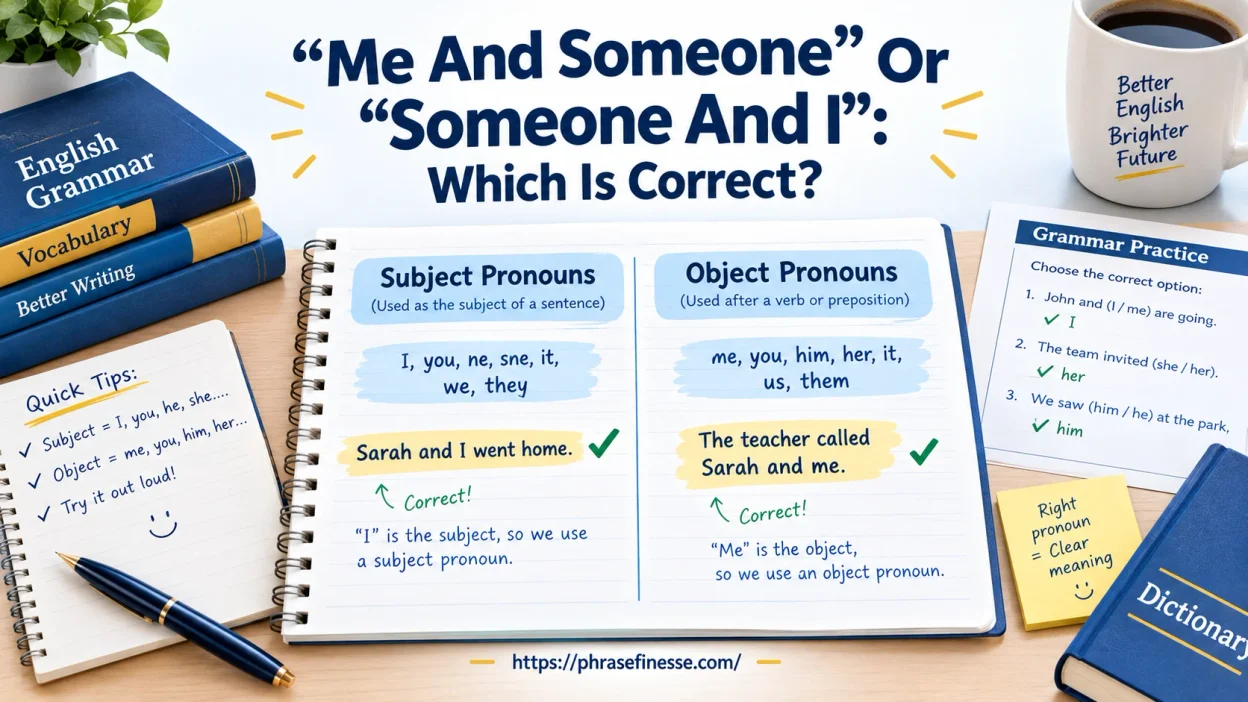
| Sentence Role | Correct Form |
| Subject | Someone and I |
| Object | Someone and me |
Examples
- ✅ Sarah and I went to the concert.
2. ✅ My brother and I enjoy hiking.
3. ✅ The teacher spoke to Sarah and me.
4. ✅ They invited my brother and me.
5. ❌ Sarah and me went to the concert.
6. ❌ The teacher spoke to Sarah and I.
The key is understanding whether the phrase performs the action or receives the action.
Understanding Why People Get Confused
At first glance, the distinction seems straightforward. Yet millions of English speakers regularly mix up I and me.
Why?
Because spoken English and formal grammar don’t always follow the same patterns.
The “Me And John” Habit
In casual conversation, people often say:
- Me and John went fishing.
- Me and my sister watched a movie.
- Me and Jake are leaving now.
These phrases sound natural because they’re common in everyday speech.
However, formal grammar considers these constructions incorrect when the phrase acts as the subject.
The Overcorrection Problem
Interestingly, many people know that “me and John” is often criticized. As a result, they begin replacing me with I everywhere.
This creates sentences like:
- ❌ Between you and I
2. ❌ The gift was for Sarah and I
3. ❌ She invited John and I
This mistake is called hypercorrection. People try so hard to sound grammatical that they accidentally choose the wrong pronoun.
Subject Pronouns vs. Object Pronouns
To master this topic, you need to understand one important concept.
English pronouns change form depending on their function.
What Is A Subject Pronoun?
A subject pronoun performs the action in a sentence.
Common subject pronouns include:
| Subject Pronouns |
| I |
| You |
| He |
| She |
| We |
| They |
Examples
- I play basketball.
- She drives to work.
- They study every evening.
When another person joins the subject, the same rule applies.
Examples:
- Sarah and I went shopping.
- My brother and I live nearby.
- David and I completed the project.
In each sentence, the people are performing the action.
What Is An Object Pronoun?
An object pronoun receives the action.
Common object pronouns include:
| Object Pronouns |
| Me |
| You |
| Him |
| Her |
| Us |
| Them |
Examples
- She called me.
- The manager praised him.
- They invited us.
When another person is added, the rule stays the same.
Examples:
- She called Sarah and me.
- The manager praised John and me.
- They invited my sister and me.
In these examples, the people receive the action rather than perform it.
The Simple Trick That Always Works
If you remember only one thing from this article, remember this test.
Remove The Other Person
Take the sentence and temporarily remove the other person’s name.
The remaining sentence usually reveals the correct pronoun immediately.
Example One
Sarah and I went to dinner.
Remove Sarah:
I went to dinner.
This sounds correct.
Therefore:
✅ Sarah and I went to dinner.
Example Two
The waiter served Sarah and me.
Remove Sarah:
The waiter served me.
This sounds correct.
Therefore:
✅ The waiter served Sarah and me.
Example Three
The waiter served Sarah and I.
Remove Sarah:
The waiter served I.
This sounds incorrect.
Therefore:
❌ The waiter served Sarah and I.
Why This Method Works
This technique works because pronouns follow the same grammatical rules whether another person appears in the sentence or not.
Think of it as removing the disguise. Once the extra name disappears, the answer becomes obvious.
When To Use “Someone And I”
You should use someone and I whenever the phrase functions as the subject.
As The Subject Of A Sentence
Examples:
- Michael and I are coworkers.
- Jennifer and I finished the presentation.
- My wife and I travel frequently.
- Sarah and I enjoy photography.
- David and I attended the conference.
In every example, the people perform the action.
How To Identify The Subject
Ask yourself:
Who is doing the action?
Consider this sentence:
“Emma and I baked cookies.”
Who baked the cookies?
Emma and I.
Since the phrase performs the action, I is correct.
More Subject Examples
- ✅ My parents and I visited New York.
2. ✅ Jack and I play tennis every weekend.
3. ✅ My friend and I started a small business.
4. ✅ Sarah and I studied together.
Each sentence follows the same principle.
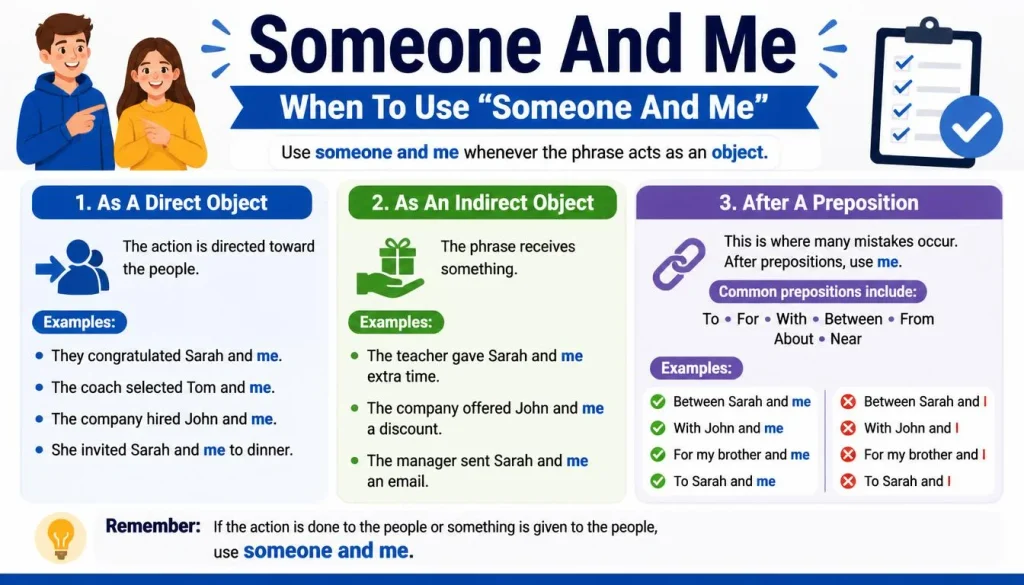
When To Use “Someone And Me”
Use someone and me whenever the phrase acts as an object.
As A Direct Object
Examples:
- They congratulated Sarah and me.
- The coach selected Tom and me.
- The company hired John and me.
- She invited Sarah and me to dinner.
The action is directed toward the people.
As An Indirect Object
Examples:
- The teacher gave Sarah and me extra time.
- The company offered John and me a discount.
- The manager sent Sarah and me an email.
The phrase receives something.
Therefore, me is required.
After A Preposition
This is where many mistakes occur.
After prepositions, use me.
Common prepositions include:
- To
- For
- With
- Between
- From
- About
- Near
Examples:
- ✅ Between Sarah and me
2. ✅ With John and me
3. ✅ For my brother and me
4. ✅ To Sarah and me
5. ❌ Between Sarah and I
6. ❌ With John and I
“Me And Someone” Vs. “Someone And Me”
Many people wonder whether word order affects correctness.
The answer is interesting.
Standard English Preference
Formal English typically places the other person first.
Examples:
- ✅ Sarah and me
2. ✅ John and me
3. ✅ My brother and me
This order sounds more polite and conventional.
Informal Speech
In casual conversation, people frequently say:
- Me and Sarah
- Me and Jake
- Me and my cousin
Although common, these expressions are generally considered informal.
They may be acceptable in relaxed conversation. However, formal writing usually avoids them.
Is “Me And Someone” Always Wrong?
No.
The phrase can be correct depending on its role.
Consider this sentence:
✅ The teacher praised me and Sarah.
The phrase acts as an object.
Therefore, using me is perfectly grammatical.
Now compare:
❌ Me and Sarah went shopping.
The phrase acts as the subject.
Formal grammar requires:
✅ Sarah and I went shopping.
Context matters far more than word order.
See More :Next Friday vs. This Friday: What’s the Difference?
Why “Someone And I” Sounds More Polite
Traditional English etiquette encourages speakers to mention themselves second.
For example:
Preferred:
- Sarah and I
- John and I
- My parents and I
Less preferred:
- I and Sarah
- I and John
- I and my parents
This convention developed as a matter of courtesy rather than grammar.
You place yourself after the other person out of politeness.
Common Mistakes And How To Fix Them
Many grammar mistakes follow predictable patterns.
Here’s a quick correction guide.
| Incorrect | Correct |
| Me and Sarah went shopping. | Sarah and I went shopping. |
| John and me are friends. | John and I are friends. |
| The gift was for Sarah and I. | The gift was for Sarah and me. |
| Between you and I. | Between you and me. |
| She invited John and I. | She invited John and me. |
| Him and me went fishing. | He and I went fishing. |
| The manager called Sarah and I. | The manager called Sarah and me. |
Why “Between You And Me” Is Correct
Few grammar debates appear more often than this one.
Many people say:
❌ Between you and I
Yet grammar rules clearly favor:
✅ Between you and me
The Reason
The word between is a preposition.
Pronouns that follow prepositions must appear in object form.
Compare:
- Between you and me
- With him
- For her
- To us
Notice the pattern.
Object pronouns follow prepositions.
“My Wife And I” Vs. “My Wife And Me”
This phrase frequently appears in business emails, invitations, and conversations.
Examples Using “My Wife And I”
✅ My wife and I are attending the wedding.
✅ My wife and I purchased a new home.
The phrase acts as the subject.
Examples Using “My Wife And Me”
✅ The organizer contacted my wife and me.
✅ The photographer took pictures of my wife and me.
The phrase receives the action.
Therefore, me is correct.
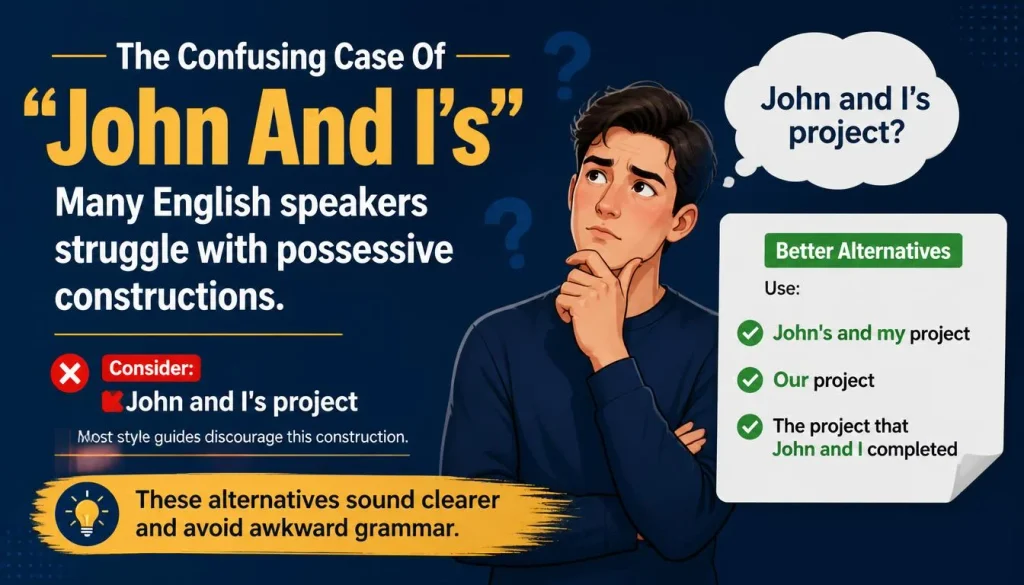
The Confusing Case Of “John And I’s”
Many English speakers struggle with possessive constructions.
Consider:
❌ John and I’s project
Most style guides discourage this construction.
Better Alternatives
Use:
- ✅ John’s and my project
2. ✅ Our project
3. ✅ The project that John and I completed
These alternatives sound clearer and avoid awkward grammar.
Formal Writing Vs. Everyday Speech
Grammar rules don’t always match real-life conversation.
That’s perfectly normal.
Formal Writing
In formal situations, follow standard grammar carefully.
Examples include:
- Business reports
- Academic papers
- Professional emails
- Job applications
- Legal documents
Readers often expect grammatical precision in these contexts.
Casual Conversation
Everyday speech is different.
Native speakers regularly say:
- Me and Jake went there.
- Me and my brother watched it.
- Me and Sarah know him.
Although informal, these expressions appear frequently in spoken English.
Understanding the difference between formal standards and conversational habits helps you communicate effectively in different situations.
Quick Reference Chart
Keep this chart handy whenever you’re unsure.
| Situation | Correct Form |
| Subject of sentence | Someone and I |
| Direct object | Someone and me |
| Indirect object | Someone and me |
| After a preposition | Someone and me |
| Formal writing | Follow grammar rules strictly |
| Casual conversation | Informal variations are common |
Real-World Case Study: Workplace Email
Consider this sentence from a professional email:
“Please contact Sarah and I if you have questions.”
At first glance, it sounds polished.
However, apply the removal test.
Remove Sarah:
“Please contact I if you have questions.”
Clearly incorrect.
Correct version:
“Please contact Sarah and me if you have questions.”
Small grammatical details like this can influence how professional your writing appears.
Real-World Case Study: Job Interview
Imagine an interviewer asks:
“Who completed the project?”
Correct response:
“John and I completed the project.”
Why?
Because John and I performed the action.
Now imagine the interviewer says:
“Who did the manager congratulate?”
Correct response:
“The manager congratulated John and me.”
The action was directed toward the people.
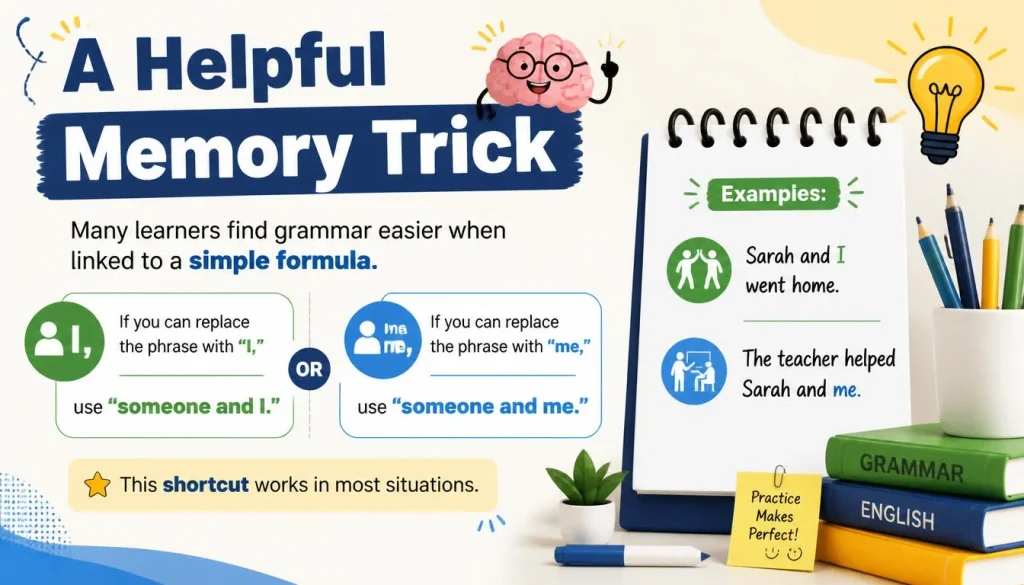
A Helpful Memory Trick
Many learners find grammar easier when linked to a simple formula.
Remember:
If you can replace the phrase with “I,” use “someone and I.” If you can replace it with “me,” use “someone and me.”
Examples:
- Sarah and I went home.
- The teacher helped Sarah and me.
This shortcut works in most situations.
Practice Sentences
Try these before checking the answers.
Choose The Correct Pronoun
- Sarah and (I/me) went hiking.
- The coach selected John and (I/me).
- Between you and (I/me).
- My sister and (I/me) play volleyball.
- The manager thanked Sarah and (I/me).
Answers
1.✅ Sarah and I went hiking.
2.✅ The coach selected John and me.
3.✅ Between you and me.
4.✅ My sister and I play volleyball.
5.✅ The manager thanked Sarah and me.
If you got them all right, you’ve mastered the core rule.
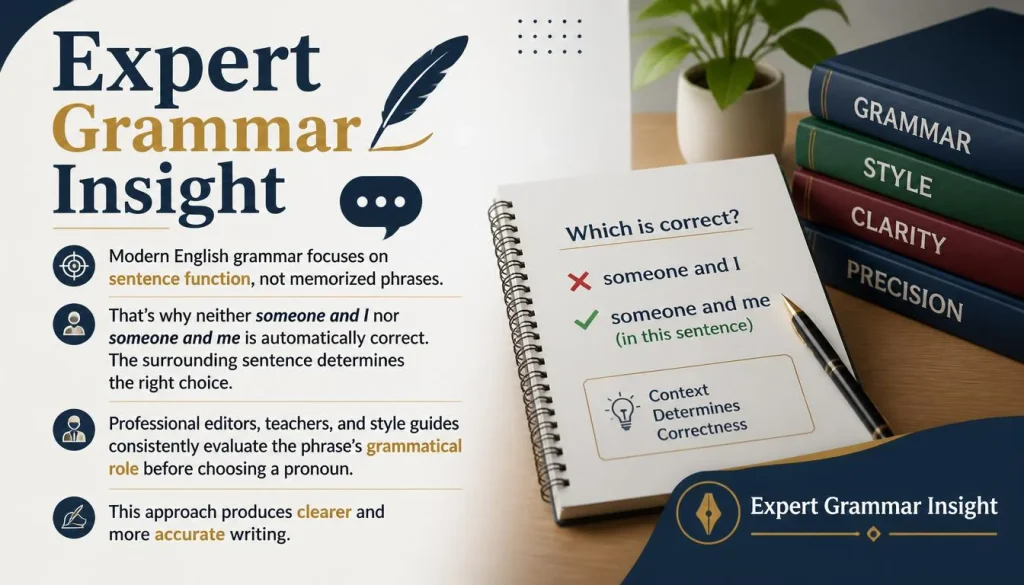
Expert Grammar Insight
Modern English grammar focuses on sentence function, not memorized phrases.
That’s why neither someone and I nor someone and me is automatically correct.
The surrounding sentence determines the right choice.
Professional editors, teachers, and style guides consistently evaluate the phrase’s grammatical role before choosing a pronoun.
This approach produces clearer and more accurate writing.
Key Takeaways
Before finishing, remember these essential points:
- Someone and I functions as a subject.
- Someone and me functions as an object.
- Remove the other person’s name to test the sentence.
- Prepositions require object pronouns.
- “Between you and me” is correct.
- Formal writing follows these rules closely.
- Casual speech often ignores them.
- Word order affects politeness but not the underlying grammar.
- Understanding sentence function solves most pronoun problems.
FAQs
Is “me and someone” ever grammatically correct?
Yes. “Me and someone” is grammatically correct when the phrase functions as the object of a verb or preposition. For example, The manager thanked me and Sarah for completing the project.
Why do people say “someone and I” instead of “me and someone”?
People use “someone and I” because it is the correct form when the phrase is the subject of a sentence. For example, Sarah and I are attending the meeting.
How can I quickly tell which phrase is correct?
Remove “someone” from the sentence and read it with only I or me. If I sounds correct, use “someone and I.” If me sounds correct, use “me and someone.”
Should I always put the other person’s name before mine?
Yes. In both formal and polite English, it’s customary to mention the other person first. For example, “John and I” and “John and me” are preferred over “I and John” or “me and John.”
Is “me and someone” acceptable in formal writing?
It is, but only when grammar requires the object form. In professional emails, reports, and other formal writing, always choose the version that matches the sentence’s grammatical function.
Do native English speakers make this mistake?
Absolutely. Even native speakers sometimes confuse “me” and “I,” especially in casual conversation. Learning the underlying grammar rule helps you use the correct form consistently in both speech and writing.
Conclusion
Choosing between “me and someone” and “someone and I” is easier once you understand the role each phrase plays in a sentence. If the phrase is the subject, use “someone and I.” If it functions as the object, use “me and someone.”
Rather than relying on what sounds right, identify whether the pronoun is performing the action or receiving it.
Mastering this simple grammar rule can improve your English usage, formal writing, business communication, and everyday conversations.
Whether you’re writing emails, participating in meetings, managing project management tasks, confirming online booking details, or discussing scheduling and time management, using the correct pronoun creates a more polished and professional impression. With regular practice, choosing the right form will soon become second nature.

Emma Brooke is an English language specialist, editor, and content writer at Phrase Finesse, where she helps readers develop stronger writing and communication skills through clear, practical, and engaging content. With a passion for the English language, she specializes in simplifying grammar rules, vocabulary, spelling, punctuation, and word usage for learners at every level.
Emma has extensive experience creating educational content that is accurate, well-researched, and easy to understand. She is particularly skilled at explaining confusing word pairs, grammar concepts, idioms, sentence structure, and effective writing techniques, making complex topics approachable for students, professionals, educators, and English learners worldwide.