Have you ever paused before writing an apology because you weren’t sure whether to say “Sorry For Or Sorry About? Difference Explained ? Although the two expressions seem similar, choosing the right one can make your English usage sound more natural, accurate, and professional.
Whether you’re writing an email, speaking with colleagues, or apologizing in everyday conversations, understanding this subtle grammar difference helps you communicate with greater consistency and confidence.
In this guide, you’ll discover when to use “sorry for” and when “sorry about” is the better choice. We’ll break down the grammar rules, explain the differences with clear examples, and highlight common mistakes that learners and native speakers alike often make.
You’ll also see how these expressions fit naturally into formal writing, business communication, meetings, project management, broadcasting, and other real-world situations where clear language matters.
Beyond the basic rules, this article explores practical usage in modern communication, including scheduling, time management, calendar updates, online booking confirmations, workplace emails, and everyday conversations.
By the end, you’ll confidently know which phrase fits each context, improve your writing fluency, and strengthen your overall command of professional and conversational English.
Sorry For vs. Sorry About: Quick Difference
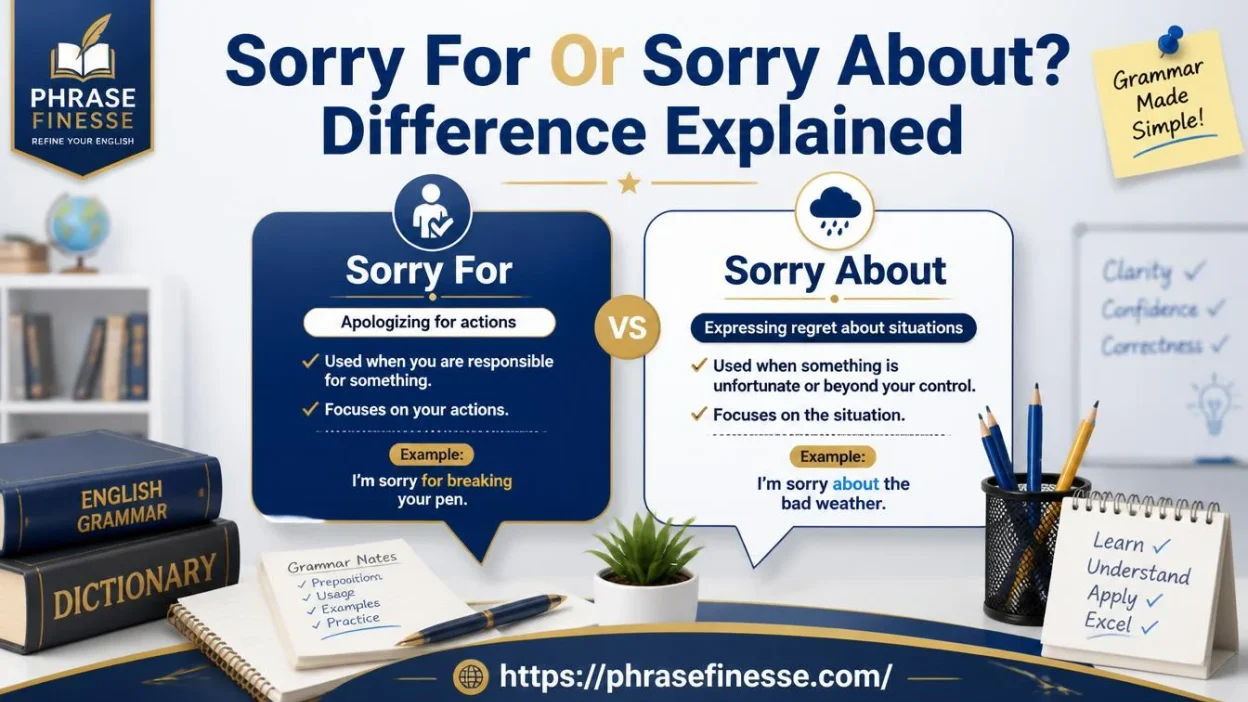
Before diving into the details, here’s the simplest explanation.
| Expression | Main Use | Example |
| Sorry for | Apologizing for an action, behavior, mistake, or consequence | I’m sorry for being late. |
| Sorry about | Expressing regret about a situation, event, or circumstance | I’m sorry about your accident. |
The Easy Rule
Use sorry for when the focus is on an action or responsibility.
Use sorry about when the focus is on a situation or event.
For example:
- Sorry for interrupting you.
- Sorry about the noise outside.
The first sentence apologizes for an action. The second expresses regret about a situation.
What Does “Sorry For” Mean?
The phrase sorry for is commonly used when someone accepts responsibility or apologizes for something.
In most cases, it relates directly to an action, behavior, mistake, oversight, or consequence.
Basic Meaning
When you say sorry for, you’re often acknowledging that something you did—or something connected to you—caused inconvenience, discomfort, or harm.
Examples:
- Sorry for being late.
- Sorry for forgetting your birthday.
- Sorry for the misunderstanding.
- Sorry for the inconvenience.
Notice that each example involves an action or outcome connected to a person.
Common Situations Where We Use “Sorry For”
Apologizing for Your Actions
This is the most common use.
Examples:
- Sorry for interrupting.
- Sorry for calling so late.
- Sorry for speaking over you.
- Sorry for not responding sooner.
These expressions acknowledge responsibility.
Apologizing for Mistakes
People often use sorry for when admitting an error.
Examples:
- Sorry for the mistake.
- Sorry for the confusion.
- Sorry for the oversight.
- Sorry for the error in the report.
Professional emails frequently contain these phrases.
Apologizing for Consequences
Sometimes the speaker isn’t directly responsible but still apologizes for the outcome.
Examples:
- Sorry for the inconvenience.
- Sorry for the delay.
- Sorry for the disruption.
Businesses often use these expressions in customer communications.
Expressing Sympathy
Certain fixed expressions use sorry for even when no apology exists.
Examples:
- Sorry for your loss.
- Sorry for your troubles.
These phrases focus on compassion rather than responsibility.
Grammar Pattern of “Sorry For”
The structure is straightforward.
Pattern 1: Sorry For + Noun
Examples:
- Sorry for the confusion.
- Sorry for the delay.
- Sorry for the mistake.
Pattern 2: Sorry For + Pronoun
Examples:
- Sorry for him.
- Sorry for her.
- Sorry for them.
Pattern 3: Sorry For + Verb (-ing)
Examples:
- Sorry for interrupting.
- Sorry for forgetting.
- Sorry for arriving late.
This is one of the most important grammar rules.
After for, English speakers commonly use a gerund (verb ending in -ing).
Examples of “Sorry For” in Real Conversations
Here are seven natural examples:
- I’m sorry for arriving late to the meeting.
- Sorry for interrupting your presentation.
- We’re sorry for the delay in shipping.
- She’s sorry for her behavior yesterday.
- Sorry for not answering your call.
- I’m sorry for the misunderstanding.
- Thank you for your patience, and sorry for the inconvenience.
These examples appear frequently in both spoken and written English.
What Does “Sorry About” Mean?
While sorry for often relates to responsibility, sorry about usually relates to circumstances, situations, or events.
The speaker may have no responsibility whatsoever.
Instead, they’re expressing concern, empathy, or regret.
Basic Meaning
When using sorry about, the focus shifts toward an event or situation.
Examples:
- Sorry about your accident.
- Sorry about the bad news.
- Sorry about your injury.
- Sorry about yesterday.
The speaker acknowledges an unfortunate circumstance.
Common Situations Where We Use “Sorry About”
Discussing Unfortunate Events
Many native speakers naturally choose sorry about when referring to unfortunate experiences.
Examples:
- Sorry about your car accident.
- Sorry about the storm damage.
- Sorry about your canceled flight.
Expressing Sympathy
This usage is extremely common.
Examples:
- Sorry about your injury.
- Sorry about your illness.
- Sorry about what happened.
Referring to General Situations
Examples:
- Sorry about yesterday.
- Sorry about the confusion.
- Sorry about the delay.
These phrases focus on the situation itself.
Grammar Pattern of “Sorry About”
Pattern 1: Sorry About + Noun
Examples:
- Sorry about the delay.
- Sorry about the accident.
- Sorry about the weather.
Pattern 2: Sorry About + Noun Phrase
Examples:
- Sorry about your broken phone.
- Sorry about your canceled vacation.
Pattern 3: Sorry About + Situation
Examples:
- Sorry about yesterday.
- Sorry about what happened.
Unlike sorry for, sorry about is less commonly followed directly by a gerund in formal grammar instruction.
See More: “I Need Your Help” 6 Polite Ways to Ask for Help
Examples of “Sorry About” in Real Conversations
Here are seven natural examples:
- I’m sorry about your accident.
- Sorry about yesterday.
- Sorry about the bad news.
- We’re sorry about the cancellation.
- Sorry about your injury.
- I’m sorry about what happened.
- Sorry about the confusion earlier.
These expressions sound natural in everyday speech.
Can Sorry For and Sorry About Mean the Same Thing?
Yes. Sometimes both expressions are acceptable.
However, the emphasis changes slightly.
Consider these examples:
| Sorry For | Sorry About |
| Sorry for the delay. | Sorry about the delay. |
| Sorry for the confusion. | Sorry about the confusion. |
| Sorry for what happened. | Sorry about what happened. |
Both versions are grammatically correct.
Yet the tone differs.
How the Tone Changes
Sorry for often sounds more personal.
Sorry about often sounds more situational.
Compare these:
- Sorry for the delay.
- Sorry about the delay.
The first subtly suggests responsibility.
The second focuses more on the event itself.
Native speakers often make this distinction instinctively.
When Only “Sorry For” Sounds Natural
Certain situations strongly favor sorry for.
Before a Verb Ending in -ing
This is the clearest rule.
Correct:
- Sorry for interrupting.
- Sorry for forgetting.
- Sorry for being late.
- Sorry for calling so late.
Less natural:
- Sorry about interrupting.
- Sorry about forgetting.
Although some native speakers occasionally use these forms in casual conversation, sorry for + gerund remains the standard choice.
Professional Apologies
Business communication often favors sorry for.
Examples:
- Sorry for the inconvenience.
- Sorry for the oversight.
- Sorry for the misunderstanding.
These phrases appear regularly in workplace emails and customer support responses.
When Only “Sorry About” Sounds Natural
Certain situations strongly favor sorry about.
Discussing Someone’s Misfortune
Examples:
- Sorry about your accident.
- Sorry about your injury.
- Sorry about your divorce.
- Sorry about your illness.
These sound natural because the speaker isn’t accepting responsibility.
Instead, they’re expressing empathy.
Discussing Unfortunate Events
Examples:
- Sorry about the storm.
- Sorry about the cancellation.
- Sorry about the bad weather.
Again, the focus remains on the event.
Sorry For Someone vs. Sorry About Someone
This area often confuses learners.
The meanings can change significantly.
“Sorry For Someone”
This usually means feeling sympathy for a person.
Examples:
- I feel sorry for him.
- I feel sorry for her.
- We feel sorry for them.
The emotion is directed toward the person.
Example
“I feel sorry for him because he lost his job.”
The sympathy focuses on the individual.

“Sorry About Someone”
This structure usually refers to a situation involving that person.
Examples:
- I’m sorry about your father.
- I’m sorry about your brother.
- I’m sorry about your friend.
The concern focuses on what happened.
Example
“I’m sorry about your father.”
This often implies that something unfortunate happened to him.
Common Mistakes English Learners Make
Understanding these errors can dramatically improve your English.
Mistake: Using “Sorry About” Before a Gerund
Incorrect:
- Sorry about being late.
Preferred:
- Sorry for being late.
Native speakers generally favor the second version.
Mistake: Using “Sorry For” With Misfortunes
Less Natural:
- Sorry for your accident.
More Natural:
- Sorry about your accident.
The second sentence sounds more natural because the accident is a circumstance rather than an action.
Mistake: Assuming Both Expressions Always Mean the Same Thing
This assumption creates awkward sentences.
While overlap exists, context matters.
Always ask yourself:
Am I apologizing for an action or commenting on a situation?
That question usually reveals the correct choice.
Real-Life Conversation Examples
Understanding theory helps.
Seeing real conversations helps even more.
Workplace Example
Employee: Sorry for missing the meeting.
Manager: Thanks for letting me know.
The employee apologizes for an action.
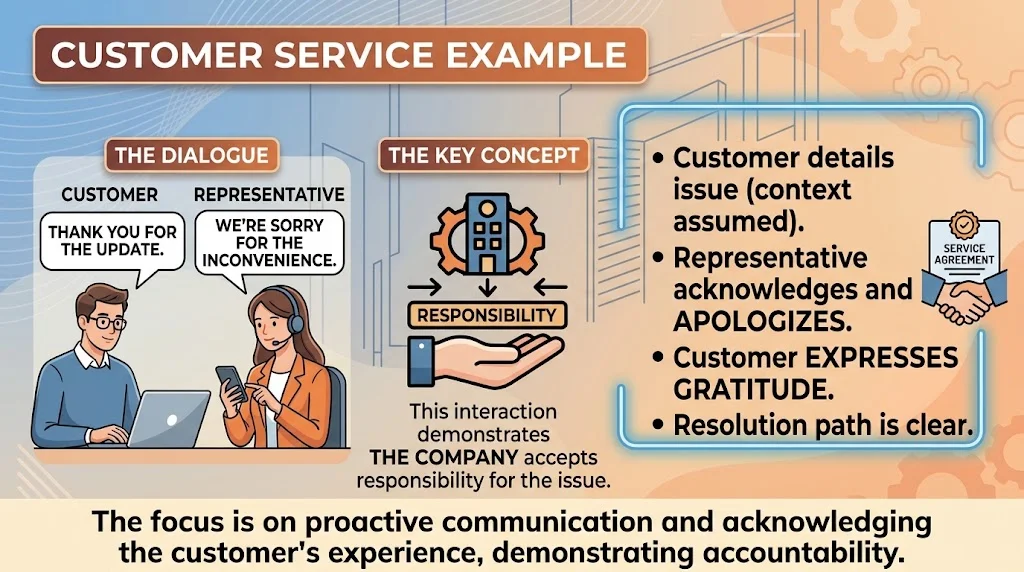
Customer Service Example
Representative: We’re sorry for the inconvenience.
Customer: Thank you for the update.
The company accepts responsibility.
Friendship Example
Friend 1: My car broke down yesterday.
Friend 2: I’m sorry about your car.
The second friend expresses sympathy.
Family Example
Sibling: Sorry about yesterday.
Sibling: I shouldn’t have said those things.
The first sentence references a situation.
The second accepts responsibility.
Alternative Expressions Instead of Sorry For or Sorry About
Repeating “sorry” constantly can sound repetitive.
Here are some useful alternatives.
| Expression | Best Use |
| My apologies for… | Formal situations |
| I apologize for… | Professional communication |
| Please accept my apologies. | Business writing |
| I’m sorry to hear that. | Sympathy |
| That’s unfortunate. | Casual empathy |
| I regret… | Formal responsibility |
| I sincerely apologize. | Serious situations |
Examples
- I apologize for the delay.
- My apologies for the confusion.
- I’m sorry to hear about your loss.
- That’s unfortunate. I hope things improve soon.
These alternatives enrich your vocabulary and improve communication.
How Native Speakers Actually Use Sorry For and Sorry About
One reason this topic confuses learners is that native speakers don’t always follow strict textbook rules.
Language evolves.
Conversation evolves.
People often choose whichever expression feels natural.
Still, patterns exist.
Everyday Conversation
In casual speech, sorry about appears frequently.
Examples:
- Sorry about that.
- Sorry about yesterday.
- Sorry about the mess.
These phrases sound relaxed and conversational.
Professional Communication
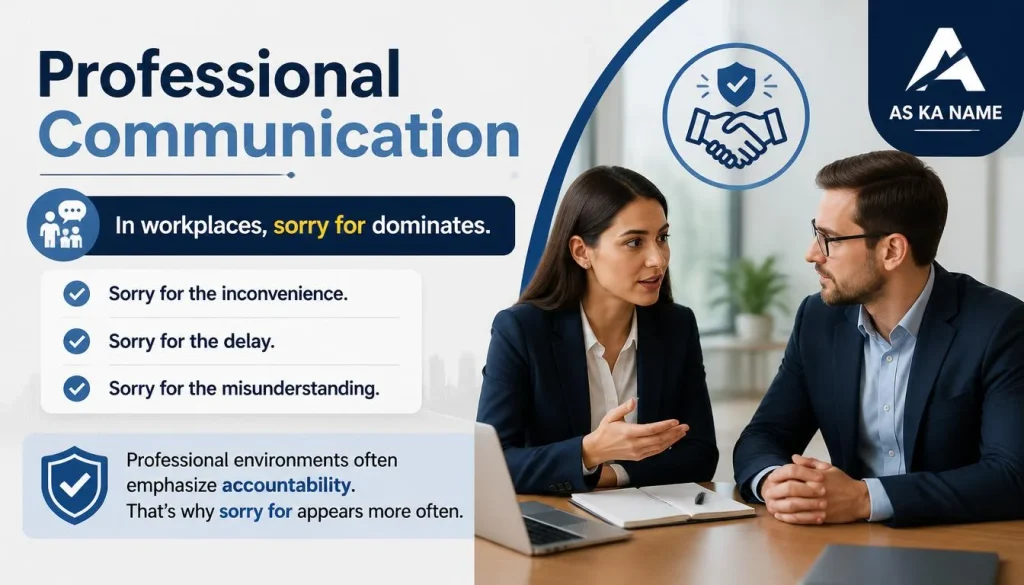
In workplaces, sorry for dominates.
Examples:
- Sorry for the inconvenience.
- Sorry for the delay.
- Sorry for the misunderstanding.
Professional environments often emphasize accountability.
That’s why sorry for appears more often.
Quick Comparison Chart
Use this table whenever you’re unsure.
| Situation | Preferred Expression |
| Being late | Sorry for |
| Interrupting someone | Sorry for |
| Forgetting something | Sorry for |
| Making a mistake | Sorry for |
| Your accident | Sorry about |
| Your injury | Sorry about |
| Bad news | Sorry about |
| A canceled event | Sorry about |
| Delay | Either |
| Confusion | Either |
| Misunderstanding | Usually sorry for |
| General situation | Usually sorry about |
14 Side-by-Side Examples
These examples highlight the most common uses.
| Sorry For | Sorry About |
| Sorry for being late. | Sorry about the delay. |
| Sorry for interrupting. | Sorry about yesterday. |
| Sorry for forgetting. | Sorry about your injury. |
| Sorry for the mistake. | Sorry about the accident. |
| Sorry for calling late. | Sorry about the bad news. |
| Sorry for the confusion. | Sorry about the cancellation. |
| Sorry for wasting your time. | Sorry about what happened. |
Study these examples carefully.
Patterns become much easier to recognize when viewed side by side.
Mini Case Study: A Common Workplace Mistake
Imagine a customer support representative responding to a delayed order.
Version A
Sorry about the delay.
Version B
Sorry for the delay.
Both are correct.
However, many businesses prefer Version B because it communicates accountability.
The company acknowledges responsibility rather than merely referring to the situation.
This subtle difference affects tone.
That is why customer service teams frequently train employees to use sorry for the inconvenience rather than sorry about the inconvenience.
A Helpful Memory Trick
If you’re struggling to remember the difference, use this simple test.
Ask yourself:
Is it an action?
Use sorry for.
Examples:
- Sorry for interrupting.
- Sorry for forgetting.
- Sorry for arriving late.
Is it a situation?
Use sorry about.
Examples:
- Sorry about your accident.
- Sorry about the bad news.
- Sorry about yesterday.
This rule won’t cover every situation, but it works most of the time.
FAQs
1. Is it correct to say “sorry for” or “sorry about”?
Both are correct, but they are used differently. “Sorry for” is usually followed by a noun, pronoun, or gerund (-ing verb) to express responsibility or apologize for a specific action. “Sorry about” is more common when referring to a situation, event, or circumstance, especially in informal conversations.
2. Can I use “sorry for” and “sorry about” interchangeably?
Sometimes, yes. In many everyday situations, both phrases sound natural. However, “sorry for” often expresses a more direct apology, while “sorry about” tends to acknowledge an unfortunate situation without emphasizing personal responsibility.
3. Which expression is more formal?
“Sorry for” is generally considered more suitable for formal writing, business communication, and professional emails. “Sorry about” is commonly used in casual conversations and informal messages.
4. Is “sorry about the delay” grammatically correct?
Yes. “Sorry about the delay” is a natural and widely accepted expression. It acknowledges the situation politely and is commonly used in emails, meetings, and customer service communication.
5. Should I say “sorry for being late” or “sorry about being late”?
“Sorry for being late” is the more common and grammatically preferred choice because it apologizes for your own action. While “sorry about being late” may be understood, it is less natural in most contexts.
6. How can I remember the difference between “sorry for” and “sorry about”?
A simple rule is to use “sorry for” when apologizing for something you did or caused. Use “sorry about” when referring to a situation, inconvenience, or event. Reading authentic examples and practicing both expressions will help you use them naturally.
Conclusion
Understanding the difference between “sorry for” and “sorry about” can make your English usage more accurate and natural. Although both expressions express regret, they are not always interchangeable.
Choosing the right phrase depends on whether you’re apologizing for an action, acknowledging a situation, or communicating in a formal or informal setting.
By learning these simple grammar rules and practicing them in real-life contexts, you’ll write clearer emails, improve your business communication, and speak with greater confidence. Whenever you’re unsure, think about what you’re apologizing for and who you’re addressing. With regular practice, selecting the correct expression will soon become second nature.

Alyan Ashraf is an English language writer and editor at Phrase Finesse, where he specializes in grammar, vocabulary, spelling, word usage, and clear communication. Passionate about the English language, he creates practical, research-backed content that helps readers avoid common mistakes and write with greater accuracy and confidence.
Known for his clear writing style and attention to detail, Alyan simplifies complex language topics into easy-to-understand guides filled with real-world examples and actionable insights. His work covers confusing word pairs, grammar rules, idioms, punctuation, and everyday English usage, making learning both accessible and engaging for students, professionals, writers, and non-native English speakers.
Every article Alyan writes is carefully researched, fact-checked, and designed to meet high editorial standards. His goal is to help readers strengthen their English skills, expand their vocabulary, and communicate more effectively in academic, professional, and everyday settings.
Through Phrase Finesse, Alyan is committed to publishing trusted language resources that make mastering English simpler, clearer, and more enjoyable for learners around the world